Hi Wendell and Team, first time poster. I was going to do a video on this but figured you guys are much better positioned. I just built an Epyc Turnin 16 core workstation (9115 on a SuperMicro HL13SSL-NT) for CFD and it dawned on me that with a high Frequency high cache variant like the 16 core 9175F, it would make for a very interesting game benchmark system. 512 MB L3, 5Ghz and 320 watts may be able to compete with consumer CPUs for gaming.
It would an interesting avenue to discuss differences between the consumer and enterprise platforms, maybe head to head with the 9950X3D for a 16 core showdown. You could play around with adding memory channels from 1-12 to see the performance impact. Look at impact on 1% lows, etc. Basically a glimpse of the future for consumer platforms.
Long story short, it was cheaper for me to type this up than to buy a $2,550.99 CPU for pure experimentation reasons. Thanks for your consideration, if you do something with this I only request that you mention my son Nate Dog in the video (no relation to Warren G).
I’d expect a 9175F to do poorly in gaming workloads compared to a 9950X/9950X3D, the CCD to CCD latency is over triple what the latency within a CCD is; to compound this there is only 1 core per CCD in the 9175F so any non-embarrassingly parallel workload is going to choke on the high latency of the EPYC architecture.
You’ll be fine if you’re not looking to shatter any benchmarks.
I’ve been gaming on server & workstation platforms for 15 years, and I have no complaints - but I care more about gameplay, story and mechanics. Performance-wise if I can get 60+ FPS in 4K i’m happy and completely stop caring about the topic.
The abundance of PCIe lanes makes tinkering with the computer fun; you actually have options, as opposed to “1 GPU + 1 M.2 thanks we’re full” desktop systems.
But single core performance will be bad. Like “a gaming laptop will beat the pants off your server CPU” bad.
If you can live with that, the HL13SSL-NT is a very good board, even though you could get rid of the Broadcom 10G NIC that is useless for SR-IOV (the VFs all go into the same MMU group, what) by going with the -N part. Less $$$ and less waste heat too, those NICs run very hot:
Another issue with Supermicro in general is fan control: they have a couple of preset profiles that aren’t tied to sensor readings: they expect these boards to go into high-airflow chassis where you don’t need to get too fancy with this.
ASRock have a better IPMI/BMC imo, and let you go wild with fan curves. The BERGAMOD8-2L2T is very comparable to the H13SSL-N, and probably better suited as an enthusiast platform, unless you want the memory architecture of the Supermicro board. And it’s a pet peeve but ASRock uses Intel for onboard 10G NICs where SR-IOV works as expected.
I’d say there’s more to it…
The 9175F may be great in single-core oriented loads, it’s like having 16 1-core consumer CPUs with full cache available for each, with presumably all of them being the high frequency cores… so as long as your app makes good use of such design where extra cache improves the performance, it would work great. However, the moment data would need to be passed across the package to share progress between computation cores, so in multi-core/multi-thread loads, the performance would tank compared to more or less all-cores-in-one-chiplet approach from the consumer lines.
That’s even more interesting given AMD repackages comparative zen generation consumer chips as Epyc 4005, that potentially would be compared with the rest of the stack…
Funny thing one would mention in the responses that such Epyc based “gaming” platform would be crushed by recent laptop designs in single-core loads. Especially given AMD has 3 variants of laptop designs available with the same zen generation - the 16-core 9955hx and the 16-core extra cache 9955hx3d that act more or less as repackaged consumer desktop chips with hardcoded eco-mode, and the Strix Halo Ryzen 9 blah-blah 395 blah-blah… and these are sooner or later used not only in halo laptops, but currently are often selected for miniPCs…
Basically a comparison of 16-core designs across the families and scopes could be very revealing. From the very expensive Epyc Turin F-series, dense and regular through Threadripper Shimada Peak, through Epyc 4005 and Ryzen 9 Granite Ridge on desktops, through Ryzen Fire Range on the mobile segment to integrated Strix Halo at the lowest power-draw end… who knows, maybe performance delta outside of edge cases each of these families tries to niche-out for themselves is actually close to negligible…
Honestly, I would love to see a comparison video across multiple benchmarks (including games) for all the 16-core vartiants AMD has to offer in the current lineup of CPUs.
Also
records in Cyberpunk with Path tracing,Psycho settings, max visuals, max NPCs, 4k, NO DLSS
records in Superposition, max visuals, 4k
records in Metro Exudus, ultra raytracing, max visuals, 4k NO DLSS
records in RDR2, max visuals, 4k NO DLSS
record in Talos II, max visuals, 4k NO DLSS
record in Ashes of the Singularity, max visuals, 4k (these are shown in the sample threads)
Runner ups are a distant second…
EPYC also allows for quite fast storage management, memory, and the rest. The whole package turns out is faster than any other chip/board combinations.
The key is to know how to set it up correctly, BIOS and OS.
etc
…all on Epyc, and effortlessly fast. …but there is a steep learning curve. I indulged in many a white paper and other peoples’ dissertations.
if you want to get a quick uptake (alla Matrix - spike in back of neck)
and
again this is only IMHO
~try the challenge yourself:
Chernobylite has a built in benchmark that has results posted at the end with a moving video in the back ground while displaying the actual parameters that were used. Its also surprisingly a great game. On any system you want, beat the score.
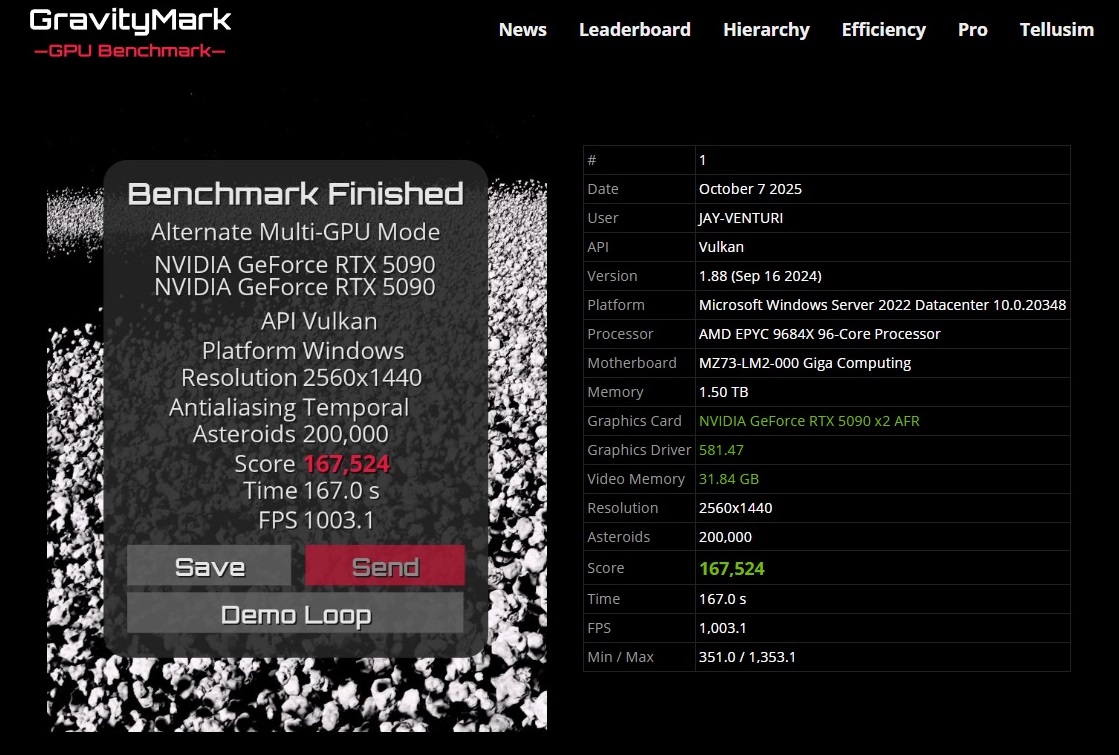
GravityMark is also a great bench as it allows for testing across multiple APIs.
The examples I used were for gaming/visuals, the EPYC system is formidable and comes in first on many processor benchmarks as well, but the post was about using Epyc for gaming ~which one should not do JUST for gaming!
hmmm… I suppose it would depend on what kind of gaming workload you were testing; I have a sneaking suspicion that many RTSes like the Total War franchise would perform better on the high core count EPYCs, but lightly threaded games and the more e-sports variety would benefit more from the higher clock speeds and tighter cache integration consumer Ryzen x3d offers. There are surprisingly few articles/benchmarks on the internet comparing the two platforms directly.
Chips and Cheese actually tested this cache “tightness”/integration theory on a 9900x and Cyberpunk 2077 where they ran the game on one CCD and then forced it onto 2 CCDs and saw a 7% performance decrease which was outside of the test’s margin of error. Extrapolating this to a 9175x where the workload would presumably get split into 6 different CCDs rather than 2, I’d expect the performance hit well into the double digits all else being equal:
I think for most of us enthuesiests, the GPU is by far the bottleneck in gaming since we’re typically running higher resolution monitors that stress the GPU before CPU; it also doesn’t help that SLI/crossfire have basically died from a game software development standpoint.
If SLI came back then EPYC might get a big leg up over current consumer Ryzen since it’d be the only AMD platform outside of TR that had enough bandwidth for the 2+ GPUs to communicate at full speed.
I agree. While the performance isn’t “bad” it also doesn’t seem to be much above that of budget normal desktop CPUs.
I’ve played tons of games on my Threadripper though; so it isn’t like I think it isn’t worth it if you want a single system to “do-it-all”, but potentially a 5090 is wasted to an extent on a crazy system like this.
I do wonder though waht kind of performance you get if you just limit it to 1 CCD?