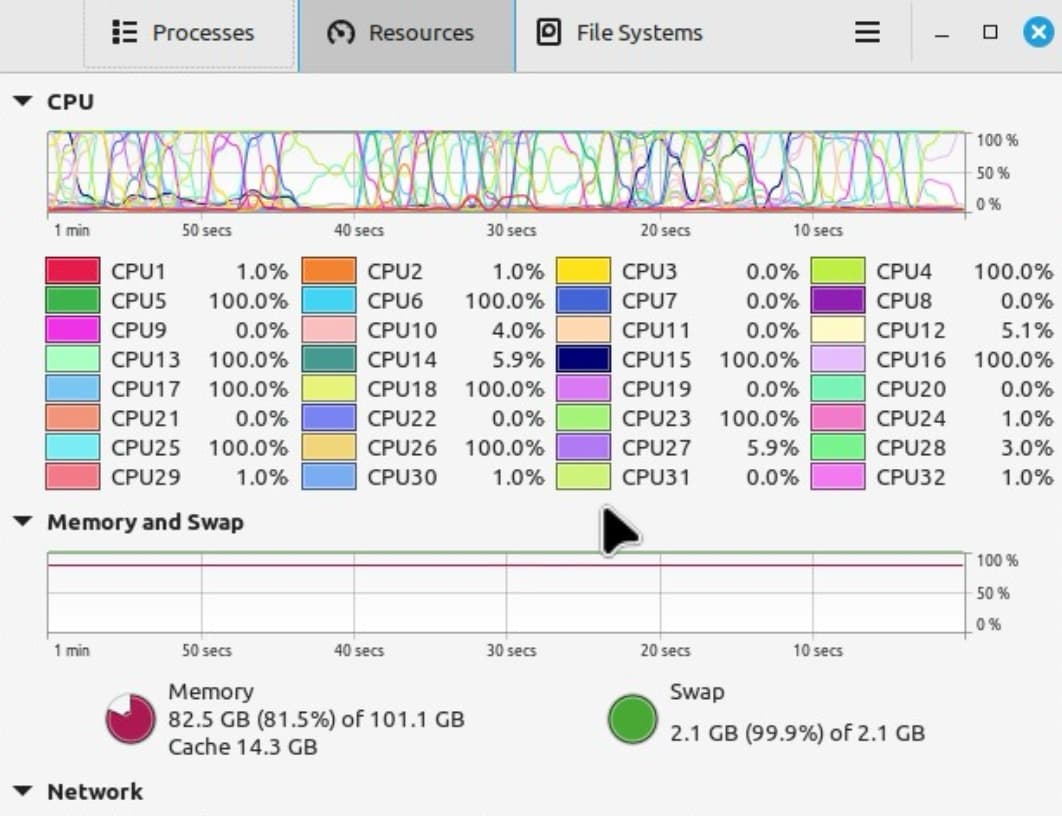
My background is in computational biochemistry — I’m a university professor and run several high-throughput virtual ligand screening (HTVS) builds. In short, I screen hundreds of millions of potential drug molecules against protein active sites to identify novel therapeutic candidates. You can think of it as having one lock (the protein) and searching through millions of keys (ligands) to find which ones fit. Once I identify promising hits, they’re synthesized (either by me or a collaborator) and tested on cell lines that express the target protein.
It’s a very interdisciplinary workflow that bridges chemistry, biology, and computer science.
I currently run five workstations, each built with the following specs:
Ryzen 9 5950X
128 GB DDR4 RAM
4 TB NVMe storage
RTX 3090
The issue I keep running into is RAM bottlenecking — I’m regularly using 100+ GB, and I’d like to expand to 256 GB or even 512 GB RAM if possible. I’d prefer to keep using my Ryzen 5950X CPUs, but I’m aware that AM4 boards are limited to 128 GB.
I’m exploring two paths:
Building a server that can handle larger memory capacities (though I have zero experience with server setups).
Upgrading to a Threadripper platform for more memory channels and expansion capacity.
My workloads are extremely memory- and CPU-intensive, so I’m looking for an economical but capable solution.
Would anyone be able to recommend a path forward — either a specific motherboard/CPU combination that can handle 256+ GB DDR4 while remaining cost-effective, or a good starting point for transitioning to a server-grade setup?
Current upper bounds are 256 GB 2DPC 2R in AM5, 2 TB 1SPC sTR5, and 3 TB 1SPC in SP5. The usual practice’s to run a cost-benefit analysis on bandwidth and RDIMM sizing. If 3 TB’s not enough you could also look at 2DPC SP5. There’s several UDIMM and RDIMM selection threads here to refer to for more detailed options and tradeoffs.
Probably best to pick one. Though, depending on workload requirements and luck, you might be able to get around that with used Threadripper or EPYC.
I’m in a different discipline but from what I’ve seen atleast of “old school” screening techniques, they align computationally fairly closely to the FEA multiphysics problems I deal with that I happen to have a hardware ranking for:
(you’d be interested in the highlighted CFD-EM column rank)
I say “old school” because I’ve heard of alot of “AI” and other blackbox algorithms starting to be used to speed up screening and I have little understanding on how these work or what benefits their performance.
So my wife actually does work with viral vectors and I have some experience building out systems for her to do similar work.
So you are pretty much at the max of what 5950x will let you do. Best bet would be go AM5, Threadripper, Epyc, or even Xeon. @lemma has great breakdown for each socket. Another possible solution is to offload your workload to a cloud provider… but that can get very expensive as well. This not a very cheap problem in which to solve.
I do know some software will allow you break large workloads via parallel computing so you could have the workload shared amongst multiple systems and have shared CPU and memory. The software you have would need to support this which I doubt it does… but never know. There could be vendor out there that does this or if you have built your own software you could investigate doing so.
Edit:
This a good possibility as well. My wife uses an LLM for some of the workloads. But it is very much beyond my expertise of what she is doing with it and how she set it up as I just built the system for her and occasionally troubleshoot odd windows OS/driver errors. I can ask if I can share her insights on this. She currently uses a 2080ti for her LLM needs, but no promises on that.
Some of the software vendors and “pioneer”-types have started trying to push machine learning to solve physics problems and I am highly skeptical of their accuracy, especially after so many of the demos I’ve seen are so contrived to arrive at accurate results.
I have a suspicion it’s the same for molecular screening since I’d imagine you are looking for a fairly unique reaction that wouldn’t be picked up in the training data for the “AI”.
If I was in the field I’d probably treat it more like a side project than the mainstay of how I get work done. The last I looked into it things like AlphaFold were decent at predicting the internal structure of proteins, but not so good at determining binding sites which is obviously a roadblock to more widespread usage.
It’ll get better with time I’m sure, but yeah maybe not quite there yet.
I agree. First thing you should always ask the vendor about is how they handle LLM hallucinations. The average response I got was them being hyper defensive without providing a good answer. I believe she currently using them to learn how they operate or for running tasks that are too large for her current system to handle via traditional means.
I am no expert but i would build a Server and Throw as many Threads and as much memory as you could at it. that way you can get that 256 or 512 of Ram. I built a Crap Server to run LLMs it not the fastest but it gets the job done.
Hard to tell from the OP but looks like the 5950X is sitting around three cores hot. So that’s like a ~25 GB/thread working set. Implication is therefore something like
AM5: 10 threads in 4x64 GB, so 9900X
sTR5: 20 threads in 8x64 GB, so 9955WX or 9965WX
SP5: 30 threads in 12x64 GB, so 9115 through 9355P
for starting points. Easy to rerun the math for different GB/thread and threads/core depending on workload properties. Usually you also look to see if you can rewrite the code to cut GB/core.
If the workload’s readily shardable and not bandwidth constrained then probably it’s most cost effective to build a bunch of 9900Xes at 6 cores/channel. Or 9950X and 9950X3D at 8 cores/channel or maybe 9900X3D. Otherwise Shimada Peak at 2-3 cores/channel and 6400 instead of 3600 may be difficult to better. Turin allows somehwat more cores per build while maintaining cores/channel but that may not be worth the downclock from Shimada or Granite Ridge.
Pushing the core count farther runs into diminishing returns since it’s more cores/channel and less W/core, depending in part on how power dense the workload is. Similarly, the cost/GB bump on 96+ GB RDIMMs is pretty substantial, so sharding out at 512 or 768 GB may make more sense than increasing RDIMM size.
Yeah, probably calls for an algorithm built for out of dataset prediction rather than statistically likely regurgitation like LLMs do. It’s possible a reaction falls into an interior void of the dataset and is thus predictable, at least notionally, by intradataset interpolation. But LLMs are built to avoid that.
I see equivalents of this basically every day I’m doing coding, for example. The autocomplete wants to go for code that’s already written, which is only helpful if that’s the current task and it’s accurate to it (which usually it’s off hallucinating something that’s not even syntactically valid, much less relevant). If it’s adding new code, rather than editing existing code, the autocomplete’s always wrong and just gets in the way.
Pretty much the only time I see out of dataset success in machine learning that’s attributable to something besides luck is when the model embeds sufficient knowledge of the problem to actually have a basis for predictions. In this case that probably looks a lot like another HTVS run.
Yeah, the question I usually start with is whether there’s reason to believe investing in some AI type thingy will produce better returns than spending the same amount of time on improving whatever it is you’re currently doing. A good chunk of the current hype cycle relies on people being willing to skip this step.