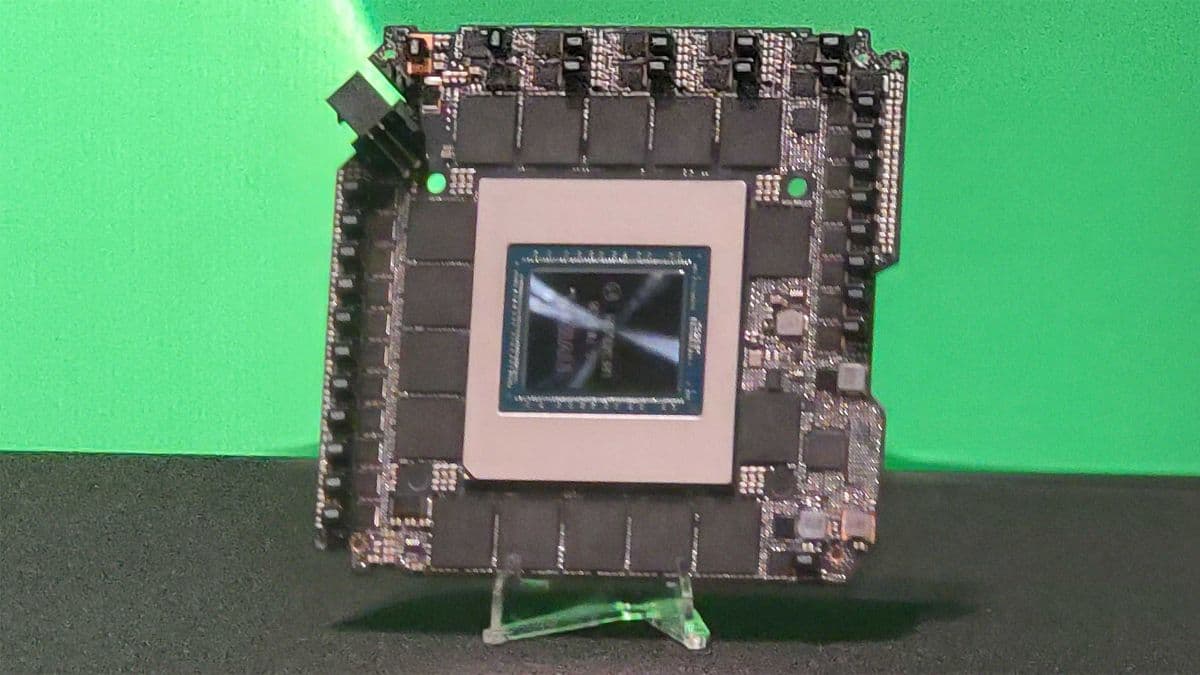
I’m not sure how I feel about them making a completely separate PCB just for the PCIe edge connector, I’m assuming they had to because they incorporated too many layers that make the PCB too thick to fit in the slot, but risers are always a little sketchy.
I’m hoping that the combination of the 12V-2x6 connector and the angled positioning of it will improve the reliability to the point where it’s no longer a concern.
Still confused as to how it works. How did they route the display outputs, etc. Hoping they know what they’re doing reliability wise… but at the very least the upcoming teardowns will be interesting to watch.
12VHPWR was only a “problem” because Igor mislead his readers by totally blown stuff out of the proportion, mixing stuff together that does not belong together and not setting things into context so he gets clicks.
Sure, 12VHPWR does not have a lot of tolerance and could have been done better from a engineering perspective. This is where I agree with Igor.
Now, with that “problem” of small tolerances, even Igor goes into the detail that stiff adapters (PCB) are not that smart. A normal pin is a little bit flexible, so there is some wiggle room. A stiff PCB from cablemod is not.
So even by Igors own failure rate numbers (he so proudly got because he works together with cable mod), there are not that many faults, and the fault that are there are the mostly the stupid PCB adapters from cablemod and a small number of ASUS that turned the connector on the GPU 180°.
TLDR:
12VHPWR wasn’t a real problem in the past, and is even less of a problem now, because there is no 12VHPWR anymore. We now have 12V-2×6.
I personally think Igor just wanted to bash GamersNexus (the had some fights in the past and he likes to make fun of him in his forum). The gaming crowd quickly jumped behind Igor, because they thought that GN is defending Nvidia and Igor is the white night with a shiny armor that protects poor consumers against evil Nvidia. But in reality, GN did a way better job than him on this subject.
12VHPWR is required for the GPU end of a 12+4 cable and on PCIe 5.1 supply ends. 12V-2×6 is a partial receptacle mitigation and thus applies to GPUs and PSUs. PCIe 5.1 and ATX 3.1 don’t really revise 12VHPWR plugs, though a IIRC few additional details are called out to exclude the most buggy implementation.
If 12VHPWR to 12V-2×6 connections were margined like connectors carrying similar amounts of power (e.g. IEC) they’d be rated for about 250 W. So 3090 Ti, 4070 Ti, 4070 Ti Super, 4080, and 4080 Super require dual 12+4s. 4090 would be triple.
I literally cannot buy a 4090 at work. Fire safety ban. I’m not expecting 5070 Ti, 5080, or 5090 to be possible either.
The main faults are
PCI-SIG standardized a low performance contact design
On what data was that decision based?
Only public data I have seen is that from Cablemod. This was the data that lead to this mass hysteria, besides it not even reaching single digit percentage (if you rule out cablemod shenanigans).
Or let me rephrase the question, where is the data that shows that 12VHPWR imposes a greater risk than PCI 8Pin? There isn’t any data.
Totally agree. But it is still irrelevant, since the connector isn’t a problem.
Sure it could be better. Everything in the world could be better.
Now I don’t know what industry they are working in. but it could very well be that they work in a facility where the environment is more conducive to combustion, be that particulates in air or proximity to oxidizers or fuels that have risk of leakage.
if the above is the case, it could be that simply the greater risk of user error which is the beginning of the chain of events that cause 12vhp failures usually is, was just too much risk for their risk department. public data having very low percentages of occurrences is not the only factor in that sort of decision.
My gut feeling (aka, talking out of my a** without having any evidence to back it up) is that if 12VHPWR actually were a problem, we would have heard from it by now.
Remember when we found out about the broken Intel CPUs?
Because they died like flies in datacenter?
Well according to estimations from some people, 80% of 4090 did not land in consumer hands but in datacenters.
But hey, in the end it does not really matter. I say the same thing that I said during the 4090:
The more of you guys that are scared of the evil 12VHPWR adapter, the bigger the chances are that we “brave” people can get our hands on one.
If even companies like @lemma are scared, that is even better.
Unfortunately even at 2k$ there is probably more demand than supply.
that is a good point. and while data-center likely has most of the cards, if i may also speculate. unless the server is specifically designed to be quiet. it is almost always default to jumbo jet cooling fans. and that very well could be contributing to keeping the connectors cool.
but even if the connector is in general fine, and the issues arise only from being pulled at an awkward angle, or mashed against a side panel, or being bent into too strict of a curve. nvidia is still in part at fault here. they released a series of cards with the connector sticking out the side directly into where the side panel goes. they could have mitigated many of these problems by testing their design in the top 100 most popular cases (I think they have the margin to afford this), and going huh, maybe we should route the plug to the end where 1. cable management is easier. 2. it wont be smashing into the side panel.
I haven’t seen any data that the issue arises even then.
Only thing I have seen are 40 random people on reddit.
And that issue is even solved with the new sense pins.
Has any ARM ITX/microATX/ATX board been presented in CES week? Either socketed or soldered-on CPU, but I want it to be power efficient for NAS use (so the board has to have multiple connectors for mass storage or a PCIe to connect an expansion board)
Yeah. And PCI-SIG and Nvidia’s willful violation of normal safety practices doesn’t seem fine as the combination of increased user awareness, hazard indicator plugs, and spec revisions appears to have reduced 4090 melting rates only by about half. Everybody I know who’s used to working with power connections is completely unsurprised. Both by this and by AMD and Intel declining to adopt 12+4 even though they’re PCI-SIG members who voted for it and produce lower power GPUs with greater implied safety margins.
While I (obviously) don’t have access to 4090s to measure, with dual slot blowers usually the 12+4’s on the cool end of the card facing the intake fans rather than in the middle being heated by transverse fin exhaust. Extrapolation from the lower power data I do have suggests this probably lowers 12+4 connector temperatures by something like 20 °C. The blowers likely also avoid the elevated failure rates of Asus’s reversed receptacle and, as you’ve pointed out, end mounts likely have fewer issues around cable bending.
There’s maybe another 5-10 °C temperature reduction available from increasing the connector’s ability to conduct heat into the GPU, which I suspect might be easier to take advantage of in blower form factors. In addition to server LFM, datacenter HVAC’s also likely to cap maximum ambient temperatures.
Love how they even optimized the fin stack’s concavity in line with the differences in airflow pressure across the fan’s surface area. The slots on the side of the GPU are also meant to direct airflow in a manner to mitigate exhaust recirculation. No idea what kind of difference this makes in practice but the extreme attention to detail is appreciated.
Interestingly, they mention that the 5070 design, unlike the higher tier models, is “similar to the previous generations” due to lower power needs.
BTW, AMD is also a member of PCI-SIG. Thankfully the new 9070 XT also will get the 12VHPWR connector. I bet as soon as team red also switches to 12VHPWR all of a sudden the critics will disappear
Everybody I know is using it without any problems. They are completely unsurprised that it isn’t a problem. Again, the question is, why should it? Just because some people on reddit? Or just because that you in theory could do a better job?
Haha, too bad this is no longer true and AMD has adopted it
Intel will follow as soon as they have a flagship card that also uses a lot of power.