Business case for the Omarchy investors/donors?

You will have noticed this week’s distro that will bring Linux to all desktops, is Omarchy Quattro.

It seems Omarchy is targeted at developers that like to be keyboard centric. I’m aware one could re-create the same experience. Omarchy just makes it out-of-the-box.

Obviously there is hype, hate, and very few truthful reviews. And the truth probably is, it is just a distro, with some new ideas and fresh wind. More choice and new ideas = good.

But what I wonder is why there were quite a few investors (or donors?) that invested substantial amounts of over $10 million. This seems to be more than what Gnome, KDE etc. have for years.

What is actually in for the investors and how do they think they get a return or other benefit? It seems the distro is free, and I doubt they can sell service subscriptions or similar. At least not in such amounts. And realistically, this is too much of a niche distro (keyboard centric!) to double Linux market share and have Dell sell more Linux PCs (Michael Dell is one of the investors). And I bet, businesses will prefer a more traditional distro, or an Atomic distro.

FWIW, DHH seems to distribute at least some of the money to projects. I assume mostly projects feeding into Omarchy, like Hyprland. He also offered money to Arch (who declined?). Obviously all other distros can benefit from that. But this makes this even less likely to generate a return for the investors (or donors, if we believe they all just like FOSS)

I understand how RedHat and Canonical make money. And some distros get by with donations and volunteer work. But none of those schemes seem to apply here.

(I’m aware people have opinions of DHH as a person. But this isn’t relevant here. Leave those discussion to Reddit. I’m only interested in the business case of the large sums)

You say to leave the politics at the door, but you can’t separate those two things. The massive cash infusion is 100% virtue signaling. The “product” is barely distinct enough to be called a distro. The ten million dollars is a statement, and if it wasn’t for the big name behind it you wouldn’t see that level of investment.

4 Likes

There is no business use case for omarchy, cause that thing is not configured to be used in a business and even if it’s meant for developers, no enterprise or business is gonna let that in or at least their security team won’t allow it, the way DHH has that configured no one’s letting that into their network and especially with all the extra junkie has installed on there there’s no way he made it for business. I personally can’t understand why it’s getting funding and from what I’ve seen the investors are legit, but I’m assuming he’s talked to them and convinced them in someway so I feel like we’re gonna see some kind of catch to the distro sooner or later, cause there’s no way they donated that money just for the sakes of helping open source. all the promotion it’s getting by tech content creators he’s probably just there friends with all of them so they’re helping their boy out.

4 Likes

At what point is a Linux OS a distinct distro? I assume they use Arch repos. But they also have their own repos.

And from what I read, they also developed a few things and didn’t just assemble already existing things. Like the agentic stuff where AI can solve an error message.

This doesn’t sound too much different from Mint, for example that use Ubuntu add/remove some things and still use Ubuntu update. Or MX Linux using Debian and their repos.

I’m mouse-centric, not a developer, and don’t care about AI. So I won’t test it nor would I be able to judge it. Besides hype reviews, I found a single bad review. It is un-dated, which isn’t great. But it seems to refer to a v3. So it may not be relevant here.

To signal what? Assuming those $1 million each person are their private investment or donation (and not from the companies). They could signal anything in a different way with that money. And outside the Linux nerd community, there is zero chance any living person (voter??) cares about Omarchy or who donates to it.

All of them seem to be tech people that are rich. Is anyone of them a controversial person (more than a tech millionaire would be)? Even if one is, I find it hard to believe there is a conspiracy of all of them. It isn’t like it is 100% AI CEOs. It seems to be a diverse tech pool. Dell is “old industry” in Tech. Shopify is old.. Coin base is crypto, OK, that may be a weird one.

What Omarchy seems to stand for:

  • AI integration (or preparation for it)
  • Tiling/keyboard WM
  • All set up and ready to use
  • Based on Arch (and up-to date because of that)

None of those features alone seem unique, but it being in one distro might be new. However, tomorrow someone could step forward and use Arch or Fedora, or a different base, and do a similar thing.

I meant, a business case for him/Omarchy/investors. Not it being a product to sell to businesses. The target may be freelance developers, or home users. But since it is free, I don’t see the revenue (regardless of if a business would use it)

FWIW, the website claims they are at close to $15 million now.

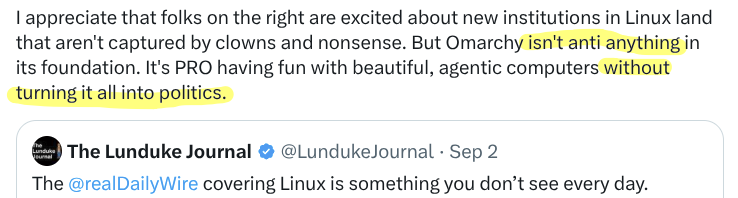
A user just going to Omarchy website and installing Omarchy would never know who DHH is or what other people think of him. His bio linked from Omarchy website does not link to his blog posts (that people seem to not like). Unlike Lunduke, for example, DHH doesn’t put his personal opinions anywhere near the Omarchy project. And expanding use of Linux seems to be the only goal. They don’t even have a mission statement making some sort of societal claims. It is 100% Linux and nothing political, religious or ideological.

Just for comparison, I read the Debian Philosophy. They basically promote FOSS and welcome everyone who interacts constructively. That sounds exactly as un-political as Omarchy

I even researched and found where DHH even turned down Lunduke’s praise and says everyone is welcome and specifically tells people to leave politics outside. DHH specifically says that Omarchy isn’t anti-anything (Since Lunduke called it anti-woke). This is much more neutral than many projects. He literally said Communists and Capitalists can cooperate on making great Linux. How can he be more inclusive and non-political in regards to Omarchy? He has a personal opinion, but I see zero evidence of that being dragged into Omarchy (unlike Lunduke, for example, who basically makes his political beliefs the reason for his distro - and he is free to do that)

OK, now I have to wash my eyes since my search lead me to Twitter. The only crime DHH committed is to waste time on Twitter.

I have zero knowledge of the developers of all the distros I tried and still use. Nor do I care. I’m pretty sure the fewest will 100% match my opinions.

Canonical sells support contracts to businesses. Cash flow would come from customisation and ongoing support contracts. In the absence of cash flow, I expect there’s a tax write-off and community/political standing. I think that unused tools lack purpose, but tools in use serve goals – there’s no such thing as ‘just a tool’. It’s hard to say what the goals are for now.

If Omarchey becomes one of the most popular Linux desktops, there are probably plenty of ways to make money from the AI integration. They would control the OS used by the demographic that uses the most tokens.

This was my original thought as well. But Omarchy doesn’t seem to pre-install or set up a specific AI. And the donors don’t seem to be all AI people (I guess everyone in tech is a bit AI these days). The user might use a different AI base than the investor/donor.

But if Omarchy is an attempt to promote AI generally, it may be those people throw spaghetti at the wall, and hope some stick. Like invest $1million in a hundred projects, and hope a few turn out good.

And maybe it is part philanthropic. Ultimately it isn’t lot of $ for most of those people and it looks like some of the money also goes to other Linux projects.

1 Like

DHH said something along the lines of “In movies we see these amazing, cool operating systems that are only in the movies, so I wanted to make that in real life”. So maybe he hopes to be able to somehow get Omarchy to be the official distro used for “cool movie hacker sequences” and make money from movie studio contracts or something?

I assume there is no copyright fee he can collect. FOSS and so. DHH doesn’t own Hprland. Older movies referring to nerds used Ubuntu, I doubt they paid.

And movie studios already were able to create mockup OS that look like a cool OS.

That would be a lot of effort for no certain return. Like GM would develop a whole car, not to sell to the public, but just in the hope a James Bond movie will buy it to blow up.

And unless a Linux is all corporate like RedHat, Canonical and Suse, I don’t see the business viability for Manjaro or Zorin. Those may carry their cost, for their hobbyist owners, but I doubt are the money-printing entities.

I bet making money with free Linux OS goes like that: “how do you end up with $1 million in distro business? You start with $2 million”

Q: What’s the price of freedom?

A: $10 million.

The NSA secretly gave RSA $10 million (the core encryption used by all Cisco routers, firewalls, and remote access) for a backdoor.

The “NSA Key” has been found decompiling Windows kernel code in the past, twice!

Omarchy will never enter the workplaces I support, nor my personal devices.

So, zero business usecase IMO. Other than spyware being under govt controll.

tinfoil-hat

Also, as Wendell has said in a recent video: LLMs are advancing to the point of finding what looks to be deliberate weakenings of current mainstream cryptography to bypass.

/tinfoil-hat

1 Like

DHH does talk about what the money will be spent on in this video. In addition to just talking about the new release and his process.

2 Likes

Sounds like they have great plans to make it an independent distro, their own complied packages etc.

It isn’t clear if they will go off Arch. He sounded like they trail Arch by a month to avoid problems. (wasn’t clear to me if that is the current state, or planned). They also add btrfs snaphots before updates (is this not standard in Arch yet?)

He also said they created specific patches for the Dell laptop he previously touted as having long battery life. Maybe that explains Michel Dell’s investment.

It all sounds more than what the Ubuntu clones do. So this is (or will be) a distinct distro.

I wish them well and if things work out, that may bring some really new outside the box stuff to Linux.

I’m also sure they will get some hate. For being successful, for not being tied to old ideas, for not discussing every feature in 10 committees…

That video is still from when they were at $8 million.

My only personal disappointment is, this will be a keyboard centric distro. Next time I find an old PC, I may try it regardless.

2 Likes

I think these are just wealthy individuals doing things because they like it. Maybe the’ll be a future leverage point maybe not. But I think DHH is honest in so much that this is driven by frustration (rightly or wrongly). People can and will spend their money to promote their ideas so I’m not convinced there is a financial strategy.

I’ve tried it, it’s cool and it has potential. Although I’m biased; I can’t for the life of me figure out why we’re still moving windows around an imaginary paper-based desktop. We should have outsourced the management of window placement to the computer a long time ago. Out of the box it’s a pretty sweet tiling WM experience. I just hope some of that money goes to hardening the security model.

1 Like

Lots of foundations and projects get funding from companies that loosely benefit from them - either to get a tax deduction or for PR. x86 laptops aren’t competing with Apple or targeting developers/engineers universally, but Dell XPS does.

CachyOS (+SteamOS, Bazzite) has taken over gaming on Linux as a perception. You get GamersNexus and other non-consumer-Linux outlets using it or referring to it. The software/tech is available in any distro, yet from a marketing point of view, CachyOS wins in gaming. Omarchy is a brand that wins for engineering/devs/tinkerers. Twitter is full of people installing it on their old MacBooks and having fun… and those people may not buy a new Mac if they like this thing more…

Then if you “invest” in Debian, Ubuntu, Fedora… those distros have to make a predictable and stable release on schedule. They can’t test multiple ideas on desktop components and default configs. I’m using Xubuntu, and it doesn’t do anything outside of updating versions and wallpapers, realistically. Omarchy is probably the first to try to ship a custom experience based on generic software that any other distro also has.

And in the end, those founders know DHH, and it’s like a bro doing cool stuff with their bros. Personal connections matter when you want to do networking, marketing, and sell your idea to investors and sponsors. If someone with money and intent looks at an open-source project and the project says they have to remove “Fash” from the project, or they don’t want federal money because they don’t like a president, that money will go elsewhere. There is a lot of activism in FOSS, and they don’t like corporate, and corporate are the ones with spare millions of Dollars.

1 Like

(Sadly, tragically) I don’t think they are large sums to those types.

Check some of their net wealths, compare against your own net wealth.

The proportionate magnitude of the decision for one of us humble commoners might be the difference between a medium or large coffee.

1 Like

I installed Omarchy on an i5-7500 with 8GB and SATA SSD. I just use it in the living room whit a Logitech K400 keyboard. I’m also not a good typist nor good at memorizing shortcuts. I’m extremely into KDE. So, I’m not the target audience here. The manual is pretty good and also works good on a phone. I’m sure at an actual desk with real keyboard and two monitors, this would be easier to learn. I use the super-simple Aurora Linux OS. Just so you have a reference.

It doesn’t seem to support secureboot. I tried to install it besides my MX Linux XFCE (yes, I’m also testing the total opposite to Omarchy! :slight_smile: ), but i was too stupid to set that up and ended up wiping the entire SSD. That is fine, this is the case for all Linux for me. The installer doesn’t use too much graphics, but is easy to follow and fast.

After you enter your data, installation literally only takes a bit over a minute on my hardware. So his claim of 45 seconds is no BS assuming he used better hardware. Updates also are fast. You need to enter password for updates.

I easily found out how to install Chrome (no idea if it is flatpak, or from repo??), create the Windows VM thing, set scaling and so on. I don’t have an AI agent subscription, so couldn’t try that. I only spend 30 minutes with it so far.

To be clear, this keyboard-focussed UI will be alien to many users and he recommends to give it 2 weeks. IF it works for you, i see how it is better. I do wish there were some context with right-click the mouse or so. It is a LONG list of shortcuts. My plan is to keep it for a while in the living room. The tiling is cool, but actual desk work will benefit more.

I see why DHH does things differently, and some things could be the future, or be a niche. Definitely a cool project after every “ another distro to add to the 500 we already have”. It is nice to see someone thinking outside the box and not just improving the old by 1%.

I did see some more reviews and they all still are the same. Some point out some security concerns and i hope those get addressed. Some comments looked like they are on a path to update things.

But I also had to see the toxic Linux community. Their reviews and comments basically boil down to:

  • DHH doesn’t deserve the money, it should go to “my” pet project or the distro I use
  • It isn’t the distro I use, so it can’t be good
  • I didn’t use it, but I know it is bad
  • i have zero knowledge, but claim it is just dot-files.
  • Something with politics where every right-wing party success of the last 150 years is blamed on DHH
  • We want new Linux users, but only if they use the distros we like
  • Used AI
  • Moves fast without going through a million discussions
  • We rather have people stay with Mac/Windows than them using the “wrong” Linux distro

Instead of just whining and complaining, every developer should look at Omarchy and steal the ideas and implement the best parts in their distros. What is wrong with a fast installer? What is wrong with a simple Windows VM setup? What would be wrong with adding tiling function to KDE? Just some examples.

DHH called those Linux trolls “clowns”. I agree. Those probably all are people who have accomplished nothing and think about politics all day while sitting in their parent’s basement. I know DHH has opinions, but please point out a single instance where those opinions appear in Omarchy. This isn’t Lunduke’s OS that revolves around politics. No swastika background images I could find, which is what you expect based on some of the people’s comments.

One clown complained that if his grandma buys a PC with Omarchy, she will have the wrong impression of Linux. My responses:

  • shouldn’t the user decide what they like?
  • We are far away from Bestbuy selling Linux PCs to grandmas. If they ever do, they will start with traditional DE distros
  • If grandmas go to a regular store and walk out with a new Linux PC, that should be celebrated. Even if it is not your favorite distro
  • If you don’t help your grandma with the PC, and then complain she got the wrong one, that says a lot about you

Where am I going with this? At this point I doubt this will be a distro I use on a desktop for myself any time soon. The UI is too alien to me, and I don’t trust Arch, nor a brand new distro. I like to see more track record first.

But I try to keep using it for 2 weeks to see how I learn the UI.

I think Omarchy is going in the right direction. I wish them well and may they bring more competition to the market. They claim it can run on a 2GB potato. Likely not fast, but that would be impressive if true. I’m supposed to get some old PCs from a neighbor and will test that claim.

Edit: one crucial thing I haven’t found out is how to get sound to HDMI to my TV. This isn’t an option in the drop down and doesn’t seem to be an easy fix. Let that be a reminder, this distro is targeted at people who can figure stuff out, and maybe use the AI to solve problems like that. And also be reminded, it is Arch. No matter how good the installer is, or nice it is set up, an Arch user still is expected to maintain the system. On an actual desk (not my living room) it probably is easier to use. The manual also is full of CLI commands. Probably great, but if you are a GUI person like myself - you have been warned! this isn’t a distro for “grandma” .
10+ million is certainly a strange sum for a project like this. Must be good marketing or something.

Some companies fund linux projects because it is directly or at least somewhat related to the products they sell. For example, you can see all the projects Framework sponsors: https://frame.work/blog/framework-sponsorships
Their rationale is that many of their customers use these projects, and Linux in general is related to Framework’s mission, so they are happy to support them. But these are very modest sums of money relative to the 10+ million figure.

1 Like

The guy who created it is incredibly rich. To me it’s not surprising, especially in 2026, to see people with more money than sense throwing said money at others in their social strata. Hell he could have done that through some other company he’s involved in as a tax write off.

As much of a distro as Hanna Montana Linux is.

I think it is part of their philanthropy or hobby. We tinker with old PCs, they can afford to support some projects that sound interesting. I’m not surprised they picked a newish project and not the 27th extension that makes Gnome a bit more livable.

The alternative is them spending money on cocaine and hookers. So, spending it on Linux isn’t the worst thing they could do.

As I said, the specific distro or technology isn’t necessarily my thing. But neither are the 499 out of 500 distros I don’t use. Maybe 1% of what will be developed with that money will trickle to my distro.

I hope fast installation in a minute isn’t controversial and will be adopted. But no, the wrong person developed fast installation - we better stick to 10 minutes installation to be pure and politically correct.

I also don’t think the donors made this a political choice. But they need an organization that gets things done and moves fast. You can like it or not. But if I had money to donate, I couldn’t see myself donating to Debian with mailing lists, cryptic voting schemes, and a third of people anti-AI or anything newer than fax. Or a website that tells everyone it still is 1995. I don’t know all projects, but most are just “continue as usual”. This isn’t exciting to tech companies.