I’ve heard that complain a lot ! And often, i also feel angree at major software provider that actively block their software from running on linux (like Fusion360)
Yet i always understood, but could never word it correctly, how much weigh it is for a company to support Linux with a Capital L
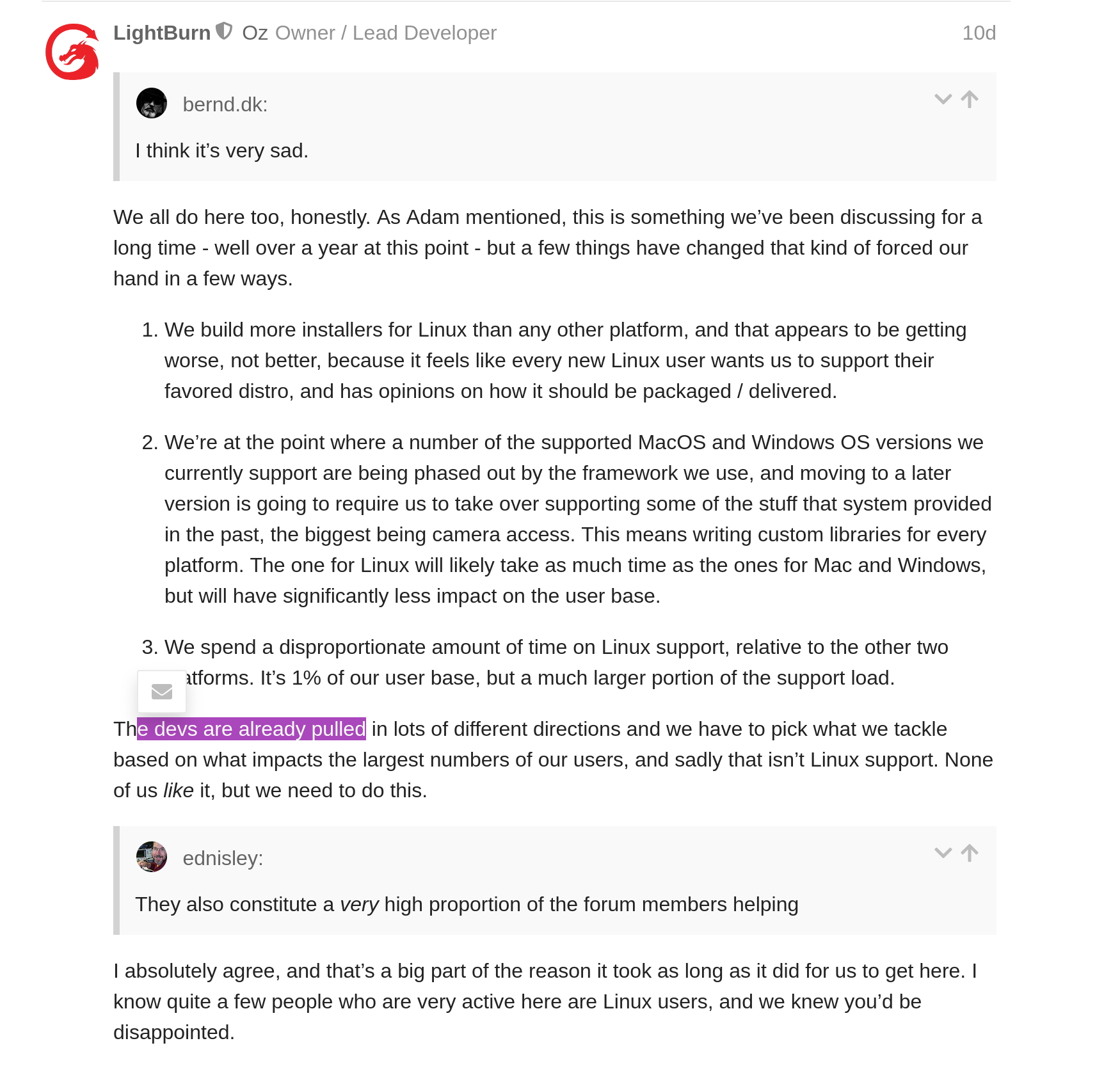
LightBurn, a laser cutting software, is dropping support, and as sad as i am about it, i find the reason really well worded, and something we should all reflect on when we ask for Linux compatibility.
I feel like this deserve a topic from people that don’t have personal grip about loosing software update, to reflect and think about the state of the Linux desktop world, highly customizable, but highly fragmented.
Tbh I see the logic here but it’s off on multiple angles.
MacOS and Windows are being silently phased out for linux if you notice where the development is going. (windows native linux support for example)
The fragmentation issue sounds more like a fluffy excuse. Essentially they make more money on the proprietary operating systems, and don’t want to admit that is their target customer base. (from my point of view)
There are so many automated ways to package software for linux distros, and I’d be confident to say the majority use debian-based distros. And even then, if they only provided debian releases it could be taken up by the community to automate package updates for other distros like redhat/arch.
Most linux distros are either redhat/arch based or debian based.
It’s not really that fragmented now compared to 2016.
To sum it up:
It angers me to see excuses like this, and its why projects should be open so anyone can take up the development if support is dropped. Not holding it hostage and booting off users.
Edit: apologies for the typos I am still waking up lol
I don’t understand that … if license are the same price and you need to work so much more to keep one of them updated when they are very few customer for it …
They don’t hide at all that it’s not worth it money wise to support linux, and that is an issue to some degree for almost all commercial software…
and I’d be confident to say the majority use debian-based distros.
Absolutely not, right now when you only offer .deb, first you have to fight for dependency between .deb-using os, and their version (libc6 is a PAIN), then you have Ubuntu who want Snap, then you have People that ask for flatpak, then you have a support ticket for that dude who only use Appimages… And that rando who use arch by the way … Plus you have to make it both X and Wayland compatible… And what about selinux ? Should they support fedora and redhat ?.. it’s really hard imo
The thing is, this is a paid product, either you support the OS and package, or you don’t. You can’t sell a licenses on a product and claim compatibly that other people will have to make true.
its why projects should be open so anyone can take up the development
And this is the main issue, and why linux is only really great with opensource software… We can’t keep that mentality and also ask for private software compatibility IMO.
Closed software results in nothing but problems, especially long-term.
From outdated libraries, to un-documented code, it’s easy to see why someone building a proprietary program for linux, all on their own, without depending on open, regularly updated libraries (why wouldn’t you?) It’s guaranteed to be a problem. Trust-wise too.
Look at nvidia. They’re still stuck on xorg for their display drivers to fully function. It’s because the entire library is closed-source patchwork and all the code was written for xorg, with very little effort/money put in to the project since. The result is any modern, proper display engine is broken for nvidia users. Not because of Linux, but because nvidia hasn’t kept up with development, and everyone has to blindly patch their bugs that “just appear” since nobody really knows what or how they’re programming.
People have reverse engineered the nvidia drivers too and found nasty, anti-competitive software lock-outs of features to set cards further apart from each other.
Sunlight is the best disinfectant.
Also just run it in a VM or wine since they dropped support. Should work just fine!
Unfortunately, there are too many people that turned to Linux (specifically Ubuntu) to reinvent the wheel and try to implement the bullshit that destroyed MacOS and Windows to begin with.
If only… most use Ubuntu as their introduction as it’s pushed so hard by YouTube hacks and a well funded marketing department.
They then diverge to: Fedora/RHEL, Debian, or go full neckbeard Arch/Gentoo (God bless em)
A company could publish obfuscated code or at least dependencies that can be compiled by end users who aren’t on officially supported distros, but flawed companies believe their IP is the product when support and up-time is what companies pay for.
I never really thought about it - but by that qualification I now have neckbeard status too by EndeavorOS (just Arch with a pre-selected set of arch packages really).
I need to write down what Linux knowledge I use on a regular basis to get a better perspective on how big my neckbeard is. Mainline Linux support for my Z16 gen 1 AMD 6850H laptop is still not complete, I had to move to arch to get basic features working. Even now the new kernel 6.10 has regressions, green blocks in HW video decode, but has hibernate-restore for my ath11k WiFi card. And it will be 6.11 before the dynamic GPU clock-gating code is mainlined to get power-consumption parity with Windows for HW accelerated video decoding.
I love it! Although I believe the ultimate beard still belongs to @wendell - he has said on youtube (maybe w. Steve?) that he has got an AMD 7xxx laptop idling at sub 5W on linux!
Case-in-point @vlycop, ever used the JetBrains suite of IDEs on Linux? On Windows? I have, and I unfortunately use them on my corporate Windows machine. The experience is horrible on my work laptop, but very pleasant on my personal Linux machines.
I don’t find their complaints credible as written.
Nobody forces them to support ALL Linux distros/package types out there. It’s a common strategy to just pick one. Just as they aren’t forced to support Windows 98 or Mac OS 7 users.
It’s Windows and Mac forcing them to throw away and redo a lot of their development effort, not Linux. Sounds like they should drop those platforms, and stick with the stable one…
Their problem with #1 is likely why they’re spending so much support time on Linux users.
@vlycop Thanks for this post. I appreciate the insight and the effort at empathy. Doing things well and supporting them have costs, both financial and opportunity. It is sad that we can’t get all the things we want, but we also don’t organize and pay for them. The proprietary vendors have multiple ways of paying a dev company to support their platforms. It would be nice if we could get together on ways of funding this kind of support across the platforms we care about, both directly and in non-pecuniary ways that enhance those incentives. Shouting “gimme moar free stuff” sure doesn’t seem to do the trick.
You just basically repeated the 3rd point here as if that’s not a credible problem.
I find this a very valid concern and the primary concern with a lot of developers.
I think if a company were to be able to just “flip a switch” to add support; a middle ground would be “we provide this statically linked tarball of our software with permission to redistribute it, but will not provide support for said package”
So basically, here it is, YMMV, good luck, godspeed.
At the end of the day, Linux support is a cost-benefit analysis. For example:
We provide AwesomeSoft for $30/mo.
We have 2500 active licenses with 75 of them being Linux installations.
Our total man-hours for support-staff is 1280 hours per month, with 350 of those hours being Linux support specific.
27% of our support effort being pushed towards 3% of our user base?
So what I’m reading here is that if we support fewer systems, we could have a higher revenue share?
By golly, let’s do it!
I really don’t know how to solve this problem, but I guess the question is if it’s even a problem that needs to be solved.
Reading between the lines on the screenshotted post, I think we’re looking at the impact of overall market downturns as well. Less money means leaner running, leaner running means cutting things from roadmap planning.
Is there any distro where appimage is unsupported? It seems like a bit of a universal fallback at least, if not exactly a perfect one.
linux does update often, updates do change things often, and changes do break things often. It would probably help to have some kind of good solution to this and legacy software support, rather than the dreaded missing .so error.
I understand that this can be at odds with security, but if you need security at the cost of basic functionality, you can always use Rock.
Rock will never leak your finances, because it doesn’t have them. It’s just a rock.