UK power setup for 2× RTX 5090 + 2× RTX PRO 6000 in a rented property?

Hi everyone,

Has anyone in the UK powered a four-GPU workstation like this at home?

My system:

  • ASUS Pro WS WRX90E-SAGE SE

  • Threadripper Pro 9955WX

  • 2× RTX 5090 (575W each)

  • Planning to add 2× RTX PRO 6000 Blackwell (600W each)

  • Seasonic PRIME PX-2200 PSU

Two RTX PRO 6000s should be fine on the existing 2200W PSU if the 5090s remain idle. However, using all four GPUs could draw around 3–3.2kW at the wall, so I am considering a second identical PSU. The motherboard officially supports a dual-PSU configuration.

My concern is the UK household electrical supply. I understand that I should not run this continuously through one 13A socket, extension lead, or ordinary double socket. I rent the property, so any new circuit would need the landlord’s permission.

Has anyone installed a dedicated circuit for a similar workstation?

  • Did you use two separate 13A circuits, a dedicated 16A/20A radial, or a 32A IEC 60309 “Commando” outlet?

  • What exactly should I ask the electrician to inspect or install?

  • Would two PSUs need to be connected to two separate circuits?

  • Did this require landlord approval and a new electrical certificate?

  • Roughly what did the installation cost?

  • Are there any earthing, RCD/RCBO, surge-protection or dual-PSU concerns I should mention?

I won’t modify the wiring myself—I’m trying to understand the correct setup before speaking to my landlord and arranging a qualified electrician.

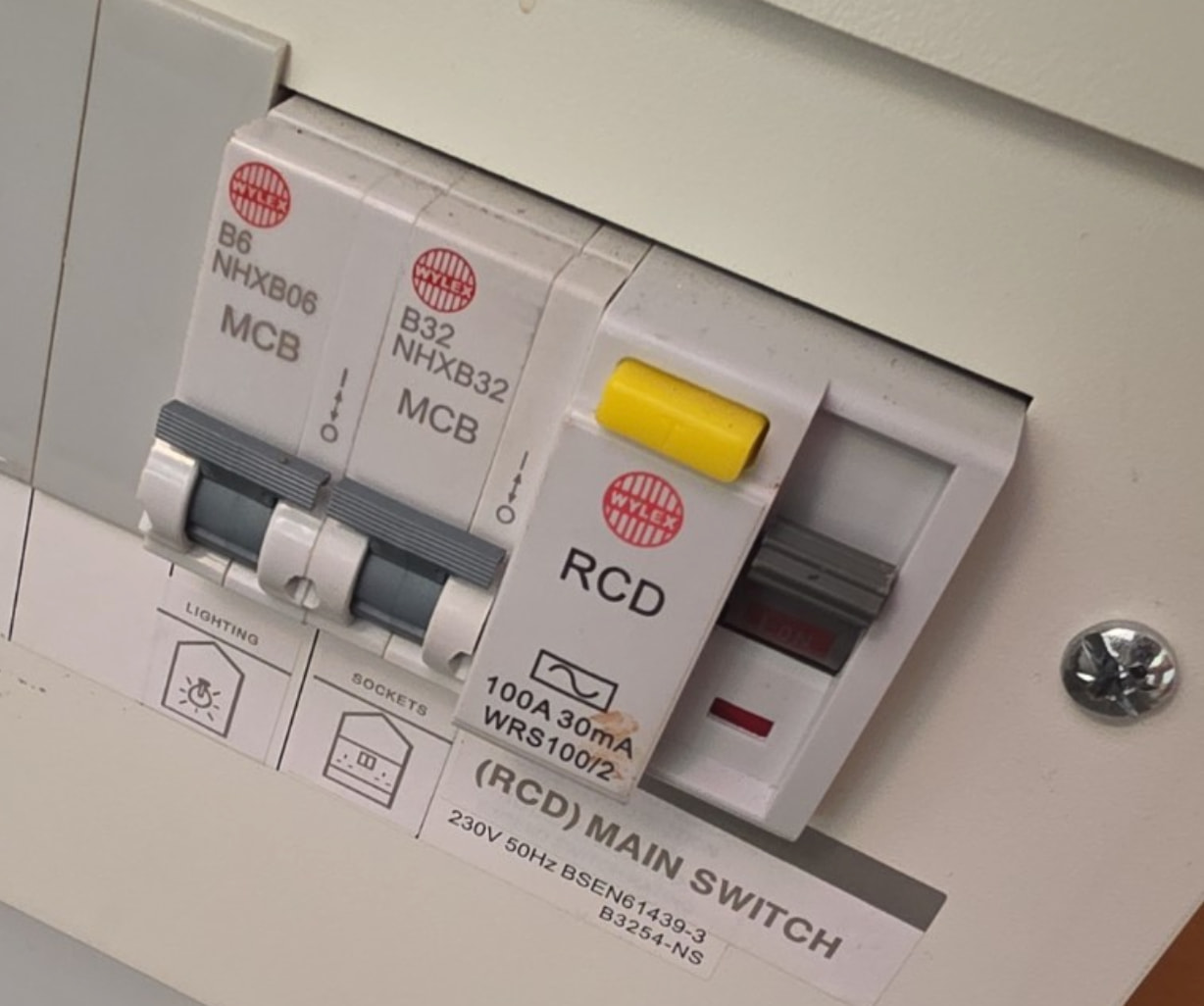
Here’s my consumer unit. I’m renting, so I haven’t traced exactly which sockets are on which circuit yet, but any observations would be appreciated.
Thanks!

Are you actually intending to run this thing at full blast for hours on end? Even training runs aren’t likely to peg the GPUs and CPU at 100% (power draw) for most of the time.

If it were me I’d first validate what my real draw was. I suspect that you’ll find that the load is generally far below anything that would stress a socket and your peak transients are also below what millions of UK household do on a daily basis with things like a kettle and a double toaster plugged in next to each other. Testing isn’t going to immediately blow the socket off the wall or melt the cable in the wall (unless your landlord’s wiring is spectacularly dodgy).

That’s not to say I’m suggesting that you throw caution to the wind, just that you’re better off knowing the numbers before bringing your landlord and electricians into the mix. That said, I’d try and work out what the overall circuit layout is in your rental so you know what’s sharing the same circuit and what the fuse/breaker situation is.

I’d play it safe and get a dedicated circuit if you’re planning to run all 4 GPUs. That’s a lot of power for a normal home setup. An electrician can tell you what’s best before you spend more money.

I’m running 5x PRO 6000s Max Q and 1x 5090 across two PSUs. Also in the UK and yes i have one PSU to one outlet and one to another. Just check your breaker to make sure that its enough to handle this and all the other stuff on that floor of your flat.

You probably want to check how many phases the place has, one phase is only 3000W.

In the UK a traditional house is single phase and it supplies well over 3kw.

Google says it’s 230-240V at 13 amps, so 2990-3120W, and the OP says the max consumption is 3-3.2kW.

To me, it doesn’t seem like that would work without undervolting the GPUs, if there is only a single phase.

His house likely has a single phase and likely has upwards of 100amps meaning 23k watts. Probably split with most wattage on the main floor so lets say 30 amp to be conservative.

Each outlet will likely be limited by a fuse of 13amps which will be tight. Two outlets with two PSUs as i stated above would work fine.

That’s really not how this works in the UK. The circuit will likely be 20A or above. The standards for all sockets are based on absorbing considerable overcurrent for hours — IIRC a double socket has to not get excessively hot while allowing a 14A load through the socket for four hours.

We fairly famously boil kettles all the time and they’re freely available to pull 13A at whatever the voltage happens to be (potentially 253V within grid spec). For continuous load something like 2kW is perfectly reasonable and I seriously doubt OP’s system will really hit that for long periods but they’re free to investigate and see if that’s the case.

probably best to use two sockets, as using only one socket you would be pushing the limits it can provide.

Afaik the UK electricals can be weird as some homes have sockets wired on the same circuit but they are still supposed to provide the rated amps. If its done to spec they use thicker wires and whatnot.

This is one of the reasons the (compliant) uk power plugs have a fuse, because the socket may be on a circuit that can technically push A LOT more than what the socket can actually handle.

1 Like

If both wall sockets are on the same ring circuit, is there any real benefit to plugging one PSU into each socket, or does it make no practical difference?

Thanks, that’s my plan. I’ll be running LLM inference rather than training, and I’ll likely power-limit the GPUs to improve performance per watt.

I’ll measure the actual wall power first before making any electrical changes. Have you ever measured the real wall power of a similar multi-GPU inference system? I’m curious how close it gets to the theoretical maximum.

That’s really helpful, thanks. Your setup is probably the closest to what I’m planning.

If you don’t mind me asking:

  • Are both wall sockets on the same ring final circuit, or on separate circuits?

  • Did you have any electrical work done, or is it all running from a standard UK domestic installation?

  • What breaker rating is your socket circuit (32A ring, 20A radial, etc.)?

  • Are your GPUs running at their stock power limits, or have you power-limited them?

  • Finally, have you ever measured the actual wall power during your typical workload? I’d be interested to know how close it gets to the theoretical maximum.

I have a family, so there can be other loads running at the same time (washing machine, dishwasher, TV, and occasionally a kettle or other kitchen appliances). I don’t want to size the setup assuming the workstation is the only thing using power on the circuit.

1 Like

If that is the only consumer unit, it lists only 2 circuits in the place, one for lighting, and one for sockets.

The sockets as a whole, are listed there as 32A, which would give a total max through that RCD of 32*230v=7360W for sustained load, for all the sockets on the entire ring, which would be the whole property.

Each socket, has a maximum of 13A*230v=2990w on that circuit,

So, you could split the load between two, 2kw PSU’s, on different* neighboring sockets, so nothing gets overloaded, and still have some other appliances running in the house
*dual sockets, share the same 13amps, they don’t get 13 each, and as Bob below notes, should keep below 13A sustained

The stumbling block, may be bursty appliances, that may temporarily take you over the RCD’s max of 7kw.

So if PC running over 3kw, a dishwasher maybe 2kw at times, and next to nothing other times, a fridges at half a kW at times, and nothing other times, and flick a kettle on, at 3kw, the RCD will trip.

Not exact, but should give a starting point.

This is presuming you live in a flat/maisonette with only one ring main for sockets, on the listed breaker

3 Likes

I just told you. The ring is designed to carry a lot more current than each socket can provide.

So while your sockets might technically be on the same circuit, which confuses americans that dont usually wire the house like that, connecting to two sockets doubles the current you can pull out safely

Yes both of my PSUs are plugged into two different outlets on the same circuit. Just like the image you showed above. I have a single circuit for all of my outlets so they are all on the same phase.

I did not do anything special, it is normal UK spec electricity. There is nothing special about this setup. Yours is probably more modern than mine by the looks of it. My 250 year old home is holding up fine. Its like Running your kettle in one room and Washer in the other. They are on the same circuit.

Mine happens to be 30 but yours is 32.

No i’ve never measured mine but i monitor my draw stated by the workstation. I’ve done stress tests where I run my cards at 100% for 30 minutes straight. No issues.

And just for clarity.

Even if you have a double outlet socket, it’s not advisable to run two plugs at high power in the same location. Power wise the ring will take the load, but thermally the individual outlet can struggle.

For sustained high loads over long durations, it’s good practice to keep outlets under 10A if practical and keep an eye out for heating.

That distribution board is not ancient and is capable, but we don’t know much about the wiring in the walls or if everything has stayed screwed in tight.

If the OP wants another circuit then they’ll definitely need landlord approval and they may want to use their own electrician. I am curious as to if the landlord included the utilities in with the rent, or if the OP is paying for the electricity, it’s not uncommon for the landlord to handle the bills.

1 Like

:rofl:

… suddenly i feel the need to find a new flat. Does rightmove let you filter by service amperage?

1 Like

I didn’t see anybody else suggest this as far as I could tell but you could power limit the cards.

The RTX 6000s can be limited to 300W and I think the 5090s can be limited to 400W. This seems counterintuitive since you paid for that capacity but actually you lose very little by limiting them this much (or a bit higher) because the vast majority of the compute is available at a lower power draw. I think limiting the 6000 to 300W drops the performance 5-15% depending on workload. The VRAM will still run at full speed.