Greetings and many thanks to Patrick and Wendell for for producing Turnstone and marketing it. I learned about it Friday and I’m exploring it to see if I can make it work for me.
It’s very nearly the sort of thing that I think I want for my non-cloud llm harness experiments. Is it safe to say that anyone paying attention to the field has noticed that llm harness products (at least openclaw, claude and codex) have made using non-cloud llm providers difficult? I really like how Turnstone has made using non-cloud LLM providers easy.
Myself, I’ve been screwing around with langchain, textual and playwright in order to try to make something useful for agentic browsing and terminal work. But I haven’t gotten as far as a coherent application that includes these capabilities with a memory and “the loop," or even anywhere near the subagent problem, which turnstone has handedly implemented as workstreams. It’s super cool from the top down that all that stuff is there waiting to be put to task.
I have fought with it just over the weekend and here are a few of my struggles. Hopefully we can commiserate, or you all can help me and anyone else get straightened out. The thing that seems the most problematic for me is the lack of control of the context that goes out with a user message. After using openwebui I have come to rely on creating a new workspace to cut-off memory between the conversations, however, I had an unexpected memory leak from one turnstone workspace into another which resulted in the agent trying to work on 100% the wrong problem, which the agent had previously become fixated on in the last workspace I was using.
In this short time, I’ve become impatient with the strictness of permissions for tool calling before I’ve even gotten anywhere near deployment to a system where important credentials or data are accessible. I see there’s a ton of fine-grain control and checks that can be implemented, but I don’t understand what the precedence is. I was able to get the judge model for determining tool call safety involved, which is super cool, but whatever the criteria for deciding what needs human review is or how it is derived is not intuitive. I guess this one sort of comes back to context control too. Is there somewhere I can just disable approval requests?
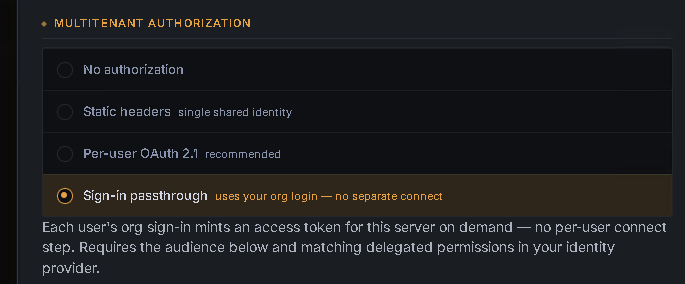
Finally (for now), the thing that brought me here to post is actually that I’m trying to add an MCP server. It’s for obsidian, provided by the “Local REST API with MCP” community plugin. Now I’ve verified that the MCP endpoint is there and responding with curl from the turnstone host, but when I try to add it as a turnstone MCP server all I get is the vague “connecting” status. Here, I have no clues. So I have to go digging through the sourcecode to troubleshoot. Or ask the Level1Techs forum how to sort through it.
Using turnstone to troubleshoot turnstone is problematic since it’s so new and very little of the troubleshooting has been committed to text, much less text that would have made it into a model training dataset. So the models don’t know the problems or how to solve them.
I think that Turnstone has made great strides in the effort to provide a transparent implementation for AI agents which run on local hardware. This is my favorite part, that I don’t have to trick the agent into using a locally hosted LLM. If I simplify the whole agentic AI product into LLM + harness, Turnstone implements some stellar harness architecture, I’m stoked for what is to come. I, personally, would like some modularity in context construction to better manage the context(s) that accompany my user messages as well as an extension of the transparency spirit into what the context actually is. Like I said, I’m experimenting and trying to figure out what works for me and I would like to use Turnstone architecture to do that.
Does anyone out there know off-hand how to troubleshoot these Turnstone-MCP server connections?