Rite now is fun times… news its all no more petrol and rationing and drama !! end of the world but guess what in two years it will be old news like covid.
1 Like
I’d push back on that.
We’ve really only had EVs that are practical and affordable for normal people for ~5-6 years. Sure, you can point to the Leaf, but that’s not really a practical car compared to an Altima or a Mazda 3.
I wouldn’t debate if we put the number at 5 years, but the reality is that the major issues that were preventing people from even being interested in EVs (charging network availability, range, cost) really only got addressed in the last few years. Sure, you could argue that the Model 3 was released in 2017, but that was a $40k car, after incentives and even when you considered that, most people don’t drive a $40k car.
I think people really just need to understand that EVs shouldn’t have to be political. The biggest mistake people made was making them political in the 2010s, and that basically made a good 50% of people hate them because they’re seen as “hippie cars” or whatever. I got a bunch of shit from my friends for driving a Tesla. Right up until I offered to let one of them drive it. After 1/4 mile in the car, he basically said “yeah, ok, I see why you like it.” and they all shut up.
As for challenges being not technical, I think there are still technical hurdles to overcome, but they aren’t dealbreakers with regards to adoption.
Things like the next-gen battery chemistry families are what I’m thinking of. Sodium ion, etc… Sure, there are allegedly commercial chemistries that do this, but I’ll be honest, I haven’t seen 3rd party reviews that I trust yet, so while I’m excited that they’re making claims, I’m reserving judgment.
On that note, I’d really like to see a law that mandates some sort of V2G/V2H system be available on cars. I’m very frustrated that I have 60kWh of energy I can’t use during my $0.70/kWh on-peak hours to cool my house in the summer, only to charge it back up when the rate drops down to $0.24/kWh. (side note, I’m designing a DIY hybrid system in the other tab right now, with the intention of contracting a roofer to do the racking in may/june, because of this stupid lack of feature…)
We don’t need the whole system integrated, because it’s obvious that you need more than to just plug the car into a branch circuit. There’s current sensing on the main line and certification agreements from the utility that are needed, generally, but all of this could be fast-tracked with government regulations and that would functionally solve all the issues we have with the duck curve overnight!
So yeah, to sum it up, I think you’re right that we have a ways to go and it is mostly just a matter of willpower and government forcing private companies to not actively stand in the way. The rest of it will just sort of fall into place.
2 Likes
I agree on sending power back out into the grid is complicated with techs needing power off to do maintenance and not get electrocuted etc 
But on property power use / storage could be flexible. Even with solar / wind generation.
In most states, even if you set up a zero-export system, you are supposed to get it inspected and tell the utility you’re doing it. Technically though, how would they know, if the system is working correctly. I think it’s mostly so that the utility doesn’t go scratching their head if they’re having issues on your circuit.
It’s one of those “locks keep honest people honest” situations.
1 Like
true test before trust situation and even then 
Depends on the use case. We had an EV since 2014, It was a little Smart, nothing exciting. However, in practice it got driven more than the Bmw or Audi because for a short local trip it was zippier, quieter, and didn’t require stopping for gas. You are correct back then a long trip required the gas car.
As to V2L and V2G, we need a standard so the cars and loads can easily interchange. It’s taking longer than it should. Last I looked some were being worked on but it doesn’t appear one has been adopted yet. If anyone has more info, let me know.
Even today a few use cases are not well covered by EVs, example, towing. However, I’d hate to set the start of the transition date as the date which all use cases for everyone is covered. That is more like the mid point or near end.
1 Like
I’m also specifically talking about the average person. Because you’re on this forum, you’re not exactly an “average person”. You’re more technical, more interested in tinkering and probably an early adopter of new technology. I consider myself an early adopter, but I didn’t buy an EV until 2023. (partially because of the timeframe when I was in the market, partially because of need, partially because of technical readiness)
I don’t think it’s realistic to say that either. Towing, is always going to be a challenge, but will really need to have batteries of 300kWh+ to make feasible, simply due to physics constraints.
But I do think it’s reasonable to say “the real start of the transition was the point at which the average person started to consider EVs technically and financially viable options for their every day needs” and I simply don’t think that a Nissan Leaf or first-gen Model S fits that bill. The leaf was affordable, but when I test drove one (in 2016) it did not have enough range to cover my commute, forget if I wanted to do something after work. And the Model S was a great EV at the time, but it was simply too expensive. (still is, IMO)
My argument for 5-6 years ago (2020-ish) being the inflection point is that we started to see numerous automakers releasing sub 50k EVs at that time. Yes, the Bolt and Kona EV were available before then, so I would be sympathetic an argument for 2018-2019, but really at that point, we’re debating 2 years, not 6 or 10. But then again, the first gen Bolt was a bit… spicy.
I don’t disagree with your statement, but, please be careful when you assume what the “average person” needs. You’d be surprised how much that differs once you look outside the state you live in.
If you want a prime example of this, look at the cringe of the latest LTT Linux Challenge video where Linus is, once again, trying to LARP as the average Linux user and ends up missing the mark on quite a few things…
Otherwise, I think your reasoning here is spot on. 2020 is a good start for the transition IMO, too.
1 Like
What they actually need and their own perception of what they need is very different.
I’m basing my statement on conversations I’ve had with people (yuck, I know) about these exact topics.
Lots of people put too much weight on needing 300 miles of range to drive to work, when realistically, 180ish miles of actual range, not the fake numbers WLTP and EPA produce, would be enough. And yes, I’m basing that on living in the Metropolis that is San Angeles. The problem is that you could look at any other major metro area (which about 85% of the US lives in), and the commute requirements would be similar or worse. I know friends who have an 80 mile one-way commute in the Austin metro area… Luckily for them, the freeways scream at 100mph, so that’s nice for travel time, but not so great for range. When I had a commute, it was 50 miles one-way, at 80-85mph, so that would suck down a good 25% of my battery on the way there, and uphill back it would be 30%.
Add on to that the whole issue of “80% charge limit” and that further reduces your EVs range. This is another issue that is probably going away soon, what with LFP and other chemistries coming to market.
1 Like
Wait until you see the CLTC numbers, they pad the already optimistic EPA numbers by another ~40%.
I think you are right, there is alot of “just in case” thinking with range, similar to why some/many people buy pickup trucks when they don’t actually haul much.
This is why I got the Y.
There are 10-20 days per year when I exceed the range of my battery, with an 80% charge. I can put just about anything I need to in the trunk, and if I’m, for example, buying a refrigerator, I can rent an F150 from Home Depot, where I bought the fridge, drive the thing 20 minutes to my house, unload it, drive it back to the store, return it within 1 hour, and pay $25 for the privilege. No harm in renting a purpose built vehicle for a very specific need that should only happen once every few years.
If I were a solar installer, or something like that, I would definitely be considering a different vehicle, but alas, I do not work on roofs.
What’s funny is that when I was younger this seemed like a bad idea and something that shouldn’t be relied on, too many unknown variables (availability, condition, timeframes taking longer than anticipated) that can cause problems; but now that I’m older it seems reasonable.
I wonder how much of that dynamic is going on in purchasing decisions among the general public.
Why not simply go to the family farm and borrow a truck if you need one. I may not be a regular person.
Because I’m a city slicker and we don’t have a family farm haha
If you’ve got that option, do it!
That option would be preferable to renting for me if I had it. There’s enough ranches around me I must know someone who works at one.
I just got three 15kVA inverters that will finally give me 277V power!:
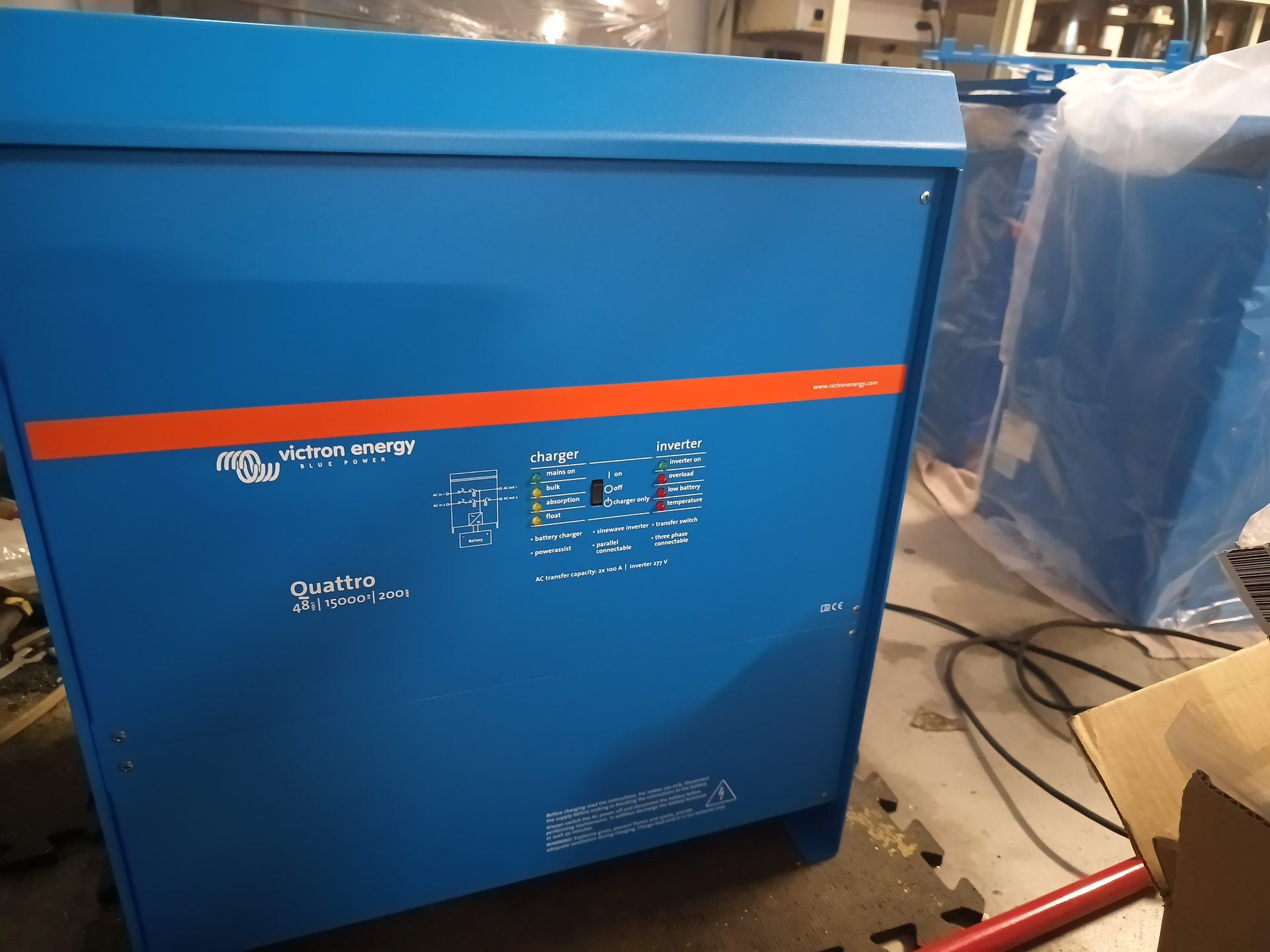
Now I just need to choose a battery to connect it to.
3 Likes

Got five more arrays installed last summer, all DIY, and doubled our batteries. It has been awesome. On a sunny days in December even with the limited sun we get, we made more than 20KWh of power a day. Will install 8 more panels and cut a few trees and then I think we’ll be able to bump that up to 30KWh in December. Allows us to heat the cabin electrically except in the deep winter when we’ll heat with wood or Toyo during the day and electric at night. Expensive but awesome.
4 Likes
If your a god fearing USA ) the devil is winning trump on that racists
b/c of solar …
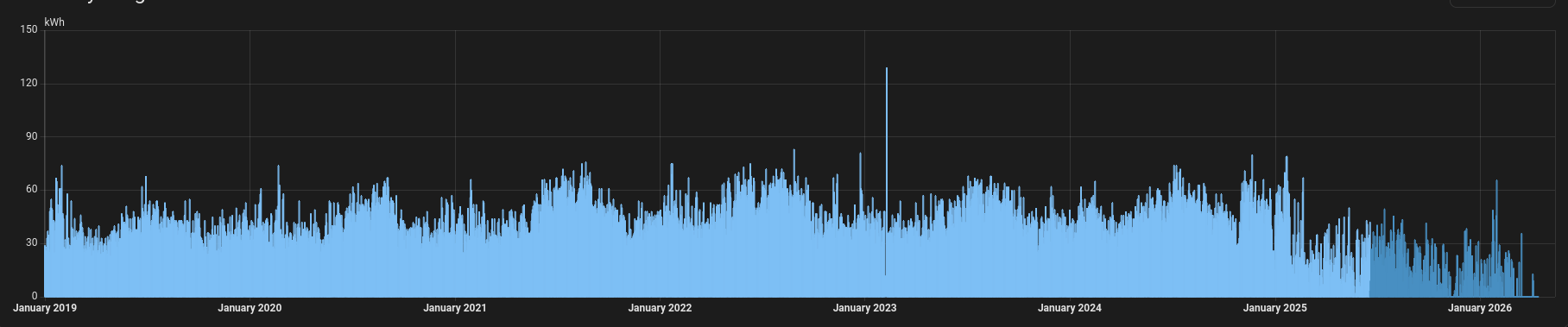
Ive used less this year than I have in any one month of the last 5 years that i have bills/data for.
1 Like
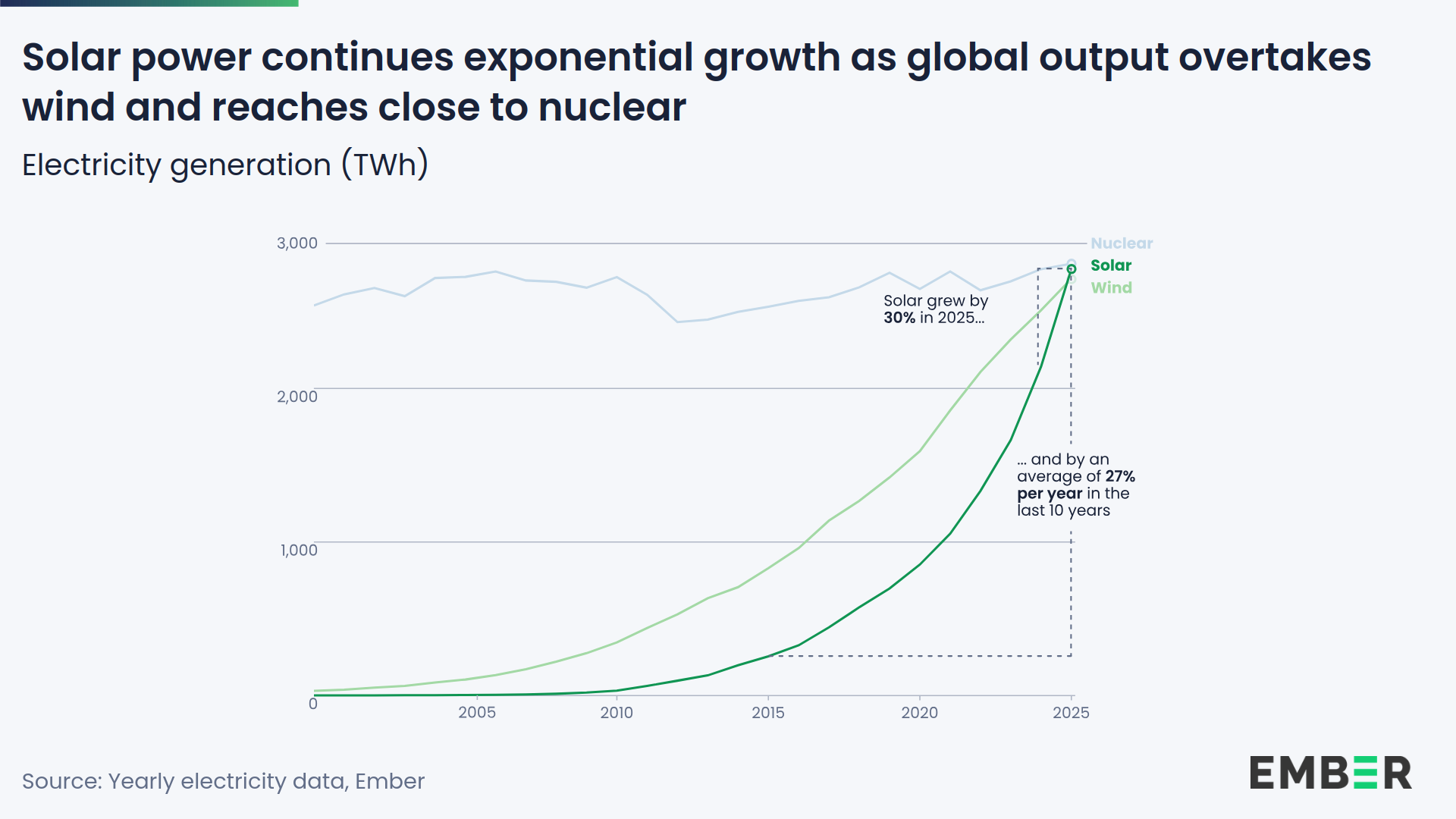
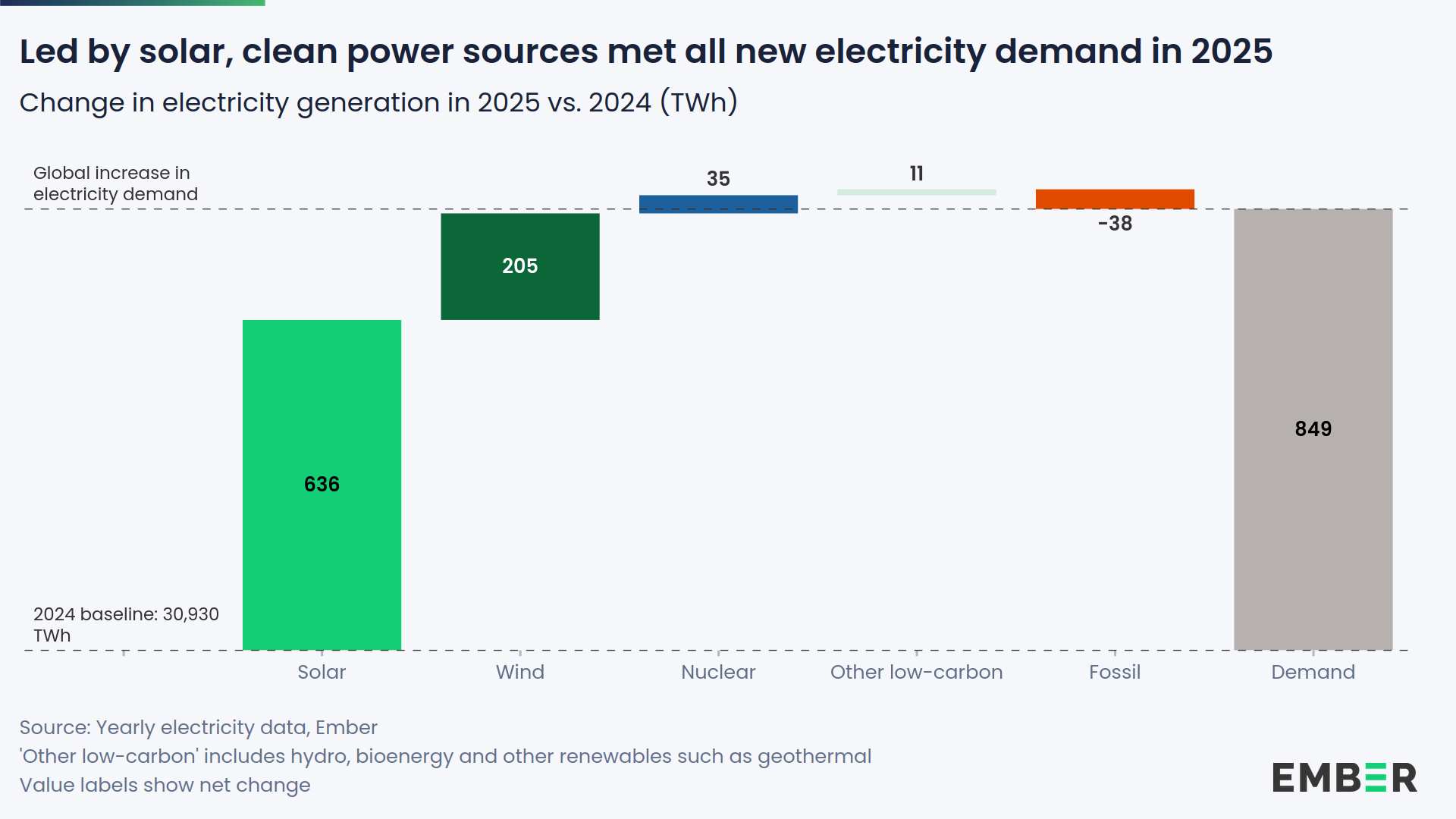
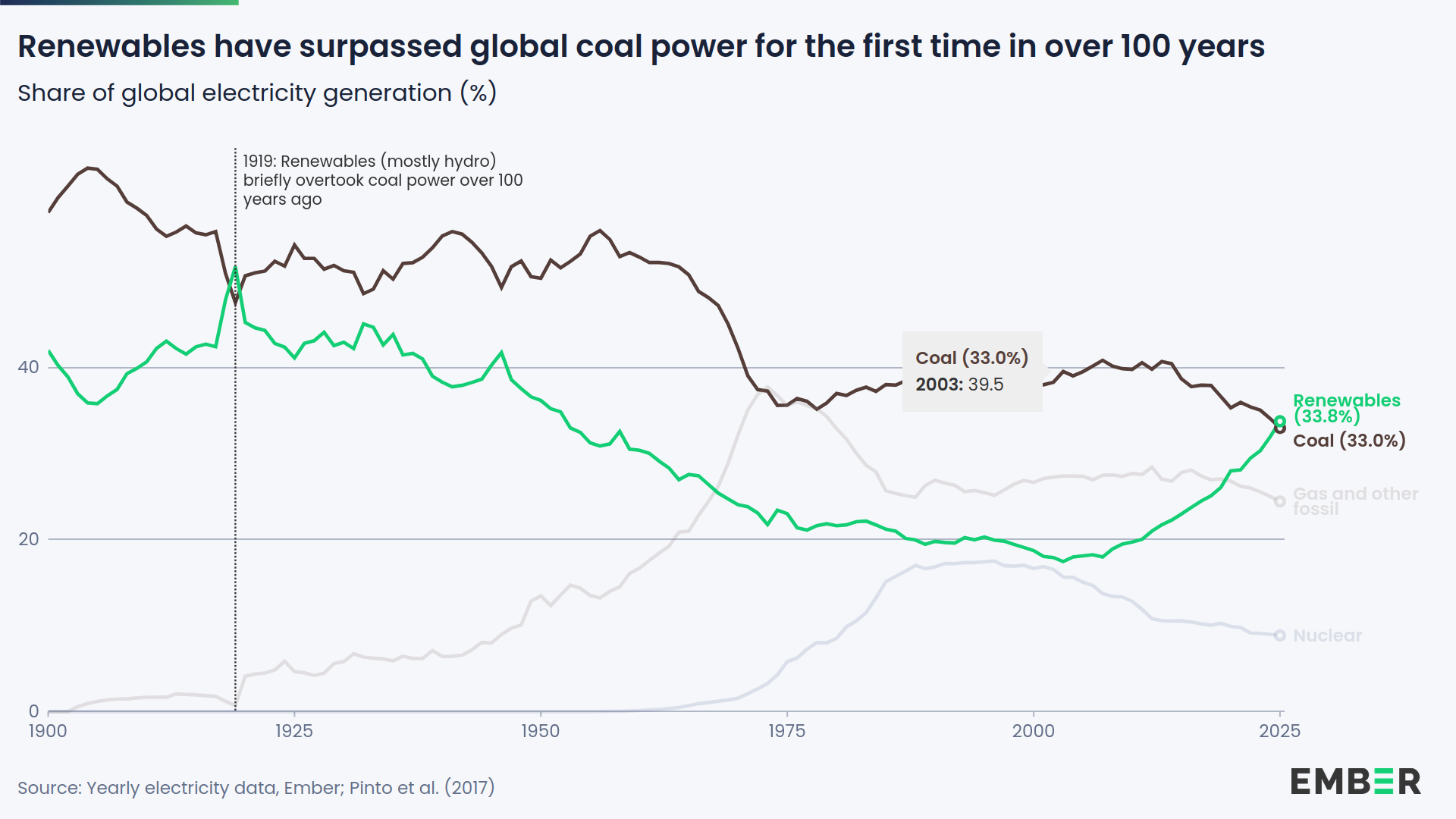
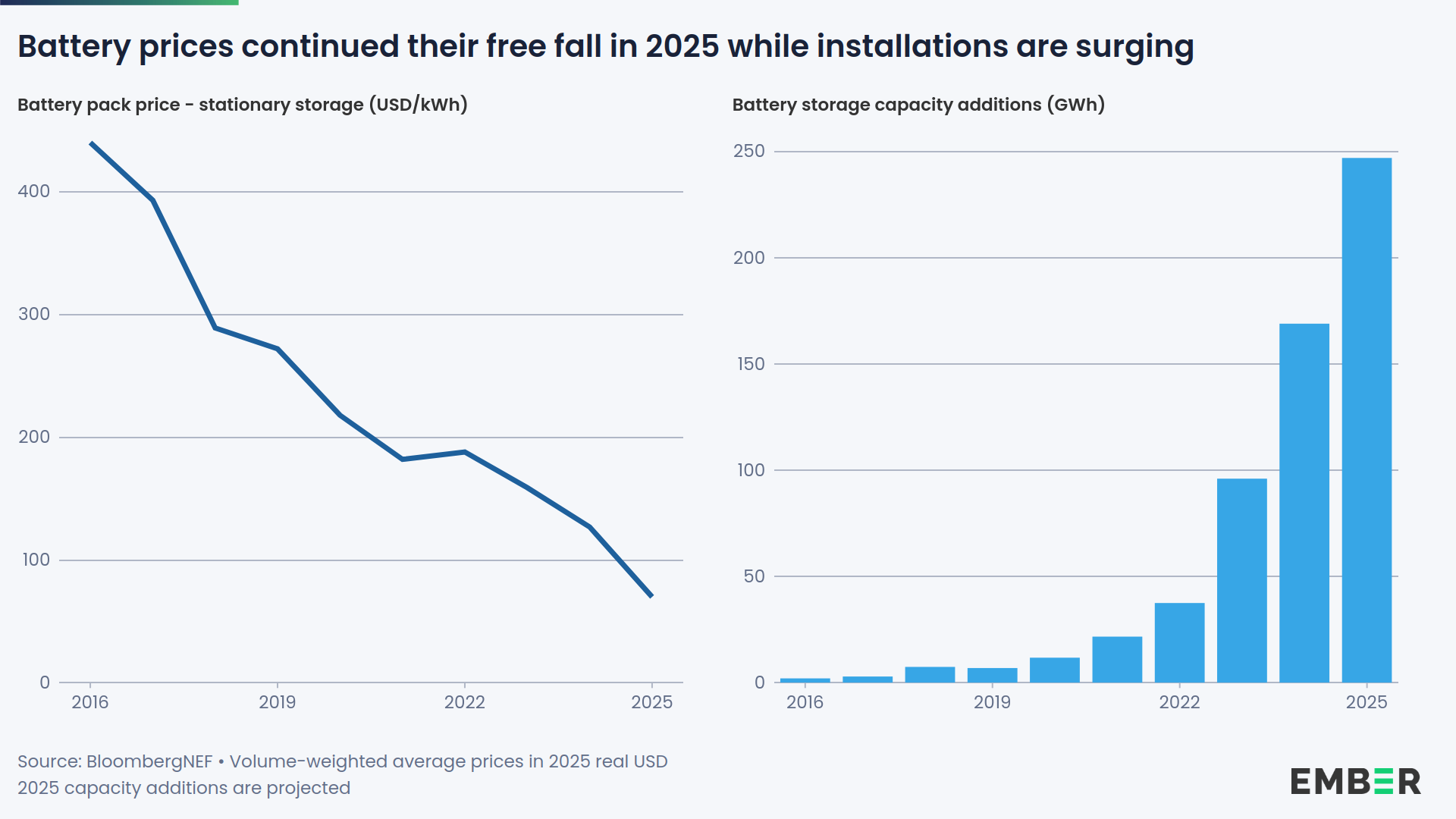
Ember’s Global Electricity Review 2026 has been released, showing how things changed in 2025. Heaps of good news and lots of interesting charts. Here’s a few:
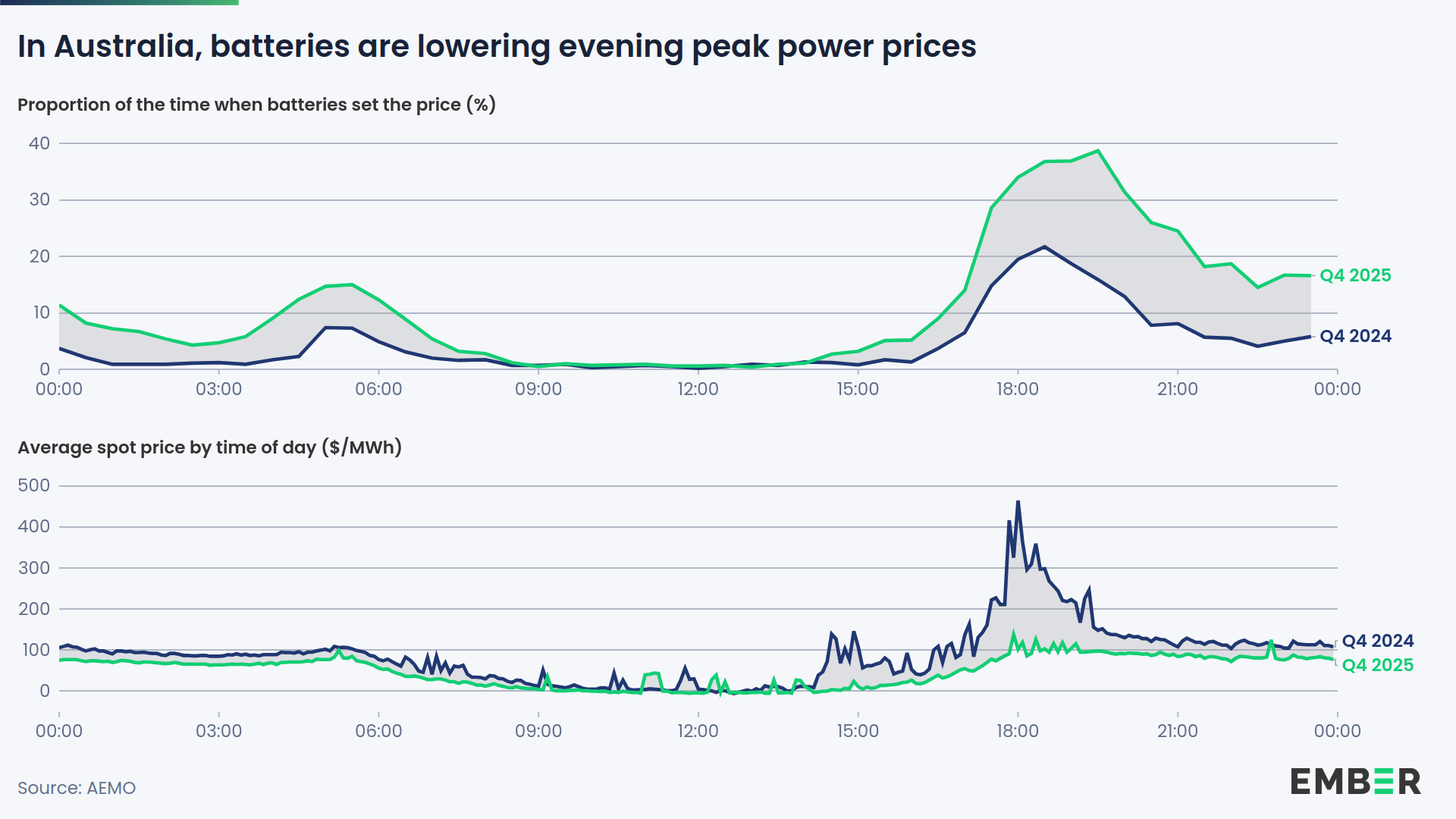
Australia shows how batteries can quickly reshape power markets once deployed at scale. In Q4-2025, during the high-value evening peak hours (18:00-20:00) in the National Electricity Market, batteries set prices 36% of the time – doubling from 18% in Q4-2024, displacing gas and hydro as price setters.
This led to significantly lower price volatility compared with Q4-2024, with average spot prices of around $100 per MWh during 18:00-20:00, less than half of the Q4-2024 average spot prices during these hours. This helped bring overall prices lower, with wholesale prices averaging $50/MWh, a $39/MWh (-44%) reduction from Q4 2024.
These dynamics, with similar trends also in Q3-2025, show that batteries are already delivering tangible system benefits by reducing reliance on expensive fossil generation and stabilising prices at the most critical times of day.

3 Likes