New toy in the homelab: an AMD Radeon AI PRO R9700 with 32 GB of VRAM. It’s passed through to a dedicated VM on my Proxmox server and runs ROCm with llama.cpp. First up was Qwen3.8-27B as a local coding agent. It runs entirely on the card with a 128K context window, generating about 22 tokens a second and getting through a long prompt at about 900 tokens a second. It works, but it’s not quite fast enough for agent work yet, so tuning it is the next job.
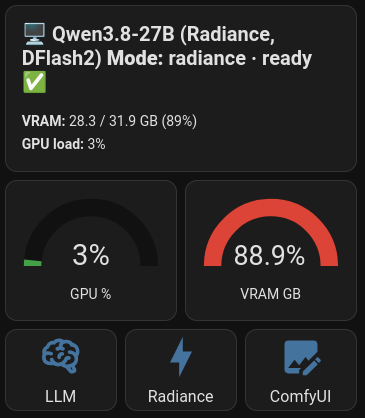
The same card also runs ComfyUI for image generation and editing with Z-Image-Turbo and FLUX Klein. A simple toggle (Home Assistant, with GPU stat reporting) swaps the GPU between “coding mode” and “image mode,” and the agent falls back to a cloud model while the card is busy making pictures.
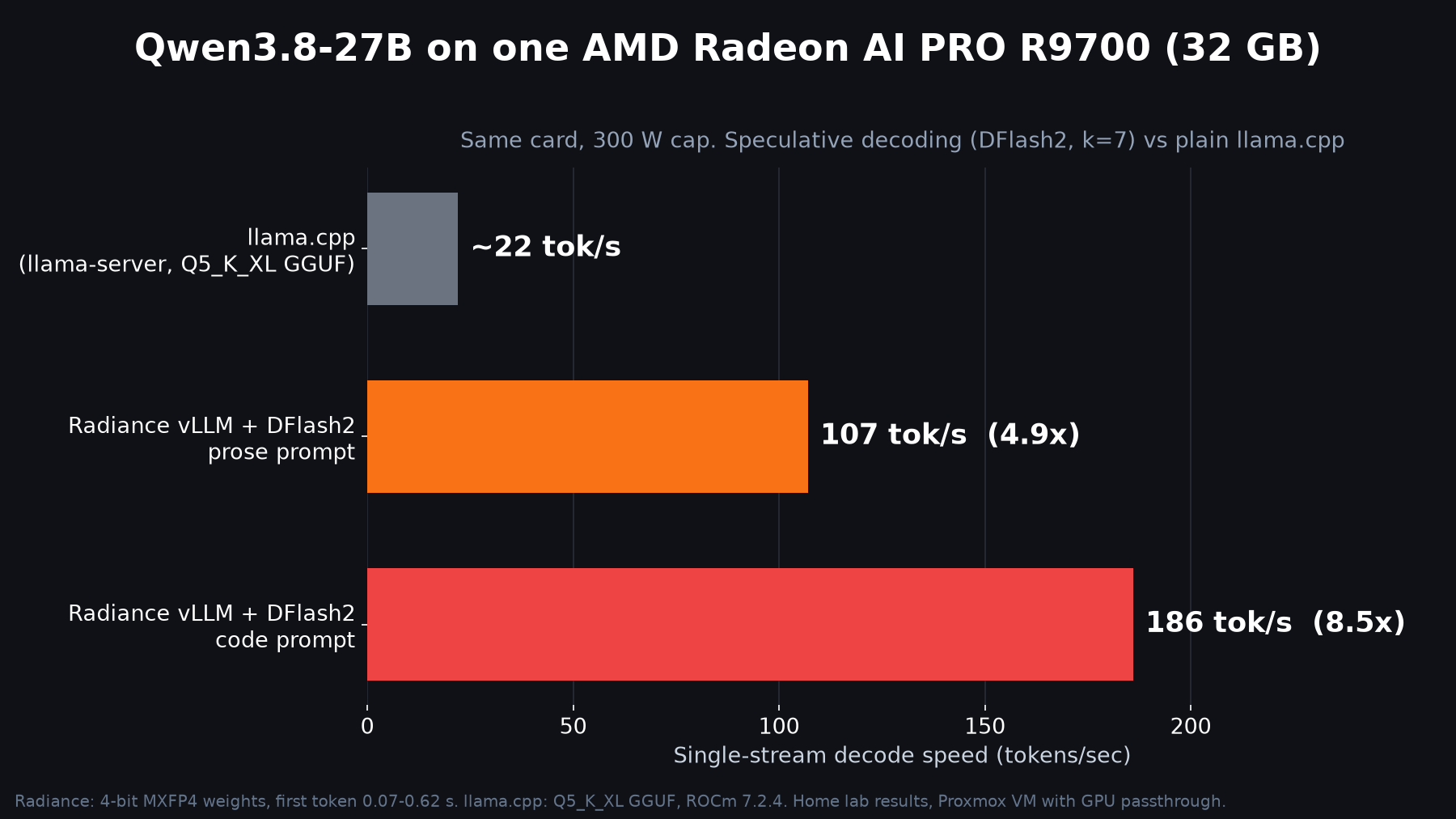
Hello, if your 22 tok/s llama.cpp run was plain decoding, it’s worth re-running it with MTP on before you commit to Radiance. AMD’s day-0 Qwen3.8 27B guide measured up to 51.8 tok/s on a single R9700 with llama.cpp and MTP set to 2 draft tokens (Vulkan on Windows). On llama-server, that’s --spec-type draft-mtp --spec-draft-n-max 2, as long as your GGUF still has the MTP layers. Then compare both on a real Hermes session. Speculative decoding speed depends on how predictable the output is, which is why your code prompt beat prose. Thanks for sharing the results.
I threw Hermes at it and Opencode as a tool and I haven’t had a chance to fine tune more. I will have to give llama a fair shake when I have a moment! Fun times learning how bigger models work. My old Gaming Rig only had 8GB, and 2GB was taken by Fedora and apps.
A single card useful for coding and experimentation is very powerful.

 But I can imagine!
