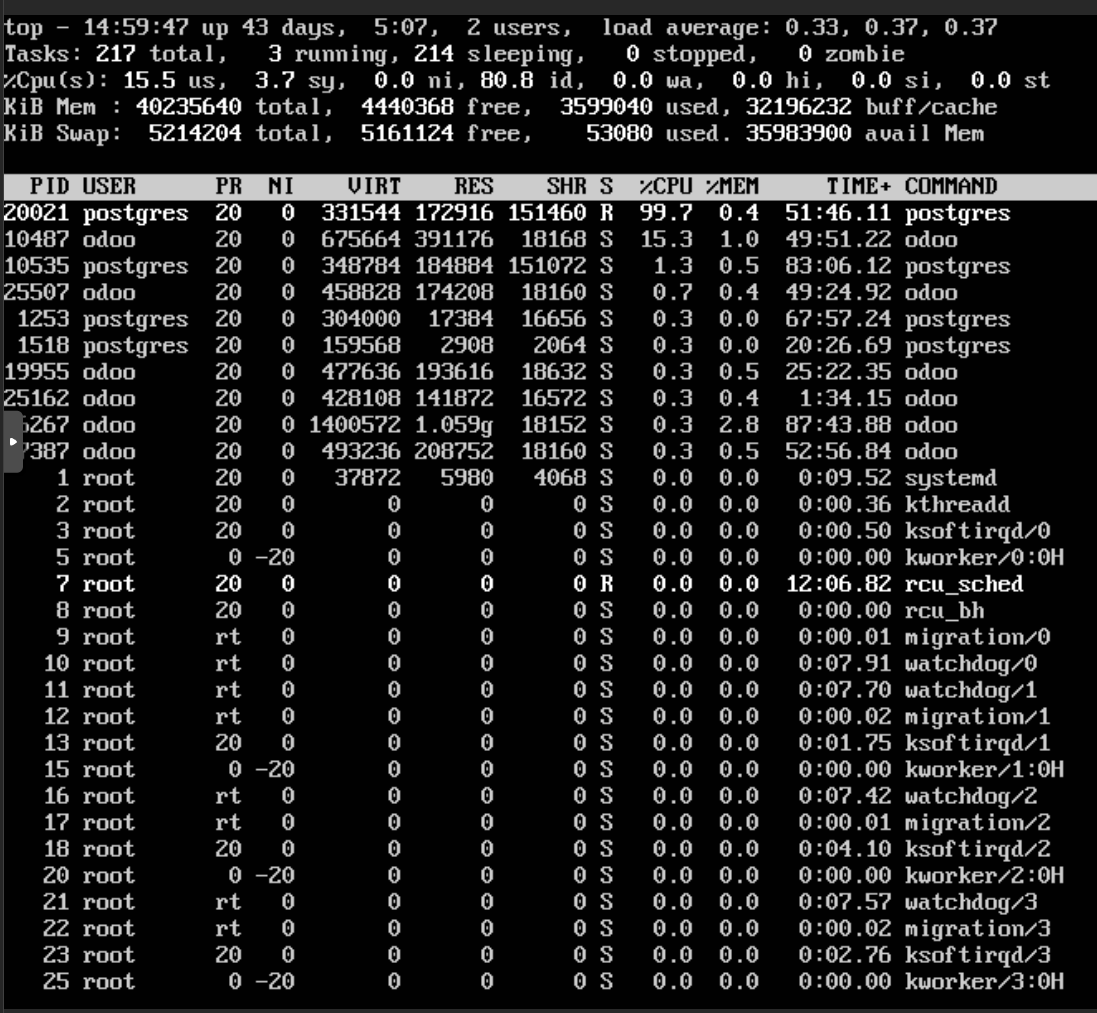
I am looking at upgrading my servers to all nvme from ssd.
Now my database VM isnt getting hit by a ton of things at once but heavy single threaded tasks. I am currently running ryzen 5700x and looking at 7503p is much slower single threaded. Is this going to actually slow down things?
Assuming you mean the 7303P , you could run cpupower frequency-set --max 3400MHz on your Ryzen, benchmark and see what the difference is - that’s the max turbo frequency of the 7303P.
Its our accounting software running odoo, its python 2.7 and 3 depending on version. They are using postgresql.
Sometimes you will see one thread pegged but it almost seems like postgres and odoo are using the same thread.
Just my 2 cents – my greatest successes with speeding up Postgresql was to get underneath it and buffer it’s disk I/O with Primocache. That said, Primocache (or something like it) will really stress your memory controller, so if you’re aggressive with your RAM speeds use EPYC not Ryzen. EPYC limits it’s speeds for durability. I’ve fried 5 3990x Threadrippers (I’m on my 6th) running heavy Postgres database restores and rebuilds using the stock BIOS voltage settings. Asus BIOS defaults allows SOC voltages to go way higher than AMD recommended maximums, the end result is BZZZZTTT and dead CPUs after a few hours. And, yes, everything was/is kept cool – 27 fans in the case – most at 100% – nothing getting over 50C.
Depending on how your Posgres is being used/queried, running raw on a fast pair of striped NVME drives will allow for much higher IOPS. The IOPS using Primocache still can’t match a striped pair of fast NVME SSDs for IOPS (go figure). Changing disk buffering helps a bit, but it wasn’t a noticeable difference. Changing Postgres defaults to use more concurrent processes and RAM made a much larger difference. Seeing that something like disk RAM buffering is just software, this might be a cheap and easy experiment to try before buying hardware, especially if there’s a 30 day trial period. You’re running Linux, so Primocache won’t work – but I’m sure there are equivalents for your OS/distro.
Thanks for all that info! That server is currently running proxmox and the VM is running ubuntu.
So having that thread pegged on ryzen with consumer nvme going to epyc with enterprise ssds will probably be slower. Everything else on my system is just regular sata ssds.
I would just throw them into my ryzen servers but they are 1u and I cant find a place for them without drilling out rivets.
I also was looking at using intel optane p4800x for the database which is really only around 120gb so 3 or 4 of them at 375g would be plenty. Probably would perform better than an NVME.
But would the epyc be able to take advantage of it?