The new deepseek models are pretty interesting. I haven’t gotten a chance to test it out yet.
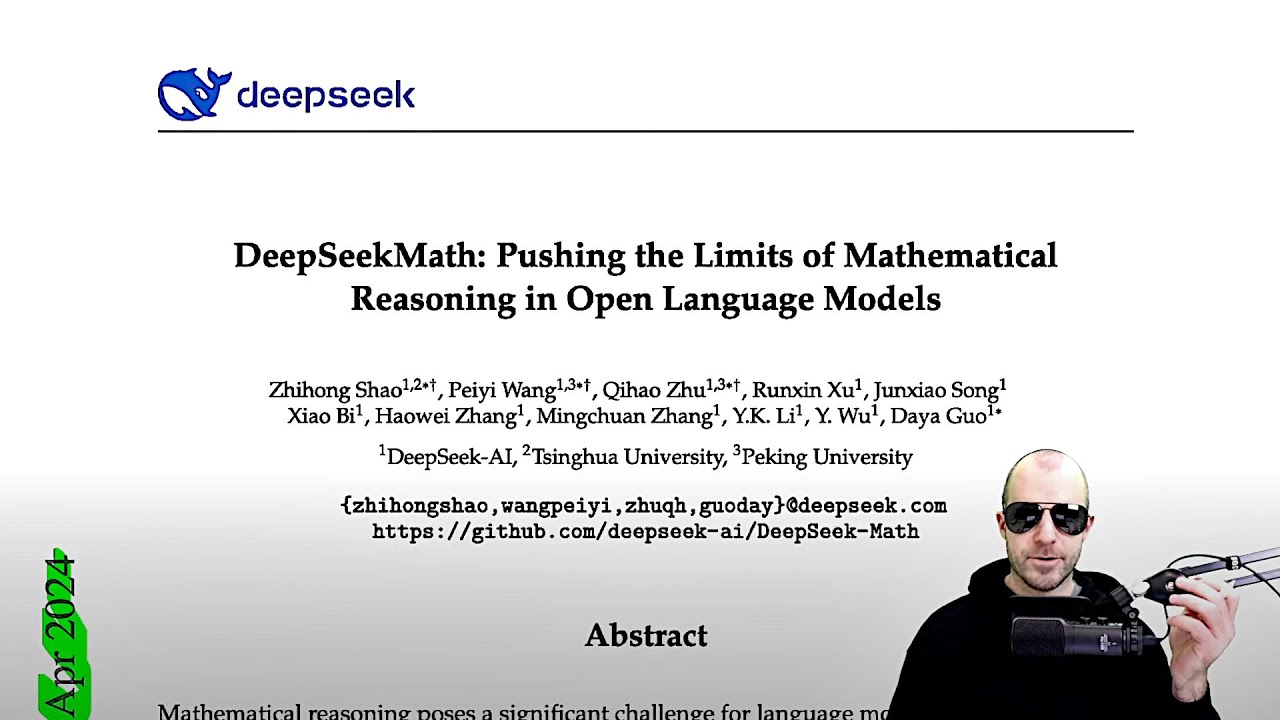
I like Yannic’s coverage of the r1 math research paper.
Mathematical reasoning poses a significant challenge for language models due to its complex and structured nature. In this paper, we introduce DeepSeekMath 7B, which continues pre-training DeepSeek-Coder-Base-v1.5 7B with 120B math-related tokens...
I watched half of it and got confused by the GRPO. My takeaway is that they had a better pipeline for curating their training dataset.
I wonder how long until the NEAT algorithm gets applied
NeuroEvolution of Augmenting Topologies (NEAT) is a genetic algorithm (GA) for the generation of evolving artificial neural networks (a neuroevolution technique) developed by Kenneth Stanley and Risto Miikkulainen in 2002 while at The University of Texas at Austin. It alters both the weighting parameters and structures of networks, attempting to find a balance between the fitness of evolved solutions and their diversity. It is based on applying three key techniques: tracking genes with history ma...
https://neat-python.readthedocs.io/en/latest/neat_overview.html
I just finished reading the deepseek v3 paper. If the abstract isn’t detailed enough the conclusion is a much better summary without getting into the weeds of the tech.
In this paper, we introduce DeepSeek-V3, a large MoE language model with 671B total parameters and 37B activated parameters, trained on 14.8T tokens. In addition to the MLA and DeepSeekMoE architectures, it also pioneers an auxiliary-loss-free strategy for load balancing and sets a multi-token prediction training objective for stronger performance. The training of DeepSeek-V3 is cost-effective due to the support of FP8 training and meticulous engineering optimizations. The post-training also makes a success in distilling the reasoning capability from the DeepSeek-R1 series of models. Comprehensive evaluations demonstrate that DeepSeek-V3 has emerged as the strongest open-source model currently available, and achieves performance comparable to leading closed-source models like GPT-4o and Claude-3.5-Sonnet. Despite its strong performance, it also maintains economical training costs. It requires only 2.788M H800 GPU hours for its full training, including pre-training, context length extension, and post-training.
While acknowledging its strong performance and cost-effectiveness, we also recognize that DeepSeek-V3 has some limitations, especially on the deployment. Firstly, to ensure efficient inference, the recommended deployment unit for DeepSeek-V3 is relatively large, which might pose a burden for small-sized teams. Secondly, although our deployment strategy for DeepSeek-V3 has achieved an end-to-end generation speed of more than two times that of DeepSeek-V2, there still remains potential for further enhancement. Fortunately, these limitations are expected to be naturally addressed with the development of more advanced hardware.
DeepSeek consistently adheres to the route of open-source models with longtermism, aiming to steadily approach the ultimate goal of AGI (Artificial General Intelligence). In the future, we plan to strategically invest in research across the following directions.
We will consistently study and refine our model architectures, aiming to further improve both the training and inference efficiency, striving to approach efficient support for infinite context length. Additionally, we will try to break through the architectural limitations of Transformer, thereby pushing the boundaries of its modeling capabilities.
We will continuously iterate on the quantity and quality of our training data, and explore the incorporation of additional training signal sources, aiming to drive data scaling across a more comprehensive range of dimensions.
We will consistently explore and iterate on the deep thinking capabilities of our models, aiming to enhance their intelligence and problem-solving abilities by expanding their reasoning length and depth.
We will explore more comprehensive and multi-dimensional model evaluation methods to prevent the tendency towards optimizing a fixed set of benchmarks during research, which may create a misleading impression of the model capabilities and affect our foundational assessment.
We present DeepSeek-V3, a strong Mixture-of-Experts (MoE) language model with 671B total parameters with 37B activated for each token. To achieve efficient inference and cost-effective training, DeepSeek-V3 adopts Multi-head Latent Attention (MLA)...
My takeaway is that the team worked smarter than harder for example they did the following:
developed a data pipeline that produced higher quality data in a higher volume
Compared with DeepSeek-V2, we optimize the pre-training corpus by enhancing the ratio of mathematical and programming samples, while expanding multilingual coverage beyond English and Chinese. Also, our data processing pipeline is refined to minimize redundancy while maintaining corpus diversity. Inspired by Ding et al. (2024), we implement the document packing method for data integrity but do not incorporate cross-sample attention masking during training. Finally, the training corpus for DeepSeek-V3 consists of 14.8T high-quality and diverse tokens in our tokenizer.
We curate our instruction-tuning datasets to include 1.5M instances spanning multiple domains, with each domain employing distinct data creation methods tailored to its specific requirements.
applied the Mixture of Experts architecture with their own spin
Beyond the basic architecture, we implement two additional strategies to further enhance the model capabilities. Firstly, DeepSeek-V3 pioneers an auxiliary-loss-free strategy (Wang et al., 2024a) for load balancing, with the aim of minimizing the adverse impact on model performance that arises from the effort to encourage load balancing. Secondly, DeepSeek-V3 employs a multi-token prediction training objective, which we have observed to enhance the overall performance on evaluation benchmarks.
optimized the training process with their model architecture to fully utilize their available hardware and optimize cost, as well as, suggesting hardware level optimizations
Architecture: Innovative Load Balancing Strategy and Training Objective Pre-Training: Towards Ultimate Training Efficiency
I’ll come back and add quotes/citations later.
I am going to virtual paper presentation to hear smarter people talk about it. Here’s a discord event link if you wanna also listen in
2 Likes
The success is effectively applying reinforcement learning (the bitter lesson) to the problem rather than previous method of an evaluation (critic) model for scoring,
They use a more simple algorithm Group Relative Policy Optimization (GRPO) which takes a group of outputs, scores them against the average and can use this as training data, this math can train the model to do more positive outputs not the negative ones.
This covered the two algorithm differences in simple enough language:
1 Like
Last weekend, I decided to work on porting my fastpages blog since the project was archived.
opened 05:35PM - 22 Mar 25 UTC
bug
# description
I am in the process of migrating my fastpages blog to nbdev and qu… arto. I followed the migration guide
https://nbdev.fast.ai/tutorials/blogging.html
When running `nbdev_migrate --path posts`, the code raises an exception for unicode characters. I temporarily got around the issue by substituting my em dash with `-`. I wanted to document this in case anyone else encountered this issue and potentially identify the function that is causing the exception
## how to reproduce
If you would like to replicate this, here's the source markdown file:
https://github.com/progressEdd/blog/blob/master/_posts/2020-12-23-Investigating-RPiPlay-Apple-Airplay-on-Fedora-Linux.md
a snippet of the code it fails when the unicode character for a em dash is in the text—
```md
---
keywords: fastai
description: As a graduate student during COVID-19 some of my classes were online. I found it difficult to share my iPad screen over web conferences. At that time, I did not want to install Zoom because of the numerous <a href='https://thehackernews.com/2020/08/zoom-software-vulnerabilities.html'>security vulnerabilities</a>. Furthermore, the feature of casting my iPad screen was exclusive to Zoom. If I wanted to share my screen in other applications such as Microsoft Teams or Google Meet — I needed an alternative. Over the course of a couple months, I researched and tested multiple methods to cast my iPad screen. This blog post is the fruits of my labor.
title: Investigating RPiPlay — Apple Airplay on Fedora Linux
comments: true
nb_path: _notebooks/2020-12-23-Investigating-RPiPlay-Apple-Airplay-on-Fedora-Linux.ipynb
layout: notebook
---
...
```
When I run
```python
uv run nbdev_migrate --path posts
Traceback (most recent call last):
File "/mnt/sda1/Documents/development_projects/progressEdd_projects/Python-Notebooks/personal-project/blog-migration/.venv/lib64/python3.13/site-packages/nbdev/migrate.py", line 180, in nbdev_migrate
if f.name.endswith('.md'): migrate_md(f)
~~~~~~~~~~^^^
File "/mnt/sda1/Documents/development_projects/progressEdd_projects/Python-Notebooks/personal-project/blog-migration/.venv/lib64/python3.13/site-packages/nbdev/migrate.py", line 164, in migrate_md
txt = fp_md_fm(path)
File "/mnt/sda1/Documents/development_projects/progressEdd_projects/Python-Notebooks/personal-project/blog-migration/.venv/lib64/python3.13/site-packages/nbdev/migrate.py", line 100, in fp_md_fm
return _re_fm_md.sub(_dict2fm(fm), md)
~~~~~~~~~~~~~^^^^^^^^^^^^^^^^^^
File "/usr/lib64/python3.13/re/__init__.py", line 377, in _compile_template
return _sre.template(pattern, _parser.parse_template(repl, pattern))
~~~~~~~~~~~~~~~~~~~~~~^^^^^^^^^^^^^^^
File "/usr/lib64/python3.13/re/_parser.py", line 1076, in parse_template
raise s.error('bad escape %s' % this, len(this)) from None
re.PatternError: bad escape \u at position 618 (line 10, column 26)
The above exception was the direct cause of the following exception:
Traceback (most recent call last):
File "/mnt/sda1/Documents/development_projects/progressEdd_projects/Python-Notebooks/personal-project/blog-migration/.venv/bin/nbdev_migrate", line 12, in <module>
sys.exit(nbdev_migrate())
~~~~~~~~~~~~~^^
File "/mnt/sda1/Documents/development_projects/progressEdd_projects/Python-Notebooks/personal-project/blog-migration/.venv/lib64/python3.13/site-packages/fastcore/script.py", line 125, in _f
return tfunc(**merge(args, args_from_prog(func, xtra)))
File "/mnt/sda1/Documents/development_projects/progressEdd_projects/Python-Notebooks/personal-project/blog-migration/.venv/lib64/python3.13/site-packages/nbdev/migrate.py", line 181, in nbdev_migrate
except Exception as e: raise Exception(f'Error in migrating file: {f}') from e
^^^^^^^^^^^^^^^^^^^^^^^^^^^^^^^^^^^^^^^^^^^^^^^^^^^^^^^
```
The exact exception
```py
return _re_fm_md.sub(_dict2fm(fm), md)
~~~~~~~~~~~~~^^^^^^^^^^^^^^^^^^
File "/usr/lib64/python3.13/re/__init__.py", line 377, in _compile_template
return _sre.template(pattern, _parser.parse_template(repl, pattern))
~~~~~~~~~~~~~~~~~~~~~~^^^^^^^^^^^^^^^
File "/usr/lib64/python3.13/re/_parser.py", line 1076, in parse_template
raise s.error('bad escape %s' % this, len(this)) from None
re.PatternError: bad escape \u at position 618 (line 10, column 26)
The above exception was the direct cause of the following exception:
```
The issue appears to be with this function that causes the error. the `md` variable needs to add some processing to substitute the escape sequences `\u` with `\\u`.
```py
# %% ../nbs/api/16_migrate.ipynb
def fp_md_fm(path):
"Make fastpages front matter in markdown files quarto compliant."
p = Path(path)
md = p.read_text()
fm = _fm2dict(md, nb=False)
if fm:
fm = _fp_convert(fm, path)
return _re_fm_md.sub(_dict2fm(fm), md)
else: return md
```
Chatgpt says there are other cases as well
> - **Unicode Escapes:**
> - `\uXXXX`: Represents a Unicode character with 4 hex digits.
> - `\UXXXXXXXX`: Represents a Unicode character with 8 hex digits.
> - `\N{name}`: Represents a Unicode character by name.
>
> - **Hexadecimal Escapes:**
> - `\xXX`: Represents a character with 2 hex digits.
>
> - **Common Whitespace and Control Escapes:**
> - `\n`: Newline.
> - `\t`: Tab.
> - `\r`: Carriage return.
> - `\b`: Backspace (or word boundary in regex contexts).
> - `\f`: Form feed.
> - `\v`: Vertical tab.
>
> - **Other Special Sequences in Regex:**
> - `\1`, `\2`, etc.: References to captured groups.
> - `\g<name>` or `\g<number>`: Named or numbered backreferences.
Asking it to suggest a substitution to capture all kinds of sequences for those above
```py
md = re.sub(r'(?<!\\)\\([uUNx])', r'\\\1', md)
```
### my environment
- IDE: VScodium
- Python: 3.13
- uv
- nbdev>=2.3.35
```bash
uv run quarto check
Quarto 1.6.42
[✓] Checking environment information...
Quarto cache location: /home/progressedd/.cache/quarto
[✓] Checking versions of quarto binary dependencies...
Pandoc version 3.4.0: OK
Dart Sass version 1.70.0: OK
Deno version 1.46.3: OK
Typst version 0.11.0: OK
[✓] Checking versions of quarto dependencies......OK
[✓] Checking Quarto installation......OK
Version: 1.6.42
Path: /home/progressedd/opt/quarto-1.6.42/bin
[✓] Checking tools....................OK
TinyTeX: (external install)
Chromium: (not installed)
[✓] Checking LaTeX....................OK
Using: TinyTex
Path: /home/progressedd/.TinyTeX/bin/x86_64-linux
Version: 2021
[✓] Checking basic markdown render....OK
[✓] Checking Python 3 installation....OK
Version: 3.13.2
Path: /mnt/sda1/Documents/development_projects/progressEdd_projects/Python-Notebooks/personal-project/blog-migration/.venv/bin/python3
Jupyter: (None)
Jupyter is not available in this Python installation.
Install with python3 -m pip install jupyter
[✓] Checking R installation...........OK
Version: 4.4.3
Path: /usr/lib64/R
LibPaths:
- /usr/lib64/R/library
- /usr/share/R/library
knitr: 1.33
rmarkdown: (None)
The rmarkdown package is not available in this R installation.
Install with install.packages("rmarkdown")
progressEdd@codium /m/s/D/d/p/P/p/blog-migration > quarto check
Quarto 1.6.42
[✓] Checking environment information...
Quarto cache location: /home/progressedd/.cache/quarto
[✓] Checking versions of quarto binary dependencies...
Pandoc version 3.4.0: OK
Dart Sass version 1.70.0: OK
Deno version 1.46.3: OK
Typst version 0.11.0: OK
[✓] Checking versions of quarto dependencies......OK
[✓] Checking Quarto installation......OK
Version: 1.6.42
Path: /home/progressedd/opt/quarto-1.6.42/bin
[✓] Checking tools....................OK
TinyTeX: (external install)
Chromium: (not installed)
[✓] Checking LaTeX....................OK
Using: TinyTex
Path: /home/progressedd/.TinyTeX/bin/x86_64-linux
Version: 2021
[✓] Checking basic markdown render....OK
[✓] Checking Python 3 installation....OK
Version: 3.13.2
Path: /usr/bin/python3
Jupyter: (None)
Jupyter is not available in this Python installation.
Install with python3 -m pip install jupyter
There is an unactivated Python environment in .venv. Did you forget to activate it?
[✓] Checking R installation...........OK
Version: 4.4.3
Path: /usr/lib64/R
LibPaths:
- /usr/lib64/R/library
- /usr/share/R/library
knitr: 1.33
rmarkdown: (None)
The rmarkdown package is not available in this R installation.
Install with install.packages("rmarkdown")
```
I only realized it after I submitted it in the wrong repo
opened 06:32PM - 16 Mar 25 UTC
closed 09:28PM - 16 Mar 25 UTC
invalid
### Bug description
When running ` nbdev_migrate --path posts`, the code raises… an exception for unicode characters.
### Steps to reproduce
If you would like to replicate this, here's the source markdown file:
https://github.com/progressEdd/blog/blob/master/_posts/2020-12-23-Investigating-RPiPlay-Apple-Airplay-on-Fedora-Linux.md
a snipet of the code it fails when the unicode character for a em dash is in the text`—`
```md
---
keywords: fastai
description: As a graduate student during COVID-19 some of my classes were online. I found it difficult to share my iPad screen over web conferences. At that time, I did not want to install Zoom because of the numerous <a href='https://thehackernews.com/2020/08/zoom-software-vulnerabilities.html'>security vulnerabilities</a>. Furthermore, the feature of casting my iPad screen was exclusive to Zoom. If I wanted to share my screen in other applications such as Microsoft Teams or Google Meet — I needed an alternative. Over the course of a couple months, I researched and tested multiple methods to cast my iPad screen. This blog post is the fruits of my labor.
title: Investigating RPiPlay — Apple Airplay on Fedora Linux
comments: true
nb_path: _notebooks/2020-12-23-Investigating-RPiPlay-Apple-Airplay-on-Fedora-Linux.ipynb
layout: notebook
---
...
```
shell command
```py
uv run nbdev_migrate --path posts
Traceback (most recent call last):
File "/mnt/sda1/Documents/development_projects/progressEdd_projects/Python-Notebooks/personal-project/blog-migration/.venv/lib64/python3.13/site-packages/nbdev/migrate.py", line 180, in nbdev_migrate
if f.name.endswith('.md'): migrate_md(f)
~~~~~~~~~~^^^
File "/mnt/sda1/Documents/development_projects/progressEdd_projects/Python-Notebooks/personal-project/blog-migration/.venv/lib64/python3.13/site-packages/nbdev/migrate.py", line 164, in migrate_md
txt = fp_md_fm(path)
File "/mnt/sda1/Documents/development_projects/progressEdd_projects/Python-Notebooks/personal-project/blog-migration/.venv/lib64/python3.13/site-packages/nbdev/migrate.py", line 100, in fp_md_fm
return _re_fm_md.sub(_dict2fm(fm), md)
~~~~~~~~~~~~~^^^^^^^^^^^^^^^^^^
File "/usr/lib64/python3.13/re/__init__.py", line 377, in _compile_template
return _sre.template(pattern, _parser.parse_template(repl, pattern))
~~~~~~~~~~~~~~~~~~~~~~^^^^^^^^^^^^^^^
File "/usr/lib64/python3.13/re/_parser.py", line 1076, in parse_template
raise s.error('bad escape %s' % this, len(this)) from None
re.PatternError: bad escape \u at position 618 (line 10, column 26)
The above exception was the direct cause of the following exception:
Traceback (most recent call last):
File "/mnt/sda1/Documents/development_projects/progressEdd_projects/Python-Notebooks/personal-project/blog-migration/.venv/bin/nbdev_migrate", line 12, in <module>
sys.exit(nbdev_migrate())
~~~~~~~~~~~~~^^
File "/mnt/sda1/Documents/development_projects/progressEdd_projects/Python-Notebooks/personal-project/blog-migration/.venv/lib64/python3.13/site-packages/fastcore/script.py", line 125, in _f
return tfunc(**merge(args, args_from_prog(func, xtra)))
File "/mnt/sda1/Documents/development_projects/progressEdd_projects/Python-Notebooks/personal-project/blog-migration/.venv/lib64/python3.13/site-packages/nbdev/migrate.py", line 181, in nbdev_migrate
except Exception as e: raise Exception(f'Error in migrating file: {f}') from e
^^^^^^^^^^^^^^^^^^^^^^^^^^^^^^^^^^^^^^^^^^^^^^^^^^^^^^^
```
### Actual behavior
the following error is thrown
```py
return _re_fm_md.sub(_dict2fm(fm), md)
~~~~~~~~~~~~~^^^^^^^^^^^^^^^^^^
File "/usr/lib64/python3.13/re/__init__.py", line 377, in _compile_template
return _sre.template(pattern, _parser.parse_template(repl, pattern))
~~~~~~~~~~~~~~~~~~~~~~^^^^^^^^^^^^^^^
File "/usr/lib64/python3.13/re/_parser.py", line 1076, in parse_template
raise s.error('bad escape %s' % this, len(this)) from None
re.PatternError: bad escape \u at position 618 (line 10, column 26)
The above exception was the direct cause of the following exception:
```
### Expected behavior
The issue appears to be with this function that causes the error. the `md` variable needs to add some processing to substitute the escape sequences `\u` with `\\u`.
```
# %% ../nbs/api/16_migrate.ipynb
def fp_md_fm(path):
"Make fastpages front matter in markdown files quarto compliant."
p = Path(path)
md = p.read_text()
fm = _fm2dict(md, nb=False)
if fm:
fm = _fp_convert(fm, path)
return _re_fm_md.sub(_dict2fm(fm), md)
else: return md
```
Chatgpt says there are other cases as well
> - **Unicode Escapes:**
> - `\uXXXX`: Represents a Unicode character with 4 hex digits.
> - `\UXXXXXXXX`: Represents a Unicode character with 8 hex digits.
> - `\N{name}`: Represents a Unicode character by name.
>
> - **Hexadecimal Escapes:**
> - `\xXX`: Represents a character with 2 hex digits.
>
> - **Common Whitespace and Control Escapes:**
> - `\n`: Newline.
> - `\t`: Tab.
> - `\r`: Carriage return.
> - `\b`: Backspace (or word boundary in regex contexts).
> - `\f`: Form feed.
> - `\v`: Vertical tab.
>
> - **Other Special Sequences in Regex:**
> - `\1`, `\2`, etc.: References to captured groups.
> - `\g<name>` or `\g<number>`: Named or numbered backreferences.
Asking it to suggest a substitution to capture all kinds of sequences for those above
```
md = re.sub(r'(?<!\\)\\([uUNx])', r'\\\1', md)
```
### Your environment
- IDE: VScodium
- Python: 3.13
- uv
- nbdev>=2.3.35
### Quarto check output
```bash
uv run quarto check
Quarto 1.6.42
[✓] Checking environment information...
Quarto cache location: /home/progressedd/.cache/quarto
[✓] Checking versions of quarto binary dependencies...
Pandoc version 3.4.0: OK
Dart Sass version 1.70.0: OK
Deno version 1.46.3: OK
Typst version 0.11.0: OK
[✓] Checking versions of quarto dependencies......OK
[✓] Checking Quarto installation......OK
Version: 1.6.42
Path: /home/progressedd/opt/quarto-1.6.42/bin
[✓] Checking tools....................OK
TinyTeX: (external install)
Chromium: (not installed)
[✓] Checking LaTeX....................OK
Using: TinyTex
Path: /home/progressedd/.TinyTeX/bin/x86_64-linux
Version: 2021
[✓] Checking basic markdown render....OK
[✓] Checking Python 3 installation....OK
Version: 3.13.2
Path: /mnt/sda1/Documents/development_projects/progressEdd_projects/Python-Notebooks/personal-project/blog-migration/.venv/bin/python3
Jupyter: (None)
Jupyter is not available in this Python installation.
Install with python3 -m pip install jupyter
[✓] Checking R installation...........OK
Version: 4.4.3
Path: /usr/lib64/R
LibPaths:
- /usr/lib64/R/library
- /usr/share/R/library
knitr: 1.33
rmarkdown: (None)
The rmarkdown package is not available in this R installation.
Install with install.packages("rmarkdown")
progressEdd@codium /m/s/D/d/p/P/p/blog-migration > quarto check
Quarto 1.6.42
[✓] Checking environment information...
Quarto cache location: /home/progressedd/.cache/quarto
[✓] Checking versions of quarto binary dependencies...
Pandoc version 3.4.0: OK
Dart Sass version 1.70.0: OK
Deno version 1.46.3: OK
Typst version 0.11.0: OK
[✓] Checking versions of quarto dependencies......OK
[✓] Checking Quarto installation......OK
Version: 1.6.42
Path: /home/progressedd/opt/quarto-1.6.42/bin
[✓] Checking tools....................OK
TinyTeX: (external install)
Chromium: (not installed)
[✓] Checking LaTeX....................OK
Using: TinyTex
Path: /home/progressedd/.TinyTeX/bin/x86_64-linux
Version: 2021
[✓] Checking basic markdown render....OK
[✓] Checking Python 3 installation....OK
Version: 3.13.2
Path: /usr/bin/python3
Jupyter: (None)
Jupyter is not available in this Python installation.
Install with python3 -m pip install jupyter
There is an unactivated Python environment in .venv. Did you forget to activate it?
[✓] Checking R installation...........OK
Version: 4.4.3
Path: /usr/lib64/R
LibPaths:
- /usr/lib64/R/library
- /usr/share/R/library
knitr: 1.33
rmarkdown: (None)
The rmarkdown package is not available in this R installation.
Install with install.packages("rmarkdown")
```
If you want to see the migrated version, you can view the blog here!
Gemma 3 released recently. People on hacker news and local llama had mixed reviews
https://old.reddit.com/r/LocalLLaMA/comments/1je1cus/gemma3_disappointment_post/mif61vd/
ollama run hf.co/unsloth/gemma-3-27b-it-GGUF:Q4_K_M
I was pretty happy with gemma2’s performance, so I’m going to try it out just to see.
while browsing the unsloth post I also found the QwQ post
ollama run hf.co/unsloth/QwQ-32B-GGUF:Q4_K_M
I probably should turn this into a blog post. On picking local llms
Just saw your response in the other thread. Awesome work, thanks!
Somewhat related question for ya: do you have any resources at a “for dummies” level that explain the quants? I understand the bit reductions, but I don’t fully follow the other flags associated. So, for example, with qwq on ollama, it’s Q4_K_M; from my understanding, that’s a 4 bit quantization, but I don’t understand what the K and M indicate.
2 Likes
I usually just look it up on the internet. The LocalLLaMA reddit and HackerNews has replies with resources.
For your question, I had to look it up because no one has asked me before.https://old.reddit.com/r/LocalLLaMA/comments/1d32q63/what_do_the_numbersletters_in_the_quantized_model/
These helped me better understand the voodoo magic of quantz
llama.cpp/examples/make-ggml.py at 5f6e0c0dff1e7a89331e6b25eca9a9fd71324069 · ggml-org/llama.cpp · GitHub
GitHub - ggml-org/llama.cpp: LLM inference in C/C++
phi3:14b and phi3:medium is actually (1e67dff39209) 14b-medium-4k-instruct-q4_0
Old quant types (some base model types require these):
- Q4_0: small, very high quality loss - legacy, prefer using Q3_K_M
- Q4_1: small, substantial quality loss - legacy, prefer using Q3_K_L
- Q5_0: medium, balanced quality - legacy, prefer using Q4_K_M
- Q5_1: medium, low quality loss - legacy, prefer using Q5_K_M
New quant types (recommended):
- Q2_K: smallest, extreme quality loss - not recommended
- Q3_K: alias for Q3_K_M
- Q3_K_S: very small, very high quality loss
- Q3_K_M: very small, very high quality loss
- Q3_K_L: small, substantial quality loss
- Q4_K: alias for Q4_K_M
- Q4_K_S: small, significant quality loss
- Q4_K_M: medium, balanced quality - recommended
- Q5_K: alias for Q5_K_M
- Q5_K_S: large, low quality loss - recommended
- Q5_K_M: large, very low quality loss - recommended
- Q6_K: very large, extremely low quality loss
- Q8_0: very large, extremely low quality loss - not recommended
- F16: extremely large, virtually no quality loss - not recommended
- F32: absolutely huge, lossless - not recommended
I now try to use Q5_K_M and larger models. General idea is greater accuracy at the cost of more Vram and storage space. From what I can tell most base models are Q4_0.
          Old quant types (some base model types require these):
          - Q4_0: small, very high quality loss - legacy, prefer using Q3_K_M
          - Q4_1: small, substantial quality loss - legacy, prefer using Q3_K_L
          - Q5_0: medium, balanced quality - legacy, prefer using Q4_K_M
          - Q5_1: medium, low quality loss - legacy, prefer using Q5_K_M

          New quant types (recommended):
          - Q2_K: smallest, extreme quality loss - not recommended
          - Q3_K: alias for Q3_K_M
          - Q3_K_S: very small, very high quality loss
          - Q3_K_M: very small, very high quality loss
          - Q3_K_L: small, substantial quality loss
          - Q4_K: alias for Q4_K_M
          - Q4_K_S: small, significant quality loss
          - Q4_K_M: medium, balanced quality - recommended
          - Q5_K: alias for Q5_K_M
          - Q5_K_S: large, low quality loss - recommended
          - Q5_K_M: large, very low quality loss - recommended
          - Q6_K: very large, extremely low quality loss
          - Q8_0: very large, extremely low quality loss - not recommended
show original
The llama.cpp wiki is also good
This guy used deepseek-r1 to answer the same question lolhttps://old.reddit.com/r/ollama/comments/1ifv422/can_someone_clarify_the_subtypes_of_models/mak8at8/
Here’s a clear breakdown to help you navigate model types and quantization:
“Text” vs. “Instruct” Models
Text (Base) Models:
Instruct Models:
When to use which:
Use text for creative generation.
Use instruct for task-oriented prompts.
Quantization Explained
Quantization compresses models by reducing numerical precision (e.g., 32-bit → 4-bit). Lower precision = smaller files and faster inference but potential quality loss.
Naming Scheme: qX_Y or qX_K_Z
    X: Bits per weight (e.g., q4 = 4 bits).
    K: Indicates "k-quant" (advanced method balancing accuracy/size).
    Z: Block size (S=small, M=medium, L=large). Smaller blocks retain more precision.
Type
Bits
Use Case
Quality-Size Tradeoff
q2_K
2
Extreme compression (low RAM devices)
Lowest quality
q3_K_S
3
Lightweight tasks on weak hardware
Low quality
q4_0
4
Default balance for most users
Good quality, smaller size
q4_K_M
4
Better than q4_0 (recommended)
Balanced
q5_K_M
5
Near-fp16 quality
High quality, moderate size
q6_K
6
Minimal quality loss vs. fp16
Largest quantized size
q8_0
8
Almost identical to full precision (fp16)
No practical gain over fp16
fp16
16
Unquantized (original model)
Best quality, largest size
Key Takeaways:
Start with q4_K_M or q5_K_M for a good speed/quality balance.
Use q2_K/q3_K only if hardware constraints demand it.
Avoid q8_0/fp16 unless you have high-end GPUs.
How to Choose
Hardware:
Quantized models are available for both text and instruct variants. Always match the quantization to your hardware and task needs!
Let me know if you need specific examples!
Edit: Credit to my buddy DeepSeek-R1
2 Likes
The UI could look better, but the core idea/demo looks good enough
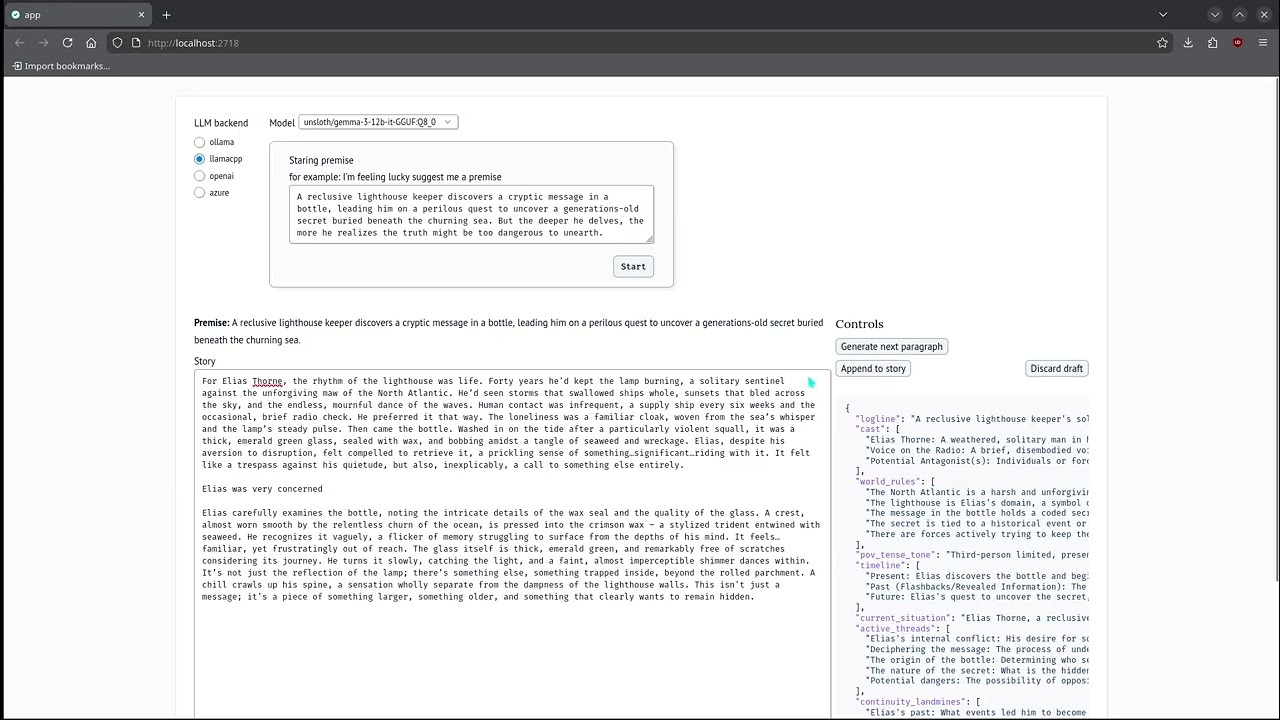
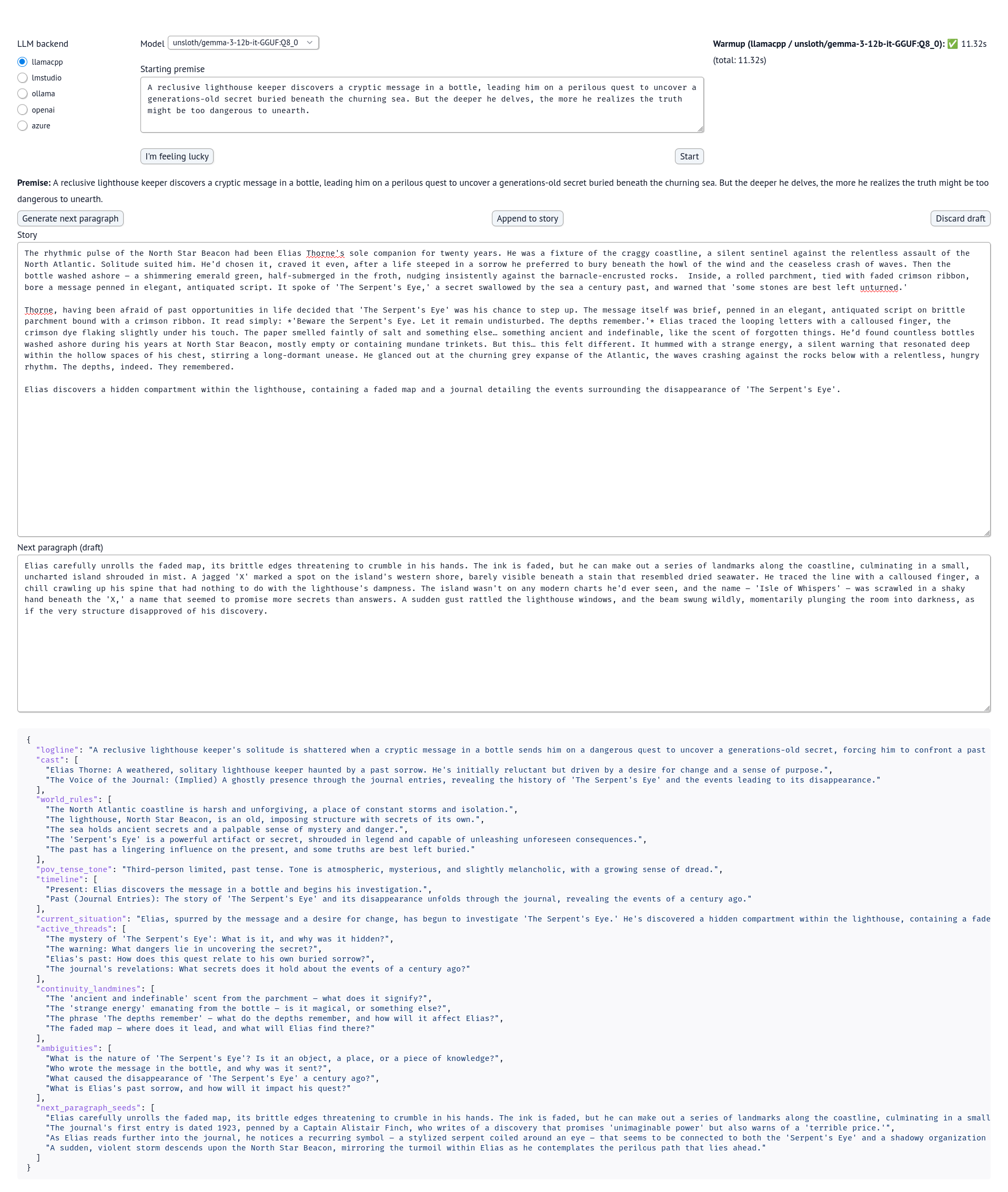
looks interesting, I had some time during the holidays and used it as a excuse to learn marimo for the front end
[image]
I think you should use structured outputs as you won’t need to write regex to parse out the premise, opening paragraph, etc. I have a example here
from __future__ import annotations
from typing import Optional, List
from py…
I updated the readme to include some demo videos the recording has a model selector drop down menu
# ai-invasion
exploring making a local novel ai story writer

## Demos
### Feeling lucky?
[Feeling lucky vibe story writing](https://github.com/user-attachments/assets/967cce72-893d-47b9-ae3c-35c158e2c794)
### Long demos
[Interact with Gemma 3 12b](https://github.com/user-attachments/assets/ab2a7194-6592-48be-b9c8-fe2c6bbf9265)
[Interact with Ministral 14b](https://github.com/user-attachments/assets/cb2af3aa-b1d4-402b-ac10-59f2f9790b53)
# Background
I had chatgpt code up the front end and wrap up the code into structured outputs after seeing the [original thread](https://forum.level1techs.com/t/bedhedds-ai-invasion/235812) for the idea
> DougDoug makes interesting and entertaining videos, a series I like is his AI invasion Series with twitch chat.
> For reference here is [a playlist of the series](https://youtube.com/playlist?list=PLzY2D6XUB8KfzQbQBRV2KVxrRJ3kO1Bwo&si=uh6k-siNpcEZMxbi)
> To make the series possible, he uses [NovelAI](https://novelai.net). I wanted to make an app that you can run locally so that you can switch out models and not > worry about updates.
show original
After getting to experience claude/open code, vibecoding frameworks (spec kit, openspec, gsd), and git worktrees at work, I decided to update my project templates repo.
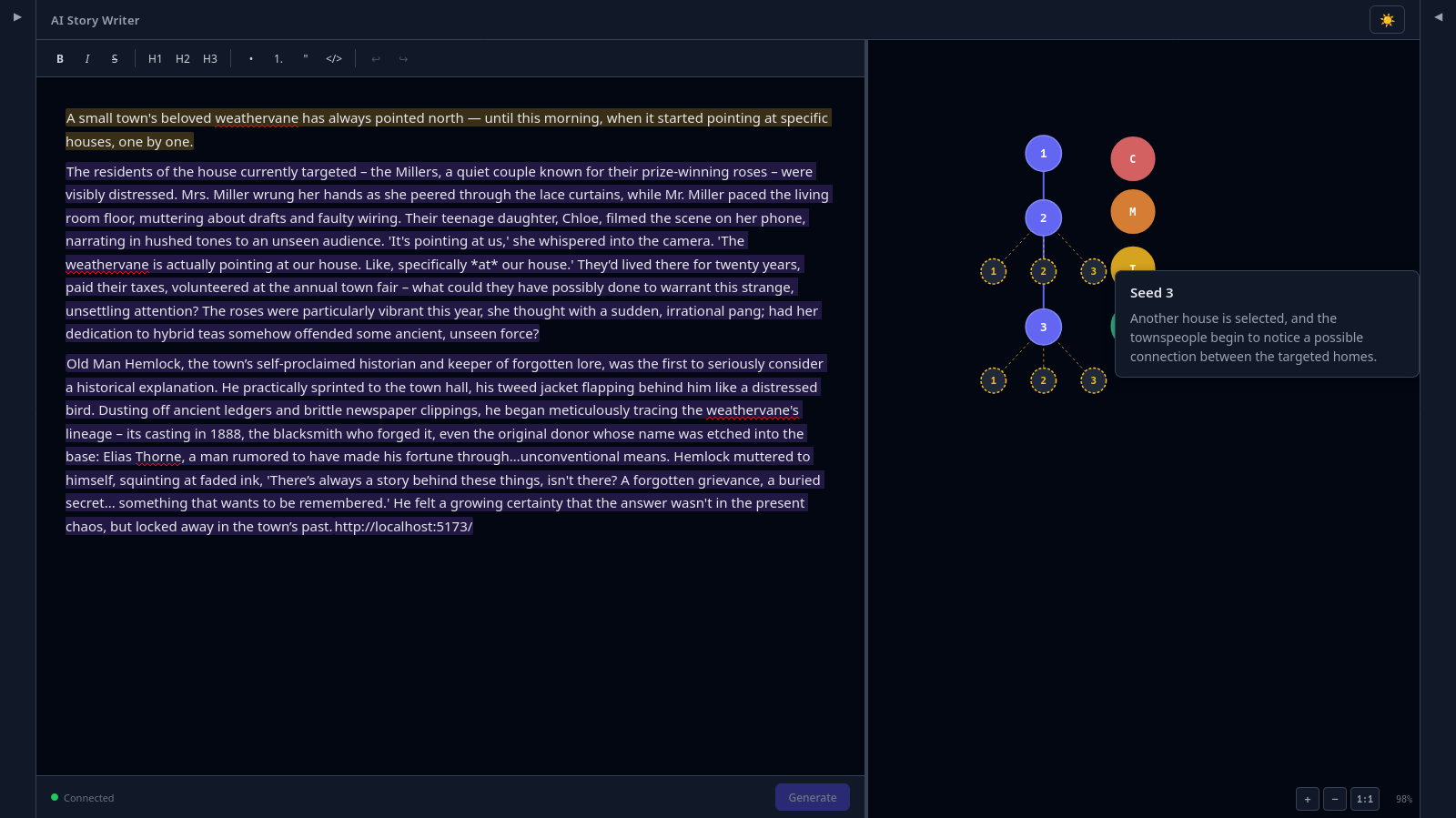
This is the current config that I used to vibecode a webapp version of the marimo mockup I made a while back
I picked Get Shit Done as my vibecoding framework
A light-weight and powerful meta-prompting, context engineering and spec-driven development system for Claude Code and OpenCode.
I found it while browsing vibecoding frameworks
BMad if you are an Engineer. GSD if you wanna prototype or get shit done!
There’s a couple of things I like about gsd over spec-kit and openspec (which is a derivation of speckit)
💫 Toolkit to help you get started with Spec-Driven Development
Spec-driven development (SDD) for AI coding assistants.
Using .planning for the folder name and better folder organization
There’s less review cycles/steps to create a plan
The chat context captures all my requirements and feedback, so I don’t have to jump back and forth between the interface and markdown files.
GSD has 3 steps plan, execute, verify. Spec kit has specify, plan, tasks, and implement this is great in theory, but has too much back and forth.
Better feedback management
if you have any feedback, gsd will create a new file for it. Although it makes the planning folder a bit cluttered, it’s nice because the llm context just needs to load a file rather than the full file
1 Like
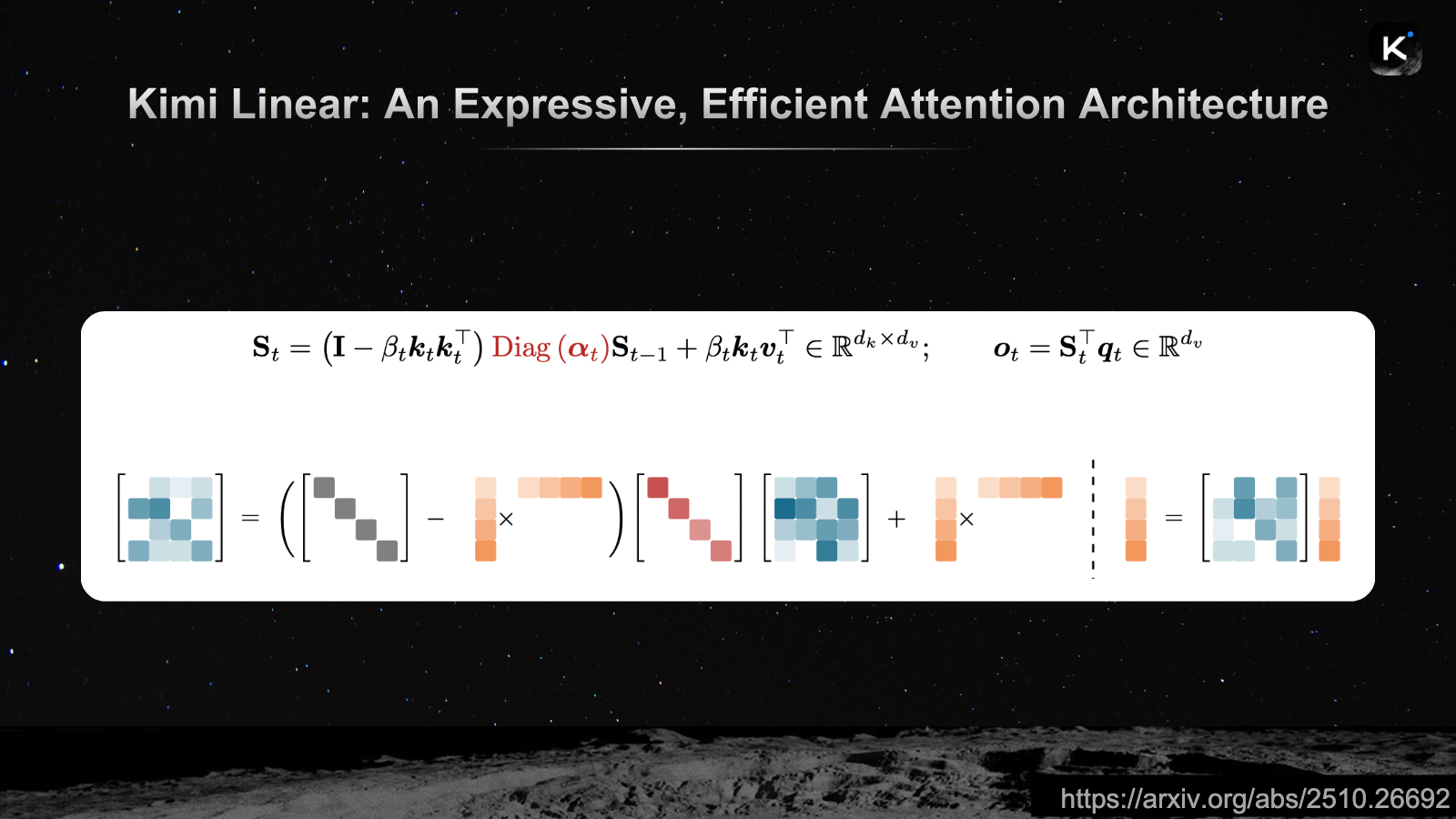
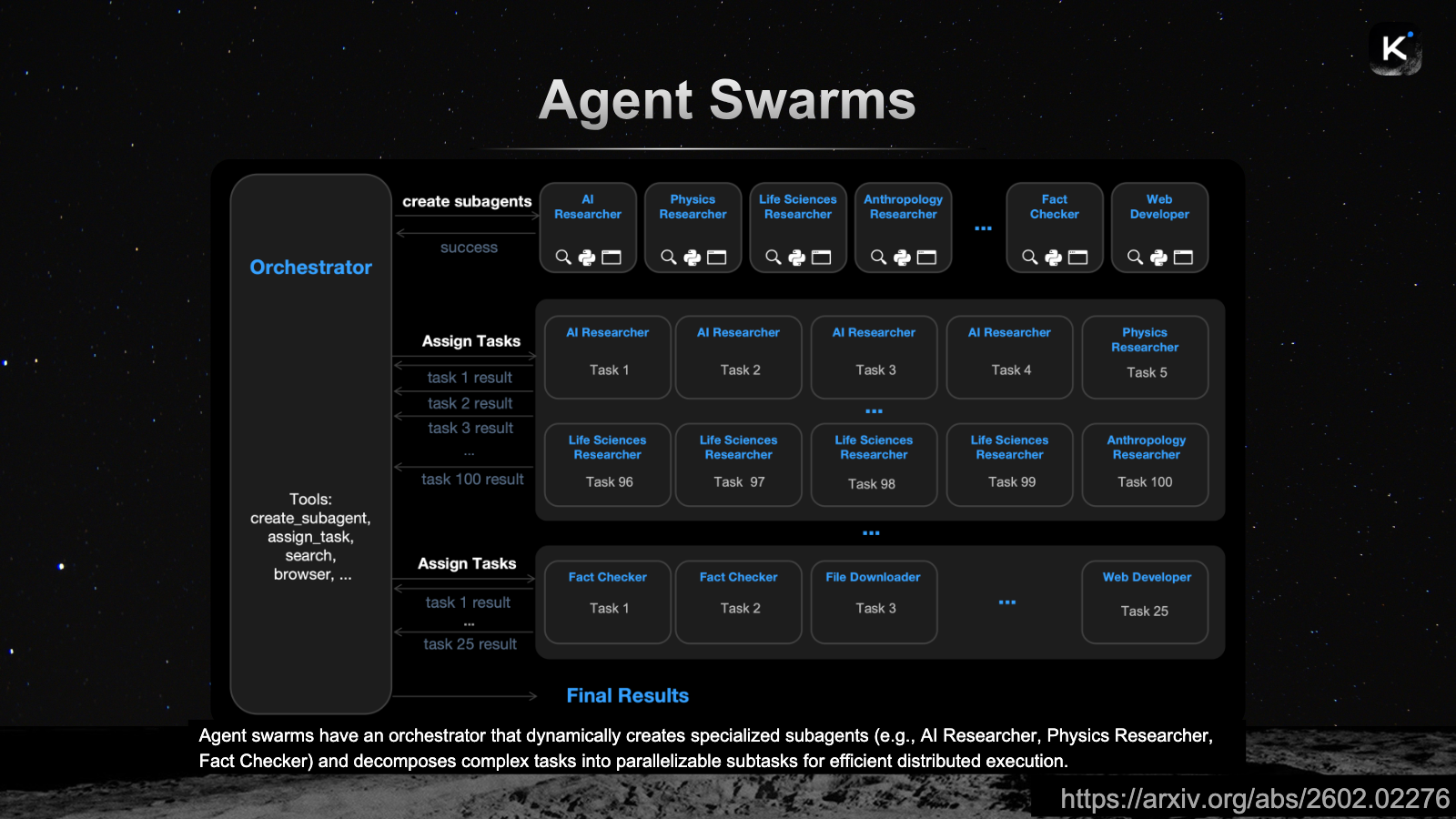
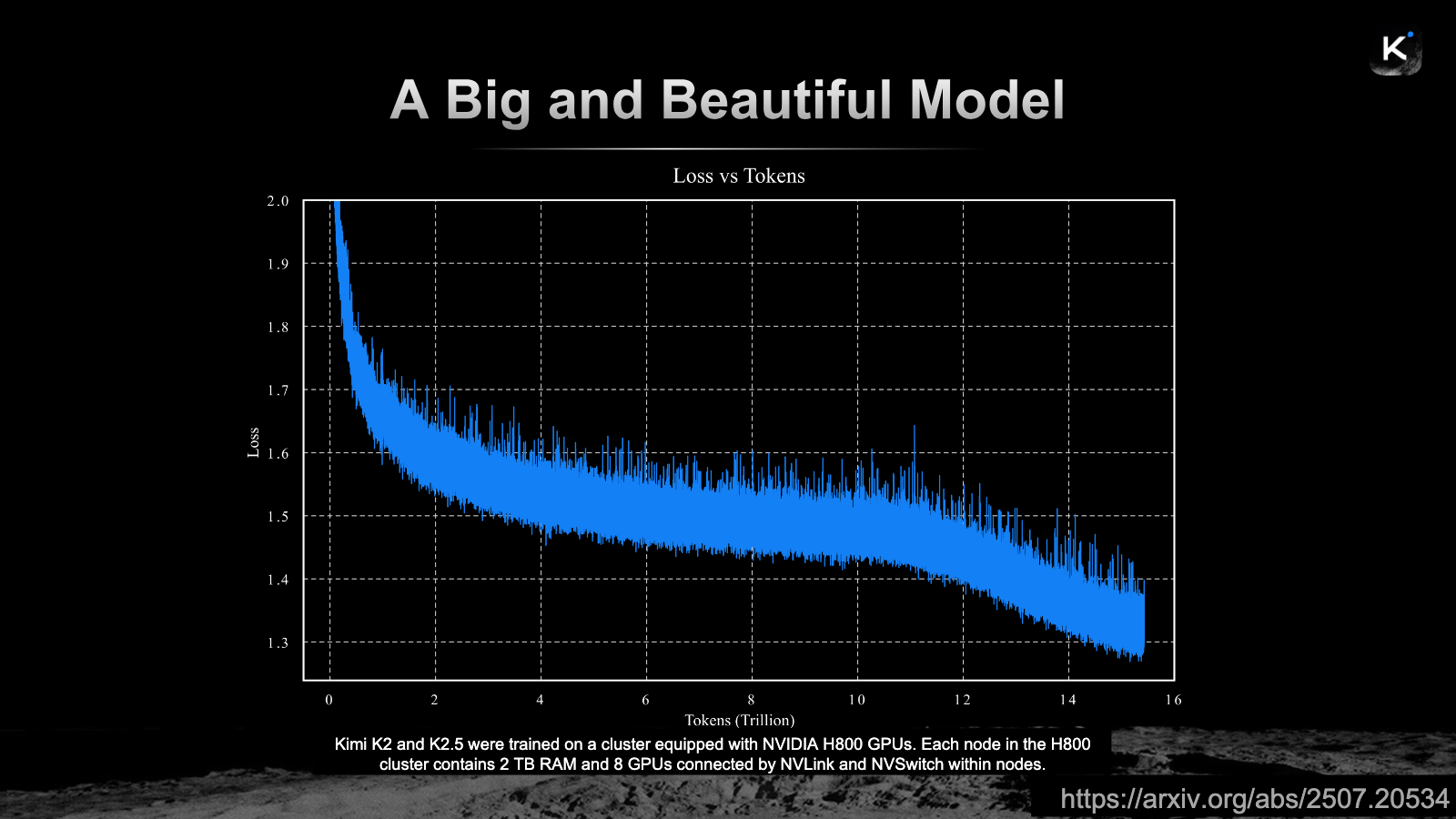
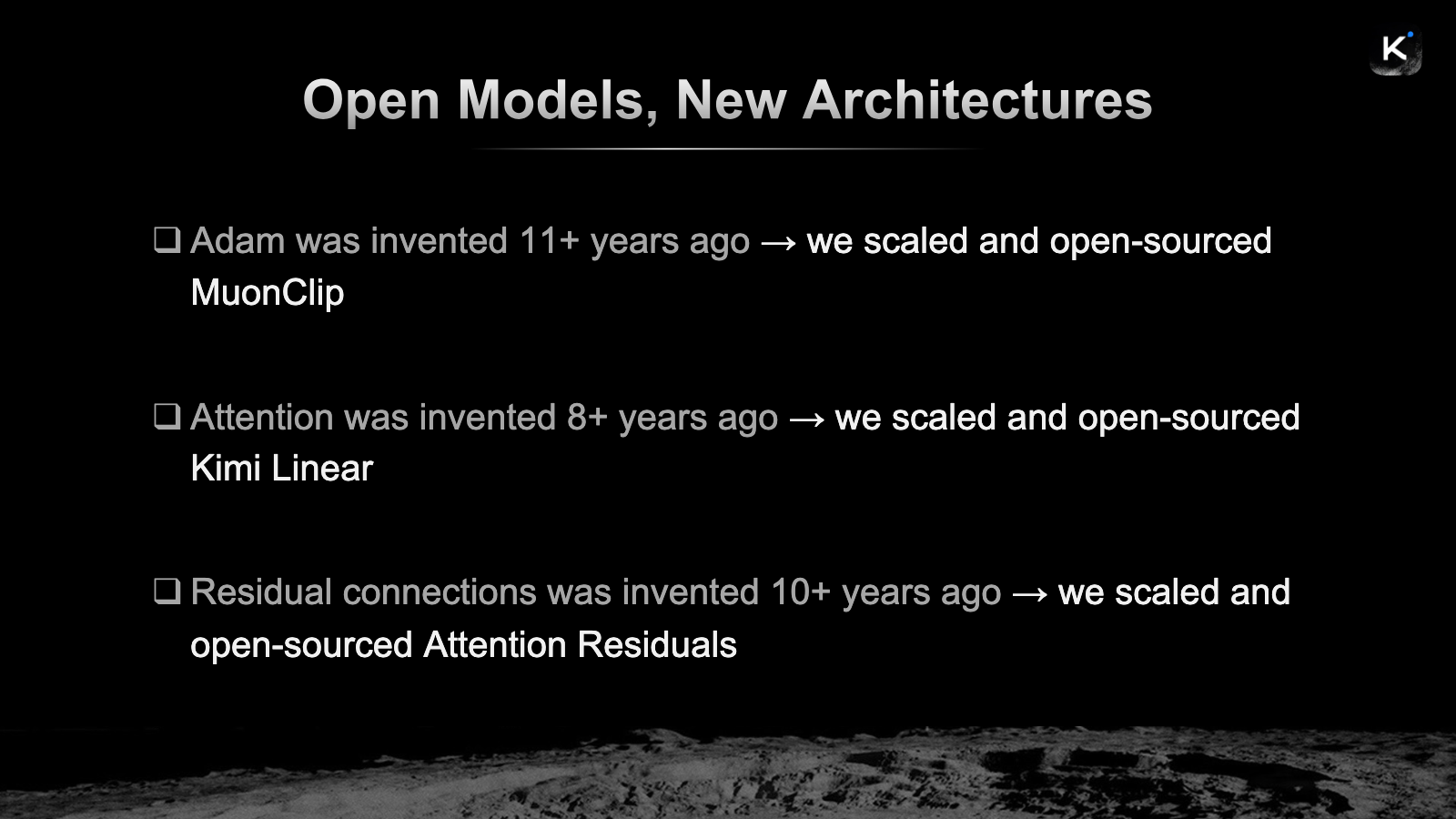
I wish I got to see the talk How We Scaled Kimi K2.5 [S81695] live and in person at GTC
The session was interesting because Zhilin Yang explained the concepts in a manner that engaged technical and non technical audiences. Furthermore, the presentation had a little of everything for everyone:
Low level Neural Net Optimizations
Training optimizations
Agentic swarms as a concept
Some screenshots I took
The slide deck too if you want to look at itS81695_1773825130217001pmt7.pdf (10.4 MB)
1 Like
I gave a talk about my experience vibecoding to a developer network at my company. I used marp for the slides
---
marp: true
html: true
style: |
  section.fill-media {
    display: grid;
    grid-template-rows: auto minmax(0, 1fr);
    gap: 0.1rem;
    height: 100%;
    padding: 28px 36px;
    overflow: hidden;
    align-content: stretch;
    }

    section.fill-media h1,
    section.fill-media h2 {
    margin: 0 0 0.15rem 0;
    text-align: left;
    justify-self: start;
    align-self: start;
show original
progressEdd:
Updates to my project template repo / vibecoding workflows
After getting to experience claude/open code, vibecoding frameworks (spec kit, openspec, gsd), and git worktrees at work, I decided to update my project templates repo.
GitHub - progressEdd/project-template at vibe-coding-gsd · GitHub
GitHub - progressEdd/LAND.E at webapp-ui · GitHub
Why Get Shit Done?
I picked Get Shit Done as my vibecoding frameworkGitHub - gsd-build/get-shit-done: A light-weight and powerful meta-prompting, context engineering and spec-driven development system for Claude Code by TÂCHES. · GitHub
I found it while browsing vibecoding frameworkslaksgandikota comments on Spec Driven Development (SDD): SpecKit, Openspec, BMAD method, or NONE!
BMad if you are an Engineer. GSD if you wanna prototype or get shit done!
There’s a couple of things I like about gsd over spec-kit and openspec (which is a derivation of speckit)GitHub - github/spec-kit: 💫 Toolkit to help you get started with Spec-Driven Development · GitHub GitHub - Fission-AI/OpenSpec: Spec-driven development (SDD) for AI coding assistants. · GitHub
Using .planning for the folder name and better folder organization
There’s less review cycles/steps to create a plan
The chat context captures all my requirements and feedback, so I don’t have to jump back and forth between the interface and markdown files.
GSD has 3 steps plan, execute, verify. Spec kit has specify, plan, tasks, and implement this is great in theory, but has too much back and forth.
Better feedback management
if you have any feedback, gsd will create a new file for it. Although it makes the planning folder a bit cluttered, it’s nice because the llm context just needs to load a file rather than the full file
Based on LAND.E the project. For most of my recent developments I switched to the pi harness and GLM 5.1 with the pro coding plan (~$60-80). The performance is as good as opus 4.5.
I recently had GLM + pi + gsd add a delete story button. Using /gsd-discuss-phase I was prompt with questions, that then helped create a context file
# Phase 04: Story Deletion - Context

**Gathered:** 2026-04-28
**Status:** Ready for planning

<domain>
## Phase Boundary

Add a delete story button on dashboard story cards with cascade cleanup. Trash icon on cards triggers a card-flip confirmation, batch mode allows selecting and deleting multiple stories at once. Backend cascade already works via foreign keys but needs orphaned canonical character cleanup. Frontend needs the UI trigger — the full state management layer (store method, API client) already exists.

</domain>

<decisions>
## Implementation Decisions

### Trash Icon Placement
- **D-01:** Trash icon top-right corner of the card, visible on hover only. `onclick` with `stopPropagation()` to prevent card open.
- **D-02:** Move the date from top-right header down to the footer, aligned with the paragraph count. Card header becomes title only — cleaner, makes room for the trash icon hover area.

### Confirmation Dialog (Card Flip)
show original
The context file got used for generate a ui spec (gsd-ui-phase) and plan with /gsd-plan-phase
---
wave: 1
depends_on: []
files_modified:
  - 02-worktrees/webapp-ui/backend/app/routers/stories.py
  - 02-worktrees/webapp-ui/frontend/src/lib/api/rest.ts
  - 02-worktrees/webapp-ui/frontend/src/lib/components/StoryCard.svelte
  - 02-worktrees/webapp-ui/frontend/src/lib/components/Dashboard.svelte
autonomous: true
requirements_addressed:
  - DELE-01
  - DELE-02
---

# Plan 04-01: Story Deletion with Card Flip UI & Batch Mode

**Objective:** Add delete story capability to the dashboard with card-flip confirmation, batch delete mode, inline edit on card back, and backend orphan cleanup.

## Summary
show original
There’s more in the 04-story-deletion folder
If you want to see the app code the branch is here
I use worktrees, so if you want to inspect the code + plans, clone from the master branch then add the webapp branch as a worktrees
This is nice, need to bookmark this for when I switch from cloud coding plans
After using my 55W 16gb VRAM GPU in the laptop for 7 months, I can tell you that while it is quite easy to get smaller parameter models running (2B, 4B, even decent 8B), you have to focus on larger Q5-Q8 quants as the quality really takes a hit - especially with toolcalls. As a matter of fact, with only 12GB, I’d say to not plan on any agentic mu…
We are getting closer a small model that matches frontier performance. GLM 5.2 Q4 on ~512GB of VRAM
Now for hardware to get cheaper or for newer models that match this performance!
1 Like
We should have a t-shirt don’t outlaw math
I’ve been using pi for my harness, GLM 5.2 on the GLM coding plan for model and endpoint and get-shit-done for my prompting framework. For my development environment, I’ve been using vscodium to browse/edit files with pi in the terminal
I got influenced to try pi out from this talk
Prior to that I was using opencode with the Alibaba cloud coding plan, but when I couldn’t resubscribe I decided to switch to GLM because I used 4.7 more on the Alibaba plan than kimi and mini maz
Use GLM models like GLM-5.2 & GLM-5-Turbo for AI coding in Claude Code, Kilo Code, Cline, OpenCode, Clawdbot/OpenClaw and more. Plans from 18/month—fast, reliable code generation and tool use for daily dev work.
I went with the pro (middle) plan because it was the same price at the time of my Alibaba cloud coding plan $20. I recently helped out my friend and we found that the lite tier was good enough and didn’t hit the quota.
For the prompting framework, I found gsd to follow my preferences. I want to discuss what I want to build and get some suggestions for how it can be accomplished
Git. Ship. Done - Core
I used my setup recently to implement story deletion + llm endpoint connection management
I gave a talk about my experience vibecoding to a developer network at my company. I used marp for the slides
Based on LAND.E the project. For most of my recent developments I switched to the pi harness and GLM 5.1 with the pro coding plan (~$60-80). The performance is as good as opus 4.5.
I recently had GLM + pi + gsd add a delete story button…
Update, GLM altered the deal, if you sign up now, the coding plan isn’t as good anymore especially If you are a heavy consumer of tokens. I am unhappy by this decision and do not plan on upgrading. I will continue to hold my Legacy V2 plan because they more open in publishing their weights and training techniques than Anthropic.
At this point, I’m saving up and waiting until hardware is cheap enough to run Deepseek V4 Flash locally like sentdex
Also until hardware gets cheaper, I think I’ll try to build out the datasets based on my pi sessions for my own data flywheel like wendell
If my plan does expire, I will probably follow the guidance from the opencode reddit which recommends open code go + minimax
I ended the OC GO limits in 2 full 5 hours sessions of GLM5.1+Qwen3.6Plus usage to implement one complex task. Speed was pretty good. If you go mainly for Qwen3.6 Plus and MiniMax M2.7, you’d have much more usage. Use the GLM5.1 as planner and reviewer only. Consider buy MiniMax Coding Plan + OC Go and use M2.7 as a workhorse, then you’d never hit the limits and M2.7 is fast even on 10$ plan.