Power-controlled power outlet?

I have a disk shelf that I would like to only power on when a certain server is running.

I am looking for the exact same function as an APC UPS’s “master enabled” outlets where power draw over X watts on outlet A (server) triggers outlet B (disk shelf) to switch on

… the problem is, I don’t want this server or these disks on battery backup, they are power hungry, might overload the UPS immediately, and even if it worked I want to save my battery’s runtime for essentials like my router. My APC UPS is set up so the Master outlet (and I think the switched outlets too?) use the battery backup.

I know “smart plugs” are one way to manage equipment power but not as elegant or foolproof as an outlet that always, and only, turns on the disks when the server is on.

Does anybody have a cheaper or more elegant solution than a second APC for the server so I can use this feature without draining the battery running my router?

1 Like

sorry for long post

One of the possible options could be smart plug from Shelly. For example:

Both Wi-Fi Shelly devices can be used locally (without internet connection) and they have an API - see documentation:


As for using UPS for such low-power devices like routers, Raspberry Pi, … I personally don’t like it, it’s very ineffective.
Why? Such devices work on DC voltage (e.g. 12V).

Standard UPS has 12V battery (DC) and DC to AC converter to produce ~230V AC and mentioned devices need conversion back to DC (AC to DC adapter to 12V or 5V). There are a lot of losses and unnecessary conversions.

                  ┌───────────────────────────────┐
                  │             UPS               │                                    12V/5V DC
┌─────────┐       │                               ├──────┐       ┌─────────┐           small devices:
│         │       │                               │ AC   │       │  AC/DC  │
│AC ~230V ├──────►│    ┌──────────────────────┐   │~230V ├──────►│ adapter ├───┐
│         │       │    │    AC/DC, DC/AC,     │   ├──────┘       └─────────┘   │
└─────────┘       │    │                      │   │                            │ 12V
                  │    │charging circuits,... │   │                            └───────► Router
                  │    └────────▲──┬──────────┘   ├──────┐       ┌─────────┐
                  │             │  │              │ AC   │       │  AC/DC  │     12V
                  │             │  │              │~230V ├──────►│ adapter ├───────────► Switch
                  │             │  │              ├──────┘       └─────────┘
                  │   ┌─────────┴──▼────────┐     │                              5V
                  │   │                     │     │                            ┌───────► Raspberry Pi
                  │   │                     │     ├──────┐       ┌─────────┐   │
                  │   │      12V battery    │     │ AC   │       │  AC/DC  │   │
                  │   │                     │     │~230V ├──────►│ adapter ├───┘
                  │   └─────────────────────┘     ├──────┘       └─────────┘
                  │                               │
                  └───────────────────────────────┘

but there are DC only UPS devices:

                  ┌──────────────────┐
                  │      DC UPS      │                           12V/5V DC
┌─────────┐       │ (MeanWell        │                           small devices:
│         │       │   DRC-100A or    │
│AC ~230V ├──────►│   AD-155A or     ├────────────────────┐
│         │       │   PSC-100A)      │                    │
└─────────┘       │                  ├─────────────┐      │12V
                  └───────┬─▲────────┘             │      ├──────► Router
                          │ │                      │      │
                          │ │                      │      │12V
                          │ │                      │      └──────► Switch
                          │ │                 ┌────┴────┐
                  ┌───────▼─┴───────────┐     │ DC/DC   │  5V
                  │                     │     │converter├────────► Raspberry Pi
                  │                     │     └─────────┘
                  │      12V battery    │
                  │                     │
                  └─────────────────────┘

I personally plan to throw some power adapters (AC/DC converters with 5V and 12V output) and replace it with one strong 12V power supply with DC UPS.

  • I consider MeanWell DRC-100A
  • but also I’m tempted to use solar controller instead (because it has an API)

If you need monitoring capabilities and data about battery levels, charging,… you can change DC UPS (MeanWell) to some solar controller (like Victron SmartSolar or EPever, but that’s a bit pricier, however, they do provide an API so you can get data and graphs from them).).
And solar controllers have usually higher efficiency.

**Power Supply Redundancy**

BTW there is also Power Supply Redundancy
It’s useful for powering critical devices.
It’s like RAID.
When one power supply dies, you have second power supply connected to ~25 Eur device called DRDN-20-12 called Redundancy Module

   ┌─────────┐    ┌─────────┐
   │         │    │         │
   │  AC/DC  │    │  AC/DC  │
   │         │    │         │
   │ power   │    │ power   │
   │  supply │    │  supply │
   │    #1   │    │    #2   │
   └────┬────┘    └────┬────┘
        │              │
        │12V           │12V
        └─────┐  ┌─────┘
              │  │
        ┌─────▼──▼─────┐
        │   Redundant  │
        │     unit     │
        │              │
        │ (DRDN-20-12) │
        └──────┬───────┘
               │
               │12V
               ▼
 ┌──────────12V_devices────────────┐
 │                                 │
 │                                 │
 │   Router, switch, ...           │
 │                                 │
 │   12V -> 5V ---> Raspberry Pi   │
 └─────────────────────────────────┘
3 Likes

I started with Shelly devices and they work great as long as there is a reliable, good wifi connection. If not, they do funky things to regain connectivity - at least in my environment. I still use a bunch of Shelly devices (the wifi kind), but removed them from my servers.

Instead, I added a switched PDU to my rack (in my case the cheapest option from Cyberpower), which allows me switching outlets remotely via SNMP. 100% reliable, scriptable, monitored. Total overkill, but I love it!

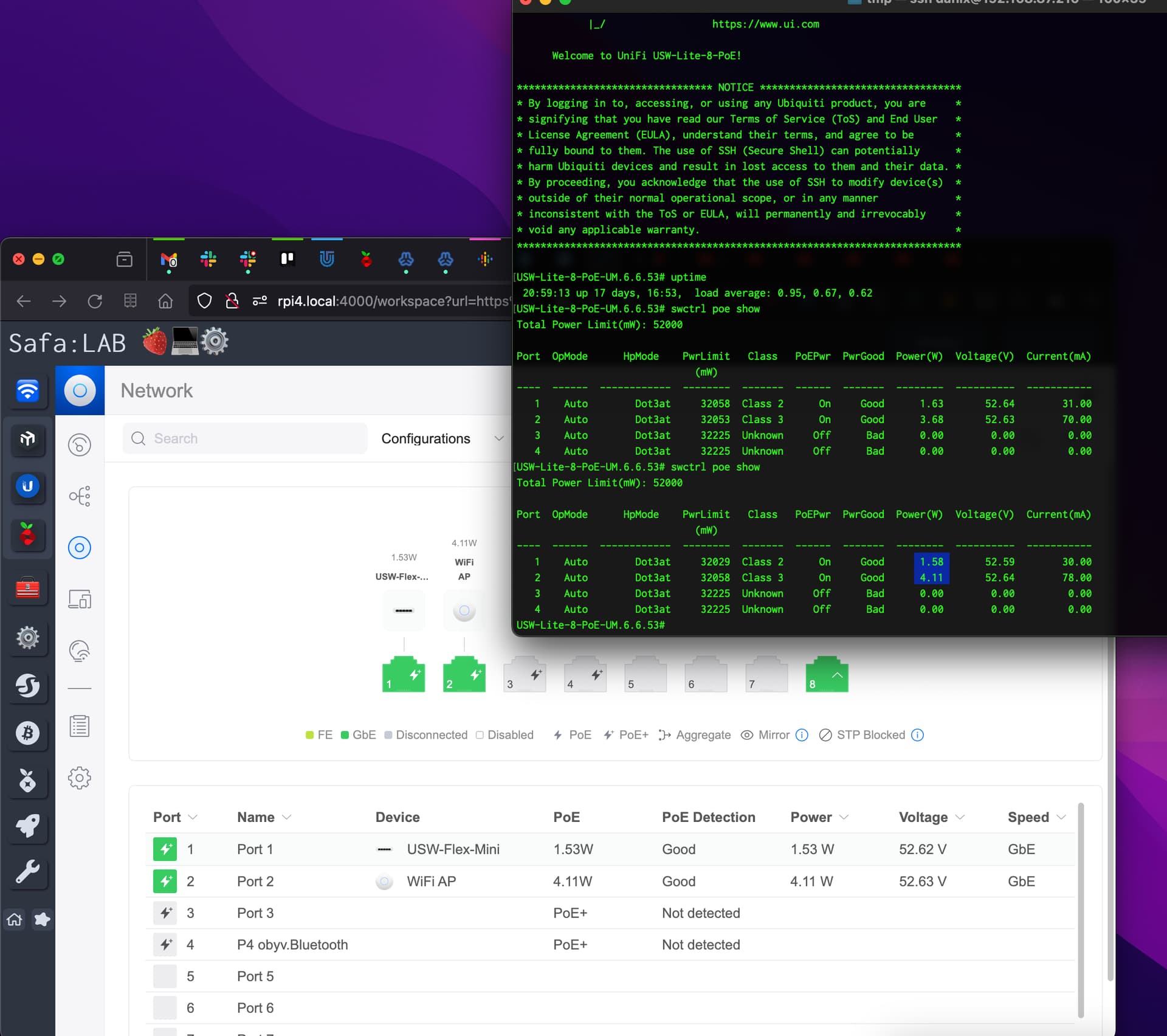
I power the low-power devices via POE from my enterprise switch. I “hope” this is more efficient (not tested), but at least I gain detailed visibility into power utilization of each device.

Example
 Port	Admin 	Oper    ---Power(mWatts)---  PD Type  PD Class  Pri  Fault/
     	State 	State   Consumed  Allocated                          Error
--------------------------------------------------------------------------
  1/1/1	Off	Off            0          0  n/a      n/a         3  n/a
  1/1/2	Off	Off            0          0  n/a      n/a         3  n/a
  1/1/3	Off	Off            0          0  n/a      n/a         3  n/a
  1/1/4	Off	Off            0          0  n/a      n/a         3  n/a
  1/1/5	On 	On          2000       4500  802.3at  Class 4     3  n/a
  1/1/6	On 	On          3900       8000  802.3at  Class 4     3  n/a
  1/1/7	Off	Off            0          0  n/a      n/a         3  n/a
  1/1/8	Off	Off            0          0  n/a      n/a         3  n/a
  1/1/9	Off	Off            0          0  n/a      n/a         3  n/a
 1/1/10	Off	Off            0          0  n/a      n/a         3  n/a
 1/1/11	Off	Off            0          0  n/a      n/a         3  n/a
 1/1/12	Off	Off            0          0  n/a      n/a         3  n/a
 1/1/13	Off	Off            0          0  n/a      n/a         3  n/a
 1/1/14	Off	Off            0          0  n/a      n/a         3  n/a
 1/1/15	Off	Off            0          0  n/a      n/a         3  n/a
 1/1/16	Off	Off            0          0  n/a      n/a         3  n/a
 1/1/17	Off	Off            0          0  n/a      n/a         3  n/a
 1/1/18	On 	On          2200       4500  802.3at  Class 4     3  n/a
 1/1/19	On 	On          4700       8000  802.3af  Class 3     3  n/a
 1/1/20	On 	On          7400      20000  802.3at  Class 4     3  n/a
 1/1/21	Off	Off            0          0  n/a      n/a         3  n/a
 1/1/22	Off	Off            0          0  n/a      n/a         3  n/a
 1/1/23	Off	Off            0          0  n/a      n/a         3  n/a
 1/1/24	Off	Off            0          0  n/a      n/a         3  n/a
--------------------------------------------------------------------------
 Total	      	           20200      45000

On this side of the ocean (europe):

On the US side:

1 Like

aah, thanks @jode

I can use some of my free PoE ports from my switch

  • but still, I will need some PoE DC/DC convertors

BTW this is very good long read about electricity, especially section about DC usage in home How to Get Your Apartment Off the Grid | LOW←TECH MAGAZINE

1 Like

They’re called power-saving or auto-switching surge protectors or power strips.

Thanks all! I think those energy saving power strips will do what I need perfectly. I know there are networked options and it sounds like the Shellys are good for the price, but the work of automating the on/off or potentially messing it up so disks are missing when they’re needed or burning power when not needed, seems like a hassle. For this particular use the relay for the disk shelf should work fine.

This is a really good idea for 12v items. I’ve also wondered if most 12v items like a router would tolerate enough voltage variation to run directly off the 12v outlets in a vehicle, and STH recently reviewed a 12v mini PC instead of the normal 19v. Sadly my “router” is a 120v computer and my wifi access point runs on 48v POE so skipping the voltage conversion isn’t that practical in my house.

I’d look into arduino or rpi controlled relays. There’s also non-smart radio or IR remote controlled wall plugs that you can also adapt to be controlled by the arduino or rpi GPIO (if the relay cannot be used for AC). All you’ll need is to have a script that SSH’es into that on power-on and turn on your diskshelf on.

The problem is, this assumes the diskshelf can be powered on when the OS is already booted up (like if the shelf was self-contained and not a JBOD box). AFAIK, some will not play ball if they aren’t both powered on at the same time. Meaning that, in order to power on the server, you’ll likely need to use something like the same Pi with GPIO relays and turn on the server via WoL (or just have the power button on a relay too) and the diskshelf via the GPIO.

Jank, but should be cheap and not have to integrate it with other stuff (in case you don’t have a homeassistant server and you haven’t invested in zigbee stuff yet).

Completely off-topic rant (and the reason I'm replying to xnd, lmao)

This thread is gold and that lowtechmagazine is awesome! Glad I just discovered it.

I’m planning on going off-grid myself at some point. I have almost all my devices on DC and have external bricks. The article on that site was from 2016! Things have evolved a lot in the last 7 (almost 8) years.

You can get cheap(-ish) portable batteries like the bluetti eb3a (which I got for my cousin) and eb70s (which I have), which can be solar powered and give you 12v 10A ports, 100W USB-PD and has an AC inverter (the only problem is that they only take 200W max solar input and having 2 of them on 2 systems would be a bit expensive to swallow, but having just one and another cheaper option, like a jackery explorer 100 or anker 737 / powercore 24k for less demanding things, like lights and phones, or even a DIY distribution and a cheap lead acid battery instead).

I’m still debating how well a solar only system would perform (but in apartments, that’s the only way, unless you add things like pedal generators). Other good energy storage, if you have a safe place to use it, is hydrogen gas in tanks, that can be done with hydrolysis during peak sunny days and burnt when demand is high in a classical gas or methane generator - AND you also get heat during winter, win-win!).

But when I’m going to be in my own place (if ever), my monitor, a lamp, some of my SBCs, my L1 KVM, my speakers, all take 12V, then my PC and NAS take 19-21V (which can be delivered via USB-PD with an adapter) and many of my lights are USB or 2x / 3x AAA battery powered or 4x / 6x AA (I got NiMH rechargeable batteries, but can make some of them work directly on 5V or 9V USB if needed). The rest of my lab can be adapted from USB-PD to their requirements (like 9V and 15V, although they aren’t many).

I even have a manual washing machine (which TBH haven’t used in a while, my last place didn’t have a washing machine, which is why I bought it, but my current place has)! Can’t wash my large jackets or my blanket, but everything else (including bed sheets, one at a time) works. And a bathtub and dedicated plunger could do to wash these.

I have my big PC, which would be tough to power without using my bluetti’s inverter and I also have a mini-fridge (the 12v fridges were more expensive and didn’t have standing options, you can fit a lot more in a fridge with shelves than in a fridge with a top door). I was thinking of building a new PC and using 2x DC-DC adapters (like picoPSUs) to power the CPU and motherboard and have my GPU split from the main PSU. But the question would be how to power everything at once with just one button and how can I provide 12V 10A to each PSU (to get at least 240W). But that’s a story for another time.

Other than that, the only solely AC appliances I have is my AC. If I play my cards right, I could get a dedicated solar installation for it during summer, with an inverter and no battery power. As far as cooking goes, I like gas grills and gas stoves, but I’d look into solar cooking more (I already know there are solar kettles that take like 3 or 4 hours to get water to boil and they keep the water warm for many hours, I could use these for my morning coffee and subsequent routine teas). I lived without a microwave a few years, it wasn’t fun, but not the worst thing in the world, could get reaccustomed.

I was thinking of something similar to the window sills solar panels, but instead above-window adjustable solar panel installations (that would also function as a kind of external curtain at night and provide some rain protection to allow me to keep the window open during warn rainy days). And being adjustable, I could set their angle during winter for better efficiency. And if the height allows it, I could also do another one under my window (as long as it doesn’t interfere with the window bellow). The only problem here is that I live in a room having windows to the south and west, with the one in the south being shaded by a long hallway (so realistically I could only get less than 3 hours of sun during summer time - AND I have a tree right at the corner between the two windows, making my room the most shaded in the house).
1 Like

Probably I will experiment (in next weeks) with custom DC UPS using solar panels, solar charger, battery and redundancy module.
I will start with simple 12V DC system and I will decide later whether to buy another battery and upgrade to 24V DC system.

//update: shunt, fuses and other safety-related things are not placed in the diagram to preserve simplicity

Here is also the diagram:

1 Like

IMO 24v doesn’t make any sense. Most electronics come in 12v, with very few supporting 12v and 24v. The amount of money you would’ve spent on thicker (lower gauge) cables, is offset by the fact that you need to buy step-down converters close to your electronics.

48v is cool, has the same limitations as 24v (and is even worse just by the mere fact that there’s barely any electronics that work at 48v, aside from low-powered PoE stuff), but it gives you so much power that you can easily run a full AC inverter with a 48v system (for a 3500W appliance, you’re only going to do ~72A @ 48v, whilst with 24v and 12v you’d need ~150 and ~300A respectively, which I don’t think is doable with anything other than solid bars - IIRC the maximum you can go with 12v is around 1500W and that assumes you’ve got very thick cables and very short runs).

I’m planning my own solar setup, but I’ll probably end up with a split-system (maybe even 3 systems, 2x 12v and 1x48v, maaaybe). I’d need a low 12v system for my computers, a 48v for power hogs (AC-powered computers, water heaters, induction stove-tops, electric kettle etc.) and another system (likely just 12v) for my essentials (fridges, freezer and lights).

Cable runs will be very limited, as to avoid voltage drops (and save a buck on the length of thick cables). Thankfully I only need 1x solar setup, but just for safety, I’ll be doing 2 solar setups (1 strictly for the essentials, doesn’t need to be large and another for the power-hogs, the latter of which can power any other systems).

Yup

Around here, most industrial control equipment is 48V, you pay “industrial grade” premiums on products though.

1 Like

Yep, but by that point, unless you’re into very high-efficiency, you’d just be going 48V to AC and oversize on solar.

I will start with simple 12V system (with 1 battery) and then later, I will see and decide. Maybe 12V system will be enough for me. I know, higher voltage, less amps and voltage drops.

BTW I have several 24V industrial devices:

  • PLC (unipi.technology) needs 24V DC.
  • some DIN relays working on 24V DC (5—24V)
  • also my router (MikroTik) accepts wide range 8—30V

my unifi devices accepts on input 50—57V DC for USW-Lite-8-PoE and 44—57V (or 48V as passive PoE) for U6-Lite

//update:
… ah, I forgot that also

  • Shelly Plus Uni which I’m using for some monitoring works with 24V DC (9—28V)

I think you’ll find most Laptops run on 20V. Car power adapters can quite often handle 12-24V input. With USB type-C PD adapters you can get 5, 9, 12 or 20V out.

In a 12V system, you’ll be feeding everything 14V while your batteries are charging, and 28V on a 24V system, so adapters / voltage regulators are a good idea for any particularly valuable equipment.

Almost my whole homelab is using USB PD cigarette “bricks” (barrels?). They output 5, 9, 12-15 and 20V. Got type-c to 5.5x2.1mm barrel jacks that can handshake a voltage (12, 15 or 20) for different devices.

My bricks support 12 and 24v input. But I was thinking more like fridges, DC aircon units, vacuums etc., most of them require 12v and very few come in 24v.

This was an old thread, I don’t remember the OP. I was more concerned with the 24v setup someone else mentioned. If you’re doing an off-grid setup, you either go 12v and save a buck on the step-down converters, or go full 48v to AC inverter.

Don’t get me wrong, there are reasons to go 24v, particularly if you have long cable runs (to avoid voltage drops). 48v will handle that better, AC will not even drop voltage. If you’re not powering server power-hogs or full-fledged kitchen and bathroom appliances, then you might want to stick to 24v and step-down converters if you have long runs. But you’d be paying a premium for RV appliances.

If you’re designing an off-grid setup, try to make a central hub, with most things close together (save a buck on thick cables and don’t drop a lot of voltage, thanks to short runs), separated by walls (drywall or fire-proof insulation) if necessary (like if you have a hot water heater or an induction stove-top, you’ll want to keep the kitchen where water lines run or all kinds of greasy vapors fly around, separated from your expensive electronics).

Sometimes that’s not feasible, so higher voltages help, but at added cost. The most common electronics will be found running at 12v. Even many AC appliances just have a 12V brick. And with the type-c revolution, this has become much more easy.

I find 24v to be a compromise between efficiency (it’s more efficient than 12v, but not as efficient as 48v), power delivery (same) and price (same again). For me, the only place 24v really shines is when you need a certain wattage, that you can’t achieve with 12v and you don’t need as much as you can achieve with 48v, like in the 2000 - 3000W range. And you can achieve these easier with 48v, but you’ll need a better step-down converter (if you need 12v) or just an appliance that takes 48v directly (hard to find).

:man_shrugging:

I know, it’s hard to choose one voltage (to rule them all). As I wrote, I will start with 12V system and most probably it will be enough for me. Actually I need only 2x step-up DC/DC converters (one to 24V and second to 48~57V).
And I will need ~15 meters cables. Probably 2x 6mm2 (AWG 10) will be enough.

I ended up getting one of the Cyberpower energy-saving powerstrips, open box on Amazon, for around $20. If you need this exact function (if server on, turn on disks) - it’s perfect. This server POSTs slowly and it would probably even work for the boot drives because the shelf powers on instantly, though it’s probably safest for storage drives that aren’t needed right away

This topic was automatically closed 273 days after the last reply. New replies are no longer allowed.