Obviously out of scope of the original topic, but in the spirit of the ever improving AI capabilities, what does the level1techs community think about the solution to the Navier Stokes millenium prize problem by openAI agents?
from
OpenAI said during a press conference that if a customer wanted to run the same problem, it would cost around $15 million. OpenAI didn’t name the AI model used, but said it was “significantly more capable” than even its latest GPT-6 Astra model.
15 MILLION DOLLARS (raising pinky like Doctor Eeevil)
I’m not a mathematician, but I’ve read some interesting things about the way that they decided to go about solving this, and there are some interesting implications. The way OpenAI decided to go about this makes a lot of sense given the construction of LLMs and the things that they are good at and things that they’re bad at. What they decided to do is look for a specific condition that would cause the blowup. And in pursuing this, they actually took advantage of a special case of the Navier-Stokes equations. OpenAI’s solution only works in the presence of an external force. It’s actually undecided, still, whether or not the equations will blow up without this external force present, and several other mathematicians have sort of piled on with this idea to essentially prove that it’s not provable in that case given only the proof that OpenAI produced.
I wish I had sources to cite for this. There was one memorable quote, though, which is that the writers of the Millennium Problem will probably regret leaving the option of this special case present, because this effectively means that the real problem isn’t solved, even though they might be on the hook to recognize the solution.
1 Like

The whole idea of the millennium prize problems hasn’t really worked out at least so far. One solved by a recluse who declined the prize and one solved by an AI. Not exactly the kind of galvanizing force for human creativity and innovation I bet they were hoping for, but I guess it’s not really unexpected either. Problems like these tend to weed out anyone who isn’t also equally eccentric.
My understanding is that the proof looks legit it’s just so unrealistic as to be completely a pure math thing, and people doing real fluid dynamics with navier stokes probably already know that water doesn’t behave this way in reality.
Yeah i know some people that can be called math nerds, they are eccentric and see more incentive in the challenge to solve stuff than in monetary rewards.
They are not so eccentric to just turn down the money, but its more of a bonus thing than a motivator to choose what math they work on as a hobby
There are several videos and form posts claiming OpenAI stole the prompts of the two known Mathematicians working in this space who were using both Anthropic and OpenAI models to assist in their research.

Others, like Primeagen in the video above, think OpenAI just saw people working on these millennium prize problems and just turn the majority of their unused compute towards them.
(although he’s more charitable, I wouldn’t put it past Altman or Dario to straight up inspect and steal their prompt/generation data as a head start, but who knows at this point).
3Blue1Brown has an interesting example of a very difficult competitive math problem that LLMs apparently could not solve
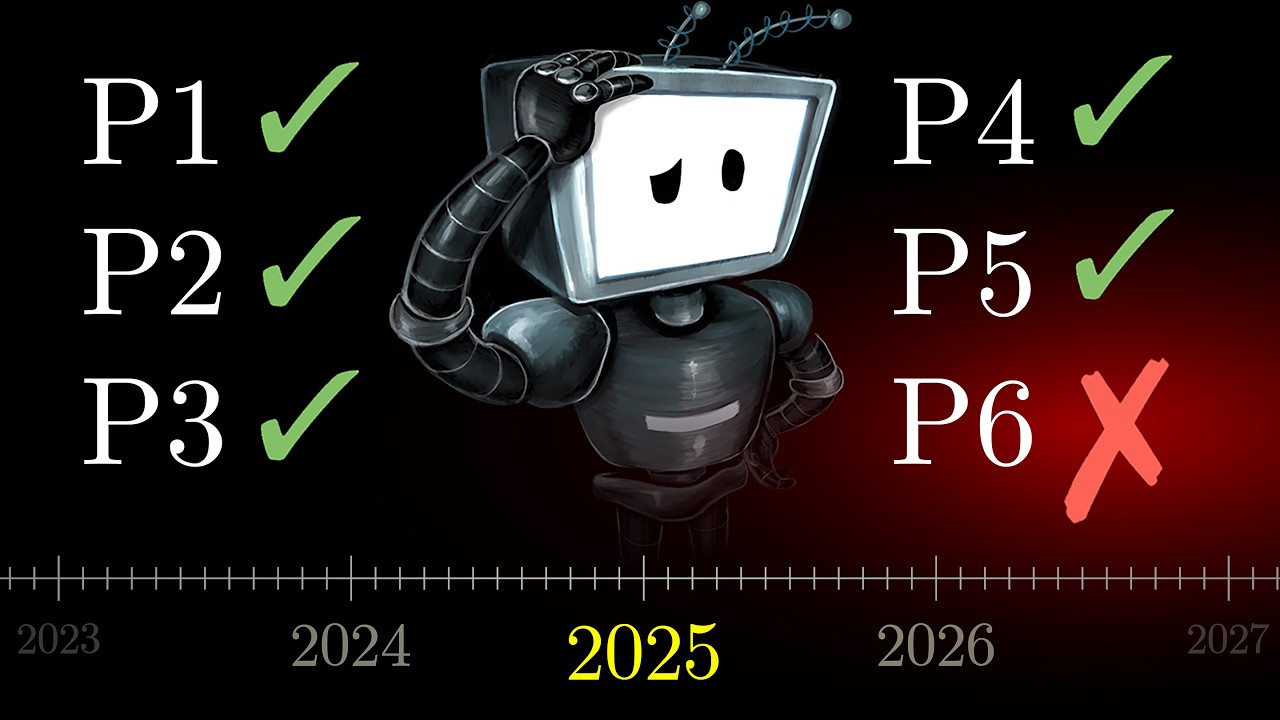
If that theory is correct, and openai’s statements are also true, they have at least enough unused compute to throw an equivalent of 15 million dollars of tokens at the problem for marketing purposes.
How much mileage does a company get out of 15 millions of dollars worth of tokens with todays rates?
Is that a lot or a little of unused compute?
Another Numberphile, tangentially related, 3B1B has some more comments on AI + math:

Predict the next token models were deprecated around 2024, now RL learning is used to train models where instead of just answering questions AI models have to fullfill goals like fixing broken code, solving scientific problems using tools etc