In the Exos X20 manual, they show this current trace for 5v:
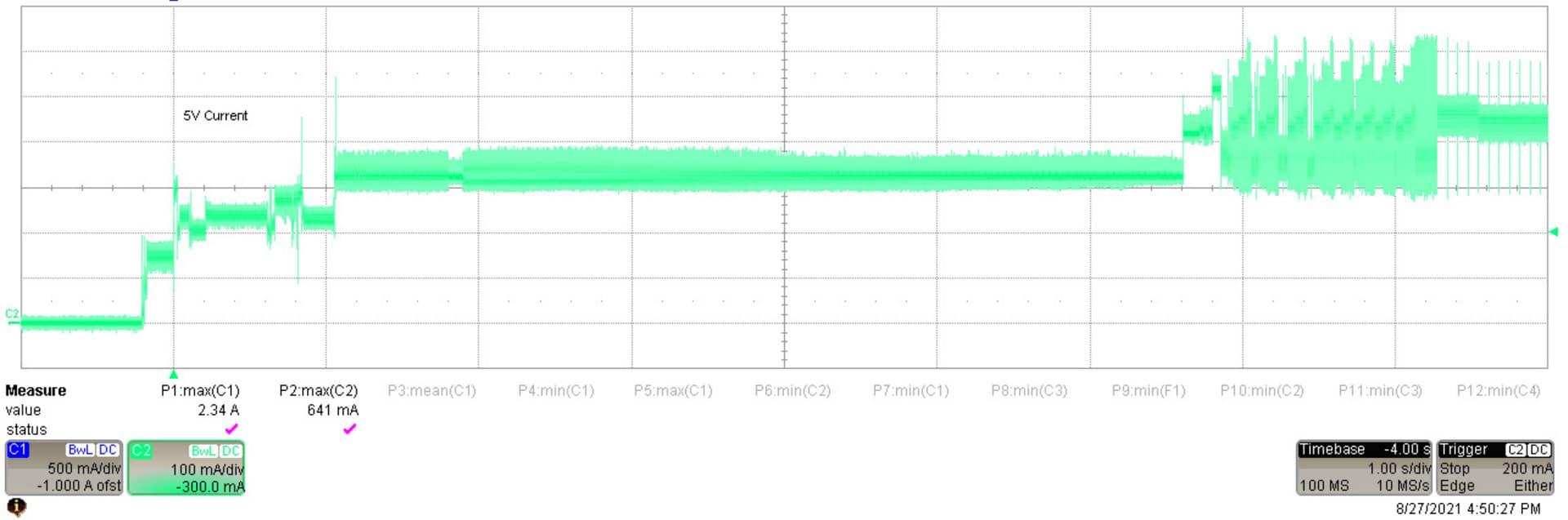
Do you mean the peak value of 1.1 A AC? As in 2^0.5×1.1? If so, I think that’s a misunderstanding of the spec.
First of all, we have the scope trace which shows “typical” startup 5 V current draw to max out at about 650 mA.
For the Maximum Start Current values in the table with the rather cryptic captions “DC (Peak DC)” and “AC (Peak DC)” my guess is they’ve used some lab-grade DMM and done both DC- and AC-coupled measurements. And then they’ve looked at the instrument’s “Peak” readings and entered those in the table.
Unfortunately it’s not really clear to me what those measurements mean without knowing the specs and settings of the instrument. Especially the 5 V data deviates too much from the scope trace to really make sense. Maybe they’ve used the instrument’s maximum bandwidth which could explain the much higher values here than in the scope trace – it would also make the measurement completely irrelevant except perhaps for EMI purposes.
And AC coupling doesn’t make sense to me in this context at all, for that matter. It’s used when you have a stable DC offset which you want to remove from the measurement, which isn’t the case here.
Edit: I think you’re pretty spot on here:
More to the point, I don’t think the people who wrote the spec sheet knows how to measure it. Except I have to give them credit for the scope trace, that’s quite nice actually!
1 Like
On the power conversation it is worth noting that most physical hard drives will - by far - pull their peak amount of power during power on when the spindle spins up.
This likely doesn’t last long enough to make slightly undersized wiring heat up to the point where it melts, but the spike can overwhelm a marginal PSU and cause it to shut down due to overcurrent protection.
Its often pretty wasteful, because if all drives peak at the same time, you need a much larger PSU, which then will never hit those loads during normal use. And during regular use, the lower your PSU load is compared to max specs, typically the lower your efficiency is. Most PSU’s are at their highest efficiency (percentage wise) when at or around 80-90% load.
So if you size a PSU for a system which is drive heavy to handle the peak load at drive startup, you are going to find yourself in a very low percentage utilizatiuon most of the time, which will mean you will waste more power due to PSU inefficiency.
If you have a decent blackplane, it will take care of this for you, by staggering the spin-up of the attached drives, but judging based on the fact that you are trying to figure out how to connect power cables to all of the drives, it sounds like you are not using a backplane at all.
Just to keep everyone on the same page, this is only true of the 12v rail, the 5v rail stays at a fairly consistent current draw throughout startup and really only sees a noticeable rise during sequential transfers.
Modern ATX PSUs typically reach peak efficiency between 30-50% load. The newer and more advanced PSUs have shifted the glut of the efficiency curve over to the 5-50% load area.
raid cards will happily do this aswell through PUIS which is arguable more elegant than the way backplanes attempt to implement staggered startup.
2 Likes
I found some specs here
- ST20000NM007D (data sheet)

- ST28000NM000C (data sheet)

not entirely sure though how to relate this back to the PSU capabilities
i dont disagree, but i also dont know who would do this. I heard some people online mention that Cable Mod might do this? But I have not figured out for sure
You need to look at the maximum values for each rail, sum up all drives and ensure that your PSU can supply that current on the rail in question. Unfortunately the data sheet’s specs are nonsensical and difficult to use. E.g. what does “AC (Peak DC)” even mean; what’s the difference between “Maximum DC” and “Maximum DC (peak)” etc. It’s just too badly written to be really useful. It’s like lemma writes: they provide clues and you’ll have to guess what they really mean.
1 Like
Interesting. How long has this been the case?
It’s admittedly been a few years since I did the majority of my testing. It was neither exhaustive nor particularly high tech testing, but this is kind of what I learned over time.
(yikes. It feels like yesterday, but I was testing with - at the time - new low end Haswell Celerons. That’s over a decade ago now! It’s weird how time flies.)
Either way, at the time I found that the closer I could get the average load to the rated sustained peak of most PSU’s the closer my Kill-A-Watt readings at the wall were to what the system was telling me it was pulling on the DC side.
Some of the most efficient systems I’ve built, I’ve built using 60W DC-DC PicoPSU’s with a matching 12v adapter from Mini-Box. With those things I got consumer Haswell era Celerons (with a single SATA SSD, two sticks od DDR3 RAM and using the IGP for grahics) to idle at ~5W at the wall when on the Linux desktop. I could never replicate this with bigger PSU’s.
This was important for my workloads at the time that may have had bursty power needs but spent most of their lives at or near idle.
For instance, it was fantastic for little special purpose mini-builds (like Kodi Boxes) but since that time ARM-based SBC’s have become better in this particular application, so I haven’t experimented with it in a while.
My custom OPNSense build still runs on PicoPSU’s though, but I have them rigged up with a ghetto-splitter to make them redundant. it is very nice and efficient despite the hot old Intel x520 dual port SFP+ NIC.
Good point. I forgot about that.
My LSI HBA’s do this as well.
for what its worth I have not actually had any power issues with the system. Even with 15x HDD, it boots up just fine. I have the LSI 9201-16i HBA connected to most of the drives, but I have not done any sort of configuration on it, just plugged it in and plugged the drives into it, so idk how you would go about changing its settings to try to stagger drives spin up
I also have the whole system on a Smart Plug, prior to the recent HDD updates when I had only 11x HDD the system was idle at 160W and peaking at 260W during Plex media scans. Now the past 24hrs after putting in 15x HDD its been bouncing around between 200W - 300W due to various activities on the system
2 Likes
It hasn’t been that long, the downward trend started several years ago, but has really ramped up in maybe the past 2-3 years.
I think what is driving this change (or atleast a big factor) is going from lower RDS(on) high Qg half bridges to relatively higher RDS(on) low Qg half bridges on the secondary side of the PSU along with full digital control loops (these were still analog on many PSUs even in the 2020s).
Planar transformers and switching to a LCC topology will probably drive us into the Ruby and Diamond certification range in the future.
I’ve always wanted to do a build with a PicoPSU, they look neat. I’m suprised the external power brick was that efficient.
Speaking of weird PSU form factors, I got one of those GaN PSUs from hdplex that are supposed to be super efficient but I haven’t gotten a chance to test how much so.
2 Likes
Yeah you’re probably fine with only 15 drives, since the startup spike is only on the 12v rail, and your PSU can do 62.5A on that rail it likely won’t be an issue.
It would be interesting to see how hot the circuitry for the 5v rail was getting in the PSU since it is a constant load that is close-ish to the PSU’s max output.
is there a way to determine that?
Yeah. So either you do the needed measurements, margin around the uncertainty, or live dangerously. Personally if I’m looking at US$ ~6000 drives and potential for a PSU collapse that could take out other parts of the system I’m inclined to be risk averse.
Do you want cheap or do you want reliable? Pick one. Backplane staggered start helps but doesn’t mean much if you get the correlated operating demand wrong. If you make a bet on decorrelation it’s pretty tough to guarantee there’ll never be a simultaneous workload peak during the array’s entire operating life.
To add a bit to what @homeserver78 said, if you want reliable, size the supply to handle all drives hitting the worst case at the same time the rest of the system load also peaks. The question here’s what’s the worst case. Unless you get on a campaign of doing comprehensive sets of drive measurements the least conservative figure I’d use is 1.14 A per ST20000NM007D. Standard sizing practice is to margin that for load uncertainty and then margin on the supply side. Which is how you get 1.5-2.0 A of +5 capacity per drive, net of other system loads. IMO they’re a bit conservative but reasonable arguments exist for 2.5 A.
A common assumption contraindicated by Seagate’s data. ST20000NM007D, for example, has higher +12 DC current ratings in operation than it does in spinup. If you go by the AC spinup number that’s the highest one in the table then operating +12 draw hits 80% of spinup.
400 V PFC safety practices and thermocouples or a thermal camera. HXi reports supply temperature but so far as I know it’s just a general one.
I would be cautious here. Even just at 1.1 A/drive that’s 16.5 A under all drive loads like array scrubs, leaving only 3.5 A for rest of system draw on a supply with 20 A +5 capacity. For builds I’ve put on HXi, ~5 A of non-3.5 draw on +5 is no problem without any USB loads. So if the drives get busy the supply’s pushed past redline into OCP margin, at least if you take Seagate’s numbers at face value, which is where stuff tends to blow up.
In principle, a PSU should handle running at 100% rating indefinitely. In practice, cost down pressures are strong and, unless you know it’s a really good supply, probably you don’t want to be taking it to 100% with any regularity. Particularly with long running operations like scrubbing couple hundred TB.
Usually you wouldn’t size a supply to run at more than ~65% of rating sustained and ~50%'s not uncommon.
1 Like
That’s really interesting. PSU’s had been mostly the same for so long that I had started to think of them as “never really changing”.
Makes me wonder how much longer I should be using the ~2019 era 1200w Seasonic Prime Platinum PSU’s I have in my workstations.
They were godlike back when I bought them, but something tells me maybe they don’t keep up anymore, at least on the efficiency front.
Also makes me wonder if I should look for upgrades to the aging “quiet” dual PWS-920P-SQ’s in my main server. Might be a good amount of power to be saved there. (though something tells me this might entail a complete case swap-out, as the form factor is likely proprietary, and I’m guessing Supermicro have moved on to something newer at this point)
Progress marches on I guess.
Hmm… I honestly don’t know why OP would want another PSU.
Like even the absolute worst case 15 drives spinning up at the same time is only roughly
- 15A for 5V
- 33A for 12V
both of wich your PSU can handle without breaking a sweat.
Because OPs PSU can handle
- 20A for 5V
- 62A for 12V
and after the spinup, power drawn goes down dramatically.
That is why if you have an undersized PSU, it goes wrong during boot, not during usage.
And it is ignoring that you can really mitigate that by staggered spinup.
Yep, and they can really stink for anything below 20%.
That is why PSUs only get tested for 20% load and more for their efficiency rating.
Only for the Titanium label you need to reach 90% at 10% load.
Oversized PSUs are bad efficiency wise.
BeQuiet is a little bit more transparent about that.
This is a 650W PSU that has a Gold rating
| 80 PLUS certification | Gold |
|---|---|
| Efficiency (%) at 230V, 2% load | 71.1 |
| Efficiency (%) at 230V, 10% load | 90.0 |
| Efficiency (%) at 230V, 20% load | 93.1 |
| Efficiency (%) at 230V, 50% load | 94.2 |
| Efficiency (%) at 230V, 100% load | 92.8 |
Funny thing is that a Platinum but bigger 750W PSU can even have worse efficiency in the lows
| 80 PLUS certification | Platinum |
|---|---|
| Efficiency (%) at 230V, 2% load | 65.0 |
| Efficiency (%) at 230V, 10% load | 88.3 |
| Efficiency (%) at 230V, 20% load | 92.6 |
| Efficiency (%) at 230V, 50% load | 93.8 |
| Efficiency (%) at 230V, 100% load | 92.9 |
Of course that is not really a fair comparison, the Gold 650W has 2% at 13W while the Platinum 750W PSU has 2% at 15W, but still.
Either way, OP with his roughly 200W power draw at idle, his current PSU is perfectly well sized IMHO.
1 Like
If talking about 10% load efficiency, you want Titanium. I got quite a bit of watts difference on my stuff by switching from older Gold to new Titanium BeQuiet PSUs.
My stuff usually runs 70W-90Wish idle and 160W peaks , so I payed special attention to 10% load efficiency (fits nicely with 750W PSU). And 94.8 way below the usual 50-60% load peak efficiency was another argument for me. It basically doesn’t get warm ever <200W.
Dark Power 13 750W
|80 PLUS certification|Titanium|
|---|---|
|Efficiency (%) at 230V, 2% load|72.2|
|Efficiency (%) at 230V, 10% load|91.8|
|Efficiency (%) at 230V, 20% load|94.8|
|Efficiency (%) at 230V, 50% load|95.8|
|Efficiency (%) at 230V, 100% load|93.8|
1 Like
Now that’s the sort of power cable I’d need for my system. Not so much for extra connections but for neater connections. My case is a repurposed IBM x3200 HMC, with 4 externally-accessible drive bays (behind front panel).