My Thoughts After Six Months of Daily Driving Linux (CachyOS)


It’s been close to six months since I decided, on a whim, to try dual-booting CachyOS. I installed it to the wrong drive and wiped my Windows install by accident. That was terrifying, but it was probably the best choice I’ve made this year. With nothing to go back to, I’d accidentally broken the last excuses I’d been making to myself for two years about switching fully to the penguin side.

It’s been quite a ride. The learning curve was steep, but not the vertical cliff I expected. Especially early on, I’d hit a problem and think, “God dammit, maybe I should just switch back to Windows.” Each time, I put my big boy pants on and worked through it. And it’s paid off wonderfully: I feel like I actually know everything that’s on my computer and why it’s there.

I’ve broken this down into three broad categories: what I like, what I’ve learned, and what I don’t like but cope with anyway.

What I Like

The customization. Once I learned that, beyond the basic family trees (Arch, Debian, etc.), the distro more or less doesn’t matter, it got a lot easier to settle on one and customize my CachyOS install to be exactly what I want. I haven’t riced my system as hard as some people do, but I’ve made it feel like home.

Gaming is (in most cases) chef’s kiss. Going in, I was afraid a lot of my games wouldn’t work, or that I’d miss the handful that require kernel-level anti-cheat (KAC). Thankfully, that hasn’t been true at all. One of my proudest moments was getting Warcraft III with the Frozen Throne expansion running. I loaded it into Heroic Games Launcher, sorted out a small hiccup with the CD keys, and then it just… worked. No graphical bugs, no crashes, no hitches. It was incredible, and it was my “holy shit, this just works” moment.

I own my computer. For the first time in a very long time, I feel like I genuinely own my computer. With Windows, there was always a sense that I didn’t have full control over what the OS decided to do. It was like living with a roommate you didn’t particularly care for, and who didn’t care for you either. With Linux I have full control, which is amazing, but it also has some downsides, which I’ll get to below.

Things I Learned

Distro doesn’t matter… much. This was a huge one. It helped me settle into CachyOS because I could let go of the FOMO and just tinker with my current system when I didn’t like how something worked.

Backups. Backup, backup, backup! I learned very quickly to set up automatic snapshots. I have, unfortunately, destroyed my system once and had to reinstall completely fresh. I don’t remember exactly what I was doing, but it borked the bootloader, and I was blindly pasting commands from the internet and AI… which, yeah, was dumb. Snapshots and backups make things far less hazardous: if something breaks, whether from user error or a bugged update, I can safely revert. Thankfully I haven’t had to yet, since I’m very careful these days.

The terminal is dark magic, but it isn’t terrifying. I admit I’m one of those “kids” who prefers a GUI whenever possible. Daily driving CachyOS has taught me not to be as scared of the terminal as I was when I was just dabbling in Linux over the past couple of years. I can comfortably handle basic navigation and commands when needed, though I still prefer a GUI.

Heroic Games Launcher and Lutris are your best friends. I can’t overstate how useful these programs are. Steam does a lot with Proton, but being able to reach my non-Steam games, like my small collections from Epic, GOG, and itch.io (plus the odd title that isn’t on any of those storefronts, like Diablo IV or classic Warcraft III), has been a godsend again and again.

Things I Don’t Like but Cope With Anyway

Full control is great, until you break something. As much as I love the total control Linux gives me over the OS, it cuts both ways. If you aren’t careful, you can completely destroy your system with one or two sudo commands. I know this from experience, since that’s exactly how I killed my bootloader.

Packages… where? I have a love-hate relationship with how Linux handles packages. These days I understand it well enough to find what I want when I need it. But as a new user, it was a nightmare trying to understand the difference between the AUR, Pacman (I at first didn’t even know pacman and the AUR weren’t the same kind of thing), whatever CachyOS offers through CachyOS Hello, Flatpaks, AppImages, .debs… the list seemed endless. Sometimes you’d find a package only to discover it’s in the wrong format for your distro, or it’s been abandoned, or it’s bugged to hell. Other times you find it but aren’t sure it’s even safe. This package is on the AUR; should I risk installing it? I can kind of follow the techno-babble the terminal is throwing at me, but what’s the difference between the AUR and the other repositories? I don’t know. Maybe I should just leave well enough alone and not install anything.

Finding the right, up-to-date information can be a hair-pulling nightmare. I’m trying to solve a problem, so I look it up. Do I trust the commands from this forum post from 2012? I can’t find anything newer, and the commands didn’t work. There’s a thread from 2025 on a slightly related issue, but it’s for Fedora-based distros, not Arch. Do I ask on a forum? Which forum? How do I give people the information they need to help me? That difficulty has often steered me straight to LLMs, in my case primarily Claude, because it can find what I need in minutes rather than hours. That said, using an LLM carries its own risks and needs to be done carefully, with a lot of critical thinking.

Some games just don’t work, period. WarDogs came out recently and looks really cool. Can I play it? No, because Linux/SteamOS isn’t supported yet. Battlefield 6 looks cool too. Can I play that? Nope. Tarkov? Nope. KAC has become my biggest pet peeve about Linux, and I wish it would burn in the deepest fires of hell and never come back. Thankfully, 99% of the games I actually play don’t have this problem.

Figuring out when to update is an absolute nightmare. I fully admit this is a side effect of choosing an Arch-based system. But my god, was it scary figuring out when and how often to update. Some people told me to update daily, others weekly, and some claimed I didn’t need to update more than once a year. It’s absurd. I love being on the latest and greatest, but the constant fear of “will this update break something?” is very real. I’ve since settled on updating once a week, on Wednesdays, and so far that hasn’t borked anything.

In Conclusion..
I love Linux and CachyOS, the whole Linux system has finally reached a point in the last couple years where in most cases it just works. I genuinely do not think I’ll ever be going back to Windows and I am very much looking forward to how things shape out as I hit the half way mark on the “1 year Linux Challenge” thing people seem to talk about a lot, though at this point it’s less a challenge and more of a joy.

8 Likes

Hello fellow new CachyOS enjoyer! I certainly feel you on the updates aspect, was kinda nuts seeing there more or less always being updates to do. Also thank you for the reminder to set up the snap shots as well…

Despite being a major pessimist (realist?) in life, I think the only way to get game makers to spend the time on linux dev is to keep having the steam OS numbers for linux continue to climb.

I say this from the stance that I too really wanted to play Wardogs and was bummed when I read I couldn’t. Almost even went and got another nvme drive just to install windows and play, but then I realized that means I “lose”.

Control = freedom = personal responsibility
Up to the individual on if that exchange is worth it.

1 Like

That’s why we protest with our wallets and not buy these games.

And when steam prompts you to take the annual survey, do it!

There are dozens of if not hundreds of examples of corporate greed and developer abuse on gaming over the decades. But here’s a current example: how can you support a company that has made the largest profit ever launching BF6, and then immediately terminates the entire team of developers after launch?

1 Like

Good stuff!

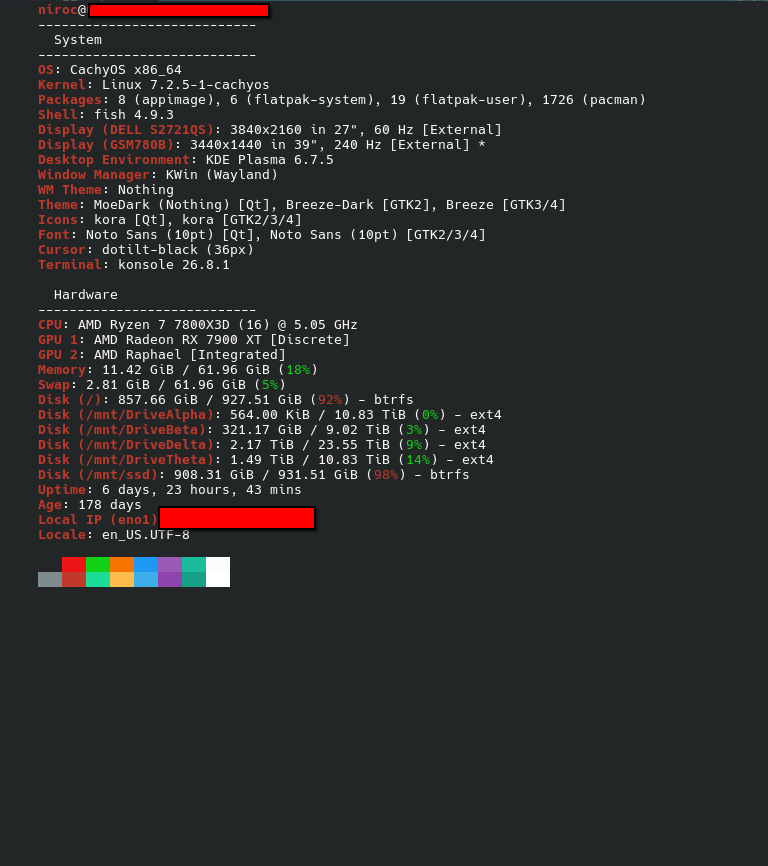
What’s the story behind your disks? btrfs is very full looking, and 4 different ext4 mounts.

So back when I had Windows on my machine I had all of these drives as NTFS or whatever the label is and I had bunches and bunches of stuff stored, backups mostly prior to getting a proper NAS set up. Then about a month after I got settled into CachyOS I plugged those big storage drives in and went through them (which took a afternoon as we were talking about multiple TBs of stuff, most of it old junk I hadn’t cleaned out yet) saved what I wanted to the NAS and then reformatted them clean to ext4 for reasons I honestly don’t remember, maybe it was compatibility(?). And yeah those two BTRFS drives are my SSD’s which have been my primary gaming drive. Though Drive Delta has my emulators and retro stuff set up on it.

Eh, fortunately I am not huge on multiplayer titles like that, I prefer my singleplayer games and the few multiplayer games I do play are all linux compatible which is nice. Also I’d disagree about the “losing” part of having windows as windows is very different from Linux which is different from MacOS etc. I have a secondary windows machine that I use to run flight sims just because proton hasn’t quite caught up to some of the DirectX stuff and the VR headset I use, the Pymax Crystal Light, is unfortunately a windows only device.

I think of Linux, Windows and MacOS more or less like different consoles, they all have their upsides and downsides and will have their own selections of what games work and don’t work.

2 Likes

It sounds you were thrown into the cold water - and survived.

Starting with Arch isn’t the easiest. Much of the downfalls of Linux you mention aren’t a problem on Bazzite, for example (no package issue or breaking, and likely more gaming device drivers).

AUR is the Wild West and should only be used by experts that actually review everything they download. You still are better off using flatpaks. Months ago I tried Cachy and could find Chrome on the AUR only. On a different forum, I questioned the security of the AUR since it was clear to me, ANYONE can put there ANYTHING. People on that forum basically declared me insane for doubting the security of the AUR since “it is open source and anyone can review the code - it must be safe!”. Needless to say, a month ago when the AUR issues happened, that I as a total noob predicted, I felt vindicated :slight_smile:

I think the AUR is for hobbyists, (or professionals) or an excuse because most software is in .Deb or .rpm, but not Arch. I’m not sure if containers are GUI in Cachy ( they are in Bazzite/Aurora). With that, you can install any software on any Linux. And for any OS (inc W11), it is better to not install every software in existence just because it looks nice.

The best feature of Linux is, that you CANNOT install the motherboard manufacturer software :slight_smile:

1 Like

For the troubleshooting, did you check Cachy and Arch wiki? Or when searching for solutions, did you add Arch or CachyOS to the query? Try adding “Arch”, similar enough to where it should not matter. Otherwise, rephrase the question. Think about how others would phrase the same problem. You can even also for example add the word “problem” to the query to filter out irrelevant posts. I find most of the trouble is finding the right search terms.

The AUR is user-uploaded packages. Like PPAs. Arch and derivates do NOT support AUR. You are on your own. I would advise to use it sparingly or not at all. Does Cachys App Store or whatever the GUI is called for installing apps also enable AUR by default? At least on Manjaro, you can disable it. No idea if it is enabled since I never use GUI to install anything. I don’t even know what the App Store is called on Manjaro, after 7 years on it.

I can’t agree with the “Distro doesn’t mater”. I have Realtek 2.5 gig NICs. Rocky Linux and Proxmox will drop networking completely after 30 mins - 6 hours. Not great for a server. For that reason alone, my media-server is running Manjaro, zero problems with Realtek. OpenMandriva ISO wouldn’t even boot with my Akko keyboard plugged in. Soon as I unplugged it, booted just fine. But then I don’t have a keyboard…
I find all distros have quirks and faults. Just depends on what you do and your hardware which problems you run into. Making some of the distros unusable.
Further, I don’t even test or try Ubuntu-based distros any more. To me Ubuntu is more like Windows than Linux. Pulling the same moves.

I would also like to say, 6 months is not a long time. What did you know about Windows/Apple/Whatever you used after 6 months? Give it time.

Thanks for the replies! This was meant more as a six-month retrospective than a help thread, so most of those pain points are already sorted, but a few quick thoughts:

@Lurker Ha, cold water is exactly how it felt :sweat_smile: . Funnily enough I have run Bazzite on my TV box and it’s great for that, but I like having the Arch side on my main machine. Fully agree on the AUR being the Wild West; I treat it more or less as a last resort or only if the package is extremely well maintained and has a good and well know reputation within the wider internet spaces.

@boarmeat Fair point on distros. That’s why I hedged with “…much”! Hardware quirks like your Realtek NICs are definitely where the differences show up. For me it was more about letting go of distro-hopping FOMO.

I am not quite sure what you mean by “6 months is not a long time. What did you know about Windows/Apple/Whatever you used after 6 months? Give it time.”? I never claimed to have extensive knowledge of CachyOS/Linux nor were my pain points listed as things that really needed to be solved. But I appreciate the reply regardless!

Edit: Yes I did poke that the wikis and sometimes they helped, sometimes they didn’t, was a bit of a mixed bag in my limited experience.

1 Like

surely not the arch forums…I think/would hope the majority there at least know to be vigilant about what they pull from AUR. does hyprland have a forum? sounds like a thing that crowd would say

historically, on any distribution for that matter, if you needed to install something that nobody packaged you had to read docs, figure out dependencies, and compile it yourself, so the AUR just made a hurdle that users of e.g. Ubuntu would constantly run into easier to overcome through joint community efforts. which was honestly nice.

It was a general Linux forum (not this one). And I also didn’t investigate too much since Cachy for me threw 10 red flags compared to other distros. It was more a test of Cachy just so I know what it is about. And as a noob without having done proper research, I shouldn’t waste the time of the experts on the Arch/Cachy forum.

Software what I think most users need is available as flatpak. That way the distro doesn’t matter and I can use the very same software version on my Fedora-based (Aurora) and Debian-based (MX Linux) and don’t have to worry about this and that (yes, I’m aware, the flatpak is not necessarily created by the actual software creator).

And if you need special software (like a new RGB software off GitHub) you have to be prepared for some unknowns. Arch and all this GitHub stuff and AUR is great - but only for the people that actually get into Linux. Not for users like me that use Linux just like a better W11 or Chromebook. Cachy is great, but not a great recommendation for every Windows refugee.

The “6 months” was meant more for deeper knowledge, it takes longer. How many people on Windows use Group Policy Editor, Eventviewer or the Registry within 6 months? I doubt many. But it is what I did right after install (after I learned about them and what I liked etc).
What I mean is there is no hurry, no one expects you to know everything. I don’t think that is even possible.
Don’t stress, enjoy the journey.

Yeah, I’m agreeing with your assessment in my earlier post, but I guess I forgot to state it.

That said,

afair there are a lot of noobs but they’re not frowned upon as long as it’s obvious they’ve done a few searches and/or show a willingness to cooperate/learn. I mean the very first category is “Newbie Corner” after all… but one big rule is that arch forums is for arch, cachy forums is for cachy (where I assume a similar theme exists).

n.b. I thought you were OP so I kinda replied to be instructive/informative - but I realize now you weren’t because of the Cachy comment looool. you guys should set avatars…!!!

1 Like

For better or worse LLMs killed these troubles for good for me.

… Mostly. You still need to know when the AI is kinda bullshitting you. Asking questions like “I’ve heard there is a newer tool for that?” can sometimes be helpful.

When you run Rolling (or, in my case, debian sid) then I have found once a week is good enough. But rolling will break stuff from time to time. You will hit edge cases and corner cases you never knew existed. Most devs didn’t, either. That’s the price you pay for being on the bleeding edge. When that happens, if it is important, update daily until it is fixed. When it is not important, just live with it.

A friend of me literally could not hold a project presentation on their computer because he did a -Syu (am I the only one who says “Seeya” here?) just before lunch. We resolved it by using another computer temporarily.

Never do rolling if your livelihood depends on the OS working.

2 Likes

if it is important, downgrade. it is almost always doable and is the very first thing I do if some minor but annoying bug shows up. you most likely still have the package in your pacman cache so can just pacman -U /var/cache/pacman/pkg/$older_package_file. in the worse scenario that you don’t, you can still pull an older version from archive.archlinux.org.

this is the main reason why I’ve never ran into similar emergency situations wrt my livelihood all these years just because of an -Syu…cause I know I don’t have to live with it.

I’m still waiting on alacritty to fix a terminal freezing bug in v0.17.0 when using a chinese/japanese IME, but in the meantime v0.16.0 it is :upside_down_face:

… Right, there is that option too :sweat_smile:

Yeah, sounds more reasonable actually.

Same. :joy: so much This. This is probably the main issue I currently have as a relatively new linux user (newer than you by the sounds of it). And figuring out which one I need and when is a bit of a pain.

That was a ballsy move pushing ahead with cachy after windows was destroyed and I commend it :saluting_face: Good luck to the both of us growing out of microslop!

I used to think native (.Deb or from distro repo) is faster than flatpak and I sheepishly used those formats. But it turns out, starting a flatpak is equally unnoticeable on my 10 year old hardware with SATA. Since then, I only use flatpak and never worry. In 2027 I will be able run the newest OnlyOffice on my 2025 Debian based OS.

Dare I say snap does the same. But that is more optimized for server applications and outside Ubuntu not relevant. IMHO.

In the rare case you need an app in its native format, using containers is all GUI and you can run Ubuntu 24.04 app right next to a Fedora app right next to a flatpak in your actual distro and the user can’t tell the difference. Really easy (even for me, so yes, really easy once you know)

Oh neat! I guess my primary concern is updating things. My understanding is that a native package updates automagically when I update my system with sudo apt update && sudo apt upgrade. That sounds ideal to me, but I suppose programs installed other ways tend to update themselves when necessary? I just don’t want to forget to update something and miss a critical security patch. Maybe I’m overthinking it, but I am starting school for cybersecurity so that’s always where my head is at

Yes, and no.

Yes, a lot of Flats have this functionality.

No, it is not a required feature and you will be polling dozens of different sources on the flats you do have installed.

Flats are made to answer a single question: How do I ensure this compiled program will always start regardless of what is on the Linux distro?

The result… Is a bit messy.

But so is the entire .deb tree, so… I guess there are no good solutions?