Last I setup any larger wired networks, it was all only cat5.
Times passed and now we have soo many varient im a little confused tbh.
I have a bunch of stp cat 7 cables i want to use. But they are pretty short runs, only ideal from switches to systems/hardware.
Between switches, router, cameras, ip’s and whatnot, i need something longer.
I have access to cat 7 sftp and get little confused if mixing the cable types would course any issue?
Maybe im just overthinking it.
Btw, yes, shielding in my case is pretty important
No issues, but beware of anything called Cat7, because its not an actual TIA standard, almost all of them are complete trash, and reputable Cat6A would be much better. Especially the pre-made patch cables.
That is, unless someone tells me something has changed in the last few years. I’m sure if you buy a box of Panduit Cat7 its going to be good, but some random stuff off Amazon might not be (But then again, random cat6a off Amazon is probably trash too)
mixing technically is not an issue as long as you stick to the shortest length spec out of the mixed cables.
Cat 7 (heck cat 9 is in the ratification process) is a valid standard but a lot of cables were sold before the standard became official so there are a lot of variances in the wild.
i have some buildings with actual cat5 (not cat5e) in them and i shoot 1gb across that stuff on short runs. like they say ‘a tube is a tube, bra.’
I use Amazon Basics Cat7 in my rack - it was cheaper than Cat5 at the time. I have 10Gb nearly everywhere, and these cables seem to work well. Just note that they are stiffer than lesser cables due to the shielding so don’t bend as easily. For short patch cables, they are more flexible fortunately. I have lengths up to 15ft (US purchases). I also have a 50m cable - I can’t remember the brand (I got it from Tesco many years ago). All of them seem well built (much better than cheap cat 5/6.
I also mix cables - some cat 5a and cat 6…primarily for gigabit devices but most seem to work at 10Gb. However, I have started to standardise as the cost difference between these and cheaper ones was quite small, and it is easier than working out why a cable doesn’t work at 10Gb…
Also riser rated UTP is fine in practically every case.
The only time you really need STP is when you’re doing an outside run where you need to actually worry about shielding (grounding and or many other cables).
Also, if you are running cables in plenum spaces then you need plenum rated cables.
It’s technically a fire hazard to run riser cables in plenum spaces.
Cat6a is really all you need to do runs, but it may be worth it to go with higher rated Mhz rated cables if you are going to be maxing out the run length (100 meters, ~330 feet).
Furthermore, for backbone cables always get SCC (solid copper core), the cheap shit is CCA (copper clad aluminum).
For reference, a good quality spool(1000ft) of CAT6a will set you back around $250.
The cheap CCA chinesium will be around $50. So if its dirt cheap; avoid.
Yes, it is a standard. An ISO standard. It is not a TIA standard though as you said. It is very much valid though. TIA and ANSI are American standards bodies, ISO is an international standards body.
All the “cat x” standards you are used to have an ISO equivalent, but just because the TIA body did not ratify a category 7 themselves does not mean it isn’t valid. We have a similar situation now with Cat8. TIA says it is “just Cat8”, while ISO says there is Cat8.1 and Cat8.2 subcategories. The TIA Cat8 specification follows the ISO Cat8.1 specification, they are the same. Just as Cat6a, cat6, cat5e, cat 4, and cat3 by the TIA also use the exact same specification put out by the ISO standard for that cable. Though the TIA now no longer recognizes Cat 4 and 3 in newer standards revision.
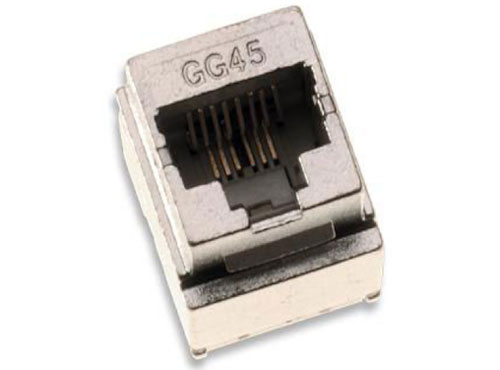
TIA doesn’t recognize Cat8.2 spec, even though it is still a real thing. The 8.2 spec is a higher-rated spec meant for when cables need to go longer distances and/or have more bandwidth headroom. 8.2 uses the same GG45 connections that the Cat7 specification used, which are basically just more advanced RJ45 connectors. They are backward compatible with each other, but GG45 has 4 additional pins along the opposite side of the connector. When you plug a GG45 into an RJ45 keystone it functions like an RJ45 plug with the lower rated distance you get from that connector. If you plug a GG45 into a GG45 keystone though, the keystone activates a small switch that re-directs two of the cable pairs to the other side of the connector to eliminate the small bit of crosstalk you get at the connector ends of all RJ45 cables when all the wires stop being twisted and are lined up parallel to each other (parallel wires = bad crosstalk)
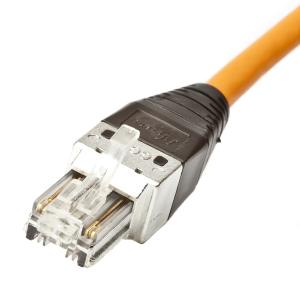
Here is a pic of a GG45 keystone and connector. Each end is fully backwards compatible with RJ45, the extra 4 pins only get routed to and used when you have GG45 connectors in a GG45 keystone
Anyway. @AT0MAC,
Cat 7 cables are fine, but if you bought them off Amazon then as others have said they are most likely just random cables that may or may not adhere to a strict spec. Im sure they will be fine for you to use though. The difference between STP and S/FTP is usually that STP means just an overall foil shield around the cable, S/FTP means a shield around each pair of cables (like a Cat7 cable spec says it should be). Cat8 actually has the best shielding, with foil shield around each pair, a tinned copper braid shield around the whole cable, and often a foil shield also around the full cable still. Complete overkill IMO, as I have run a basic cat6 STP cable in parallel with an unshielded 480 volt, 3 phase, 30 amp power cable and it performed perfectly fine at gigabit speeds with no hint of trouble. Maybe there would be a problem at 10gb, IDK. I suspect not though.
If you decide you want the best cables with the best shielding even though you dont need them at all, here is a quality spool of 1000’ of Cat8 for $480:
You’ll pay more than the cost of the spool just for connectors and keystones though. You are better off just using a spool of Cat6a for half the price and connectors that are also half the price.