Looks like NVIDIA GB300-based workstations are starting to hit the market

It has been almost a year since the DGX Station was announced, and while there have been lots of partners showing their prototypes at trade shows, there was no sign of pricing or ship date (at least not publicly). However! Today I saw on CDW an MSI GB300 workstation listed with a price of $96,995.99 and a claimed ship date of 3-5+ days. The listing doesn’t have any specs, but I am assuming it has the full RAM allotment.

Pricey, but not surprising as it is inline with the previous DGX Stations. It looks like they might finally start shipping in March if they haven’t already.

Does anybody have experience with GB200/GB300 and knows how well weight offloading performs with NVLink-C2C? Is going from 384GB GDDR7 to 279GB HBM3e + 496GB over NVLink-C2C going to fill like a step back or a step forward?

There does appear to be a lot of work in SGLang and VLLM to leverage this capability: Driving vLLM WideEP and Large-Scale Serving Toward Maturity on Blackwell (Part I) | vLLM Blog

1 Like

Absolutely out of my price range, but I am still curious.

I’m not finding this CDW listing you speak of.

I’m interested in the platform since I’m pretty heavily invested into the GB10 platform. But it seems like yet another Blackwell architecture to attempt to run things on. GB10 support is finally starting to see some traction, but it seems like it is a very small market.

The DGX Station (w/o price) and MSI model with price show up when searching “gb300”. Search Results

1 Like

It is also worth noting that this is basically a node from one of NVIDIA’s supercomputers - so it is a real Blackwell GPU with SM 10.x compatiblity. This is the big appeal of these workstations as it is a way to get one of NVIDIA’s high-end GPUs in a computer you can sit next to your desk.

NVIDIA misleadingly named their latest consumer RTX GPU line “Blackwell” as well - but they are not the same and the consumer cards lack a lot of the tensor core instructions that were added in Blackwell. This is why when you load up something like vLLM your RTX PRO 6000 Blackwell cannot run the Blackwell kernels. NVIDIA had the good sense to give Hopper and Ada different names, but with Blackwell I think they were intentionally misleading customers.

Yes, I’ve come to realize how mis-leading Blackwell is. SM100, SM120, and SM121 all have slightly different features. What I don’t know is DGX Station SM121 + SM100? GB10/SM121 is a weird beast it really focuses on unified RAM. Only recently have we seen some decent wheels going for vllm on multi node GB10’s. Is DGX Station yet another architecture that will require it’s own optimizations for the hardware? Given the price point, the developer support will be smaller and it seems like the GB10 user base isn’t large, seems like there is way more enthusiasm for Strix Halo, that seems to be an inferior platform in some ways.

I’m also slightly worried about the firmware/oem support for such a small user base. The DGX Spark saw some firmware updates that improve idle connectx power usage. But I don’t think any of the OEM GB10’s have released the same firmware update.

GB300 is SM10.3 (see CUDA GPU Compute Capability | NVIDIA Developer and 5.1. Compute Capabilities — CUDA Programming Guide ) the one notable change with GB300 over SM 10.0 AFAICT is that FP64 got downgraded to be a similar level of performance per core as consumer RTX. If you are doing scientific computing, this may be an issue with your existing codebase - but this looks like an appropriate move to me as FP64 can be emulated, and that silicon area can be used for more in-demand features (an article I read on this topic: Fifteen Years of FP64 Segmentation, and Why the Blackwell Ultra Breaks the Pattern - Nicolas Dickenmann )

I agree on the concern about firmware support. While I am sure it will work great in the near term as it is going to be essentially the same software as what NVL72 racks are using - at some point those things will come off lease and be decommissioned, and support will focus on Vera Rubin and future architectures. That said, I haven’t heard people complaining their DGX Station A100s no longer work - but it is hard to say.

2 Likes

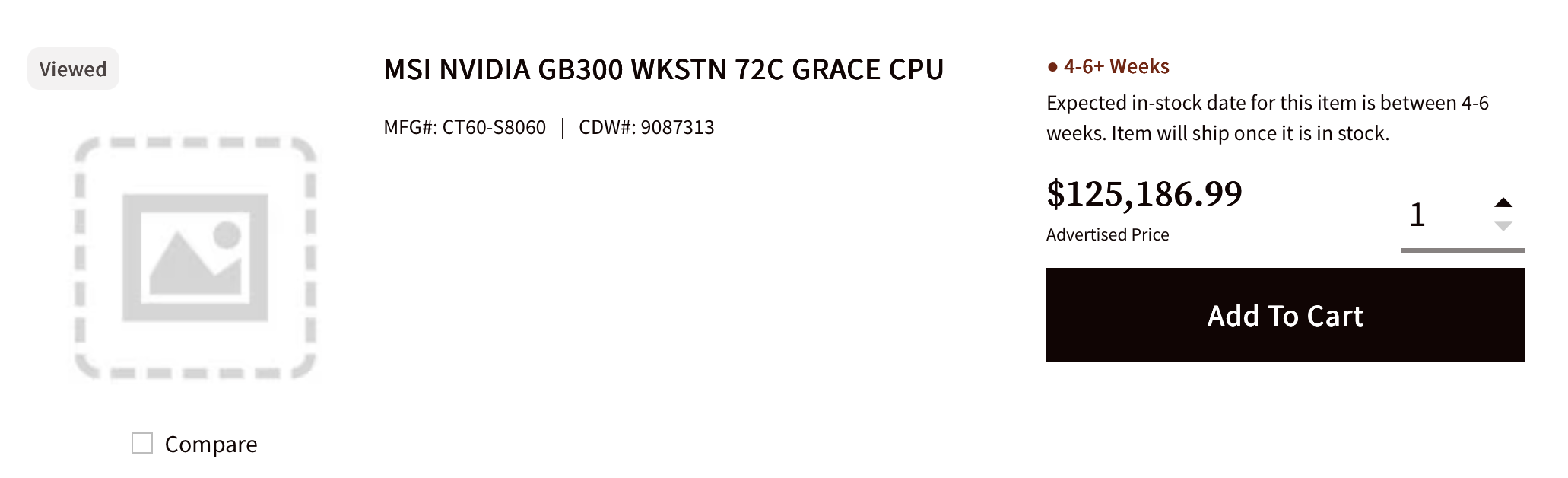
And the price is now $125,186.99!

I am still thinking it might be worth picking one up (assuming I am able to purchase one as an individual and not have to go through my employer), but at this price you are starting to be comparable to a 4x H200 NVL system and that would give you a platform for developing NVLink-based software.

I do have some concerns about these units though:

Each OEM seems to ship the same spec 1600W PSU, and only one of them. The GB300 in the data center configs runs at 1300W - and in one of the recent YouTube videos there is a clip of a terminal running nvtop on a SuperMicro GB300, and it also shows 1300W. Is 1600W actually sufficient for powering these units? I also see some OEMs having a configuration option to add a GPU to drive a display, up to an RTX PRO 6000 Workstation card. I find it hard to believe these units can power the GB300 fully as well as a 600W GPU from the 1600W PSU. What is the story here? I suspect there are going to be serious pain points around powering these workstations (at least in <200V countries as they could theoretically swap for a larger PSU).

Also, GB300 in data center gets 288GB of HBM - and the DGX Station was advertised as “up to” that amount when it was announced last year. Now they are advertising 252GB of HBM. What happened to the other 36GB of RAM :slight_smile:. I am hoping it is only a reduction in capacity and not a binned GB300 with fewer memory channels and maybe fewer SM cores, but it seems like the hardware was down specced since announcement.

In @wendell ‘s recent video where there was some discussion on these workstations - I hope you are able to cover them more in depth in a future video. If you do, it would be great to get some clarification on those issues (or if you already know the answer, please share!).

For others who, like me, are curious about switching from RTX GPUs to Hopper or Blackwell I have done some performance testing to compare different configurations. I was testing with a Wan 2.2 I2V (video generation) script that I have put together that will do the denoising steps over multiple GPUs using Ulysses for sequence parallelism with a couple of different CUDA configs.

For a 1248x832 resolution 81 frame generation using FP16 model weights with CFG != 1.0 (so both a conditional and unconditional pass per step) and PyTorch 2.11 provided SDPA kernels:

GPU Type GPU Count Seconds per Step
RTX PRO 6000 (600W) 1 50.9 seconds
RTX PRO 6000 (325W & +250 Clock Offset) 1 60.5 seconds
RTX PRO 6000 (325W & +250 Clock Offset) 4 (PCIe) 16.4 seconds
H200 NVL (600W) 2 (NVLink) 17.0 seconds
H200 SXM (700W) 2 (NVLink) 15.6 seconds
H200 SXM (700W) 8 (NVLink) 3.9 seconds
B200 (1000W) 1 12.2 seconds

So, for Wan 2.2 denoising, a B200 @ 1000W is a bit over 4x faster than an RTX PRO 6000 @ 600W. According to spec sheets, at FP8, B200 is 9 petaFLOPs and GB300 is 10 petaFLOPs - so we might theoretically see a 11% improvement over the B200 numbers.

But the interesting numbers for me were that an H200 performs about 2x my RTX PRO 6000 Max-Q, and B200 is about 5x.

H200s scale remarkably better than RTX PROs thanks to NVLink, with very little lost to communication overhead compared to PCIe-based P2P communication. All of these numbers line up with what you would expect from the NVIDIA datasheets, but I found it interesting to be able to confirm it with a real-world use-case.
1 Like