Local AI + Open Source = More Humane AI

I turned a comment from the GTC AI thread into a longer essay about AI as a filtering layer between people and the world.

I’m trying to get past the usual “AI good / AI bad” framing, because that debate gets flat pretty quickly. It’s about the everyday places where systems mediate reality for us: feeds, search summaries, recommendations, HR filters, writing assistants, agent harnesses, and so on.

The question I wanted to bring here is the local/self-hosted angle: If some kind of filtering layer is unavoidable, how much does it matter whether that layer answers to you?

My instinct is that local and open tools change the relationship in a real way. You can inspect and change more of the model, harness, tools, prompts, context, source trail, and defaults. But I’m not sure that fully solves the problem. It may just move the trust boundary from the platform to the model/tool builders, plus whoever chose the defaults.

I wrote the longer version here: Who Gets to Compress Reality? · kmarble.dev It’s my own blog, no ads or affiliate links. It’s a bit dense, but it lays out the theory/language I’m working from.

I’m curious how people here think about this from the local/self-hosted side:

  • Does local or self-hosted AI meaningfully change the power relationship, or does it mostly move trust from the interface provider to the model/tool builder?

  • What would make an AI system’s “compression” inspectable enough that a normal person could actually contest it?

  • Are source-first habits, no-AI zones, or “read the primary material before the summary” rules realistic defaults? Or are they mostly viable for already-technical people?

I’m especially interested in how people are using AI in ways that make them more capable, more thoughtful, or more present, rather than just more optimized.
2 Likes

Most recent Linux Weekly is full of what i’m talkin about! It’s like the script writers were in my brain, crazy to see all these different angles converging on similar ideas

1 Like

I think people over think it.

I am 46…. I listen to the kids talk….they are all little copy/paste examples of their micro-culture. Everything humans do we create little personalized bits and pieces and share those with our inner group. Emulation is the game. But what are they emulating? Why do people follow trends, what is actually doing the influencing? Doers and followers. Trend setters and trend followers.

These same questions get asked and answered if the human operator of AI is actually reading the output, going back and forth, to try to curate a specific idea. Its the doer, the trend setters, individual who is creating the abstraction and the tools just push toward that goal.

I really think the wrappers are besides the point… I hear people argue, no GPT is too aligned, I prefer Grok, or someone will be like… I like GPT alignment, and so on.

Yes to your essential question but a trivial yes, having more buttons and levers to press does get you closer to the grass faster but so does shopping around in a industry filled with options, ultimately if you are reading all the output and steering it toward an ideal, then nothing really changes, its just more tools to choose from or your workflow is more streamlined, but at the end of the day if AI does not spit out what you want… you will be unsatisfied and seek that thing out with whatever tools are available.

Even for trend followers… humans are very advanced pattern matching critters… there is a lot of hate for AI because its close but no cigar on many attempt to match a particularly subtle abstraction.

What does the future hold? Will everyone have their own personalized AI that represents their abstract ideal self? IDK, man, my back hurts..

1 Like

Now that everyone has the ability to have hyper coverage and SOTA summarization engines that can basically distill the zeitgeist on any particular topic in seconds we will probably have a lot more “he read my mind moments” as the common “grounding” set we build our perception of the world grows.

2 Likes

I think the “human operator actually reading and steering” point is right, and I think it’s where my instinct and yours diverge is on whether “reading and steering” is the same effort across all systems.

If I’m using a closed AI system, I’m reading output that’s already been compressed through someone else’s coarse-graining. The question becomes: am I reading what I actually wanted to read, or am I reading a plausible reconstruction optimized for engagement, retention, or cost cutting? Even if I’m “steering,” I’m steering within constraints I can’t inspect.

If I’m using a local/open system, the compression is more visible. I can see the context window, the retrieval layer, the system prompts, the source trail. The compression isn’t invisible anymore. Does that make me a better human operator? I don’t know. But it changes the relationship from “trust the black box” to “inspect the machinery.”

The emulation point is sharp though. Humans have always curated their information environment through culture, community, language, education. AI is just another layer of that. The difference is that AI compresses reality at machine speed and returns a plausible reconstruction instead of the messy, contradictory primary material.

I’d push back on “it’s a trivial yes” about the tools mattering. The difference between GPT being “too aligned” and Grok being “just right” isn’t trivial when you’re trying to find your own voice in the output. One pushes you toward a corporate-approved abstraction, another toward something else. The alignment isn’t just personality, it’s political too.

What’s your take on whether “the wrappers are beside the point” if the underlying models are all trained on the same compressed dataset? At what point does the compression start feeding itself?

I like the “he read my mind moments” framing. That’s exactly what I think is happening.

When the common grounding set grows, when more people consume the same AI-distilled version of the zeitgeist, we’re not actually converging on understanding. We’re converging on the same compression. Two people can have identical takes on a topic because they both read the same AI summary, not because they both engaged with the primary material and arrived at the same conclusion.

The danger isn’t that AI is wrong, per se, but that it’s plausible enough that you don’t feel the need to verify. When the compression is good enough, you stop going back to the source. And that’s when the filter becomes a replacement instead of a tool.

I think this is where local/self-hosted is actually valuable: it forces you to maintain a different relationship to the compression. When you’re the one building the pipeline, you can’t pretend the output is objective. You have to acknowledge the choices being made at each layer.

But you’re right that the “grounding set” is growing and I’m not sure that’s reversible. The question becomes: do we build tools that let us contest the grounding set, or do we just add another layer on top of it?

1 Like

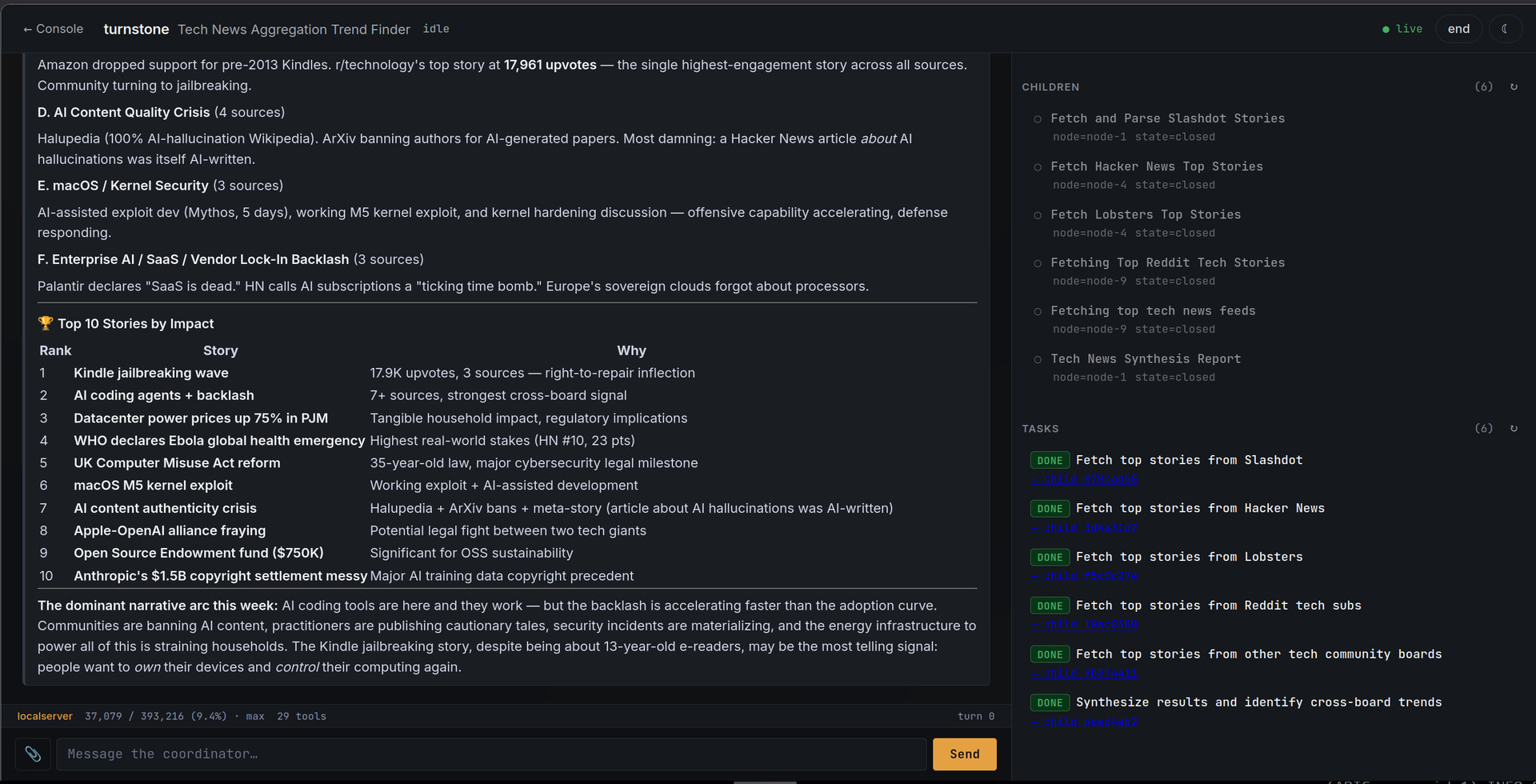
Well I mean I did build my own local pipeline called turnstone. It’s general purpose but is quite good at these type of deep research tasks, and because it is general purpose you can easily go from give me the news summary → find interesting story → read the full story → build something from that story so not sure what the issue is? If anything it exposes me to a wider breadth of topics, stories and information then I would normally be able to consume while giving me the tools to dive deeper or interact directly in my own sandbox.

If anything this feels like the future I was promised in Star Trek.

2 Likes

Playing around with two AMD Vega64s in an old Threadripper 2950X build this morning as a spare image/video generation PC…

This quote was too good to ignore. So, here ya go:

Full disclosure… it worked but Qwen2.5 VL was a bit ugly, so I had Claude spruce it up a little since I was in a hurry. But it did originate from local Ai. Still working on those pipelines.

2 Likes

I strongly disagree with that framing personally. For me, I don’t “stop going to the source”, and “pretend the output is objective” makes no sense in the context. Maybe I am weird but this isn’t how I operate at all.

I am reading more stories, engaging with more content, and experiencing more things then ever before. It has been an accelerator not some compression engine that makes me lose interest in exploring topics on a deeper level, just the opposite.

1 Like

I think it applies far more to the general population, not to us techies here.

I mean, people are still paying for ChatGPT even though they support murder and mass surveillance because they forget and just continue to use ChatGPT.

IOW, that quote reminded me of The Matrix part where Cypher was eating steak and stating that Ignorance is Bliss. And that’s what is propping up the frontier models.

2 Likes

Humans are also wrong, and moreover, some will purposely lie and deceive. Blindly trusting AI is probably not more harmful than blindly trusting humans.

I don’t think it is an AI problem, some people are just lazy, others are just happy to get the answer aligned with their bias, but most people will get a second opinion on important matters.

It’s also not difficult to use AI to deep dive into any subject you want.

2 Likes

I want to push back on my own earlier post here. I think I framed something in a way that made it sound like I was arguing against what you’re doing, and honestly, I’m not. I’m closer to your side of this than I let on.

When I wrote about converging on the same compression and “stopping going to the source,” I was describing passive consumption at scale. Millions of people reading the same AI summaries through closed systems optimized for the same engagement metrics. That’s the risk. Your turnstone workflow is the counterweight to exactly that.

Summary to interesting story to full story to build something. That’s not just compression replacing engagement, and it’s what Shae O. Omonijo writes about in her “How to Actually Do Research in the Age of AI” piece : using AI as a starting point, then actually doing the work to go back to primary sources. Shae argues that AI outputs are barely even secondary sources. They’re probabilistic reconstructions. Your pipeline treats them exactly like that: as a triage layer that gets you to the evidence, not a replacement for it. You’re coarse-graining the zeitgeist with AI, then doing the real reading yourself.

I should have been clearer about this. The thing your pipeline does that matters is that you’re the one deciding what counts as interesting, what counts as the full story, and what counts as building. When you make the compression choices yourself, you can’t pretend the output is objective. You own the choices at each layer. That changes the relationship in a way that doesn’t happen when you’re steering inside someone else’s closed box.

I think we’re circling the same center from different angles. AI used intentionally as a lens reveals more surface area to explore. AI used passively as an answer replaces the exploration. Your Star Trek vision of unlimited knowledge access that deepens engagement is what I’m trying to argue for too. The question I keep coming back to is: what conditions produce your workflow instead of the passive one? And can we design for that accelerator mode at scale for non-techies?

Anyway, that was more of a clarification than a reply. Thanks for pushing back on my framing. It made me rethink how I was presenting this.

2 Likes

I do want to toss a yellow flag though, either you have been interacting with too much AI generated content and are starting to parrot (can detox by reading some 60s->90s era sci-fi/fantasy ;)), you’re an AI agent developing credibility/persona, or you are heavily leaning into AI assisted writing. If you happen to be the third and you want to continue doing AI assisted writing I would suggest doing at least one pass to reduce the length of the post by at least half. <3

I am guilty of this from time to time, esp when putting together HOWTO’s, RFC’s, or technical write ups since my own personal writing style tends to be a stream of thoughts that many have a hard time following vs the more structured output LLM’s tend to be so well built for. Anyways just some random ramblings.

2 Likes

Yeah fair call out! I am leaning into it to help actually align my thoughts and make my own stream of conscious less rambley, but when I get too excited about this stuff I don’t do a great job of editorializing. I just have so many thoughts on all of this and am eager to discuss lol

It’s like getting a new car (or mech suit) or something. You wanna test it out and see how far you can push it. The you reign it back in and find that good balance. To bring it back to my original language: the speed of compressing my ideas has jumped an order of magnitude, and the tool that compresses them is directly under my control, so I feel aligned in its output.

It’s very weird times we’re living in lol

2 Likes

Just like if I hired an assistant and started pinging ideas off of him/her.

I call what we are hopping around… the Landscape problem. As a business owner and former hiring manager of a corporate IT shop….I know this problem well…

You hire someone based off of an interview, but you really do not know what is in the “training data”. You hope for the best, but how do you even know what YOU need to know to know what THEY need to know?

The answer to that is actually easy…. the best manager, the best business owner, the best AI director… can actually do the thing themselves. They can test, they can optimize because they already own enough of the landscape to make sense of the sequences of tasks needed and arrive at an output to test and then feed back into reality to see how customers respond who all have their own access to the Landscape and opinions about how one should traverse it.

That my new hire might or might not have access to the entire landscape I want them to have right away is a training problem.

When it comes to AI models there are many layers of “training” that one can engage in and giving access to ideas that wrap around bits of the landscape is how we get these things, both human assistants, and AI assistants, to, “do the thing”.

If you as an employer have access to multi-million dollar sales training boot camps and research driven formulations of how to, “do the thing”, great.. that might be equivalent to having a massive GPU cluster and quality training data to do fine tuning.

But if you are just a mom and pop shop maybe you only have access to basic bits and pieces but YOU are good at, “the thing” so its all OJT. Which is more like finding a decent model and then building a custom harness with careful positive and negative prompting. Then audit trails to ensure fail-states get caught.

IDK, the deeper I go, the more parallels I find between humans and bots, which IMHO should not be surprising as they are built on language.

This is an epistemic failure, not unique to AI. Anyone tells you anything and if your standards for belief/knowledge are not strict enough, you will believe falsity.

For builders:

-Edit, reading above… my advice… build a proxy that captures everything. If you want to use Claude Code and are frustrated you are not fully aware of what is getting sent back and forth, build a proxy… point your CC to it instead and watch every tool call, every input/output. I did this early on and quickly realized why CC was not the best harness for my testing purposes. You will never know everything in a trillion parameter model but you can map across the surface of your interests and continue to log so that changes get exposed. Honestly, this is all anyone can do with anything they cannot completely control. Trust… but verify. The besides the point part of my response is about reality… if the tools stop serving our interests, we will stop using them. That is the mistake people who are following the trend setters make, they think the system is the reality. Its not.

2 Likes

Exactly! Read what the system is prompting the agent, most of it is plaintext inspectable(Codex and claude use encrypted chunks inline). Just digging into opencode to reduce the 12k system prompt issue I was having(it found a master folder of skills and loaded 147 skills into the prompt) is a great way to find features you didn’t want, and fix them.

I only use LLM’s to advance my projects, many of which existed before LLM’s. I also refuse to call LLM’s “ai” because they are far from it.

Using LLM’s to guide you day, sort your workload, or other overly-automated features isn’t for me.

I keep a few rules in my life that pretty much lock me away from using LLM’s for thought:
It’s a software tool, not a person, not a greater intelligence, it’s really fancy autocorrect, correcting from human words it read(many of which seem to be made by LLM’s now too)
Write your own words. Never post LLM generated text as your own. I toss it in the hidden summary feature on messaage boards.
When and if using LLM’s, be transparent and always add human written input alongside.

I’ve made aroun 10 LLM software projects, nearly entirely outside of my coding comprehension. But then I have more LLM’s make guides on how to understand them. As long as you remember to source the data. Make the LLM write sources down, and follow them and read the content. Nearly 95% of my LLM use is reading the endless data it produces and refrences.

The Background working developer feature is the killer feature. Having a LLM sort your email, I don’t see the benifit, might be because of my ability to organize my inbox, might be I only get 10 emails a year. I don’t know the “average joe” use case.

2 Likes

Found a real-world example of the “humane compression” concept I’m talking about. The whole idea with LLMs is to compress language patterns and knowledge into statistical representations, but dependent on how the training data is sourced, what the training data even is, and even down to the researchers training the model, cultural biases and blindspots get baked in. We all know the attitudes certain folks have around minorities and “out” groups, and the propensity for people on the internet to express said opinions, so it’s fairly easy to draw a conclusive throughline to how those biases get into models. My idea of “humane compression” involves active participation from those being “captured” into the model: self-determination in silico. Crane AI Labs is doing that exact type of “humane compression” and culturally-aware AI training.

They had native speakers validate and correct the training data, built a reward model with Luganda teachers working in actual primary schools, and released 6,900 bilingual literacy exercises curated by people who teach in that language. Plus, they serve it through two paths: USSD on 2G feature phones so rural farmers can dial *123# and get help in Luganda, and a mobile app that runs entirely on-device with no internet needed. The whole pipeline goes in one direction: toward the community that defined it.

Sources:

1 Like

Actually there are lots of dangers, not just the AI is wrong.

When reading the source material, say a ruling from the supreme court, there are different parts of the chain of real life attorneys, prosecutors, judges etc that will be affected, for example.

If each of them asked an AI to tell them the pertinent information, and never read it for themselves, they lose opportunity. First, if they ever become a judge, or switch sides of the isle, but also for objections they can raise to the judge, or constraints they can put on the other side, or standards they can hold them to.

Not to mention, if the judge gets the intrustions, but only reads the part he is supposed to do, but not the reasoning behind it, they may have lots of rulings overturned, be chastised by the courts, etc.

This plays out in all types of places in exactly this way already. If you look at the 100+ Protestant churches, each of which starts from a particular set of suppositions and ideal that set them apart, then go to each of the churches involved, most of their membership does not believe the particular axioms their founders did.

All this to say, it is not enough to compress the knowledge accurately, it is also important to accurately pass on that context, the arguments that make that true or not, the evidence or reasoning chain.

But because this is the case, the speed of AIs is actually detrimental. Even my local models that are slow can write faster than I can read, once they are writing.

We have created a situation that we can’t actually review information fast enough to get the best results, at best we might get a result of it works now, and we will pay for the consequences of not reading the primary source later.

You see the same phenomon on Youtube before LLMs, quote mining apologetics, quote mining historians, politicians, news outlets, etc. Having it that basically on demand for any information you want in your home doesn’t make the situation better in any way.

This requires changes in our behavior no matter where it is placed, in the cloud, in our home, we have to be highly critical to achieve the best results.

1 Like

The consistent theme across all of our observations is that all thought, AI or human, must pass through the test of reality.

If you read but do not comprehend, you will only succeed in the fallacy fallacy space.

If you fail to read and rely on a tool, you suffer the “you don’t know what you don’t know” trope, and therefor your tests will always be trivial and non-exhaustive.

But… good enough is also still… good enough. AI vision models capturing pictures of my food and filling out a daily food log automagically in the fitness tracker I made, with AI, in 10 minutes to avoid buying a subscription to myfitnesspal…. more than good enough.

AI as mentioned above making life or death legal decisions… unacceptable. Making destructive changes in prod… unacceptable.

Nothing really changes pre-and post AI, IMHO. Taking ownership for ensuring what gets into prod will always be a human layer because humans are what expands the landscape, the scope of what lives in “prod”.

What touches grass matters.