I was surprised to not find a thread to this effect here already, so I guess it falls upon me to create it.
Because there are so many keyboard warriors out there either praising the EV experience, or spreading unfounded fears about it, I figured we could try to have a civil and non-political discussion about the realities of living with the Battery Electric Vehicles of today.
What brings me here?
Well, in a matter of two weeks we went from a three ICE vehicle household (Mine, Hers + backup hauler) to a two BEV, one ICE vehicle household, and I’ve certainly learned a lot in the last few weeks since that happened, so I figured it would be fun to share and compare.
Firstly, our vehicles.
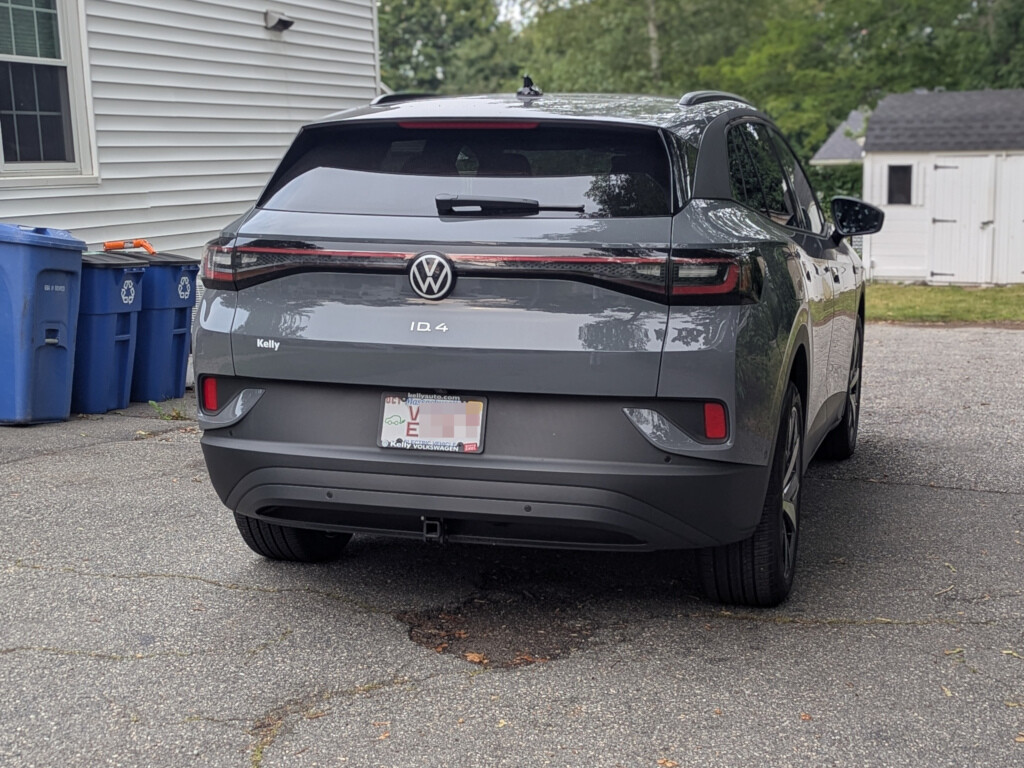
Hers:
2025 Volkswagen ID.4 Pro S AWD with optional larger 82kWh battery:

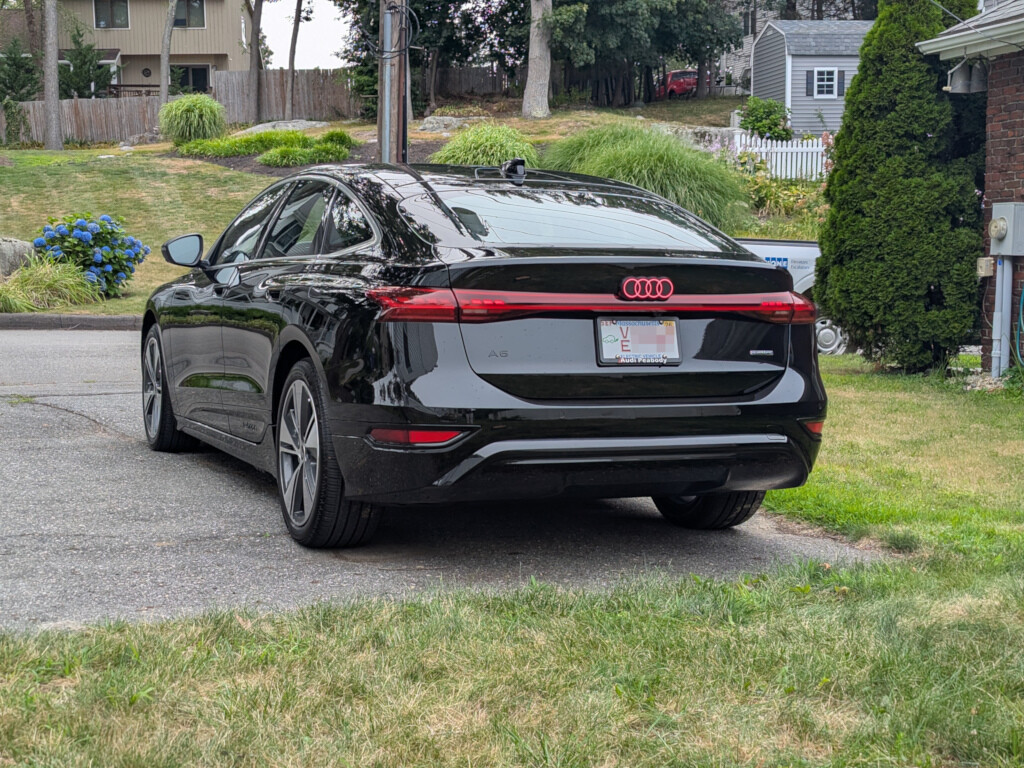
Mine:
2025 Audi A6 E-Tron Quattro (100kWh):

Both are very nice vehicles. It was driving and riding in hers that also convinced me to consider electric vehicles.
The VW has an estimated US EPA range of 263 miles. The Estimated range for the Audi A6 E-Tron Quattro is 333 miles.
The smoothness and quietness of these vehicles in operation is spectacular. Once getting used to them, stepping back into my one remaining ICE vehicle (which admittedly is older at this point, but it is well maintained) feels like going back in time.
I’ve learned there is a reason most BEV’s are SUV’s or cross-overs (in addition to the fact that this is what the market demands these days).
At least with the A6 on Audi’s PPE (Premium Platform Electric) platform in a Sedan (or Sportback as it were) configuration, you wind up sitting a bit higher than most are used to in conventional sedans, due to the battery being in the floor. This took some getting used to at first, and I am still not sure I am a huge fan of it, but it is a tradeoff I am willing to live with.
A lot of people have so-called “range anxiety” when it comes to battery electric vehicles. I have to admit, I was still a little bit uncertain about this part of electric ownership too, but the truth is I got over it really fast even before buying my own, just by experiencing my better halfs car.
For daily driving the range simply does not matter at all.
She drives approximately 9-10 miles each way to work 5 days a week with a few errands sprinkled in in between. It is rare she drives more than 35 miles in a day.
I drive even less these days. At least most days. My drive to work is slightly longer at about 13 miles each way, but being hybrid, I work most days from home. While I used to drive quite a lot when I was younger, sometimes 30k miles per year, these days I drive a whole lot less.
It is pretty rare either of us use more than at most 10% of our batteries in any given day. So even if we stay between 20% and 80% as is recommended in order to minimize the wear on the batteries, we can each get more than 6 days worth of driving without charging.
But that brings us to home charging.
I installed one of these chargers on our house:
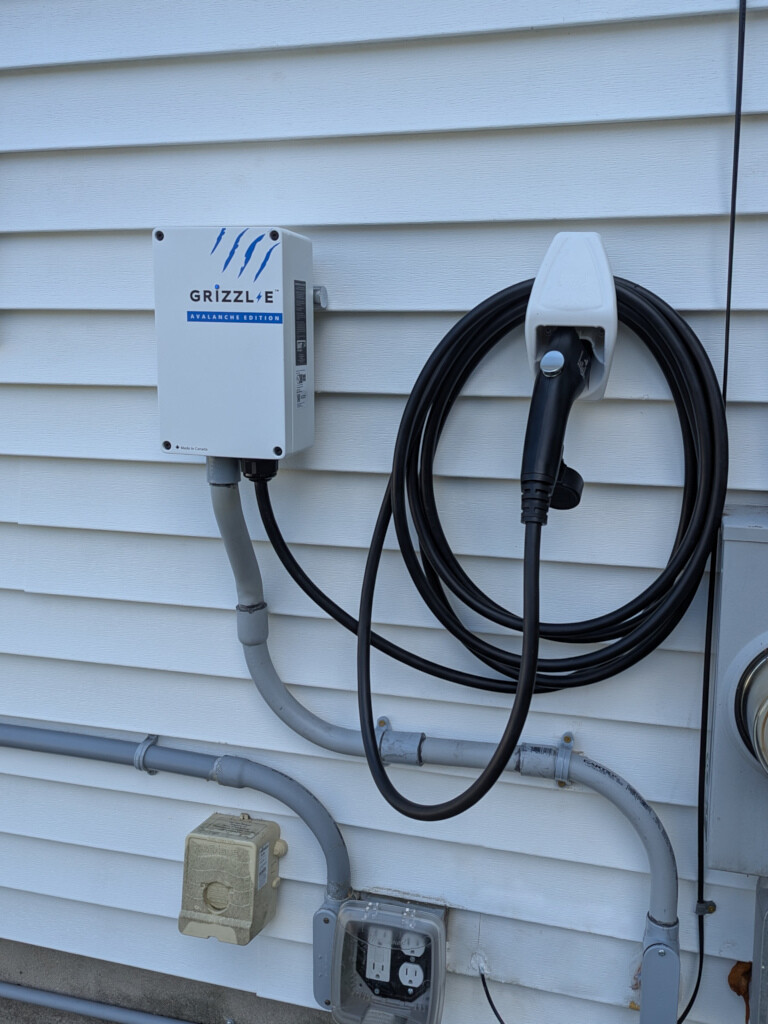
So, we can charge when we are at home and parked, and with a 240v 40A Level 2 charger, there is more than enough charging capacity to charge from empty to 100% overnight should we want to. (though we never would)
A <10% of the battery daily drive worth of power, charging at home takes less than an hour on either vehicle.
In theory, you could just top it off every night, and have 80% (or more should you desire, at the cost of higher battery wear) available in the morning, every single morning and never have to stop anywhere to “refuel” again.
The convenience aspect of this is huge.
While people worry about the inconvenience of dealing with range and charge times, I’d argue that in daily life this worry is completely unfounded. Daily driving an EV is much easier and more convenient than daily driving an ICE vehicle. With an ICE vehicle you eventually have to go to a gas station and refuel. With a battery electric you never have to. You just drive home, plug in, and you are all set. You also never need to get an oil change, need brakes a lot less often (since most of the time you are using regenerative braking)
This is a huge quality of life improvement. Never need to stop to fill up, and rarely need to schedule appointments for maintenance.
In reality though, we do not charge every night. In an attempt to be kinder to the battery both of us have separately concluded that we’d rather minimize the number of charge cycles.
She prefers to drive the car until it has about 20% charge, and then charge it over night back up to 80%. With this strategy she winds up charging it about once a week.
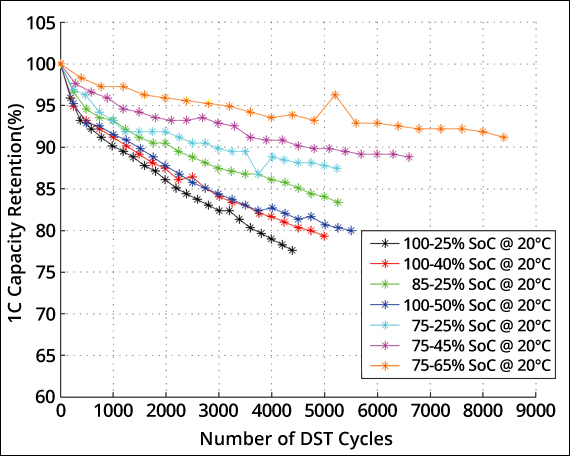
I took more of an engineering approach and read up on all of the charge cycle and wear information on the site “Battery University”. Particularly they did a study where they compared different charge cycles (25% → 100%, 40% → 100%, 50% → 100%, 25% → 85%, 25% → 75%, 45% → 75% and 65% → 75%) and determined the number of charges each of those cycles it would take before the battery degraded to 90% of its original full capacity.
This became a little bit complicated because the different charge cycles would provide different amounts of miles, and a shorter charge cycle (like 65% to 75% would result in much less wear per charge, but it would also result in many fewer miles of range…
So, if you instead only charge when you need to, while each of those charge levels would result in more wear, you also have the fact that each of those charge cycles provide more miles, and thus you don’t have to charge as often, so there are fewer charge cycles.
Of the cycles Battery University tested, I analyzed the data and instead expressed it as number of miles driven until the battery reaches 90% capacity. This turns it in to a comparison between more, shorter charge cycles, and fewer longer charge cycles.
According my my calculations, of the cycles they tested, The 25% - 75% charge cycle, only charging when needed when it gets down to 25% produced the best results, with an estimated 478,688 miles before the battery is reduced to 90% capacity.
The worst was obviously the 25% → 100% charge cycle, which only - per my estimated calculations - would get me about 250k miles until the battery is down to 90% capacity.
Then also read up on the fact that for long term storage, it is best to get the battery down near about 40%, as this results in the least amount of storage wear. My assumption then was that there are two components to battery wear. Charging habits / use and time. If 40% is best for long term storage, it is probably also best at reducing the time component of battery wear even during daily use. So I decided to center my regular charging at about a 40% average by charging from 20% up to 60%, and then driving until I need to charge again. This results in fast charging, and very minimal battery wear.
All of this has also allayed my fears when it comes to battery wear. Even if I do worst case charging when it comes to battery wear, I should see 250k miles of driving before the battery capacity drops to 90% capacity. I’ve never put 250k miles on a single car. Have you?
My Audi came with a years worth of free DC Fast Charging through Electrify America. Because of this, I have decided for the first ear to just charge it at DC fast charging stations for free instead of charging at home where I pay for the electricity.
While we have yet to actually take either vehicle on a round trip drive longer than ~70 miles, charging at DC fast charging stations has given me a bit of insight what it might be like going for longer drives where I may have to actually charge on the road in this car.
But DC Fast charging worsens battery wear, right? Well, I thought that too, but it turns out it doesn’t really on modern EV’s.
This got lots of people scared because of early battery electric cars like in the first gen Nissan Leaf, which didn’t have much in the way of active cooling/heating and protection for the battery module, fast charging (and even regular charging) would cause the battery to heat up and exit the optimal charging temperature, which would rapidly result in battery degradation.
Luckily in modern EV’s, this is no longer the case. The cars will use their heat pumps and push coolant through the battery pack to bring it up to optimal charging temperatures before starting charging, or keep the 4temperature in check when it heats up during charging, in order to keep the battery pack in the optimal temperature zone for charging when DC fast charging, and this almost completely eliminates the accelerated battery wear from DC fast charging.
It is not without its downsides though. On hot days, the heat pump can sometimes not fully keep up with battery temperatures and when the heat pump can’t keep up and the battery gets too hot during charging, it will throttle the charging slowing it down to the point where the charging can still proceed without excessive battery wear.
My Audi - if connected to a charger that can deliver it, has the ability to charge at up to 270kW. This is quite a lot. Typical Electrify America DC fast charging stations can deliver up to 350kW, so my car can use most of that. If connected to a 270kW+ charger, Audi’s official specs for a 10% to 80% charge is only 21 minutes, which is kind of nuts.
Now for various reasons (limited power to the charger, hot day causing battery to run hot, etc.) you don’t always hit this max speed, but my real world results have been pretty favorable.
Today - for instance - but battery was down to about 25% do I decided it was time to charge. My closest Electrify America charger is at my local Walmart (about 4 miles from my house). I decided to take the opportunity to do some shopping and charge my car while I was inside.
The problem I ran into was quite the opposite one most people worry about when it comes to EV charging.
I set the car to charge to 60%, and went inside to start charging. 9.5 minutes later I got notified that the car was at 60% and done charging, and I had to return to the car and move it or risk being charged idling fees. So I had to stash my cart with its two items in it and go move the car, before coming back and continuing my shopping. Luckily the cart was still there when I got back.
Today the temperature was only about 80°F, and in these weather conditions the car was able to sustain its max charging speed for a 25% to 60% charge.
The previous time I charged at Walmart, I didn’t even bother leaving the car. I was just giving it a slight top-off. I had a work event to drive to the next day, and wanted it up at 80% just in case I needed to do more driving than anticipated. I was at just over 60%, set the charge target to 80% and plugged in. I expected this to take about 2.5 minutes, but in reality it wound up taking just over 5 minutes. Why? Well, it was 95°F out for starters, so the car was probably unable to keep the battery in the ideal zone, and throttling the charge speed on me a little.
Still, even on a hot day, I was able to add about 70 miles of range in about 5 minutes, which really isn’t bad.
Lets say at some point in the future, I am on my way home from a longer drive. I anticipated being able to make it on one charge, but lets say it was unusually cold out, and the heat pump consumed more battery keeping us warm in the car than I had planned, so I am running just short of enough juice to get home. I now know that even on a hot day, I can stop at a DC fast charger along the way for just 5 minutes, and add enough extra capacity to get me all the way home.
But if I really need to, I can stop at a charger while en route, and on an average day that isn’t really hot, expect to go from 20% to 80% in about 16-18 minutes, adding as much as 200 miles of additional range in that time, until I’d need to charge again at 20%.
So I’m pretty happy with these results, to the point where I probably wouldn’t be scared off from taking the Audi on a road trip if I had to. Though I haven’t actually taken a road trip longer than the ~120 mile each way drive to my parents house for the holidays in YEARS.
It’s not all sunshine and rainbows - however.
The reason I had to go to Walmart to charge today was because last night I had planned on doing the same at a different Electrify America charger at a nearby mall. My better half needed some cosmetics (or moisturizers or something, I don’t know, I’m a dude) so I asked her if she could get those at the mall, and she said she could, so we decided to make this a mall for cosmetics + dinner on a Friday night outing while allowing me to charge while we were inside.
When we got to the mall, I went to where the chargers are, and found that while there are 6 dedicated EV charging parking spots, there are only three chargers, and all the chargers were occupied.
We pulled into one of the empty EV spots and decided to enter the mall and look for her cosmetics while waiting for a charger to become available.
When shopping was done, we decided to go back to the car and charge it while eating dinner.
But when we got back, all three chargers were still in use. One of them was done charging, and had been sitting idle for 23 minutes accruing idling fees. But while the offending vehicle was done charging, you can’t just go up to a car and yank out the charger. They are usually locked until the owner removes them.
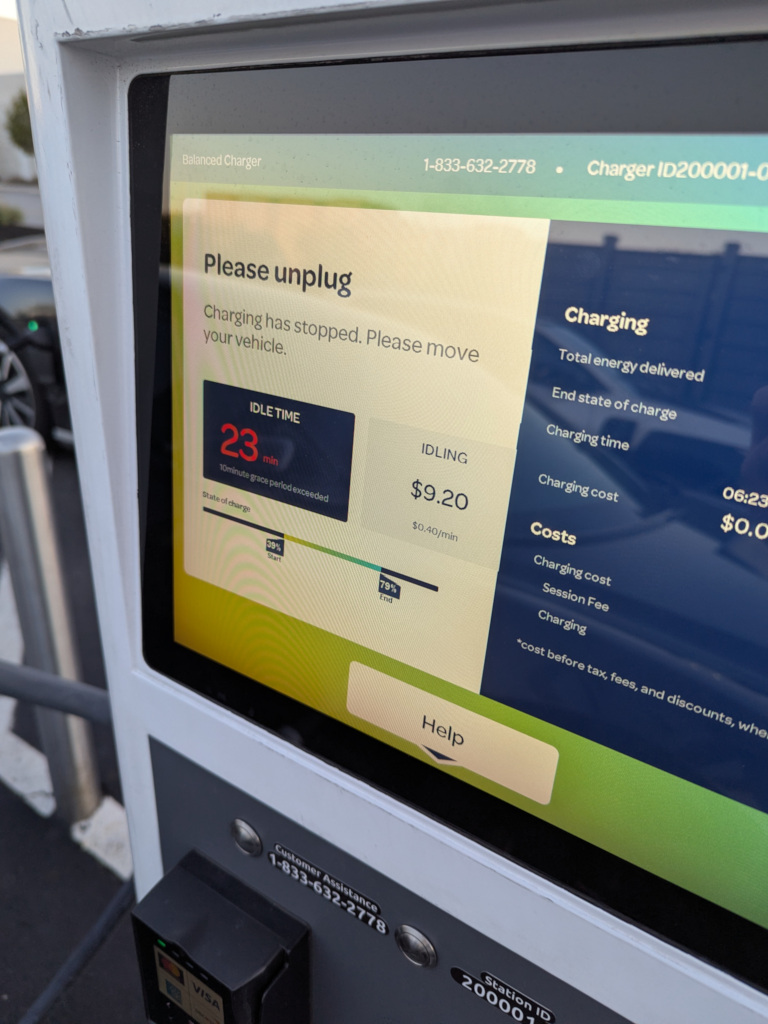
There was also a driver with some sort of Mercedes EV who hadn’t been there when we arrived the first time waiting to charge now, pacing back and forth around the chargers and waiting to be able to charge.
We decided it wasn’t worth waiting, and went on our way getting dinner elsewhere. But it seems underwhelming to only have three chargers for one of the states largest malls.
It also highlighted that these mall parking lot charging stations don’t have any kind of natural queuing flow when it comes to who’s next. I don’t even know what charging etiquette is like. Is it always first come first serve, or do I lose my place in the queue if I leave the car and go inside?
To be fair, the Mall did have a few other brands charging stations, but only Electrify America is free for me (for the first year) so I didn’t want to use those.
Anyway, so this experience taught me that there can be potential difficulties when it comes to charging on the go in a potential road trip scenario.
I can easily picture a big driving holiday (let’s say Thanksgiving) causing there to be a lot of traffic on the road, and chargers along your route being in use and unavailable. So while charging is better now than it was with older models, more capacity is definitely needed to meet demand.
I still plan on primarily using DC fast charging for my car for the first year (because who doesn’t like free “fuel”?) but honestly I expect my life to become slightly easier when I revert to charging at home like my better half does with her VW.
I guess in conclusion I’d suggest that EV’s are much more convenient than conventional vehicles when it comes to daily driving like commuting, driving to errands around town and the like, unless your driving for such purposes is excessive to the point where you would need more than the range your EV can provide on a single charge in a day.
As long as you stay under the max range of the battery, charging at home overnight with a level2 EVSE charger is just very convenient. If your driving is on the lower end of the spectrum (like ours) you can even get away with level 1 charging (standard plug, 120v 15A). It might take 6-7 hours just to charge from 70% up to 80%, but if you plug in whenever you are parked at home, you can absorb occasional longer drive days over several days of charging. You don’t need to hit your charging target target every night (though this might become an issue if trying to drive longer than typical distances more than one day in a row)
For road trips, as long as you pick the right car with high capacity DC fast charging charge speeds are much less of a concern than in the past. Audi tends to have high charging speeds. My A6 is 270kW. My better half’s VW is 170kW, so a bit slower. The Lucid Air can reportedly charge at 200kW-300kW (depending on equipment level). Teslas - depending on the model - can range from 250kw up to a reported 500kW (though I imagine keeping the battery cool at 500kW charging may be a limiting factor) and they also have more charger availability than others, though they are opening up their charging network to other brands which ought to help things)
The uncertainty is going to be chargers availability on busy driving holidays. I’m not sure if I’ll need to charge when I go to my parents house for Thanksgiving, or if topping it off to 100% before leaving will give me enough range to make it there and back (it depends on how much using the heat pump reduces range) but I guess I’ll find out at that time.
TLDR version:
So in conclusion I guess I’d say, it’s neither as doom and gloom as the nay-saysers would tell you, nor is it as fantastic as the BEV fans would suggest, but it is still quite nice.
The best part of it is during daily driving around town. Range is never an issue, and charging takes zero real time because you just plug it in in your driveway while sleeping and you start with 80% (or 100% if you want to wear you’re battery) every morning no matter what.
The worst part of it is probably for road trips. Charging speed has improved to the point where it is actually really fast (but still amusingly slightly too slow to just want to stand there and wait, yet slightly too fast to actually get anything of real value done while it is charging before you have to move it or pay an idle fee.
And on hot days, things might charge more slowly. This might be more of an issue if you live in a really hot climate. (I have only seen slowdowns when it is in the 90’s or above out)
Additionally battery degradation is a non issue unless you plan on putting over 250k miles on the car (and if you baby the battery, maybe not unless you plan on putting over 480k miles on it)
I will undoubtedly learn more over time, and will post back here with my experiences.
I’d also like to hear others experiences, tips and tricks, etc.