So… Actually fixing the issue in the new supported way is irrelevant?

So… Actually fixing the issue in the new supported way is irrelevant?
Since we are just doing everything on one thread, I’ll post a Weston bug here.
Procedure is to turn the display off(power down) and leave it until the ??dpms?? sleeps or turns off the DP(display port). Then turn the display on.
There are 3 initial conditions I’ve tested, only 2 are relevant.
The first is with the linux console and some form of getty(this should not be relevant) as the active VC. With these initial conditions the system, display pc combination, work as intended. Nothing but the display’s power button need be pressed to arrive at a visible getty prompt.
The second initial condition is viewing Weston as the active VC with either 4k@60 or 4k@120 display mode. In this configuration the result of hitting the power button on the display is a loss of sync. The PC never recovers and if allowed the display will time out and turn off. This is not the desired behavior.
A solution is to wait for all the display’s power rails to come up and then ctrl-alt-f4 to a getty and then ctrl-right(or whatever) back to Weston. It’s not necessary for the getty to fully come up, it’s just enough to be on a getty for a moment for the linux console driver and KMS to sort things out.
This leads me to guess/think that writing a compositor is HARD and that in this regard only the linux console driver got “it” correct/right. Perhaps if I dived into this I’d see that the compositor must make kernel on kernel ABI calls that are not exported to userspace, but that’s speculation.
It’s so common to see this reaction from those passionate about a project.
It really is something to address to a global audience and not just some random issue report or even here. It is relevant here, though, because I see the same dismissal of data from those passionate about Weston.
I must be doing something wrong because sway + wayvnc + ssh worked for me flawlessly (with headless and head…ful(?) sessions). Maybe because wayvnc is for wlroots compositors only, idk.
Umm.. isn’t it a PA vs PW debacle still?
It would make more sense to compare Xlibre to Xorg like Xorg to XFree86. The fact that you can’t comprehend that is telling.
I believe every minimalist/lean distribution (like alpine) chooses anything except systemd. I personally like systemd and think it has its place, but let’s not pretend that there are no alternatives.
No, “vibe coded” means junk. It doesn’t mean that everything written with help of AI is junk, but everything that is “vibe coded”, by the sole definition of the term, is inevitably junk.
WTF are you still doing in this thread. I think we should collectively just block @wertigon and/or ignore any of their replies because their only goal appears to be to derail any meaningful discussion.
pipewire has already replaced PulseAudio and jackd - with virtually no loss whatsoever. So no, it is already over.
In practice, if you are so limited by hardware constraints that systemd is an actual problem then you should be using something like FreeRTOS or the more beefy (but proprietary) VxWorks or QNX in either case.
Alpine et al are mostly an academic exercise.
The alternatives does not allow for systemd style unit files or timers. They do not monitor if processes are started. They do not support complex rules like “if A and B is running, start C”. And so on and so forth (or at least they did not when I gave up on them in 2018). So yeah there are alternatives but nothing comes even close to prevent race conditions and other nasties before they even become a problem.
Any serious alternative to systemd now needs to support unit files and do most of what the systemd core does. My own biggest gripe is binary logs - but I prefer that over losing the stability systemd brings to the table. It is all about the tradeoffs, and systemd offers a much better stability overall than the alternatives.
Now, to reconnect that to the thread… Ubuntu and Fedora have both removed XOrg from the distribution. That is ~70% of the user base already. Gnome has already completely dropped support, KDE will do so in 6 months. XLibre will not support the two biggest desktops out of the box in 2027, nor the two biggest Linux distributions. So as far as I am concerned XLibre is a massive waste of time.
If you want to pour your energy into something pointless, go right ahead. My time is a bit more valuable than that, but your time, your resources, your choice. I may not agree with your choice but it is still your choice to make.
Oh yeah because linux desktop has always been about lowest common denominator and having the highest possible userbase. There are not and have never been opinionated DEs and entire distros for a niche audience, choosing different from the ubuntus and the rhels of the day.
Everything you personally dont like is a waste of time, but you do waste a lot of time trying to make your opinions seem objective fact on this thread
Good luck maintaining the XOrg infrastructure with a handful of disgruntled, DEI-hating volunteers intent on worshiping the past. You might want to fish around in the Amiga crowd, I hear they still chant for the revival of AmigaOS… 
You can’t escape the fact that XLibre is built on X11, and since X11 is certified garbage XLibre is also certified garbage with a pretty ribbon on top.
You want to be stuck as a luddite fighting a losing battle for the next ten years, be my guest. Meanwhile the rest of us got work to do.
Let’s see, across the 3 most popular alternatives (runit, s6-*, OpenRC):
 , pure scripts only
runsv  (i think)
s6-supervise s6-rc (standard POSIX but highly declarative using structured variables and functions)supervise-daemon or other backend with a supervisor= statement need, use, want, before The consistency of “no timers” makes you think that’s because it’s cron’s job (pun intended).
This is just factually incorrect and out of touch with modern infrastructure.
For one, Alpine is literally the bedrock of modern cloud infrastructure, accounting for some 50-60% of Docker/OCI images. Even as a virtualization/container host it offers minimal footprint and rapid startup times.
But that’s besides the point. Beyond containers, it (and other non-systemd distros) still hold strong in the embedded/IoT market and network appliances.
Also, suggesting FreeRTOS or QNX as alternatives misses the point. Those are Real-Time Operating Systems or microkernels. Alpine gives you a full, standard Linux kernel and POSIX userland with a package manager.
I understand (and like) systemd on desktops and most mutable server environments, but if you want a deterministic and fast startup that hardly ever changes (if at all) I’d rather pick an alternative.
The claim that I’d somehow miss unit files or the other Emacs, is also outrageous. Both of these are to be avoided. Give me timers that exist on a single line, that’s what Linux should be. The idea that having a timer exist as two files with about 20 lines each as a selling point, sorry I think I’ll buy my bullshit elsewhere.
If you would’ve actually taken the effort to read my previous post:
in fact, here’s links to the Fedora Spins that rely on X.Org, all of which were tested by me and SouthernG as part of Fedora Respins three days ago:
here’s links to the relevant package in Fedora:
and in Ubuntu:
and, seeing as Xubuntu, Ubuntu Unity, Ubuntu Cinnamon, and Ubuntu MATE (which are all official Ubuntu distributions) rely on X11, it’s well more than safe to say Ubuntu isn’t purging X.Org packages any time soon.
So, runit is a joke to systemd, kinda like MS Paint vs Photoshop. OpenRC has some basic level of control but is plagued by System-V biggest weakness; init scripts and pid files. s6 is much better designed, but assume static startup and again has only weak control flow.
Meanwhile systemd use actual kernel features to achieve control, like cgroups, which allows the apps to easily track a “ready” state, not just started or stopped.
If I had to choose between the alternatives, s6 seems to be closest but still lacks quite a few guardrails systemd has. And why not simply adopt the systems unit files for s6 static compilation? It is after all the new standard on making configuration work, and then we can at least simply write a single unit file for an app, instead of having to care which boot system is being used.
Nah. Where I work in Europe most have just switched to this:
Which is far more useful than Alpine for actual embedded projects. For containers and VMs I had no idea Alpine was that big, regardless you can get Yocto to under 1MB easily. Plus payload of course. I wonder what replacing tiny-boot with s6 does there?
Ubuntu, Kubuntu, Fedora and Fedora KDE will all remove XOrg within a year from now - if they have not already.
For the other spins above, those moving on to Wayland like XFCE and Cinnamon will drop the package once Wayland versions are stable. So it will gradually disappear over the next five years. By 2030-2032 sometime, almost every single spin will be wayland only. And XOrg support for newer GPUs will be lacking, too.
So while the packages may not be deleted… They will be hopelessly more and more outdated.
The fact you seem to not understand that the Linux ecosystem is in constant motion, is quite telling.
Like I give a c(ar)p about what the braindead masses are doing. Let the lemmings jump off the cliff, I’ll stand by and laugh.
Yeah, this is not a strong argument. If this were true then Linux wouldn’t even exist, it’s just a dumb thing to say to the ppl who starting using Linux in the mid 90s.
Only because the Wayland, Gnome (and likely RedHat & canonical pushing things behind the scenes) are ganging up to repeatedly stab XLibre in the back (and by extension, us users). But then again we’ve never said Gnome is anything but maliciously user-hostile, and every other project is following their lead.
I’m thinking the only solution for all the crap coming down the pike is for the internet to crash permanently.
I need to exit this thread, as it’s obvious the Gnome/Wayland/SystemD cabal are only going to continue to destroy open source and make everyone’s lives miserable.
This is a topic I’ve been banging on drums about for a while. FOSS in general suffers from non-predatory maintainers, like I don’t even have the words to describe what’s going on. By maintainers I’m talking about the group that determines what patches are “blessed” enough to be merged. They have entirely too much power. I can write a wonderful patch to linux-util’s libblkid, but if it doesn’t get merged… Then I’m stuck maintaining a fork of all of linux-utils and that’s just not reasonable, full stop.
Unfortunately you are viewing open source through a lens of 1990’s romanticism, conflating the origins of Linux and open source projects of yore (like the original X11 server) with the realities of maintaining a modern massive graphics stack.
I too miss those days, but that is just not where the world is today.
Virtually all critical infrastructure in the Linux world today is heavily backed by corporate interests (Red Hat/IBM, Canonical, SUSE, Google, Valve, Intel, AMD). The developers who actually maintain the graphics pipeline, DRM/KMS kernel drivers, and Mesa are almost entirely corporate employees paid to do this full-time.
It is rare to see a major complicated project today that has the ability to sustain itself entirely through volunteer contributions.
Xlibre is trying to preserve a dying standard that the industry is actively trying to move away from. It’s not filling a vacuum; it’s resisting a transition. They face an existential crisis in doing so. If Red Hat, Canonical, and SUSE developers are all working on Wayland, who is reviewing security patches for X11? Volunteers alone rarely have the bandwidth to maintain a massive, legacy display server against modern security threats.
That was indeed much more possible in the 90’s, but the code base was smaller and simpler then, and did not have to stand up to the scrutiny of our “always online” security challenge which places a much higher level of constant pressure on any project to stay on top of security.
As an example, the Linux Kernel was only about 10,000 lines of code back then. Today it is over 30 million lines of code.
To bring it back to Xlibre, the Xorg/X11 codebase is a massive, tangled web of legacy code accumulated over nearly 40 years. There is no way a small team of volunteers can manage it and keep it up to date for security patches and bug fixes alone, let alone keeping up with features.
The world today is very very different than it was 30 years ago, and so is Open Source.
If the grfx stack is too massive… then it’s too big.
I’m only speaking for myself, not the world. I still have the same “I can support this work myself attitude.” I’m sorry if that light has died out for you, that sucks.
This was never not true, well perhaps it started with the East India Trading Company. Though I’m sure they would say they got the idea from someone else.
This concept is just stupid.
I’m sorry, but you vastly underestimate the complexity and workload of supporting a project on the scale of Xlibre.
It is going to require lots of man hours from very competent people.
I’m pretty sure there isn’t even the remotest chance that a project of this scope can survive with just volunteer contributions.
But we don’t have to argue about it. Let’s just wait and see how it goes 
A bit dated, but related talk I stumbled upon recently:
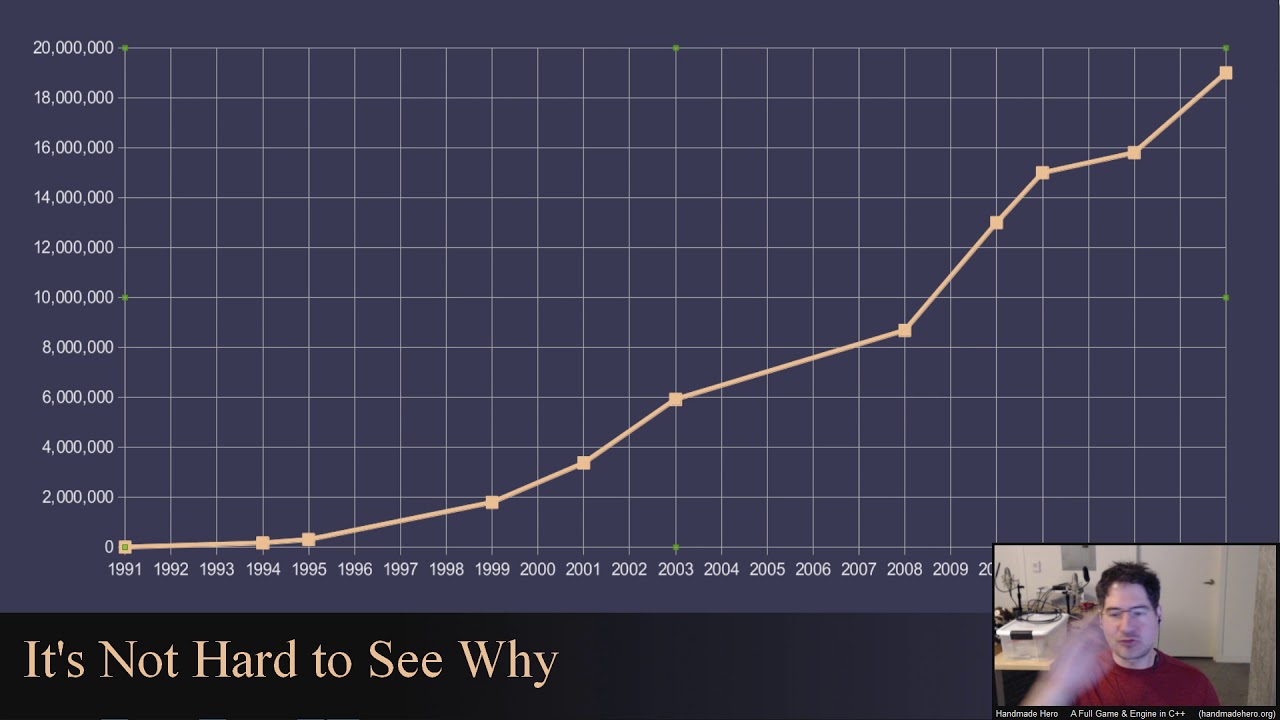
I don’t 100% agree with Casey in this talk, but he has some valid points. Might be worth checking out if you’re interested.