Is the iPhone Birth Control?

IS THE IPHONE BIRTH CONTROL? CAUSAL EVIDENCE FROM AT&T’S 2007–2011
CARRIER MONOPOLY

Abstract:

The U.S. general fertility rate has fallen by 22% since 2007, a sustained decline not readily explained by economic conditions, contraceptive use, housing or childcare costs, or other commonly cited factors. We assess the potential role of a different shock: the diffusion of the smartphone. The U.S. rollout of the iPhone, the first modern smartphone, provides a natural experiment: from June 2007 through February 2011, the device was sold only on AT&T, allowing us to identify its effect from variation in AT&T’s mobile broadband coverage. Entropy-balanced Poisson and synthetic difference-in-differences event studies imply that access to the iPhone reduced births by 4.5–8.0% at ages 15–19 and 3.2–6.6%at ages 20–24, with statistically significant but smaller declines among older cohorts. Placebo analyses applied to Verizon and Sprint’s pre-2011 coverage footprint are null. Taken together, these cohort effects imply that the diffusion of the iPhone deepened the decline in births among women under 30 while suppressing the rise in births among older women. :backhand_index_pointing_right: Overall, the diffusion of the iPhone explains 33–52% of the decline in the general fertility rate among women aged 15–44. :backhand_index_pointing_left: National-survey evidence on time use and sexual behavior is consistent with the iPhone reducing in-person interactions, increasing pornography use, and reducing sexual frequency.

tl;dr: Smartphones are significantly contributing to fertility rate decline and thus exacerbating population collapse.

3 Likes

Could also be forever chemicals, microplastics and other toxins as suggested in the video. Far more drastic numbers.

3 Likes

I am not sure that really tracks.

there are reasons they are commonly cited, and amongst graduate acquaintances, they are definitely factors my peers have chosen not to have (as many) children.

my non graduate peers, who have similar levels of iphones, still had regular levels of children, and did not consider those factors, as we have welfare state to allow subsistence for all

so, it may instead, be the push for further education, that reduces reproduction, rather than entertainment devices,

1 Like

The quest to not admit the birth rates falling are mostly related to massive increase of higher education and women freedom ( ie women choosing work career over family life) continues unabated.

this week we blame… Checks notes… Technology!

I don’t think that iPhones are birth control!

4 Likes

It really does feel like the financial crisis, had more impact…

1 Like

We’d like more kids, but we lack affordable housing and stable jobs.

Austerity is the name of my generation’s game, and tragically having kids takes up housing space which is obscenely expensive.

For now the government maintains national growth through sizeable immigration, rather than via birthrates which are below replacement.

2 Likes

That has never been an issue in the past or in the african continent and other third world countries. This statement actually means you will accept to make kids only if you can reasonably guarantee they will have a good life. Instead than making them out of necessity, their life quality be damned.

Nowadays in first world countries kids aren’t usable as cheap labor nor required to care for their elders when they age out of the workforce, unlike in the pre-welfare-state and especially pre-industrial past. Infant mortality went down A LOT too so you don’t need as much redundancy to ensure some of them survive to adulthood.
A lot of people didn’t want to have (many) kids even in the past, but there was huge economic and religious pressure to have them.

I’m not endorsing the way the world was (and still is in africa and third world), just saying the current situation is mostly caused by a radical (and foolish) change in the incentive structure.

1 Like

True.

1 Like

There are dozens and dozens of variables that feed into a declining “fertility rate”. Higher education and the pursuit of ‘careers’ are certainly among them. The paper does not assert that smartphones are THE cause, just ANOTHER cause — one worth considering.

One can question the “33-52%” range — and future studies no doubt will come up with different numbers — but it’s good that at least there now is some sort of figure to get the ball (discussion) rolling.

That’s not at all what the paper does. It just introduces smartphones as another variable that helps explain fertility decline. The authors attribution range (33-52%) is quite wide. There’s obviously a lot of uncertainty, and plenty of room for other causes.

That’s how science works. People assume things are a certain way because of [reasons]. Some folks believe that [reasons] are inaccurate or insufficient. They do their own research and publish the results for peers to review and stimulate discussion. Thereby nudging everyone towards a more accurate understanding of why things are the way they are.

New ideas should be entertained. Questioning is good, not bad. Even if subsequent research shows that the range was wrong, that’s a positive outcome. Even though simplistic explanations appeal to many people, they are rarely accurate. The world isn’t black-and-white — it’s very much grey.

Let me guess… you didn’t read the whole abstract, certainly didn’t click the link and read any of the paper, but just knee-jerked your way to the nearest meme-repository to pull down something (which you think is “an argument”) that supports your pre-existing world view?

Ok. Thanks for ‘contributing’, I guess.

Just so I understand you correctly… the “radical (and foolish) change in the incentive structure” that you are talking about is:

Correct?

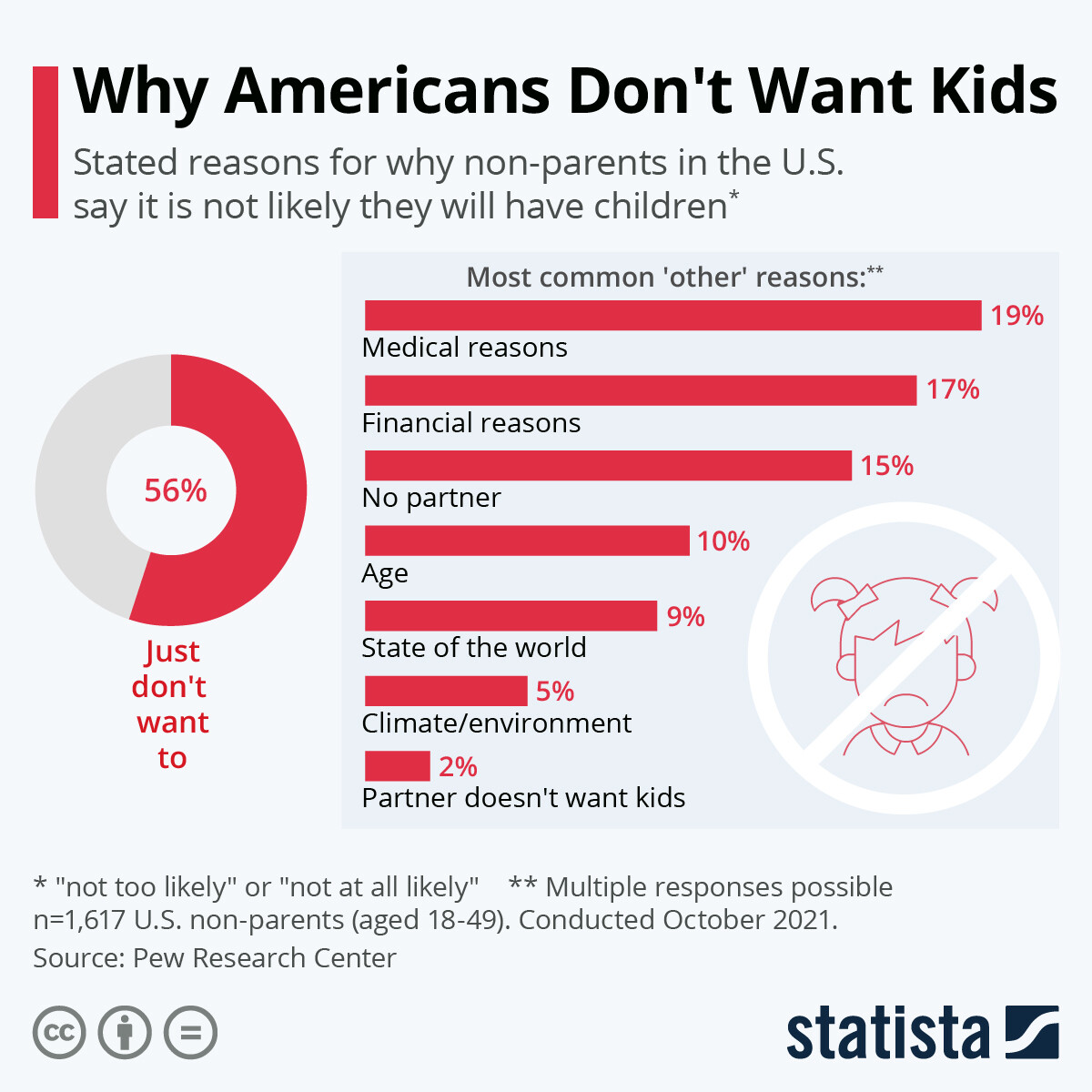
“Financial” is the third-most cited reason why Americans don’t want kids.

I don’t understand all this fuss about declining birth rates in technologically advanced countries. The more a country’s technology advances, the fewer people we need to maintain a society. So a higher birth rate means we would have more and more people unemployed. Which means they become politicians, government bureaucrats, and idle people who become tools of the new-feudalist elitists (like the WEF and George Soros). Better to take Japan’s stance.

OTOH, if you have an Android, you are not getting a second date.

It’s the usual scientific paper mill article, it’s science only in a very broad sense. It’s “science” that is cheap to produce, somewhat clickbaity, low value as a result but fills the article quota most professors or researchers have to maintain their grants and whatnot. I can clock those things at a glance and I have a very poor view of them.

Talking about poorly designed incentive structures, that’s another one.

No. Also what you did is a dirty move, please don’t do that. I’ll pretend you just asked me to explain, this time.

It’s very self-evident that if you decide that a lot of the major factors that historically maintained steady birth rates must be removed you should have something in place to replace them. Superior moral standing does not change physics or biology. If people have much less compelling reasons to have kids, they will make less kids. This is not rocket science

That’s what’s foolish, tearing everything down without replacing it with something that maintains the same incentive structure, just hoping for the best. Then again there aren’t a lot of precedents for massive societal changes done with any amount of foresight anyway. But it still drives me up a wall that we have the information, the science, the technology and yet we don’t seem to be much better at this than a random ancient civilization.

Imho it’s mostly tied to welfare state and taxes. There are other economical issues but this is imho the main ones. Less citizens means less tax income for the state (yes you can raise taxes and yes this is already happening, but there are limits), and more importantly the welfare/social security/“free healthcare” is set up as a Ponzi scheme. There is a less obvious name for it, “contributive” I think. Where people pay in money into the system but it’s not earmarked for them to use in the future but just handed out immediately to other people that need it right now, relying on the assumption that we will never end up in a situation where the majority of the population is older and therefore a net drain for the system.
Again, before someone tries to claim I said something I didn’t, I’m just talking math here. The current system was set up with some assumptions, which don’t match the current situation.

I wouldn’t blame smartphones at all.

A reduction in birth rate is natural as economies evolve.

People want to feel settled in their lives and careers before they have children, and that is increasingly difficult as real estate gets more and more expensive.

If technology is to blame at all, it is from the perspective of giving people a platform and source of information to communicate. IN the past all many young people knew was what their parents and the people in their community had done before them. Many got married and had children just because that’s what they thought they were expected to do. Now people know that they have choice, and choice is a beautiful thing.

If you look at the details numbers on the birth rate though, it is notable that the biggest percentage drop-off is due to the enormous reduction in teen pregnancies. They are more than 70% since 2007! That is not something to be scared of. That is truly something to celebrate!

There have also been drop-offs in births from women in their 20’s, but much less of a reduction than among teens. And I’d argue this is also not a terrible thing. It’s probably better to be more mature in ones relationship and more financially stable (both of which most people are more of in their 30’s than in their 20’s) before deciding to raise a child.

The more concerning part is that births among women in their 30’s is also dropping. The good news is that it is by a much much lower rate.

The interesting part in all of this is that births among women in their 40’s are actually up very slightly.

I think it is way too early to panic about birth rates. We are indeed in a slight baby bust, but these things always come and go. There were a reduction in births - for instance - during the period of the First World War, the Great Depression and the Second World War. Species (not just humans) always tend to slow down reproduction when under stress. The good part here is that once that stress was greatly reduced, after the second world war ended, the birth rate came back swinging and resulted in the baby boom generation.

Now, what we are seeing right now is nowhere near the period from 1914 through 1945, but we are still certainly in a period of elevated level of stress above the baseline level due to affordability issues, inflation, political uncertainty and the like. The cost of real-estate in major markets is likely a large part of this. Where I live in greater Boston a basic single family starter home now starts at $650k, but chances are you won’t even get one much under $800k, which is leading many young couples to worry if they will ever be able to afford a home, and causing them to delay having families.

What the birth rate data does show is that younger women are having fewer children. What it does not show (yet) is if this is just a matter of delaying having a family, and they will catch up in their 30’s and 40’s, or if this is a drastic long term decline in births.

We won’t know that for a while as the data keeps flowing in. Maybe those girls who are not having children in their teens and 20’s will turn around and have just as many children just a little bit later in their lives resulting in another baby boom.

That said, the overall trend is downward in developed economies. For the longest time the U.S. has been bucking this trend somewhat compared to other developed economies in the world, but now it seems to have reached us as well. If I had to guess, it would be that in long term, even once the “delay” factor resolves itself we will still see a reduction in birth rates, probably still to the point below the replacement rate, but my educated guess is that it will be minor, not as large as it looks in the numbers right now.

Now - of course - this is still an economic challenge, as lower birth rates automatically mean aging populations, and aging populations come with their challenges like greater financial expenses as the proportion of the population in their working years shrinks relative to the proportion of the population that are retired, but as Japan has shown us is that this is survivable. Once they got out of their doldrums in the 90’s and early 2000’s they have a quite healthy economy. Its nowhere near the explosive growth machine it was in the 60’s 70’s and 80’s, but it is healthy, respectable and nowhere near collapse. I expect the same for the U.S.

In a way, the U.S. may be in a better position to handle this than many countries with larger social safety nets and expectations of government pensions. While we do have medicare and medicaid, these are much smaller programs than their equivalents in many advanced economies, so a good chunk of the government budget increases that other nations see from aging populations are going to be smaller here.

Either way, the takeaway - to me - is that it is much less bad than it seems, the U.S. is likely better at dealing with it than other countries, and it won’t really be a problem unless we start looking at birth rates like in South Korea. They are really in trouble. We aren’t.

That - however - doesn’t mean we should be thinking about how we can improve things so that the birth rate can level out at or above the replacement rate. (Roughly 2.1 children per woman in developed nations with low infant and maternal mortality rates)

I’m a huge proponent of choice. Letting people live the lives they want to live. If people want children and families they should have them. If they don’t, they should not feel pressured into a life they don’t want.

If we want to resolve the decline in birth rates we have to be prepared to do things in this country that Americans have traditionally been resistant to. Things like:

  • Free or subsidized government funded child care, so parents can continue to work once they have children and aren’t bankrupted by insane childcare costs
  • Universal, government funded parental leave
  • A focus on housing affordability
  • A focus on health care costs, and potentially even embracing a European style single payer or even single provider healthcare system. (This helps both young families with expenses, AND reduces the costs to society of an aging population)

Americans have often been very resistant to funding things like the above through taxation, but if birth rates continue to decline, we have to start addressing some of their causes, and the above would probably be a good start.

Either way, we are not in trouble quite yet. So sit back, relax, and let people make their own choices about their lives. If the birth rates continue to fall, we’ll have to cross that bridge when we get to it.

2 Likes

We have to have a distinction between the two different definitions of fertility.

When governments talk about fertility rates, they are usually simply talking about number of infants born per woman, or what the rest of us would call “birth rates”

They are NOT talking about the the inability of people who want to have children to get pregnant.

While there certainly has been an increase in the inability to have children over the years, this is a relatively small driver of the reduction in the birth rate. The overwhelming majority of that reduction in birth rate comes from people simply choosing to not have children.

Just like how the Lost and Greatest Generations opted to have fewer children between 1914 and 1945 due to all of the troubles in the world during those years.

If we are looking for explanations we need to stay focus on social, cultural and economic change, not on sperm counts. They are mostly irrelevant here.

Sperm count is relevant if it reaches zero among the majority. Which is suggested to happen in 20 years. Then there is the eggs. When fertility clinic visits go from 0% of the people who want to conceive to 17% in ~20 years, it is a problem.
Plus the “You can have a career, worry about getting kids later” isn’t helping. Best chance to to have kids is when you are young.