PTS Results:
https://openbenchmarking.org/result/2604231-NE-INTELXEON28
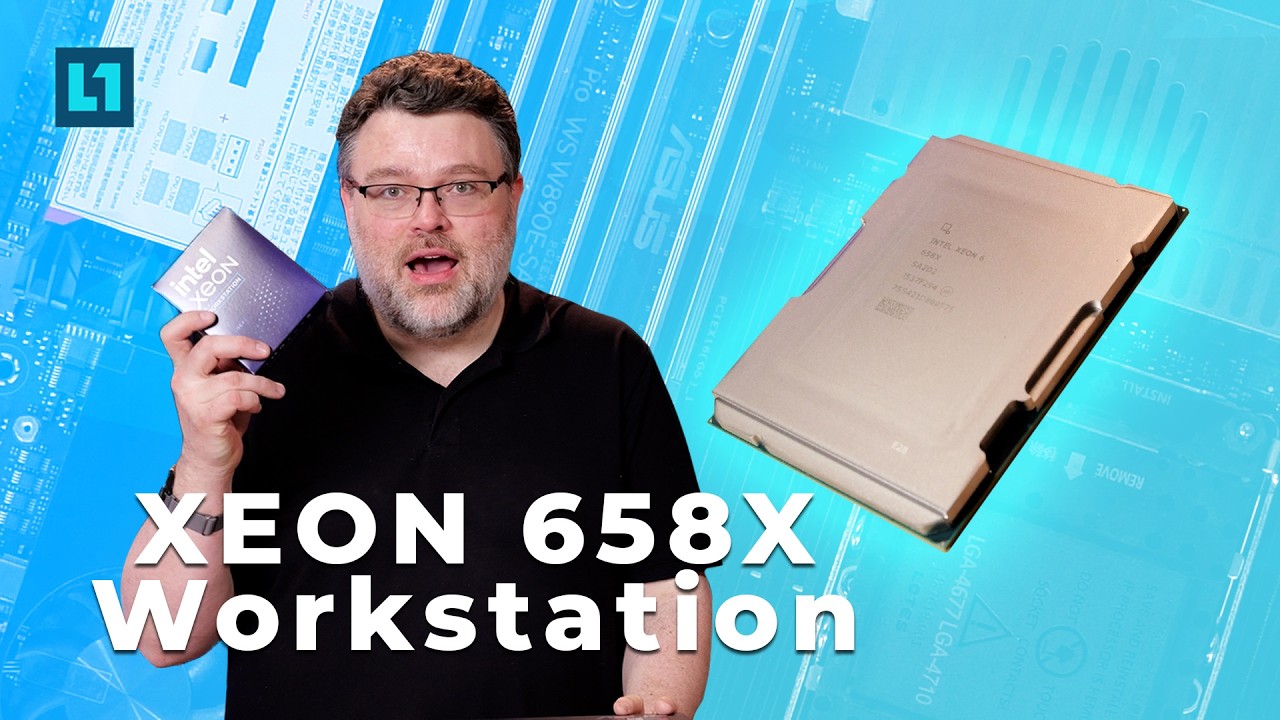
Intel’s Xeon 6 workstation launch, specifically the 24-core 658X paired with ASUS’s W890E Sage platform, is not about chasing peak core count, nor peak core performance, but more about redefining platform balance. This is effectively a workstation-class adaptation of Granite Rapids: 8-channels of faster DDR5, 128 lanes of PCIe Gen5, and a focus on sustained throughput rather than bursty, power-hungry boost behavior. Asus’ inclusion of active DIMM cooling and server-style features like BMC and dual PSU support underscores the direction—this is a server platform wearing a workstation badge, and the distinction is increasingly meaningless.
From a raw performance standpoint, the 658X is not able to dethrone high-core-count Threadripper. Lightly-threaded uplift is modest, roughly 5–7% over prior generation Xeons (but much more in multi-core workloads), and heavily threaded workloads still favor AMD’s larger SKUs. But that framing misses the point. Intel has shifted toward efficiency and consistency under load. Instead of dumping power into a few cores, Granite Rapids delivers materially better performance per watt at scale, with far less scheduler drama. The result is a CPU that feels more predictable and better behaved, even if it doesn’t top every chart.
Where this platform becomes genuinely disruptive is memory bandwidth and I/O. Eight channels of DDR5-6400 (and beyond, in practice) push real-world memory bandwidth into the 400–500 GB/s range, which is enough to fundamentally change workload characteristics. Many benchmarks that appear core-limited on paper shift toward bandwidth-bound behavior, allowing this 24-core part to compete with or exceed much higher core count systems. The same applies to PCIe: peer-to-peer bandwidth and lane availability make this platform particularly compelling for multi-GPU, storage-heavy, or accelerator-driven workloads. In contrast, AMD’s lower-core Threadripper Pro SKUs often underutilize their own platform capabilities, making Intel’s approach feel more cohesive at this tier.
This balance shows up clearly in modern workloads, especially AI and data-heavy tasks. AMX acceleration and sheer memory throughput allow the 658X to punch above its weight in inference and scientific computing scenarios, even when traditional CPU benchmarks suggest otherwise. The broader takeaway is that CPUs are no longer just orchestration layers for accelerators. In 2026-era systems, they are deeply involved in data movement, preprocessing, and coordination across increasingly complex pipelines. Intel’s design leans into that reality. Pat Gelsinger was right! The CPU is important here for these reasons, and AI Agents executing on the plan hatched over on the GPU side of things.
The net result is a platform that makes a strong case on capability per dollar rather than absolute performance. If you need maximum cores, Threadripper still wins. But if your workload is constrained by memory bandwidth, I/O, or platform scalability, the Xeon 658X is unusually compelling. You only need 24 cores to fully saturate 8 memory channels at 7200 and beyond? That’s a big deal for a lot of workloads. More importantly, it inverts the usual limitation: instead of less-expensive CPUs not properly utilizing the platform, here we have “modest” 24 core count CPU that can exercsie the features of the whole W890 platform. That makes me want a bigger core count SKU just to see what more cores can do.
Will we see even more memory bandwidth? At 6400 our best-case-scenario is just over 400 gigabytes per second.. with both CPU memory overclocks we can push well past that… It seems like this is the better platform for hosting a lot of networking and I/O if 24 cores is a sweet-spot for your workload.
This is not a result I was expecting at all, but I’m glad to see it.
 )
)