Intel Optane P5801X Review: The Great Value Brand P5800X

A couple of weeks ago, I snagged a 400GB Intel Optane P5801X SSD on eBay for $250:

I there appears to be very little documentation and public information on forums/websites for this SSD, so I thought I would make a short review.

The intel Optane P5801X is the little brother of the P5800X SSD. It was released in 2021 and uses the same 3Dxpoint technology as the P5800X. The key difference is the capacity and the interface: While the P5800X has capacities up to 1.6TB, the P5801X is limited to 400GB and 800GB. In practice, I’ve only ever seen it sold online in 400GB capacities.

This SSD can also operate at PCIe gen 3.0, albeit with a significant performance hit in both sequential and 4K random performance. See my old post here which also contains some information if you can’t get yours to work:

One of the problems with this SSD is the interface: E1.S. E1.S is even more different-er than U.2 inside a consumer PC. Luckily, it’s still PCIe lanes somewhere. So all we need to do is purchase a couple of adapters. I used this M.2 to U.2 adapter from Aliexpress:

https://www.aliexpress.us/item/3256807753213649.html

And this U.2 to E1.S adapter from Amazon:

I have mine zip-tied to the inside of my PC Case. Just to the right of the motherboard:

Onto the Benchmarks:

SSD was tested on the following System:

Ryzen 9 9900X
MSI X870E Tomahawk Wifi Motherboard
Intel ARC B580 Graphics Card
32GB DDR5 4800MHz

In 2025, we now have PCIe gen 5 SSDs hitting as high as 14GB/s reads. So while the numbers here aren’t groundbreaking, they’re still very impressive:

CDM

The most impressive is random I/O. Even today, this is one of the fastest single SSDs you can buy with incredible 4K random performance.

Personal observations:

I now understand what @wendell was referring to when using one of these SSDs as a boot drive. This SSD “feels” faster in a way that no benchmarking software can easily capture. Similar to when we transitioned from HDDs to SSDs well over 10 years ago. And it’s not something I can easily explain in a simple forum post.

Lightweight applications such as VLC Media player open instantly. But even bloated software like Fusion 360 or Microsoft word opens in 2-3 seconds. Not even my framework laptop with a PCIe Gen 5 SSD can open software this quickly. And once my PC reaches the POST splash screen, windows 11 boots up in under 5 seconds.

If you want to simulate what it’s like running an Intel Optane P5801X SSD, I suggest booting into a Linux Distro and loading the entire live CD into RAM. Then seeing how fast programs open for yourself.

Except this is what your PC is like… all the time.

Why did I call this a “great Value” Optane P5800X? Because Unlike the P5800X, this SSD can usually be found on AliExpress or eBay for ~$350-380. And while you need to use some adapters to make it work, it’s much more affordable than a standard P5800X. All for very close the same performance.

3Dxpoint was way ahead of it’s time. I do think NAND flash will catch up - eventually. But for now, this is one of the coolest, weirdest, niche technologies you can buy.
13 Likes

Wow pretty cool project! Is it running at full PCIe Gen 4 speeds with your adapter? Great job on the benchmarks, and that 9900X on an X870E sounds like a sweet rig!

That thing stacks up very well for a PCIe 4.0 NVMe drive even against newer PCIe 5.0 NVMes!

P5801X T700 T705
Price $250 $210 $265
Size 400GB 2TB 2TB
PCIe Gen 4 Gen 5 Gen 5
Seq Read 7GB/s 12.4GB/s 14.5GB/s
Rand Read 4k 1.48GB/s 1.5GB/s 1.55GB/s

I myself have an X670E Taichi. Given my mobo has only a single Gen 5x4 NVMe slot, I could see using something like that Gen4 Optane as a boot drive and using 2TB+ Crucial T700 or T705 in my Gen 5 slot.

Appreciate your thorough writeup!

4 Likes

Thank you for the review! I also bought one of these drives to use as a boot drive and am satisfied with it. Although the one I bought came with a (supposedly) PCIe 5.0 adapter card included, but was more expensive.

I do feel the drive is indeed very snappy as an OS boot drive, slightly more than a standard SSD. However, I am experiencing low real world performance in the case of copying locally (from drive to itself), for example copying large files sequentially in Linux (Pop OS 22.04) compared to Windows 10. I am only able to do local copying at around 650 MB/s in Linux compared to 2.5 GB/s in Windows 10, but am unsure if it is a limit of the drive or of the rest of my system. Do you see the same issue on your system?

My system config, tests and benchmark results can be found in the other thread about this drive on posts 52 and 54 to 57:

Wish Intel still made these drives…along with the 900p. They’re kind of like western digital’s velociraptor drives in a sense, fast but underrated.

Excellent review! Wish I saw this earlier. Information online is sparse and what information that is available can be confusing.

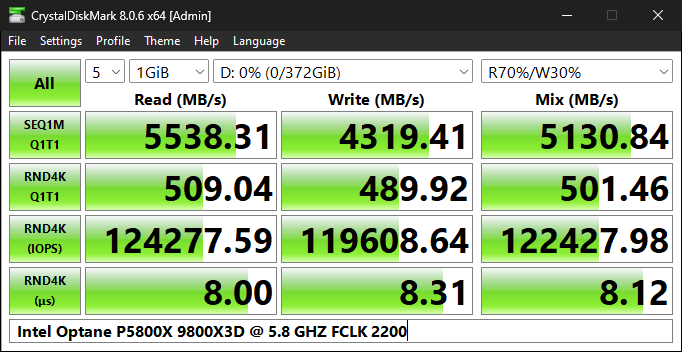
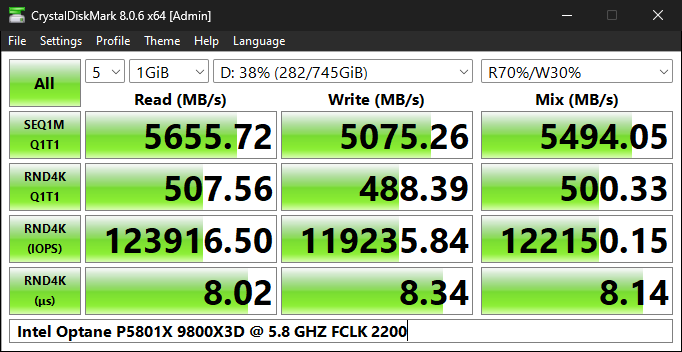
I know Optane drives are extremely receptive of single thread speed and how they are connected to the motherboard. Figured testing them both on the same system thru the same slot would be as close as I can get to an apples to apples comparison.

CrystalDiskMark_20250219235727
CrystalDiskMark_20250220001622

The Seq1 speed improvement on the P5801X was expected prior to testing this as its a 800GB unit vs the 400GB P5800X. The random speeds are the main test focus and do confirm they behave exactly the same.

Your analogy of a live CD loaded onto ram describes its responsiveness perfectly.

3 Likes

I’m using the p5801x as a bootdrive on my linux workstation as well, and am very happy with the performance so far, I havent quite been able to test whether it feels that much faster (or at least to make sure that its not just placebo) but if i open vlc on here vs on my macbook m1 air the difference is incredible, same with other programs. Of course its not quite an apples to apples comparison, given that the specs are much newer, 8 times as much ram etc. but given that apple has the memory integrated on the SOC i think its quite cool

1 Like

Your copying speed in linux is limitation of your file manager, which most likely uses only single-threaded copy procedure.

Thanks for the reply!

I did perform some tests locally copying a large file using different applications (Dolphin, Nautilus, Thunar and cp via terminal) and there were some minor differences. I also tired Thunar’s “Transfer files in parallel”, but I am unsure if that works for single large files or not. These were all within the 600 to 700 MB/s range compared to Window’s 2.5 GB/s copying speeds I was reaching.

This situation does raise a few questions IMO:
Does Window’s perform copying using multi-threading instead of single-threading? Or is there another reason for its performance advantage? Is there anything I could configure differently on my Linux install? Or is getting a faster CPU in single-thread the only improvement I can make?

1 Like

Hey guys, any of you can post the anvil benchmark results of a p5801x 400gb ?
I’m considering to migrate to one for a boot drive thanks

Any update brother ?

Use robocopy. It is much faster than using Windows drag and drop. I regularly get 750 to 850MB/s writes to a older 2 drive SATA SSD ZFS stripe pool with a 10gb connection. If i use the GUI its about 500 to 600.

Here you go.

I bought my P5801x on eBay for just shy of $300. I’m using the following two adapters:
amazon com/dp/B0DJJ9H76K?
amazon com/dp/B0DGFCXZ7Y?

I was able to route the cable through the rear IO heatsink area and get the factory NVME heatsink screwed down to cover the adapter, which I think aids as a strain relief.

Do these drives support ASPM?

First time and thanks for the info. Definitely useful review.

Have any of you listed your benchmark results (pref. with specs)? Any preference amongst level techs peeps?

For anyone interested, I just came across a 4 port PCIe 5.0 e1.s card:

Currently $99 USD at Amazon (Amazon.com: JMT ADT-R37 PCIe5.0x16 to 4-Port U.2/EDSFF Hard Disk Split Card 4x128Gbps 1 to 4 Expansion Adapter Compatible with Gen3/Gen4/Gen5 (R37D 5.0,to 4* E1.S/E3.S) : Electronics)

I just ordered one for 4 p5801x and will post a note after testing. Given it has a 6 pin PCIe aux power input, seems likely it will be great for them, should let them pull a total of ~150W

I’m optimistic, the ADT-Link stuff I’ve used in the past has been pretty good. Would love to ditch the ruler cards…

1 Like

How did the test go?

All 4 drives recognized, I was able to upgrade firmware and format as 4k. However I had some AER noise in my kernel logs for one of them when I started benchmarking

I didn’t have time to investigate further, I suspect it’s just a poorly seated drive.

Will post back when I have time to look into ut further

1 Like

Pretty great performance. I got one several years ago

Great find, would be nice if someone can teste it head to head against a Gen5 SSD. Like a full on test not just the burst copy speeds, since these beasts can hold their full write speeds no matter how large the file is.

Great post!

Interesting product.
Your numbers in benchmarks are very good!

I own a Dell EMC - Intel Optane DC P5800X 400GB SSD (053M3R).
I am using it with a Delock U.2 to PCIe 4.0 x8 adapter card.

That E1.S interface is a bit scary, for me.
But, I am still interested.

1 Like