Seems like there’s a lot of avid supporters of enshitification around here.
Some google-fu:
–Enshittification is the process by which online platforms and services gradually degrade in quality, shifting from providing value to users to exploiting them and business partners to maximize short-term profits for shareholders.
Please explain how this can apply to Linux or a distro?
2 Likes
Gentoo.
Gentoo Gentoo Gentoo Gentoo Gentoo Gentoo.
Gentoo.
Just use Gentoo. It’s made for old farts who don’t like new stuff but also for whippersnappers who want systemd and hyprland and everything else.
It’s odd to look at a big company like Canonical doing something you don’t like, then try and pretend this means Linux is imploding and becoming Windows 2. As if you can’t just… not use Ubuntu.
It’s like complaining about Gnome as if there aren’t 47 DEs/WMs to choose from. Yeah I don’t like the choices the Gnome devs have made so I just… don’t use it.
Heck, you can use KDE 3.5 if you want: Trinity Desktop Environment . It works on most distros.
The last like 2/3s of this thread has been people getting inside a box then complaining about the box. Just step out of it. Thus the bird cage meme I posted above.
4 Likes
can yall please take it easy with the dissing and jabs at each other cause i dont want this thread to taken down for something as childish as insulting each other
How do you know /var/log exists? Or what each of its files contain?
Because systemctl status tells you.
How TF you jumped from containers to walled gardens is beyond me. Lay that stuff off.
Now you’re making a fool of yourself. There’s nothing in the Wayland v X11 divide that’s even remotely related. Moreover, some of the most popular Wayland compositors are, in fact, keyboard-first/keyboard-oriented.
4 Likes
“Enshittification” is more than just online services. It relates to hardware, software, or anything else in the world. Your box of cereal that gets smaller and smaller while getting more expensive? Enshittification. Your pair of jeans that would have lasted 5x as long in the past? Enshittification. Your washing machine that will break within 3 years, when your old one lasted 30 years? Enshittification. Stores that used to be well stocked but now are filled with useless and unwanted kickback-financed flashy displays, product selection decided on by how much a vendor bribes the store to carry it, hidden cameras that manipulate pricing depending on how much they think they can gouge you for, all the while the things you actually want are online-only? Enshittification. The list goes on and on.
If anyone remembers the pictorials Mad Magazine used to do giving satirical views on how a company, store, or whatever could provide a horrible customer experience; I think a lot of these MBAs thought they were instruction manuals rather than comedy.
Right, all in the name of profits. So again, explain how this applies to Linux?
2 Likes
Ah yes, there’s another example of “enshittification”; the inability of people to read and think.
Translation: you can’t answer the question.
Every single example you just listed - shrinkflation on cereal, planned obsolescence on appliances, vendor kickbacks, and MBA greed, is driven by corporate profit extraction. (can you read that?)
Linux is a community-driven, decentralized open-source project where anyone can inspect, modify, and fork the code for free. There are no shareholders, no quarterly earnings calls, and no corporate margins to juice.
You diluted a term with an actual economic definition into “things in the modern world that annoy me” because the moment you’re asked to explain how community developers modernizing an open system fits that definition, the premise completely falls apart.
Also, Deflecting with an insult instead of answering a basic follow-up doesn’t make you look sharp; it just shows everyone reading that you ran out of gas while on that short-bus of yours. If you can’t connect your own analogy to open-source software, just say so buddy. It’s ok to be wrong.
2 Likes
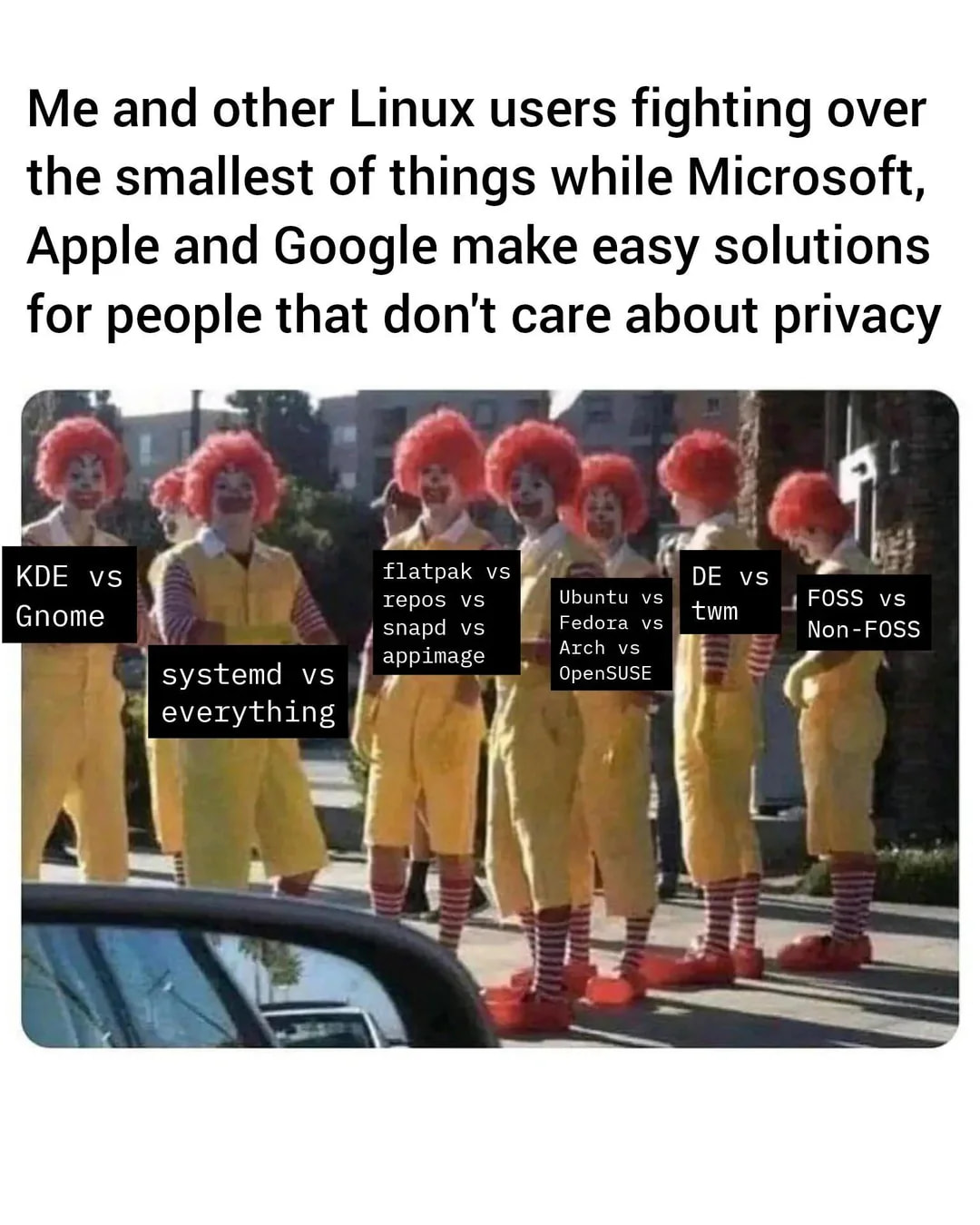

You DO understand the concept of “metaphors”, don’t you? Probably not. I’m done here, Think whatever you want, youngster. I’m done trying to talk sense into you people.
Right on schedule: the retreat to “it was just a metaphor,” throwing out a condescending “youngster,” and rage-quitting the thread when pressed for a single shred of substance.
A metaphor only works if the two things actually share a mechanism in common. Next time take a minute to lookup the word you’re basing your whole argument off of before coming to the shootout, ok good buddy? I Suggest some ice for that burn grandpa. Get some rest.
3 Likes
As a noob i was overwhelmed and used to think less fragmentation would be better. But every project has a reason to exist. At least for the maintainers. It is a bit like evolution where the strongest survive. But for that to happen, we need more than one option to begin with.
Ubuntu heard you  The problem with that is, who decides which one is it? And who forces that one OS to play nice with all DE or TWM? And who forces that ”one” OS to improve? This is what happened to Windows and Apple, they made it a quasi-standard, and then just are mean to us. The same would happen if there is a single distro. Plus all the political things that now go on in Linux. Some people wouldn’t be allowed on Linux if there only was one standard.
True. But some distros are very close. Linux has a steep hill to climb since it isn’t pre-installed. To make up for the effort of installation, it needs to be even better than Windows/Apple.
And 99% of people will never ever install an OS on any device. Even most Windows user will never do that and have a “neighbor kid who is a computer freak” help them run the virus scan if they ever have an issue.
I’m actually surprised Linux is at 3 or 4% (or whatever) as that implies people actually figured out installation, or had a helper.
1 Like
Today’s dose of enshittification is brought to you by Canonical and the Snap Store (which marketing forced them to rename to “App Center”):
In 26.04, we are taking initial steps to centralise software management and make App Center the single place to handle all applications, independently of the packaging format..
“the SINGLE place to handle ALL applications”
This is a foundational step to creating a walled garden. Restrict software to a single point of entry — which the corporation controls.
Another step is to add friction to any options you want to ultimately remove. Canonical has already done this in various ways: .debs couldn’t be opened for 3 months or so; flatpacks don’t even get shown in the store by default; apt installs get hijacked and replaced by snap installs; etc., etc.
Since normies can’t be bothered using the command line to bypass the restrictions of the Snap Store / App Center, the uproar will be muted when those options are removed completely down the track and the final walls go up.
Congratulations, you are now trapped in an iOS-esque walled garden. Warden Canonical controls what is available and what can be installed. ¿Comprende?

Congratulations, it took 194 posts someone finally found an actual commercial corporation with profit motives to apply the word “enshittification” to.
Nobody here is going to defend Canonical’s push to force Snaps, stealth-replace apt packages with snap wrappers, or steer users into their own managed frontend. It’s obnoxious at best and the community has rightfully called them out on it for years now.
The problem is that Ubuntu is not Linux, It’s a distro.
Canonical is a single private corporation packaging a downstream commercial product built on top of Debian. They don’t own Debian. They don’t own the Linux kernel. They don’t control Fedora, Arch, openSUSE, Void, Gentoo, or Alpine. And on an enthusiast forum like this, my bet is that most people aren’t running Ubuntu as their primary daily driver precisely because of decisions like this. (at least I would hope not)
To make another point: An “iOS-style” walled garden requires hardware lock-in and a total monopoly over the platform. Canonical has neither. The entire reason Linux cannot be turned into a corporate walled garden is that the second Canonical pushes something people hate, downstream projects strip it out (like Linux Mint ripping snapd out by default) and users migrate to another distro in an afternoon.
You proved that a commercial distribution vendor can make anti-consumer design choices. You did not prove that Linux itself is becoming a walled garden. If anything, the fact that the wider Linux ecosystem routinely rejects Canonical’s proprietary pet projects proves the exact opposite: decentralization works, and no single company gets to dictate policy for the rest of us.
4 Likes
Just don’t install Ubuntu.
Your point would work if Canonical controlled Linux like Microsoft does Windows NT or Apple does Darwin. As MadGoat pointed out, they do not.
It could maybe kinda work if Ubuntu was the only “install it and use it” distro, but we’ve got CachyOS, EndeavorOS, MX Linux, prolly more I’m forgetting (I don’t put Fedora in this category because it doesn’t ship with the RPMFusion repos enabled). The Linux Mint team has a Debian-based version too IIRC.
You’re simply not forced to use Ubuntu so the fact their maintainer (Canonical) did some big corporate buffoonery as usual doesn’t really mean much.
2 Likes
It is not one thing, it is 10 or more. What is the Unix/Linux philosophy? Do one thing and do it really well. Systemd flies in the face of that.
One thing that bothers me is the Journal. It is binary files. If you try to read them manually, they make no sense. Which means if I have a machine that crashed and I cannot get it running again via chroot or similar, I cannot get ANY logs of what went wrong. No way that I know of.
The other thing is that there are so many components. Do you notice something? Not a single distro uses all components. If Systemd is so great, why is that?
I also do not like the networking-part of Systemd. It becomes a major pain when I set up a DNS server at home. I have to shut the Systemd part down, delete it, uninstall and replace it. Just to be able to set a DNS server for DNS queries to connect to. That is ridiculous. Instead of editing a config-file and setting an IP-address…
“Yeah, but no normal user…” There are no normal users. Half the people run Pi-hole and similar stuff. There is just going to be more custom solutions, like ad blockers, Javascript-stoppers etc as companies become more and more aggressive in mining your data. What’s next? That will be the new normal.
microsoft, macos, ios, and android are knocking at the gates: fights over systemd which is otherwise functional.(and wayland from the inside and outside too)
Didn’t say it was free of trade-offs; officially Windows 10 doesn’t “support” heterogenous CPU types either, but it runs. CPU performance is rarely the bottleneck these days anyway, its IO or RAM.
You take the set of trade-offs and you make your choice.
This.
Do I like systemD? No.
Is it the worst thing in the world and I’m unable to deal with it? No
If choice of init system is such a burning issue for someone, they clearly don’t have any real issues to deal with in their life.
Realistically, if you’re deploying a typical app to linux today (as a server) it really doesn’t matter so long as the host can run docker or node or whatever.
And on the desktop? Its largely irrelevant and something the average end user never really needs to touch or care about.
1 Like