Interesting. Good to know, how ever it’s still a hard pass for me.
Those apps can still be collecting telemetry from within the sandbox, such as your phones model and version and such (which doesn’t require permissions). And lord knows what ever else in those tracking libraries and the ever shifting android API…
private fun GetBuild() {
    val manufacturer = android.os.Build.MANUFACTURER
    val model = android.os.Build.MODEL
    val brand = android.os.Build.BRAND
    val device = android.os.Build.DEVICE
    val releaseVersion = android.os.Build.VERSION.RELEASE
    println("Manufacturer: $manufacturer")
    println("Model: $model")
    println("Brand: $brand")
    println("Device: $device")
    println("Android Version: $releaseVersion")
}
This above sample requires no permissions defined in the manifest, and just works out of the box. Quite frankly I think android is lacking a permission for information like this. It’s still a terribly leaky platform.
They can provision what ever they want on their phone. They will be provisioning nothing on my phone. I require complete physical, digital and psychological separation. No exceptions. No compromises.
Telemetry is fine, especially on android where a lot of devices/brands do things in different ways and require model/version specific workarounds in the app.
I only care about protecting personal data, I think going overboard and allowing zero telemetry is a deteriment for software development. Nobody reports bugs and even when they do they lack the ability to provide useful info for debugging.
Neat, this kind of bs data collection about installed applications should be severely limited when the browser is a flatpak and the permissions are hardened with Flatseal. Not sure if more hardened browsers like Librewolf can hide the installed extensions.
I do try to push my colleagues towards TOTP, but I notice that some choose SMS when they can.
I think it’s simply because it’s a better User Experience (UX) for them. They get the SMS on their phone, which means they only need to glance at a notification to see the code. Maybe even glance at a connected smartwatch.
It’s not a huge thing, but it’s evidently faster and more convenient than opening an app to get a TOTP code, or responding to a push notification in an Authenticator app.
I have another reason to hate SMS, which is that it gets less secure every year.
SMS messages are sent unencrypted over the wireless {mobile|cell}phone network. Anyone can read them. The move to RCS/iMessage means that some might be sent over that instead, but we can’t rely upon it.
I can’t find the links right now, but I remember seeing stingray type devices talked about by researchers twenty years ago or more - and the price was over ten grand. A few years later, it was a couple of grand. Ten years ago someone built a “phone mast in a printer” with a Raspberry Pi and a software defined radio - Want to spy on the boss? Try this phone-mast-in-an-HP printer • The Register . Given this it’s hard to believe that the cost now would be more than a few hundred bucks.
SMS is insecure. It can be intercepted for far less money than you think.
I understand why my colleagues choose it, but I warn them that at some point my company will remove the option. It’s not a matter of if, it’s a matter of when, so why not move to TOTP now?
I thought the semi recent issue where SMS was compromised and 2FA codes were stolen would have put an end to SMS based 2FA, but the entire industry seems to ahve forgotten that incident as soon as it dropped from the headlines.
I would choose pretty much any other system for MFA, but me not electing to use it doesn’t mean diddlysquat if an attacker can simply opt to use it when trying to reset the password on my account.
My guess is it continues to be used because businesses want to make sure you must provide your phone number when signing up, so they can use it to data mine you as a key database field to associate your data with other sources of data.
So much of our data is flowing around out there, but if there isn’t a unique identifier (like a phone number) associated with it, so it can be compounded with other sources of data, it’s value drops precipitously as mistakes are easily made when trying to combine multiple data sources.
Remember that harvesting and monetizing your data is a good chunk of the revenue for almost every single business, or product, online or not out there right now, and if they can tie the data traces you leave to a unique identifier (like a phone number) that data is much more valuable to buyers.
That said, I use randomly generated very strong passwords, and never under any circumstance click on links in emails that could be deceptive. As such, I would honestly like an option to not have 2FA/MFA at all.
It bothers me immensely that the lowest common denominator idiots who can’t be bothered to have strong passwords or are fooled by deceptive links force us to endure this bullshit.
My work used to allow SMS based 2FA, but switched to the MS authenticator last year.
Which I thought would be an upgrade.
Now I wonder how long I will be able to log in though. Because MS has also said that it would not allow the authenticator to work on non-standard ROMs… And I run /e/OS
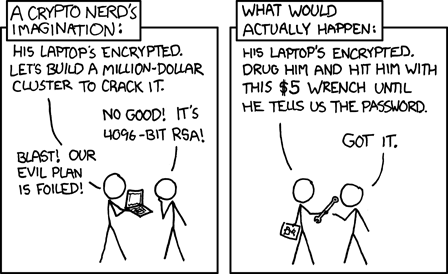
Some script kiddie in Russia is not going to assault me with a wrench from 5000 miles away.
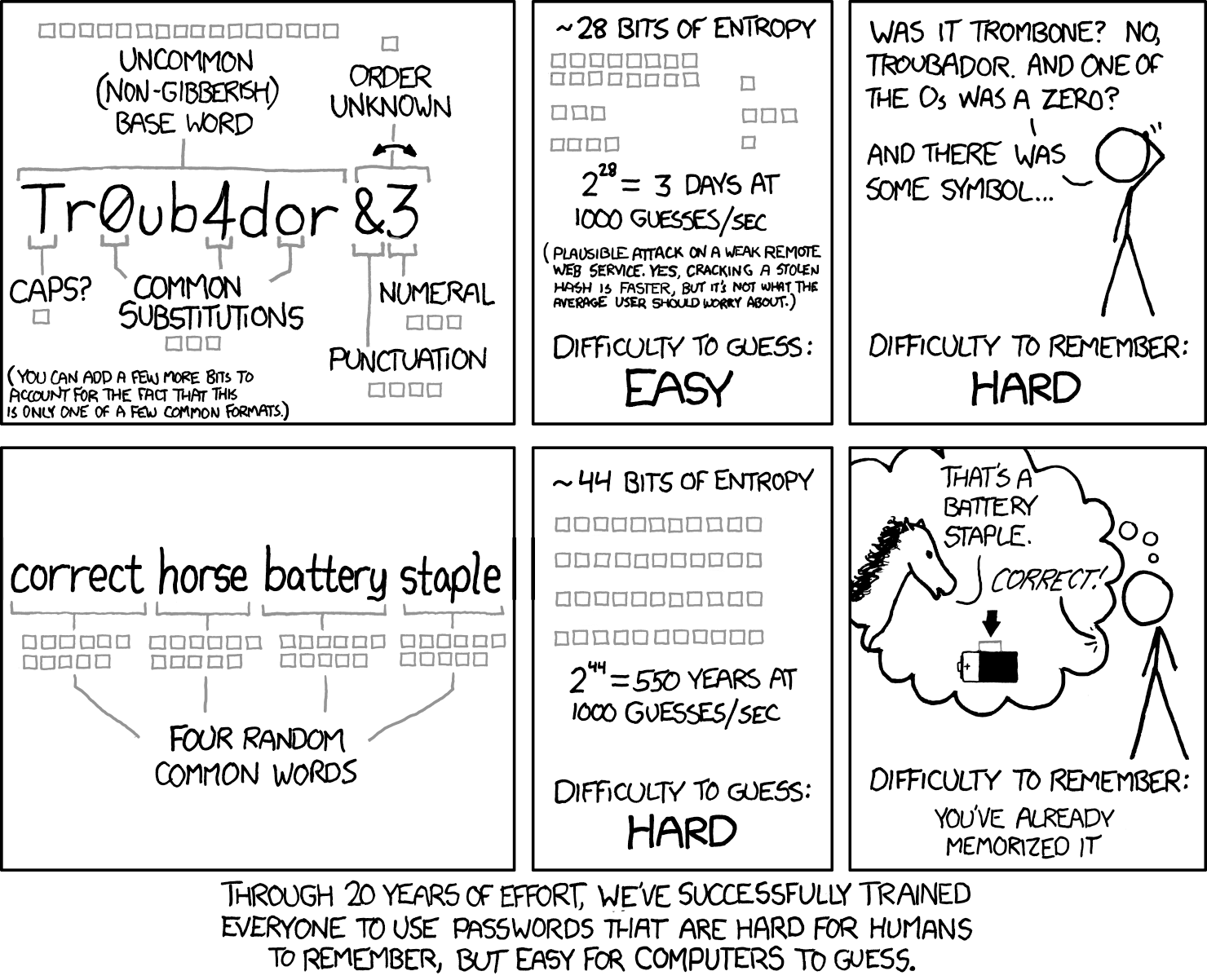
I’d argue that remembering a password is the problem to begin with.
I think everyone should use encrypted password databases. At that point you never need to think of a memorable password. Just randomly generate a unique one for every site and store it in the database.
My database sits on my NAS. Not only is it strongly encrypted, but the remote SSH connection can only be established my my private key.
I need to remember exactly one password in order to access all of my passwords, and they can be as complex and long as I want them to.
Here’s one I just generated:
|÷oÖ´Åo%ÅuVÎo&Q÷õEA0ó·d¤¥$ؤ´f\ã¸ûÎï¸39?[wòûÊâIÉq!ùÔ>HaZ¦®h×5¦ðÆj×1óë¯JeIJ{ëÛ/&Ø*¼ÔûüÔà¾4Äã§+ÖÓãô’¢¸ÛÇkVd¼êVLCÿSdCø~-gê³Ls«@BRÙd
It’s 757.30 bits of entropy.
Only time this plan backfires is - for instance - when you need to type it in manually to set up a new phone.
Telemetry that is on by default with no way to opt out, is not fine. Not to me. If it’s optional and can be turned off, that’s fine.
I don’t care if it’s a detriment to development, that is their problem. Not mine. Case and point that windows has more telemetry than ever, and windows is still a POS and getting measurably worse year over year…
And I don’t want to have to dig through 100+ pages of TOS and privacy policies to find out what your collecting and who you are sharing it with. And that’s even if you can trust them, which in many cases you can’t. Case and point the recent linkedin thing where they do not disclose what they are collecting in their TOS. These perverted databrokers don’t understand that no means no. They will take anyways.
Even if you can trust them, they will eventually leak:
And then this becomes problem number 2. Now you are also forcing me to run a particular OS?
This is the same issue with banking apps and integrity cancer. Further locking in the gatekeepers and duopoly of having to choose between iOS and “certified” android.
If your shitty authenticator doesn’t run on my Ubuntu Touch device, well that’s your problem. You don’t get to make it my problem.
This will not mitigate the in-browser Active Extension Detection (AED) and DOM walk. Check out the how it works section, eg:
Stage 2: Passive DOM Scanning (Spectroscopy)
Independent of the AED scan, LinkedIn runs a second detection system that walks the entire DOM tree looking for evidence of extension activity.
Many Chrome extensions inject elements into web pages: modified HTML, added scripts, altered attributes, UI overlays. When they do, the injected content often contains references to the extension’s internal URL scheme (chrome-extension://). Spectroscopy finds these references.
As well as the other fingerprinting methods, canvas, etc… It is not a permissions issue.
If you have javascript enabled in chrome, you are vulnerable to this. They seem to target chrome primarily, but you can still walk the DOM via javascript on Firefox, so yes LibreWolf too can be targeted if you have JS enabled and aren’t using the canvas blocking.
Effectively, everyone by default, unless you are a “crazy person” who disabled JS.
They aren´t… because they never thought about there being people without a smartphone or OS other than “regular” Android or iOS.
But I do wonder what they’ll do with it, because I won’t buy another phone for them. I’m not contractually obliged to do that… If they want to give me access, provide me with a work phone (which will just live on my desk without a pin to unlock it) or give me a hardware token.
Banking apps aren’t really a problem here. They work perfectly fine without Google services. You only need to download them through a MicroG anonamised account or sideload them. Which was something I checked before I switched to /e/OS.
Perhaps your particular banking app is fine, in which case you are lucky.
But there are tons where this is a real growing issue where they rely on Goolag Malware Services and Play “Integrity”. GrapheneOS for example has issues with many banking apps:
Functionally speaking, they are forcing you to run a particular OS or not be able to use your bank. It’s absurd.
Unless your bank disabled the website and only allows the app, as has happened with some banks. I forget where, trying to find the article…
edit, not the source I was remembering, but stuff like this:
Its even going as far as not allowing you to have even have adb enabled on your device (no usb debugging / developer settings):
The there is a growing trend towards forcing apps. And only running on some “authorized” OS’s, therefor forcing you to use a particular OS.
I will use my banks website as long as possible. If they ever force an app, I will find another bank, or only go in person and use plastic. I absolutely refuse to run google malware services on any of my devices.
I have never installed a banking app in my life, and I ain’t about to start. (yes, I am stubborn…)
Additionally, many of these authenticator apps use push notifications, and those do rely on google. May not be an issue if you can go in-app and refresh while waiting for your token to arrive.
Also, some parking companies require an app to pay for parking. I am not installing an app, just to park a car. This is truly absurd.
Why is it that we are forced to use either google or apple in order to participate in society? Further cementing these gatekeepers as our overlords?