I already use Radeon Pro V340 for workloads. My stepdaughter is into journalism and photography. My stepson just got in trouble for using AI on one of his tests. My youngest daughter is an elementary school and is already showing interest in utility for AI, large language models.
I’ve shared the workloads to my stepdaughter and now showing my stepson the art of prompting.
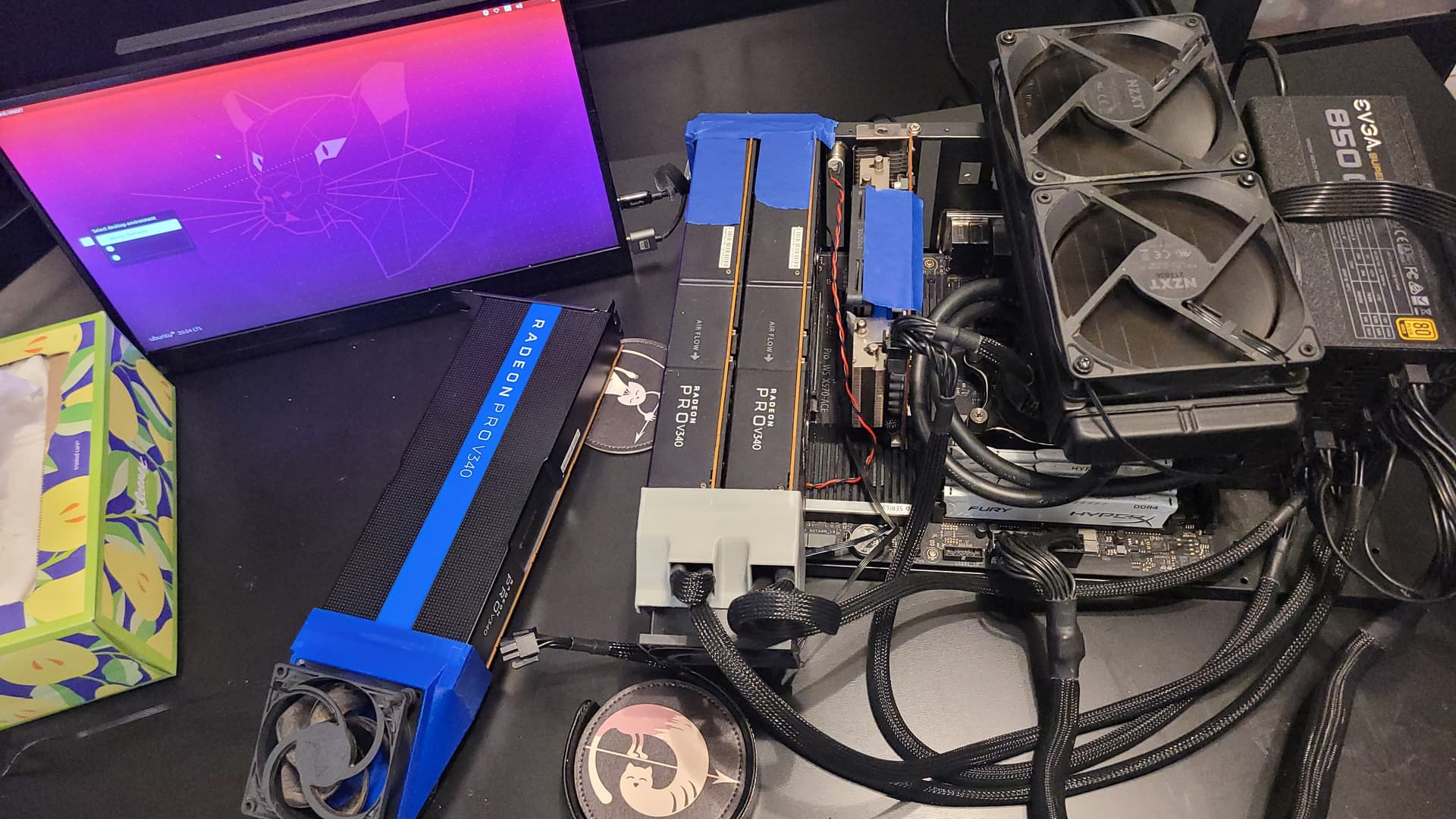
A hybrid GPU environment where a Radeon Pro 9700 functions as the host, visualization, and orchestration GPU, while three Radeon Pro V340s operate as scalable, multi‑tenant compute resources. The goal is to deliver reliable, isolated GPU acceleration to multiple users while maintaining a stable workstation environment for administrative and supervisory tasks.
The Radeon Pro 9700 anchors the system. It runs the primary operating system, manages display output, and hosts the orchestration layer responsible for scheduling, monitoring, and allocating GPU resources. Because it handles the desktop and driver stack, the 9700 ensures the V340s remain dedicated to compute workloads without interference from visualization or OS‑level GPU tasks. This separation improves stability and prevents driver conflicts that commonly arise in mixed‑GPU environments.
Each Radeon Pro V340 contains two physical GPUs and supports SR‑IOV, enabling the creation of multiple virtual GPU functions (VFs). These VFs can be assigned to virtual machines, containers, or user sessions. Depending on workload requirements, each V340 can be partitioned into four to eight VFs, allowing the full system to expose 12 to 24 isolated GPU slices. This makes the architecture ideal for multi‑tenant environments where users require predictable GPU performance without affecting one another.
The 9700’s orchestration layer monitors GPU utilization, assigns VFs to users based on demand, and reclaims resources when workloads complete. This creates a dynamic, scalable compute environment where light users receive a single VF, heavier users receive multiple VFs, and specialized workloads can be assigned entire physical GPUs.
This architecture blends workstation stability with datacenter‑grade virtualization, enabling efficient, flexible GPU distribution across many users while maintaining a clean separation between supervision and compute.