There are a lot of people fighting to preserve the ownership and right to repair your stuff. Follow these people and support them in their efforts the best you can to preserve your right of ownership software & hardware.
2 Likes
Just like back in the day people will find a way. I have a suspicion the kids more so than the grown ups. As in my older age I feel I was more resourceful when I was in school to get around the bullshit than I am now but I didn’t work and was in school with free time if I wasnt outside playing, Its a different sandbox now but its still a sandbox and those with a need and time well idle hands will always find a way. That and when enthusiasts get back into older spaces they thrive for a reason. I’ve always been under the impression passion leads to innovation and needs lead to money flowing to the ones who show it in their work. Its def a slower road. Laws are if you have ever been on both sides are just guidelines for the niave. People don’t tend to get arrested until they piss off the “right” or “wrong” person.
1 Like
The reason why the classic Personal Computer dies is because of the users. we, the older generations are still used to the PC as the general machine for daily usecases but the younger generations replaced it with smartphones. that’s a simple fact, these younger generations want a small, mobile device that can be used everywhere at anytime. cloud-power is necessary if they need applications with a strong compute power. times are changing.
From personal experience, gdpr is mostly smoke and mirrors whose main effect is give a job to certification firms same as ISO9002 and most others. Its just a racket
Kids are taught, and if they aren’t taught, society will teach them what you may not want them to know & do.
Most certs especially ones that require CE’s are rackets.
This is just a silly argument that only makes sense if you look up literally nothing and believe every word of it at face value
More kids buy real desktops today than any generation before them bought them. There are literally more gamers playing specifically Fortnite on PC than desktop PCs had been sold TOTAL GLOBALLY by the year 2000. Let alone all the kids who use their PCs for college, research, CAD, engineering, and more.
I don’t have much GDPR experience, but when it comes to QMS standards (I think you mean ISO9001, as that is what manufacturers certify to, not ISO9002, which is just a guidance document on how to comply with ISO9001.
I have spent a career in the medical device industry working under ISO13485, which is essentially ISO9001 on steroids targeted at the medical device industry, and I honestly do not know how anyone runs a reputable manufacturing business without some form of ISO certified QMS.
The only downside I would say ISO9001 has is that it is not as strictly enforced as ISO13485 is, and as such is not as effective at proving an organization is trustworthy, though many might suggest that this is a risk-based decision, as ISO9001 organizations are rarely as high risk as those certified under ISO13485, where failures can easily kill people.
I would argue that strict adherence to a QMS like those defined in ISO9001 or ISO13485 are not just a good idea, but are absolutely critical to running a reliable manufacturing organization, and when a manufacturer lacks these certifications it is usually an indication that they like to cut corners and not do things right.
The biggest problems with these standards is that the business seeking to be certified pays the notified body which certifies them to the standard, and the notified bodies are for-profit organizations who who love growing their business, which means that there is an inherent conflict of interest.
At least in the more regulated ISO13485 world though, this is tightly controlled by competent authority oversight of the notified bodies, and the notified bodies don’t want to get into trouble with those competent authorities, so it helps keep them mostly honest.
On the ISO9001 side there may be less of that. I am not sure. I have never actually worked in a non-regulated industry, so I don’t have first hand knowledge of exactly how strict ISO9001 notified body auditors are.
2 Likes
GDPR is not really relevant to this conversation as it relates to organizations storing, processing and using data of individuals, their protected characteristics and sensitive information. It covers quite a lot from individuals having the right to access, amend or remove their data as well as requirements such as you can not store the data unless you have a legitimate business use. Anyone who wants to, please feel free to complete my mandatory GDPR yearly training 
GDPR has some pretty sharp teeth when it comes to force companies to remove your personal records, like Apple after some moron signed up my email address for an AppleID.
After being told it couldn’t be unlinked for a month, suddenly it was fixed.
Something on this wide ranging general theme of personal computing becoming unaffordable; look at windows (and its app ecosystem) becoming ever more bloated to run on a desktop… how many cores is the current minimum? My win 11 IDLES at 11.3 GB ram…. [eye roll emoji]
On the other hand, they sell windows 11 laptops and mini PCs with 4gb of ram now. They’re essentially unusable, but they do sell a lot of them.
All desktop systems will cache as much data as possible, there is no reason not to use all the system memory.
The cache memory will be freed when an application wants to allocate more memory.
Loading the same data over and over from disk, while having free system memory, would just make the OS feel less responsive.
Never gunna happen because consumer market buys PC and company’s own the govnment.
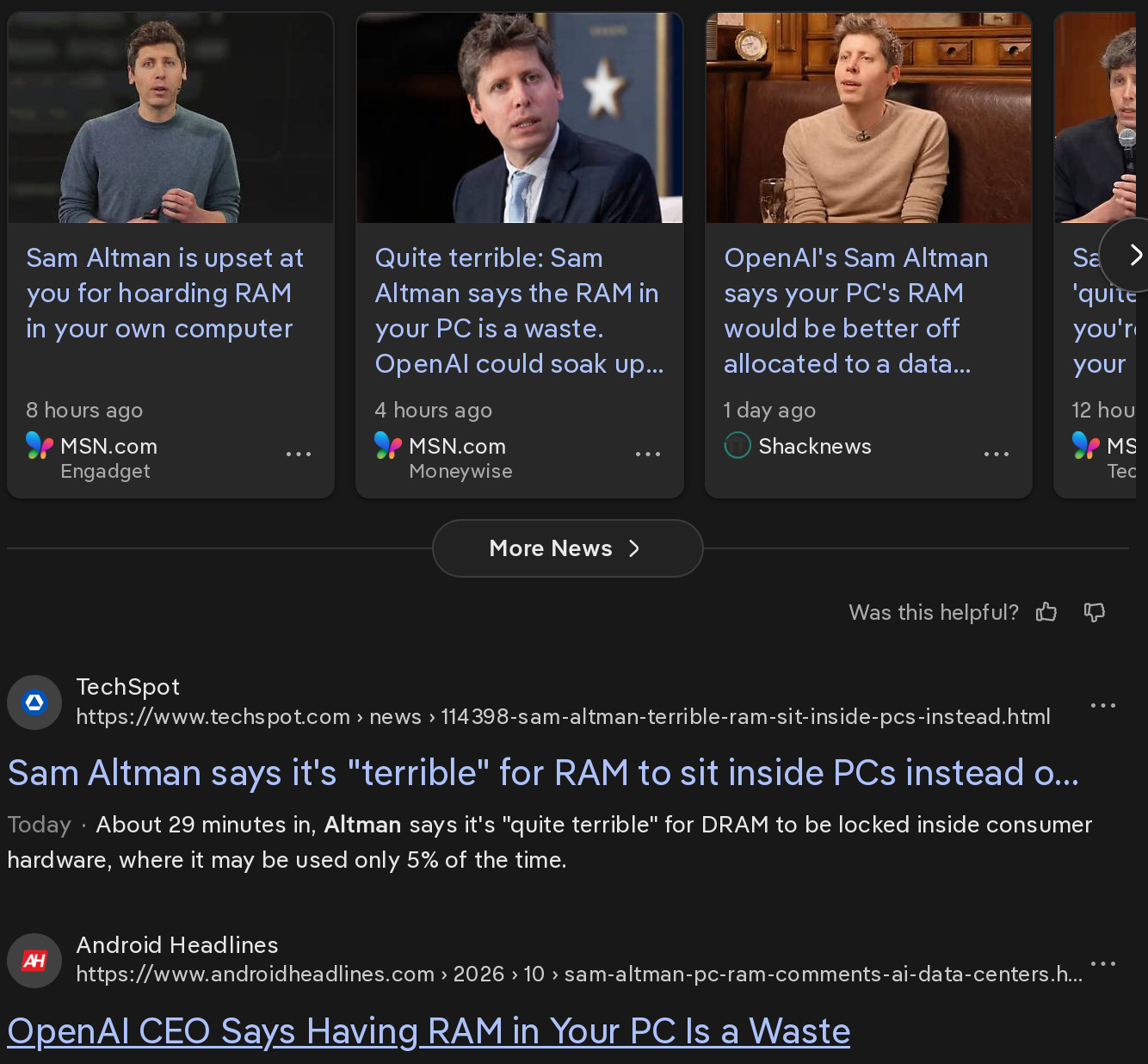
The man who totally didn’t murder/suicide his own former employee (allegedly) is telling everyone the RAM in your personal system is a waste and would be better off in data centers.
I think the technocratic class definitely wants an end to compute that individuals control. They wanted everything as locked down as an eyeProduct or PlayStation (although the PS5 seems to have a new exploit a week at this point). That’s the whole point of “age verification.” The Altman’s, the Musk’s and the Dario’s of the world want all your interactions through a cloud service where they can track and tag every individual.
An earlier time would have meant an explosion of people buying personal devices like the DGX or Halo devices and they’d be dropping in price.
Cloud infrastructure and its consequences have been a disaster for the human race.
2 Likes
I don’t think, they official ban home PCs. The outrage would be too much.
I think, at the moment it is a big bet from these rich/ai corps on the future. Altmann wants to have all our RAM or all the RAM of the world. But even if they buy most of the available stock, it is wasted/unused in warehouses because they don’t have the datacenters to use it all, yet.
Maybe they never will because these have to be build in the first place and they need cooling and even more important power which is not available in such amount needed. So, even when they have the compute with RAM, they don’t have enough power.
They are betting on the future, on not now existing data centers, power plants and cooling solutions, because even on this water planet is water a finite ressource. Maybe all of it will never be available in such amount.
The bet hurts the whole world because a lot of jobs, companies and families will suffer and nothing is preventing this bet.
They just buy everything they can get, so that competitors won’t be able to buy it. We had a similiar scenario before. It wasn’t the RAM, it was human ressources. The big firms hired a lot of personal which they didn’t need for their day 2 day business. But they hired them, so that they wouldn’t compete in any way. A lot of these employees got fired some time ago. Now they do the same with components. They have too much money to play with the market.
We have to make sure that their bet will be lost in the end.
Strata, OSS models, Wendel with L1T and their solutions, etc. should help to make AI more locally feasible to give solutions to AI using companies to run their own AI instead of renting and giving money to the big corps and their bet.
1 Like
There will always be Lo-Teks lurking in the fringes, cobbling together working stuff from other peoples junk, building communities into abandoned bridges…

2 Likes
You missing a point man it’s not the computer it’s the operating system that it runs and when that operating system can be controlled by the government
oh yeah.. GDPR do have teeth.
That is why FlockCameras never will become a thing over here.. as GDPR laws prevent companies to save identifiable data about everyone. You have to be a customer for them to save your data.
The same with shopping stores using face recognition.. that will go against GDPR.
Microsoft might end up in a lawsuit after it got known in July 2026 that a hacker got caught do to Microsoft Telemetry and its GDID that could identify the user to the telemetry data. This is a violation of GDPR.
I have a home alarm with camera surveillance.. i cant do as people in U.S. and point my camera out toward the road as that is a space for everyone. That is against GDPR as i then can collect data about others. So only on my property and toward my house that isn’t a space for everyone.
And as others visit my home, they do get caught on the camera. So i can never upload a picture online on anyone without their consent as that is a touch of GDPR too.
But i can say this.. its kind of comic Discord has age control, but they refuse to obey to GDPR. 
as for the topic.. no i do not think the personal computer will be banned.
I think as someone above wrote… do to people using computer less and less, they will become a hobby or a business tool. The concept of home-computer will be replaced with smart-TV and smartphone and tablets.. a docking station to your smartphone to get keyboard, mouse and a screen, like you have to laptops.
Or you have a keyboard and mouse to your smart-TV.
As for nerd like us in here and gamers.. the personal computer will continue to exist.. even it will become expensive as fewer is made.. It’s one thing for HP or others to make a new computer and split the development cost on 10 billion people.. then to split the cost on 100 million people.
This is why smartphones was expensive in 2008-2010 compare to now 2020-2024 (before Ram crisis) as more units they make, as cheaper they become.
2 Likes