I’m just trying to figure out what kind of current hardware would be required to match or somehow exceed Opus 5.5? As it seems to be the new peak of solid general AI coding performance?
I know matching the software capabilities of GPT / Claude for long running goals is another matter, or has that been figured out yet? I haven’t tried running linux/open code on a while on my RX 9070 XT system, but previous it was quite a pain and barely worked, didn’t try a lemonade server though.
Like Might Gorgon Halo with 196GB of memory be alright? Or would someone need that new Threadripper Halo system with 4 MI350ps? Or the NVidia equivalent.
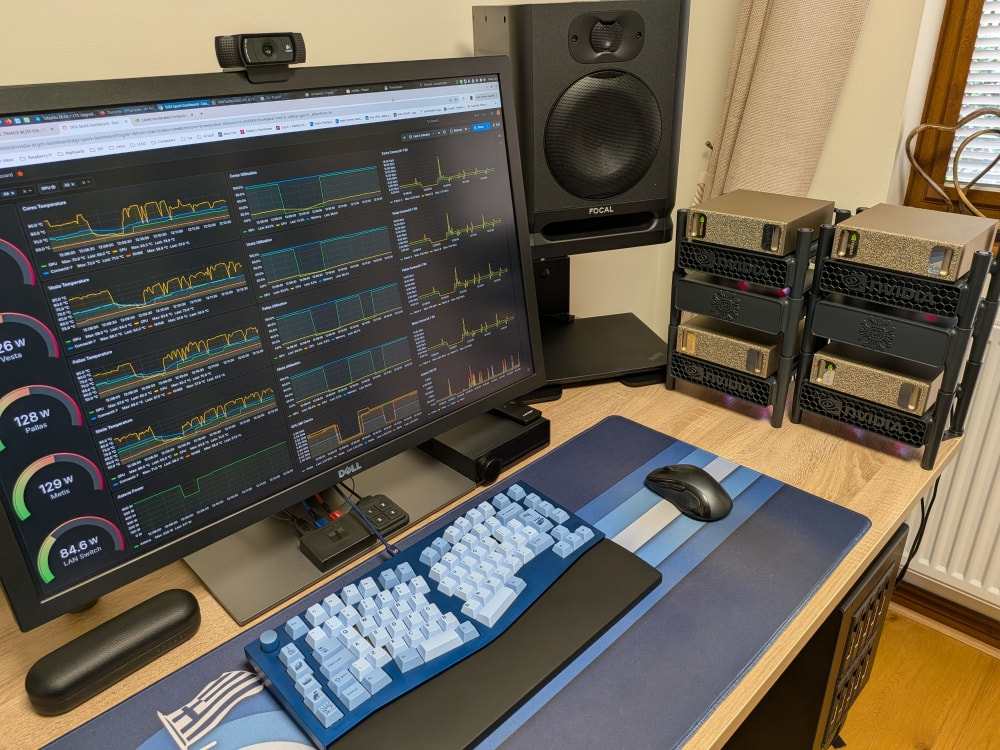
I’m running a very large local setup with latest ds4, glm5, etc.
Different models are good for different use cases. Your specific one matters. Test it extensively on the hosted version of the model before considering a local instance.
From a cost perspective for most people it makes no sense. For hobbyists, its a really hard swing unless you are dropping 100k.
Its the difference between mostly 1-shotting any coding task I throw at it with great results, or something that barely works at the first go and needs significant bug reporting in my experience, especially on models that fit in a single consumer GPU.
I wouldn’t exactly need speed, but for example game decomps/recomps would be interesting.
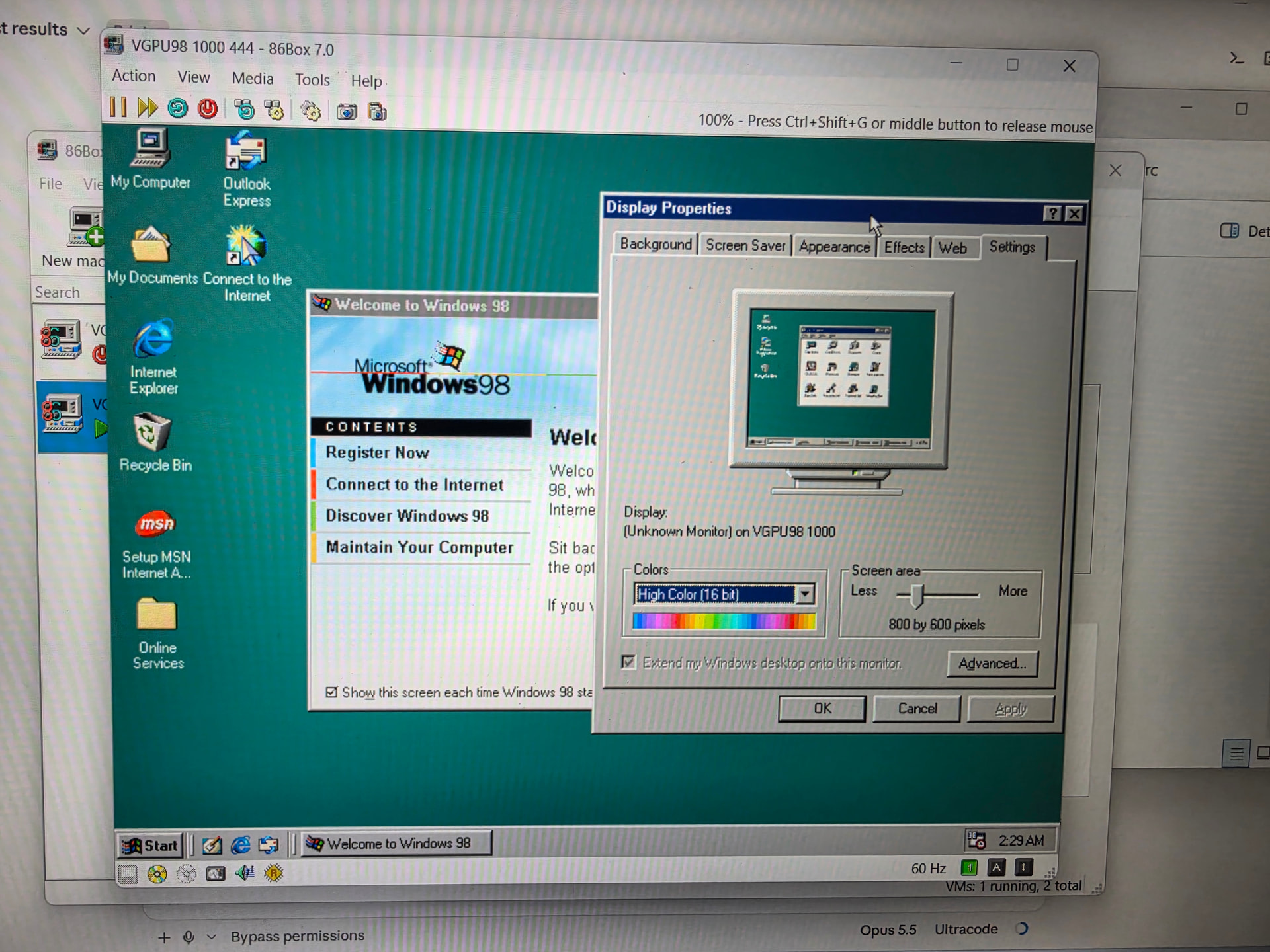
Opus 5.5(on ultra) was able to create a virtual GPU in 86box with working desktop display modes in only a few runs, think it also wrote a bunch of assembly code here.
I’m trying to get a translation layer to use the emulated Pentium 2, but with the hostGPU hooked in. That’s my next step tomorrow.
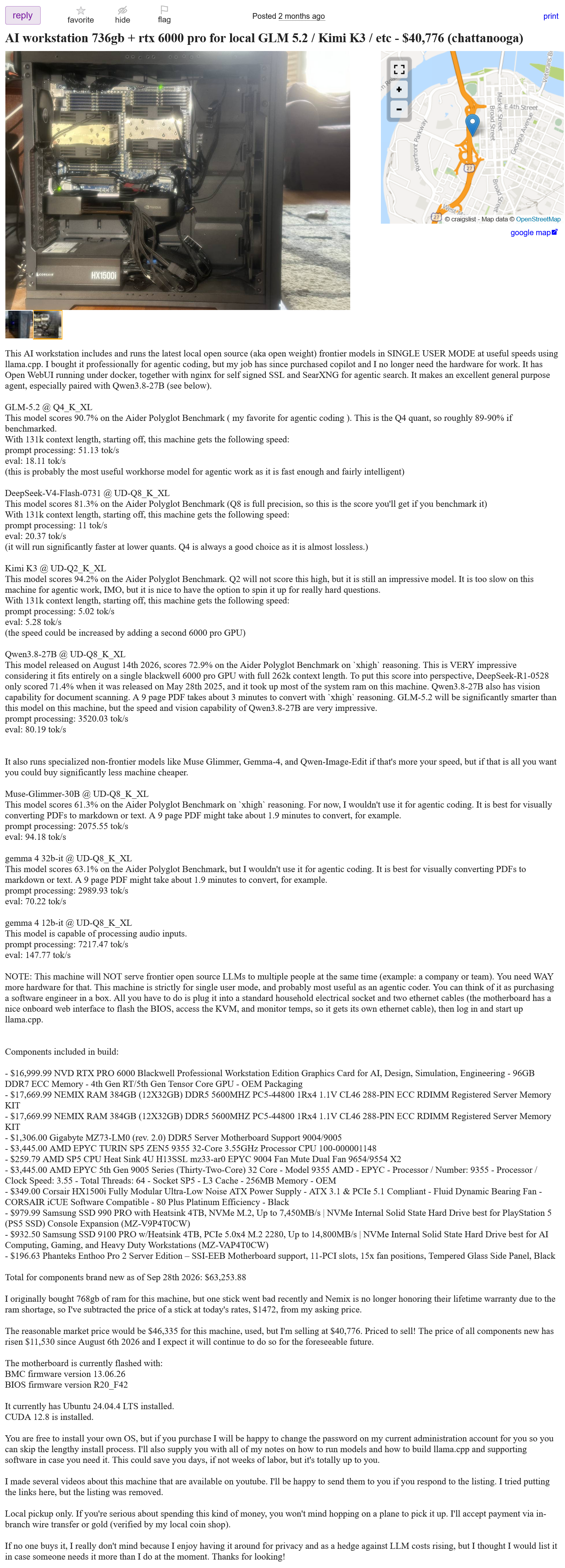
Someone in my city is trying to sell this RTX 6000 beast with 700GB+ of ram. They probably should have spent more on RTX 6000s and less on ram. The description says, even with all that compute, you’re only going to be able to support a single user and not a team of people.
I just ordered a 5090 Thermaltake pre-built since they’re now less than the cost of a 5090 by itself (probably due to buying bulk at the former prices), but I don’t plan on using it for LLMs. I plan on using it for better video generation (10 seconds takes ~2 hours on my AMD R9700 with Wan 2.2),
Did you buy those at the old prices? That’s like $16k worth of compute, right? (Which would be more like $30k right now?)
The Sparks have turned out to be a good investment as I got them back in May so gone up 25% already in value here in the UK.
But in the meantime I will have the pleasure to play with large models like Deepseek v4.1 Flash at native quants locally. This is all a hobby/for the fun of it while also learning a shed load that I will use professionally going forward.
One thing to keep in mind is that 6 months ago the idea of running Opus 4.6 at home was a pipedream. Now, we have Qwen3.8 Flash Next that trades blows with it and that can run on 128GB.
While I’m not saying we will get Opus 5.5 down to 128GB in 6-12mo, we will see openweight models get bettter and better. With the help of something like Turnstone, you could be more than happy with a “small” model compared to paying $200+ a month for a cloud model.
To add to this, one eye-opener for me in recent weeks was the “cost per task” metric.
You can use e.g. Opus 5.5 and one-shot most tasks, or use a cheaper model like GPT 6 Luna and let it try / think for 10-20 times as long. In my experience, the result is often equally good, as long as the problem isn’t super hard and you can easily check whether the answer is correct. For APIs, this means there can be a sweet spot where the cost per task is about the same, so you get your result faster.
The same logic applies to local models like Qwen 3.8: you’ll get a valid solution for many problems, but it will take longer, possibly much longer depending on your hardware. But you need again a metric that verifies a good result.
Take this with a grain of salt, though: there are many variables when running models locally, so what person X gets out of their hardware might not match your setup.
You also need to babysit and help it in the right direction, making the 20 times longer feel like a massive waste of time, and many tasks feel like they would have been solved as fast, if not faster, if not using the AI.
The more I use Opus at work, the more annoyed I’m getting with the smaller flash models I use at home.
I wonder how long it’ll be before local hardware/software is strong enough to take a prompt like:
”Create a feature complete clone of Photoshop CS2 in Rust”
I think the hardware requirements get pretty extreme once you’re trying to match a frontier model like Opus 5.5. Local models can be very capable, but for long-running coding agents, model architecture and software optimization matter just as much as having a huge amount of VRAM or RAM.