Help with 10GBase-T over ethernet connection.

Hi all
I’ve been googling this for several days and going down the usual rabbit holes, only surfacing for snacks and caffeine and decided it’s time to ask the hive mind (the results are better than AI).

I’ve got a 70m (262 foot) Cat6a link. Yes - I begged for OM4 but too many corners to go round and they couldn’t do it, so I am determined to get the best possible results from it.

If saw there are 10GBASE-T SFP+ adapters rated for up to 80m (didn’t see any for 100m). I assume these will get hot, hot, hot.

Do switches with built in 10GBase-T have the same 30m/80m restrictions, e.g. a QNAP QSW-2104 2t, MikroTik CRS304-4XG-IN or Hasivo F1100W. Very tricky to find the right info.

Would I be better using generic 10GBase-T SFP+ 80m modules in a SFP+ cage switch.

Perhaps a better option would be to use a MS-01 with it’s x710 internals, an Intel 10GBase-T at one end and a MikroTek switch at the other end. I’m concerned about the heat though on this config. Maybe just add a heatsink on the SFP+ module.

Any recommended options or experience would be most welcome.

10GBASE-T SFP+ max distance is hard limited by max available power of SFP+ slot. Few years back calculus was that any native 10GBase-T beats sfp implementation. As in do not expect 30+m out of any SFP+ to 10Gbase-T.

And that’s not taking heat issue into account. From all the hubub I heard and read 10GBASE-T SFP+ is frankenstein retrofit that was never supported in first place. It should always be the last resort implementation in any network design.

Quote from ubiquiti forums discussing the issue:

All SFP+ 10GBASE-T modules are hacks and get hot due to the complex electronics inside. They basically cram a 2-port 10GBASE-T switch into that tiny package.

The IEEE standards for SFP+ do not include support for 10GBASE-T! Hence the need for a full protocol decoder / encoder chip. Aquantia made themselves rich by micronizing a protocol converter (aka. “gearbox”) into such a tiny package.

Over time, these chips will migrate to smaller transistor processes. As they do, they will need less power and thus run cooler.

The 1st generation modules have a 30m Cat6a cable limit and pull a whopping 3W of power, which is the maximum SFP+ can deliver.

A few years ago, the 2nd generation modules came out supporting close to the full 100m Cat6a cable length for 10GBASE-T. These draw less power, around 1.8W or 1.9W.

You will want to shop for these lower power modules. They still run hot! Compared to say a 10GBASE-SR fiber module that sips 0.8W!

At this point, it is in the “ain’t broken, just milk it for all the $$$” mode for Marvell (who bought Aquantia and their patents). Expect to wait another 10-15 years before the 3rd generation of SFP+ 10GBASE-T modules come out.

Avoid 10GBASE-T SFP+ unless you already locked into that, and if you are try to source newer modules.
Ubiquiti is supposed to have newer revisions with much better power draw and the thermals. No reviews or comparison to verify that.

These would be the best bet, they advertise reach up to 100meters with cat6. 170€ per unit and you will still need cooling Not worth it in my opinion, better source native 10GBASE-T switches and cards or drop down to native 2,5/5.

Anectada also report that these behave weirdly and sometimes cannot handle bidirectional trafic well, even at lower rates on good cabling.

10GBASE-T SFP+ module is the weak point, no way around it. I fucked around with original mikrotik modules few years back (i.e gen 1) and gave up after initial testing.
They were too hot even under idle and I observed perf drops after minutes of idle operation.

3 Likes

The only good SFP+ to RJ45 transceiver is the newest one from Broadcom:

It reaches 100m, and has the lowest power draw of 1.8w. It still gets hot, but not ridiculously so like the other modules that typically use 2.5w.
As Greatnull said, switches with built in 10gb ports are more efficient and will be cheaper in the long run with the high cost of these specific transceivers that use the newer Broadcom chip

Yeah, but 150 USD/170+ € is insane amount of money per port give the caveats. And longevity is not guaranteed given the heat.

Assuming three connected devices I am already better of buying new native 10GBASE-T switch.

Yep, as I mentioned, unfortunately I am locked into the 10GBase-T over CAT6a for this single run. Not my first choice, not my second but that’s how it is sometimes and I have to use it as best I can, thus the question.

Thanks for the thoughts, comments and links. It looks like a switch with native 10GBase-T is the “better” option at least for heat. Probably one with SFP+ slots as well to keep future link options open, which leaves very few options. QNAP QSW-M2108-2C or similar seems about the best. I do like the Mikrotek CRS326-24G-2S+IN, but I’d have to use a converter in that, and like you say, given the cost per port…

Is there anything I can check in the limited tech specs available that would indicate if I can expect a native switch to manage the 80m? Ask tech support the only recourse? Sales will probably promise anything.

It will, as long as ther switch complies with specs. No reason it shouldnt.

You can even use the current CAT6 as feeder cable for your new fiber :slight_smile:

Anyway, just be aware my Mikrotik Switch set fan speed to 100% after inserting a 2m, 10BASE-T. Had to replace the fan because of it.

Question is not wheter you locked in 10gbe over cat6, its whether you are locked into SFP+ 10gbe by hardware choices. Unless you already have bought hadware assuming thaht, toss 10GBASE-T SFP+ modules into dustbin of history where they belong.

You are also looking in wrong direction completely with mikrotik.

This is cheapest good 10 gbe switch Switch Flex XG - Ubiquiti Store

4x10GBE ports for 330€ , less than purchase price of two SFP+ modules.

Now supplement it with 8x2,5GBE switch for 180€ Switch Flex 2.5G - Ubiquiti Store

and you are done.

Nearest close mikrotik is this one for about 600+€:

Blockquote You can even use the current CAT6 as feeder cable for your new fiber :slight_smile:
Blockquote
Yep, I thought of that too. There are too many bends that are not compliant with the radius of fibre. grrrrr.

Which switch model was that?

Thanks for the thoughts and the brainstorming. Much appreciated. My fixed lock-ins are a Zyxel AX7501 on the edge with a PM7000 GPON. This presents a 10GbE RJ45 connection in Room A, and a Cat6a 10GbE cable between Room A and Room B.

I’d like to connect various 1 & 2.5 GbE devices in Room A, possibly a home lab server at 10Gbit, and in Room B a 10Gbit connection on a PC, and various bits at 10/100/1000 including a MicroVaxII project which I probably won’t need to worry about connecting to 10Gbit :slight_smile:

I’d missed the Ubiquiti so thanks for that.
4 x 10GbE. Unfortunately, it looks like all ports are 10GbE only meaning I’ll need another 10GbE capable switch at A & B for connecting to the existing 1Gb switches.

Mikrotik have a new offering. CRS304-4XG-IN that is similar to the Switch Flex at a lower price point and also supports 1G/2.5G/5G/10G. Also runs switch or router firmware.

The QNAP QSW-3205-5T also gives 4 x10GbE RJ45 with negotiable speeds at about the same price. However, it’s unmanaged.

The QNAP QSW-M408-4C builds on the above with a number of 10/100/1000 ports also included. maybe good for both rooms A & B. PC could connect via a x710 card & DAC

Otherwise, the CRS318-16G-2S+IN would have been ideal if it had the 10GbE RJ45s instead of SFP+ cages.

I did wonder about a little 2 port SFP+ and 2 port 10GbE RJ45 which would fix that issue, connecting via a short DAC but I couldn’t find anything suitable except on AliExpress.

So tantalizingly close…

I’m using a CRS309 with three 10GBaseT (Ubiquiti UACC-CM-RJ45-MG), one MOCA (Magic-SFP) and two DAC modules, in 26C ambient.

The Ubiquiti modules are rated for 10G@100m (Cat6a) and I use them for 10G and 2.5G over Cat5e. They run warmer than fiber but much cooler than earlier gen 10GBaseT modules like the S+RJ10 or AOM-AQS-107-B0C2-CX which were only rated for 10G@30m (Cat6a). I can leave my finger on the Ubiquiti module without getting burnt unlike the latter 2. The CRS309 can’t extract temperature data from it though.

I am also using an 80m-rated 10GBaseT module from Fibermall in my Chelsio T6225. This particular module support temperature reporting, but not NBaseT. It also presents itself as a fiber module in the CRS309, which might explain why the NIC works with it not the AQS107 or UACC-CM-RJ45-MG.

Lastly, even switches with built-in 10GBaseT might be restricted to 30m Cat6a, if they are earlier gen products like the CRS312-4C+8XG-RM.

Personally, I think these 80m/100m modules are fine temperature-wise; I have transferred 3TB@10Gbps from T6225 (10GbaseT) to CRS309 (10GBaseT) to NAS (DAC) without a hitch.

Somewhat contrived but how about a DAC cable into a 10gbe media converter at each end.

I know the cable already seems to be in and so this is a moot point now, but Im guessing this has to be because it is hard to pull and thus they dont want to damage the cable with the pulling required? Cause OM4 has 2-3x smaller bend radius than cat6 spec does.
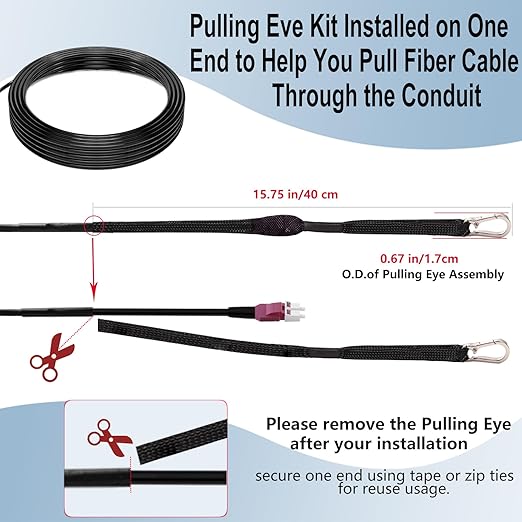
Typically you would use armored cable with pulling eyes for longer length runs or when you actually have to use some force to pull the fiber, which should make it possible to use anywhere cat6 is capable of being used. The armored part uses metal around the fiber so it can withstand the pull:

just speculating…
it could be that the connector on the fiber is the component that wouldn’t survive the run, if these bends/the pipe is as tight as it sounds. it could be that they barely got the cat 6 in without ends on it, and then terminated it.

i have done field terminations on fiber, but i certainly wouldn’t ever recommend them, they are obnoxious.

Yep. Exactly that. They weren’t even confident about Cat7 or 8 cables due to the lack of space in the ducting and some of the bends they had to negotiate. As they would have been culpable for breaks in the fibre the risk was too high for them so CAT 6a was my only real option. Thus my question - after seeing the SFP+s are distance marked, does the same hold true for the switches with native 10GbE-T ports and if anyone has any experience to share over a distance of about 80m. The link above for MikroTiks CRS312-4C+8XG - the first MikroTik product with 10G RJ45 Ethernet ports and SFP+ only being rated for 30m doesn’t bode well. I’ll ask them about the distance for the new CRS304-4XG-IN. I don’t particularly want to use 10GBase-T SFP+ adapters, but if that’s the only way to get the distance, I might have to. Unfortunately, in a design there’s always a compromise needed somewhere.

Yes, it was the bend radius that was the killer. They were really nervous about breaking fibers as it would be at their cost. I showed them many similar diagrams and even wore my lucky persuading hat, but sadly cat 6a S/FTP (at least it is shielded) won the day.

unless a switch specifies that it can not do the full 10Gb spec. you either have to assume it cant, or assume it can. lets for a moment assume it can.

assuming your cable is of sufficient quality, cat6a should be able to do 10gb for 100 meters. so assuming all equipment on both ends can do 10gb to spec, you should be fine to plug it in.

additionally just because your sfp+ modules say 80M does not mean it wont work. that just isnt what it is rated for. however, if your sfp+ modules can do it, you are not going to drop all the way to 1gig, you would likely be able to negotiate a 5gig link – not as good, but still nothing to turn your nose up at.

fibre <> 10GBit-T media converter. Unless you know of something that works cheap, I might aswell just put a 10GBit-T copper converter in a SFP+ cage, or were you thinking of something cunningly different?

Thanks [nereith]. That’s really interesting to see the 30m limit on the CR312-4C. I wonder if the same applies on the new CRS304-4XG-IN. I’ll email them, and the others - Ubiquiti, QNAP etc.

Good to know the Ubiquiti modules work well. How long is that Cat5e stretch you are running over? I’ve also seen good reports over distance for the 10Gtek 80s if I really must go that route.

I was trying to solve your heat problem, DAC cables are copper twinax and run cooler than optic transceivers.