Disclosure up front: this write-up was drafted by my local AI agent from our measurement logs, with the numbers cross-checked by hand. The measurements were run on my box by that agent under my supervision; the opinions at the end are mine.
The box and why I was shopping for engines
I run a Ryzen AI MAX+ 395 workstation with 128 GB unified memory (MinisForum MS-S1 in performance mode, Fedora 45 server, headless) as a 24/7 local inference server. It backs an agent stack that lives entirely on local hardware: chat, tool loops, structured extraction jobs, the works. The model is Qwen3.8-Flash-Next (125B MoE, ~6B active), which is the current sweet spot for this chip: big enough to be genuinely good, MoE enough that the active set fits the bandwidth.
For months the serving engine was mainline llama.cpp (Vulkan), tuned specifically for this platform. Then halogen-flash-server showed up: a closed-source container with hand-written gfx1151 kernels for this exact model family, claiming roughly 2x decode and 3x prefill. The community has been arguing about those claims, and a fair chunk of the skepticism is deserved, because most of the headline comparisons beat a stock llama.cpp install. My llama.cpp config is not stock. So I ran the comparison properly before committing anything.
The two arms
| llama.cpp arm (my production config) | Halogen arm | |
|---|---|---|
| engine | llama.cpp b12651, Vulkan | halogen-flash-server 0.21.0 (Docker) |
| weights | unsloth UD-IQ4_XS, 94 GB, 4 shards | their .hgn v2, 62.1 GiB + 47.7 GiB ngram table |
| context | 262144, q8_0 KV, swa-checkpoints 8 | 262144, bf16 KV pool |
| speculative | MTP draft-mtp, n-max 3 | MTP head + prompt-lookup |
| batch / slots | tiling 4096/4096, parallel 2 | 4 pooled slots |
The llama.cpp arm had the MTP head, the full 262K context, q8_0 KV, the tiling flags and the memory-margin tuning. This is the config that served as my daily driver, not a benchmark toy.
Harness rules (the boring part that makes the numbers mean something)
- Same box, same day, one engine at a time. The llama.cpp stack was stopped for each Halogen arm and verified restored afterward with a real completion through the production endpoint.
- Every rate is the server’s own reported timing (
timingsobject / slot print timing), never curl wall time. Wall time includes queueing, HTTP and prompt ingest, and it lies. - Greedy decoding (temp 0) with a fixed seed, identical probe payloads on both engines.
- Prompt cache disabled on both engines for the throughput runs, so prefill isn’t faked by cache hits.
- Reasoning effort pinned to the same level on both engines (the Halogen default differs from the llama.cpp template default, so both were pinned to medium).
- GPU-empty gate between arms: no
/dev/kfdholders and GTT back to the ~17 MiB floor before starting the next arm. Halogen’s docs warn about stuck GTT after unclean exits; the gate meant it never bit. - Known limitation, stated up front: single run per arm per probe, not medians of repeats. For claims of 1.5x and above I’m comfortable; for the sub-5% stuff I wouldn’t say a word.
Throughput
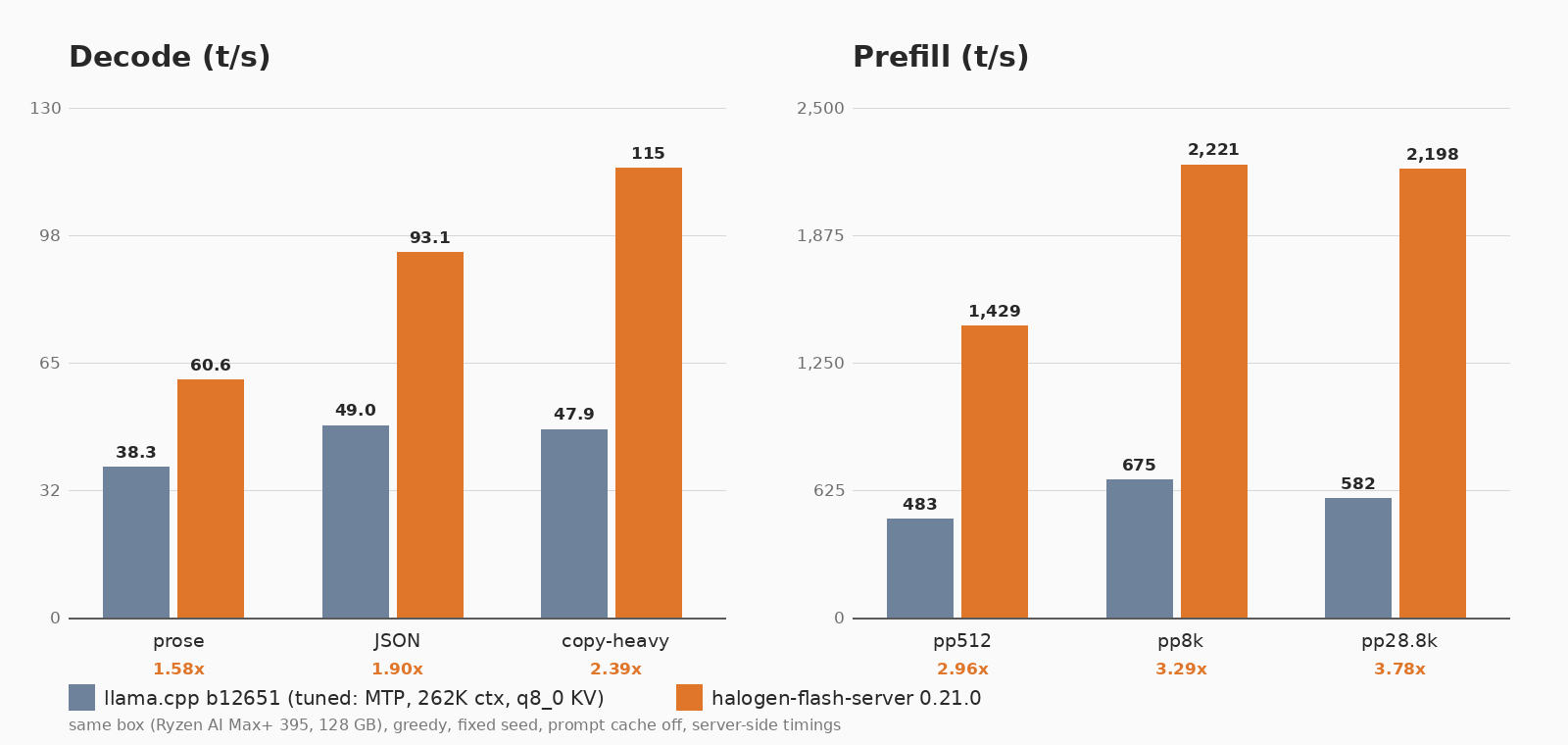
| probe | llama.cpp b12651 | Halogen v2 | delta |
|---|---|---|---|
| decode, prose | 38.3 t/s | 60.6 t/s | 1.58x |
| decode, JSON | 49.0 t/s | 93.1 t/s | 1.90x |
| decode, copy-heavy (1947-tok prompt) | 47.9 t/s | 114.6 t/s | 2.39x |
| prefill pp512 | 483 t/s | 1429 t/s | 2.96x |
| prefill pp8192 | 675 t/s | 2221 t/s | 3.29x |
| prefill pp28800 | 582 t/s | 2198 t/s | 3.78x |
The copy-heavy row is prompt-lookup speculation eating repetitive output, so treat it as a best case; the prose and JSON rows are what you actually feel. The prefill numbers reproduce the vendor’s shape (~2,000 t/s) on a tuned baseline, which is the part that made me convert.
Accuracy gate
Speed that eats quality is a downgrade with extra steps, so both arms ran the same frozen gold set (28 notes, 65 machine + 60 model labels, extraction task) through the same eval harness:
| llama.cpp | Halogen | |
|---|---|---|
| strict F1 | 0.608 | 0.608 |
| recall-mode F1 | 0.627 | 0.630 |
| seconds per note (recall) | 4.49 | 2.61 |
Same labels caught, same false positives. Same model, different plumbing, so this mostly proves the engine isn’t quietly degrading output on this workload.
Production reality after the cutover
Since switching the daily driver to Halogen: decode 53-59 t/s on streamed generations under real load, uncached prefill around 1,490 t/s, and warm-prompt TTFT of 0.01 s with the prompt cache holding 161k tokens of live session context. That last number is the sleeper for agent workloads: a long tool loop stops paying prefill on every step.
The costs, because it’s not free
- Closed source. You’re trusting a binary with hand-written kernels. License is free (no key, no telemetry, benchmarking allowed), but unauditable.
- It wants its own weights. My UD-IQ4_XS GGUF was refused outright (
unknown tensor type 42, which is Q2_0 in the down-experts). Budget ~110 GB for their .hgn set. - One engine owns the box. It cannot co-exist with a big llama.cpp model on 124 GB usable RAM. I retired my multi-model router; the non-Flash-Next presets are offline now.
- Docker on Fedora needs
--device /dev/kfd --device /dev/dri --ipc=hostand numeric group IDs (Docker resolves--group-addnames against the image’s /etc/group; fails on SELinux hosts). - Startup is faster than llama.cpp though: ~22 s to serving vs ~90 s cold load.
- One correction to my own early notes: I first recorded that it pins ~82 GiB of host RAM. Wrong. The weights are mmap’d into reclaimable page cache (container RSS ~3 GiB). It behaves better than its own docs suggest.
My read
The honest framing is: against a tuned llama.cpp, Halogen is ~1.6-2.4x decode and ~3.3x prefill, not the 4x some threads imply. That’s still the largest engine-level win I’ve measured on this hardware, and for a single-model daily driver the prefill alone justifies it. If you need multi-model serving or you refuse closed binaries, stay on tuned llama.cpp, it’s genuinely good.
Happy to answer questions on the harness, the flags, or the eval set. And if anyone wants repeat arms on these probes, say so and I’ll run them.