Good News: AI Isn’t Replacing You. Bad News: It’s Complicated (GTC 2026)

I’m back from GTC and ended up with five separate videos PLUS separate extended interviews because there’s no way to compress what’s going on into a single take without losing the plot.

This thread is the overview — the connective tissue between all of them.
The Videos

That’s a lot of videos!

DLSS5 — a missed opportunity (or a messaging problem)

One thing that didn’t land well was DLSS 5.

If DLSS5 had been presented not as DLSS but as a developer tool — something to help align lighting, textures, motion, and scene consistency during development to more quickly and easily achieve the art direction goals for the game, it would have made a lot more sense. A tool for building better worlds.

Instead, it’s framed as a consumer-facing feature. More interpolation. More abstraction between what the game is and what you see.

That’s where it starts to feel… off. Who’s in the driver seat here? The game devs or the gamers?

It’s not necessarily that DLSS5 is bad — it’s that the goal feels misaligned with the potential. So I get why gamers would be up in arms.

AI as a breeding ground for grifters

If you’re not part of the solution, there’s good money to be made prolonging the problem.

And right now, there are plenty of grifters and opportunists trying to ride AI FOMO to make a quick buck.

  • “AI-powered everything” with no substance

  • wrappers on top of wrappers

  • promises that don’t survive contact with reality

That’s not unique to AI — it’s just the current flavor.

But it does make it harder to separate signal from noise.

The bigger picture

AI might actually be as important as the printing press.

Not in the “everything changes overnight” sense —
but in the “this reshapes how knowledge is utilized, shared, and acted on” sense.

And like the printing press, it’s going to be messy. There will be misuse. There will be hype cycles. There will be backlash…. but there will also be real progress — especially where AI meets the physical world:

  • robotics

  • science

  • automation

  • data generation

For the folks that I met at GTC, they’re trying to keep their head down and steer clear of the drama. The new tools let them focus on their work and are a force multiplier for their ability to get work done. I don’t see it as replacing human labor at all unless the goal is to slow overall productivity. That’s the part that felt real at GTC.

Also, Storage!? 256tb, yes terabytes, in a single drive?! WTF Kioxia!?
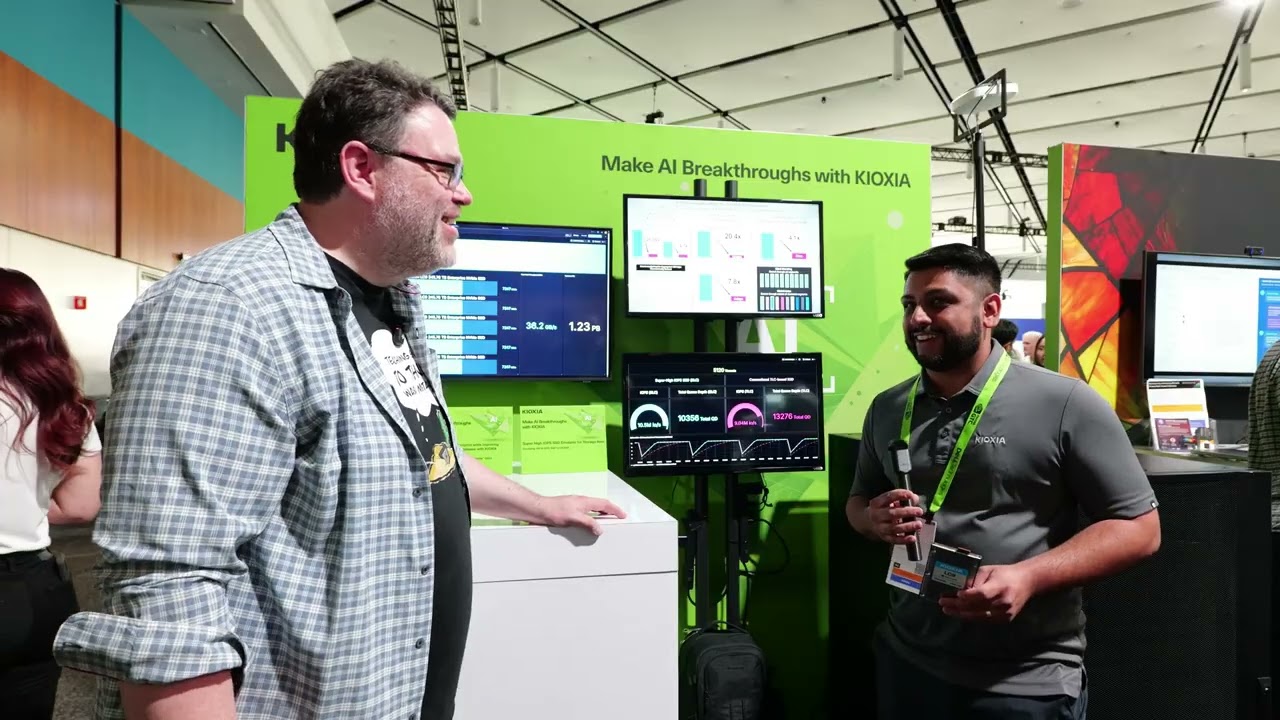
Kioxia showed a 256TB E3 PCIe SSD — 256TB in a single drive! That’s the trajectory. Mechanical storage is running out of road as they reach capacities around ~60TB, not just because of density but because throughput is fundamentally capped — ~300 MB/sec, maybe ~600 MB/sec with dual actuators. Flash scales differently: more capacity generally means more parallelism, more throughput. AI is accelerating this transition whether it looks like it or not — hyperscale demand is soaking up all the good flash production right now. And like cheap USB drives, consumers will likely see lower-binned or mixed-quality NAND in the near term. Still — if this is the path to “affordable” 8–16TB consumer SSDs, I’m here for it.

Thanks

To everyone supporting us on Patreon, Floatplane, and everywhere else — thank you. Even if you’re not as pro-AI as I am… thank you for engaging in actual discussion – not just knee-jerk “AI slop” responses, but real arguments, real skepticism, and real curiosity.

That’s how we figure this out. Because at the end of the day — AI isn’t going to decide what this becomes. We are. And we, as reasonable people, may have to get in here with a forcing function for what’s reasonable for common and decent human outcomes. I’m onboard for that, too.


15 Likes

Sure it can do interesting stuff, but as things are right now it doesn’t seem to be anywhere close to worth the real cost.

Just nicely handwaving the serious issues and concerns people have because of the vibe coming from the salespeople at a convention was good isn’t a great look.

I’ll look into more of the interviews later, but I have to ask, did anyone of the people making their pitch there cover the power, enviormental or econimical sustainability of it or is that just conveniently ignored as per usual?

1 Like

Im not afraid of AI or Agentic whatever. Im very afraid of dumb management getting scammed by Salespeople of some bs AI product and firing a ton of workforce thinking they can do without them

2 Likes

How many high-potential people are trapped in low-impact roles? Capitalism implies meritocracy and feedback through markets. The dumb management firing workforce creates even more likelihood of high-potential but trapped in low-impact roles, imho, just as things are starting tog et good.

Many corporate roles exist to enable other roles, not to produce outcomes, and those may be eliminated by AI. That may not be a bad thing.

Early corporate charters (18th–19th century) often required public purpose. We did away with that..

I am glad to see so many people fired up about AI, maybe good meaningful change will come from that, but the rage is somewhat misdirected imho. If people come into the fold and demand accountability, though, that could be good.

We no longer live in a system where value creation reliably translates into reward or power, but it’s not because of AI that this is happening. Or even “because AI” that it is transparent. No one would be complaining if everyone were making more money, groceries cost less, and most peoples’ personal outlooks were looking pretty good. It isn’t like that, though.

  1. Management increasingly substitutes tools (now AI) for judgment
  2. Corporations operate with limited accountability to the public or even long-term market discipline. Outsourcing judgement is another way to escape accountability.

The good thing, I think, about AI is that

  1. Entire layers of coordination, reporting, and “process work” are unnecessary
  2. Many roles exist to enable other roles, not to produce outcomes
  3. etc.

I think management is using AI to preserve existing structure, not rethink it, where we see mass layoffs. And because capitalism was a bit broken to start with.. its not a good outcome for “we the people.” I think at least 50% of “ai layoffs” are because the economy had already been hollowed out, and AI is just an excuse to deflect (accountability there again…).

Whatever companies instead redeploy workers toward higher-value ends instead of just keeping them busy are going to take over the universe. If capitalism were working properly in those spaces. Imho.

Having done a lot of work inside large corporations.. the tragedy I always saw, even before ai, is the wasted human potential at scale.

The real failures have never been because innovation is too fast or because machines replace labor—it’s institutional immunity from consequences.. too big to fail, regulatory capture, vendor lock-in,

if you look back far enough corporate charters in the 18th and 19th century had a public good component. That’s mutated into only shareholder value. But if you’re not a shareholder FU. I think a lot in government understood this, but also, if you have a 401k or retirement account… you’re essentially a shareholder.

It’s always been the case that there is a lack of fairness, agency, and accountability in systems that shape our lives…. but AI used badly by corpos sure does make that a lot more apparent because of the speed that things are moving here.

I think the fix is two fold: corporate accountability, and everything that goes with that; and really hardening collective bargaining rights in federal law. Workers have had their leverage unfairly eroded, but the most egregious thing imho is that worker benefits tend not to be portable across employment.

The real crisis is not technological—it’s institutional.

For decades, accountability has eroded, value has been obscured, and human potential has been misallocated.

The result is an economy that keeps people busy instead of making them productive.

AI gives us a choice:

  • Double down on preserving broken systems

  • Or rebuild institutions so that value, responsibility, and reward align again

So I don’t see it as “resist the AI”

I think the individual should channel that energy into reclaiming agency in a system that stopped rewarding merit… and that was true long before AI arrived. So I’m here for that. And with local AI, almost like an AI ouroborus, I think “we the people” can use AI for a great effect here, and positive outcome for the individual.

14 Likes

Nevermind

We need to regain our humanity. And the only way to do that is…to help other people.

AI does not put bread on the table. As our national debt explodes, the governments of thte world will put a tax on anything AI enabled- people out of work become a government burden. The govt will need money to deal with the externalities AI does not address.

Forget about the negatives of AI. Forget about the positives. Imagine there’s a bunch of people trying to ignore AI wholesale. Because it’s boring. Because it does nothing of value for them. Because it’s present in all facets of life if you let it and at best it’s tedious, at best. Imagine there’s been a war of attrition for years where you’ve been gently and not so gently bombarded with hot takes from everywhere about a topic you do not care about. To me AI is one of those things you skip in content just like ads and sponsors, just another way AI’s existence has made my life that tiny bit more annoying.

I lean towards the “AI denier” end of the spectrum.

It is not that the tech isn’t interesting. It is.

My problem with AI is the social aspects of it. Corrupt companies and/or leadership proclaiming things like “we have achieved AGI” and “$500,000 engineers should consume $250,000 worth of tokens” have shown me that the industry is full of grifters trying to sell you inflated promises.

Cory Doctorow has said “AI CAN’T do your job, but an AI salesman CAN convince your boss to fire you and replace you with AI.”

I have run local models a bit but I haven’t really gotten into it much. I am struggling to understand what problems to solve using AI. Or maybe it is not about solving problems, but rather how do I use AI to improve my workflows or accelerate my work.

Some areas that AI seems to help:

  • Searching - It seems to be good at searching but trusting a company with my search history isn’t great. Local LLM with Searxng or something is an option.
  • Proofreading and editing text - identifying problems with spelling and grammar, improving flow, improving presentation.
  • Negative testing - i.e. “tell me what is wrong with….”. Using AI to poke holes in your current work and challenge your work/assumptions/results.
  • Coding - Clearly AI can produce code. As I understand it, AI can’t/shouldn’t be the architect but for generating boiler plate/well known code, it has it’s use cases.
  • Learning - AI can accelerate people’s entrance into a hobby or field. I have copied and pasted code into my homelab from random Internet sources without fully understanding everything about it and then learned from it. AI can do the same.

Some areas that AI is a risk:

  • AI companies replace Google (or whatever other company) as the collector of all of your information to profit on it. Basically, AI companies influencing the masses for their own profit.
  • Allowing the AI to make your decisions. This one is a spectrum, of course. If it decides to structure a 5 line script in a different way than you would have, that is probably not a bad thing. If it codes your entire enterprise finance system, it is probably going to be bad.
  • Other peoples expectations of AI. Your boss saying “just use AI to develop a policy”. Also see “AI salesman CAN convince your boss to fire you and replace you with AI.”
  • I’m sure there are some others but can’t think of them now.

So, I think for me, I need to develop some personal guidelines for using AI.
Off the top of my head:

  • You are accountable. If you use the AI for something, it is ultimately your work that it is producing (and that you need to verify).
  • Don’t use AI as a therapist. If you need some human connection, go talk to someone. If you need to, post online somewhere supportive. Go talk to your dogs. All better options than talking to an AI (especially an online model).
  • Use AI adversarially. PewDiePie has a council to challenge him… so, I guess use AI to challenge your thinking.

Are there any other personal guidelines you have for using AI? If you had to “explain like I’m 5” on how to use AI, what would you include?

2 Likes

I guess my reticence for the AI of the now and the near future is that the companies running the majority of the AI attention are the ones you absolutely do not want to have this power. They really want us locked into their way of doing things.

Jensen is by all accounts a terrible person. Altman likewise. Zuckerberg too. It’s the same all the way down the pyramid. Add to that, these companies are screwing us over, wrecking the environment and steering us down negative paths and you can see why there’s a change in peoples attitude.

If I could run the computer from Star Trek on my own (not massively over priced) hardware, that people missing AI were actually held to account and we the citizens were in control, I would be happy. The era of “tech is good and I believe it" is sadly, for me, dead and has been since “Don’t be Evil” stopped being a thing. The future definitely looks more like V for Vendetta than Star Trek right now. I don’t want it to be and I really want to be wrong but I don’t think I’ll be too wrong.

1 Like

Yes, exactly, as I’ve said a lot. I am 100% on board to help bring about a positive flashpoint for society.. I believe that the randos, randos here on the forum and in large part our community, are better able to govern reasonably than whatever it is we have now. AI doesn’t have anything to do with, really, the lack of accountability that we see everywhere.

“AI” might make it more clear to the average person, but it’s not really anything new. I.e. your parent company could always treat you badly and disposably and if you want to change that it starts with fighting for worker protections and collective bargaining.. not setting AI on fire.

If “AI” is the flashpoint that brings about real change and reasonableness, I think I’m onboard for that too. I don’t think most people should abdicate societal responsibility to the monsters we have now. We all agree on that, I think, and yet…

  • Other peoples expectations of AI. Your boss saying “just use AI to develop a policy”. Also see “AI salesman CAN convince your boss to fire you and replace you with AI.”

To me seeing all this just underscores how disconnected/out of touch the management of most companies are. If those companies speed run into the ground and it allows more diverse companies to pop up, that’s probably a good thing too.

As long as the academic papers exist and open source isn’t outlawed, everyone has access to the tech. The thing I’ve been most worried about, too, is that all any benefit from this technology is locked up behind someone else’s gatekeeping – physically – but so far that hasn’t been the case with AI.

This same kind of ‘tech is good’ thought dying inside/looking at it is exactly what spawned the free software movement. Software and copyright would lock away the common person’s ability to use the technology they own.

Fortunately there is enough of a critical mass of people working on both open weights and models, but also the softawre to power them, I am less worried about it. The efficacy of open models also keeps the gatekeepers in check, imho.

It’s already the case that if you have a use case where there is a benefit for using claude or chatgpt AI then you can reduce your cloud token usage by 5-10x by running a local model to do the work first, and then have the cloud model evaluate what has been done by the local model.

From an economic standpoint I really don’t see any way the current investments can be recouped unless the productive output of what humanity is doing also grows by 10x or 100x such that a trillion dollars tomorrow is only about a billion dollars today.

3 Likes

To add to your point about high-potential people: new technologies allow for people whose potential wasn’t fully utilized by older technologies to develop the talents and become highly productive with the new technology.

Example: With the advent of computers and assembly language, people who had the talent of holding assembly language in their head could now directly apply their talent to writing programs.

Example 2: With higher level languages, people who weren’t good with assembly language but were still good with putting together other programs were now able to cobble together new programs that unlocked new functionality.

Etc, etc.

1 Like

Yeah, I agree with this, in the light of “new tools” and “new paradigms”, we are pushing the goalposts further and that is a good thing.

Further to this, the lack of accountability is due to recent(ish) policy decisions. Section 1201 (circumvention of copyright protection systems) of the DMCA is clearly weaponized by companies to create the enshittigenic environment we are in now. If we can change the policies, we can change our lives. Cory Doctorow has also advocated for a country (any country, really) to legalize the reverse engineering of software. If some country takes the first step in doing this, it could/would be the first steps in dethroning big tech.

I love tech and big tech has given us some great stuff but it is enshittifying quickly. A “market correction” (or maybe a “policy correction”) would improve things.

The only way I see us reaching (or rather claiming to have reached) “artificial general intelligence” currently is not that the AI has become so intelligent but rather that humanity has become so stupid. Einstein wrote “Two things are infinite: the universe and human stupidity; and I’m not sure about the universe.” So, AI has reached human level intelligence, but only because too many dumbasses are using it in the wrong way. :joy:

I’m also just reading Dune for the first time. A quote that seems relevant for today’s world is “Once men turned their thinking over to machines in the hope that this would set them free. But that only permitted other men with machines to enslave them.” Current AI companies would (and maybe do) happily enslave people.

This goes back to the policy issue…. I could see big tech trying to outlaw open source. Or maybe not outlaw it but at least move the needle (think “open source is dangerous, you shouldn’t use it”).

I definitely think it is important to lobby for change on this front. Big tech is lobbying. Others (such as Louis Rossmann, for example) are pushing for positive change for consumers. It’s definitely something I think people should be involved in.

Bubble is gonna bubble. I’ve got my pin ready to help burst it however I can.

3 Likes

AI is just a tool. A new, very powerful, very shiny tool, but still just a tool nonetheless. The moral weight comes from who’s holding it and how they’re using it. With any rapid tech advancement, the first wave is usually people trying to make a quick buck. What we call “AI slop” right now is that first wave hitting the attention economy. Buried under the slop, real things are happening though. Lab automation, protein folding, drug discovery. Real, earnest to goodness scientific improvements for the rest of humanity.

What worries me more than either the slop or the layoffs is the filtering layer. Right now my reality is getting rendered by opaque corporate systems optimized for engagement. Every “for you” feed, every AI-assisted headline, every “personalized” recommendation is a layer between me and anything resembling an unmediated world. Put no effort in and you’re just consuming someone else’s model of what you should see today.

Until the profit motive gets balanced by something closer to a “humanity motive”, where the goal is people actually flourishing, not just staying hooked, we keep getting the same shape of problem with different flavors. The slop’s one, the layoffs wendell’s describing are another. Same root though. This is why I think local AI matters and why I feel strongly about our position to help others see the potential. It’s not a purity thing and I’m not claiming “intellectual superiority”. The point is the thing sitting between me and the internet answers to me, and I can look inside it when I need to. That’s a very different relationship with the tool than “we’ll let OpenAI decide how you should see the world today.” We get to directly show others “this is how this tool is improving my life in a meaningful way”.

wendell’s right that open weights keep gatekeepers in check. I’d add that the motive layer matters just as much. Open source pointed at the same extractive goals is still extractive. The tech being “open” doesn’t automatically make its use humane, it just means more people get to decide what it’s for (i.e. us!), and makes that accountability layer a bit easier.

I don’t think the fight is with AI itself. The fight is with whoever’s wielding it and what they’re wielding it toward. I’d rather spend my energy building the humanity-motive version than being mad at the profit-motive one. But I completely understand and empathize with those that are reactionarily opposed to AI, especially in its current “commercial” form.

6 Likes

It does not, but it enables them to do a lot more damage, at least for a while until the fad passes and everybody will just see all AI as a grift since they have been burned by grifters. This is the same song and dance of blockchain and crypto, but now it is not optional to participate in the rugpull.

Everybody and their dog knows the elites are unaccountable, its a fact of life. The thing that changed recently is AI and thats what people will hate the most because it is the new thing, the change. It too will pass eventually when AI-assisted elites will just be a fact of life.

I am having the absolute best time of my life.

I have been a techie for 35 years. I’ve done everything from Helpdesk to leading and training teams of engineers in fields ranging from QA to App and Product support for a decade before leadership got old. Now I do AD Architecture and Systems Engineering for a top U.S. financial markets company.

I have been utterly bored for several years now. I am not a spring chicken, and I am spending more time thinking about retirement than about the next steps in my career.

AI has changed all of that. What once was boring and tedious is now enjoyable and productive. I can stand up entire clusters of servers with my bots. I can send my AI server off to research topics and argue among its AI council to produce refined ideas that I sometimes come back to and marvel at, and other times trash entirely.

I was bored because protecting and maintaining production environments is a game of defense, and I am very good at it. Having the security awareness and expertise that comes from 20 years of owning various layers of production systems, understanding the principles of good security, and often being the person resolving vulnerabilities has led me to a great understanding of what I call the landscape problem. You don’t know what you don’t know until you do.

The Engineer in me realizes that, with AI, almost everything is an engineering problem. If you attack a problem as someone with a highly defined sense of the landscape and a rich test environment, you can maximally leverage what AI is good at: tireless iteration. Long loops become about data collection and failure are signals to collect.

You establish primitives, principles, and purpose. You collect techniques and test open source harnesses against the 3 P’s.

Virtualization, containerization, and the proliferation of APIs everywhere have made the world of software something you can control with astounding ability through nothing more than natural language and persistence.

Data integrity and stewardship is vital. New regulations around how these companies collect and use data is important. The hype however.. is real, if you do not agree… you are just not trying hard enough to find out.

2 Likes

This is something that has never existed at scale in the biological sciences.. but it soon I think that’ll change. That’s the area I’m most worried about proprietary lock-up at the moment.

I need to think more carefully because a great deal of work needs to be done on a new open source movement – the same fears our forbearers had about being locked out of computing hardware by proprietary software certainly exists in very similar ways with what we’re going through with AI now. So much of what I have said and meant to say is misunderstood by so many…. so much “feel bad echo chamber” type sentiment when the problem is, and has always been, bad people doing bad things with tools.

Need a movement that’s less nuke datacenters from orbit and more structures that reinforce the positive aspects of the social contract.

8 Likes

Why not both? Centralization in datacenters has lead to a lot of issues and abuse, and it is the same for centralized AI datacenters, but worse