Here’s a Reddit thread where finally someone from AMD (“Bill from the OC team”) is looking at the situation and communicating with the public and they confirmed to know about the recent Level1Techs video:
At first he said he hadn’t been able to reproduce the issue, I suspect by chance he was using specific motherboard models where the ECC = Auto setting is pre-configured to ECC actually being disabled. Basically the same as Wendell in this thread with the Gigabyte X870E X3D Ice motherboard.
Also happened in Hardware Unboxed’s unfortunately incompetent ECC overview of AM5 motherboards where they attested ECC not working on some models due to those UEFI settings while not knowing about them or how to change those UEFI settings.
I had to roll back to bios revision F9 on my gigabyte x870e xtreme to get my vcolor ecc udimms back to 5600. What’s odd is that F11 is agesa 1.2.8.0, so I’m not sold on it being a 1.3.0.0 problem like some are saying.
I wonder why just enabling SME for whole system memory encryption wasn’t the go-to fix.
Also because tooling like what LaurieWired developed this fix is already going to be moot. Is there money in it? I could use her technique to show 5200 doesn’t fix it either lol SME would be a better approach imho.
Wouldn’t TSME be enough to mitigate any rowhammer attacks? Though TSME probably has a latency cost.
My Threadripper 3970X machine has a BIOS option for TSME as does my Ryzen 9 7950X3D machine. The processor feature flags (from HWINFO64) indicate support for SME and SEV on the Threadripper, but only SME on the 7950X.
I haven’t tested if it works, I could probably run the PoC for the exploit to see if turning on TSME in the BIOS mitigates it. Both machines have ECC memory though (Hynix M-die in the case of the 7970X3D) which means I need a PoC that works with ECC memory (or disable ECC).
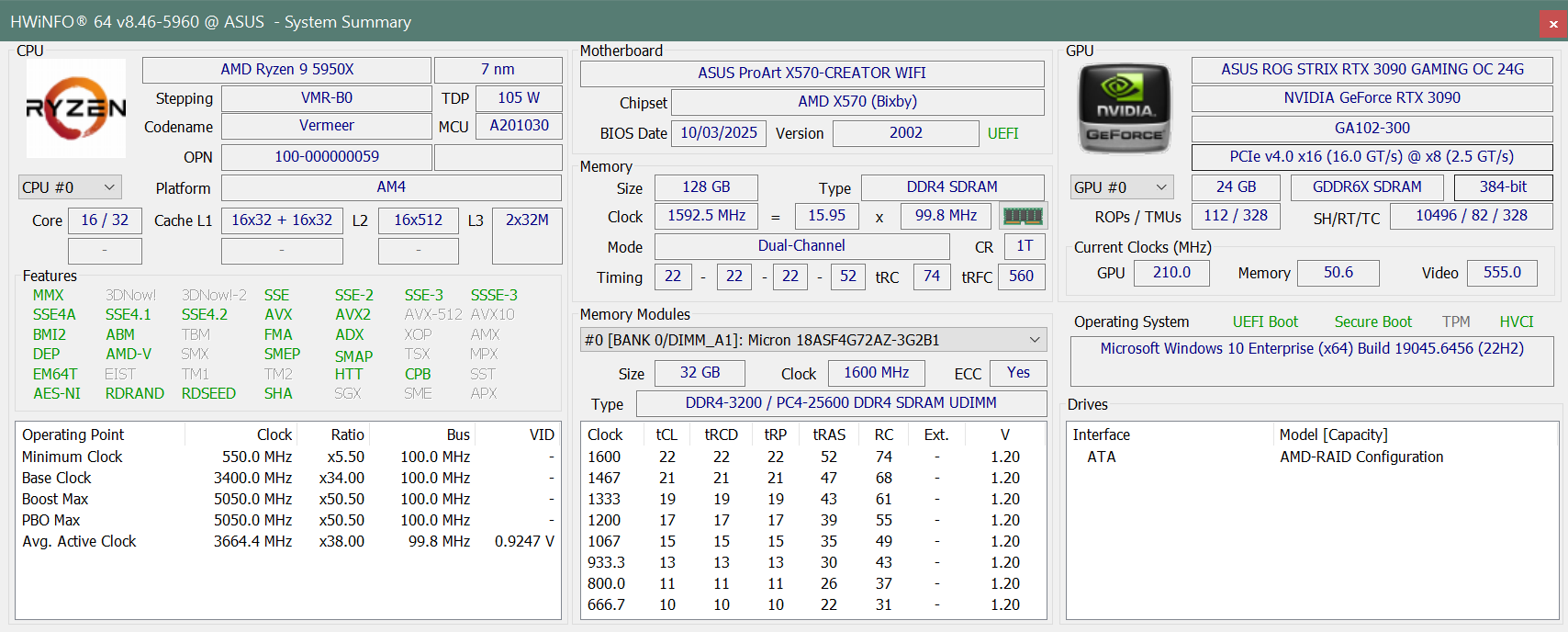
I have been using *(T)SME on AM4 and AM5 - *by “using” I mean explicitly enabling everything in the UEFI that sounds like it has to do with that and then check for example with HWiNFO that the little SME icon in the supported features overview is green.
Does that mean it’s actually active?
I have no idea.
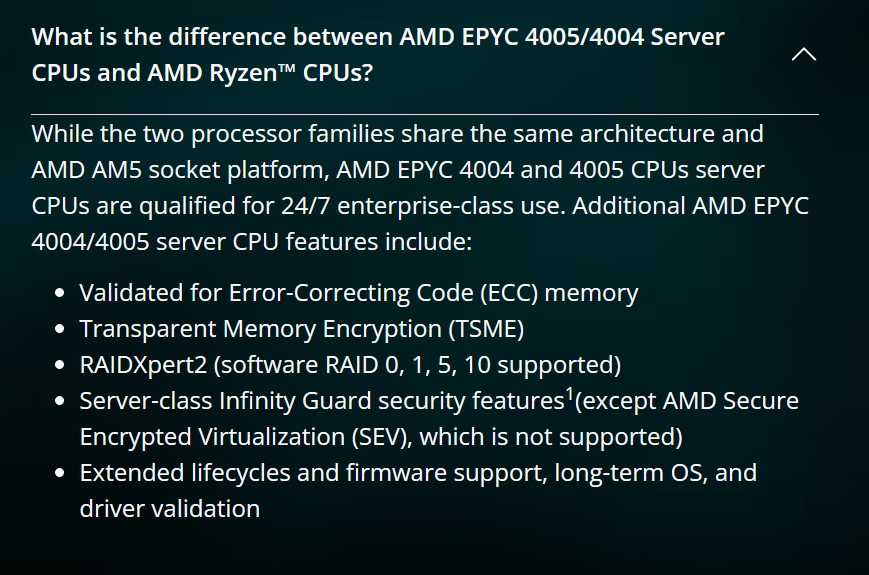
But some BIOS versions broke this feature sometimes on AM4 and when it was broken Zen 3 Ryzen 5000 and Ryzen 5000 Pro (CPU line, not the APU models) behaved exactly the same here with HWiNFO showing it red/supported by the platform but currently inactive, leading me to believe that the whole Ryzen Pro line (and now Epyc 4004/4005) regarding the “qualification of the platform features” is just marketing BS, them being the exact same chips but with lower TDPs.
Video suggestion:
Get a bit of liquid nitrogen (co-op with Gamer’s Nexus?) , cool the memory of a running Ryzen system with TSME enabled and see with a memory reader if the memory encryption is actually active?
AMD Ryzen 9000 series does NOT support SME/TSME. It has never supported it since they launched.
I personally have enabled TSME since I bought 9950X3D + ASUS X870E Proart, but before the bios version XXXX (I don’t remember) fwupdmgr and cpuid confirms TSME flag but internally it has never passed the TSME test.
With recent BIOS versions, it does not even report the false support flag.
BTW, exactly same thing happens with 5900X/7950X3D with B550/X670E. Now I see AMD likes to drop incomplete features with “updates”.
Be sure to go through the various UEFI menus and explicitly enable the TSME and SME options instead of leaving them on “Auto”. Auto doesn’t always mean enabled and the meaning of Auto (if it means Enabled or Disabled for a specific Option) can also change between different UEFI versions.
I’d bet the Zen 5 AM5 Epyc-labeled CPUs behave the same with AGESA 1.3.0.0(a)/1. At least that has been my experience with UEFI issues with Ryzen and Ryzen Pro-branded CPUs (not APUs) of the same generation so far. Epyc 4005 is just the current marketing for the Ryzen Pro lineup with CPUs (AM5 APUs still exist as Ryzen Pro).
That HWiNFO stats mean nothing. Even if you explicitly turn off all SMEE/TSME options in BIOS, it will still show SME is available (yes, it means “available”, not “enabled”, and even that SME availability is false).
I’ve just tested it with all the options enabled/disabled, and no matter what, HWiNFO shows SME available.
Perhaps AMD noticed that overclocking ECC memory would threaten the sales of other products (like Epyc 8000), haha.
For example, a 9950X paired with a 4x64/48GB SK Hynix ECC UDIM can easily reach 6000 C30/32, which is a very strong performance level. After doing this, compared to other products with similar performance, AMD is basically giving away money.
Are you worried about OC instability? Why would you have such a worry? As long as you spend a little time verifying the stability, there’s nothing to worry about. I’ve built at least several hundred such systems since 2025, and the consistency of the first-party original ECC UDMM is excellent. Even if the memory does fail, you can just replace it (but I haven’t encountered that yet), without needing any additional re-tuning.
Another reason that motivated me to do this was the supply issue. Ryzen CPUs and high-performance motherboards are readily available, while EPYC and motherboards face various supply problems.
HWINFO just show the processor feature bits, not where it is enabled or not. While it is not useful for determining if something is enabled or works, I would be pretty sure a feature would not be available if the processor doesn’t support it.
I know what to chase in the lab and can discuss with the memory team. I will do what I can to at least make sure we retain the ability to manually control the memory configuration through the AMD Overclocking Menu, even if it turns out we reduced the initial boot frequency on ECC configs for some reason. I’ll be doing some content on EXPO soon and I will try to cover some other topics, like the boot frequency behavior I mentioned above, and an update on the ECC topic if needed. But again, my team’s goal is to enable you to take manual control of your configuration despite the default boot behavior, so I will try to get that sorted.
That was educational, thank you. Can confirm that SME stays green in HWiNFO on the 9700X test system no matter what setting is set in the UEFI regarding SME.
Now I remember that it was only ever influenced by BIOS updates, here for example it’s broken/removed by the latest BIOS version (2002) on an ASUS ProArt X570-CREATOR WIFI, in older BIOS versions it’s present (no difference between a 5950X and a 5900 PRO).
I will try to make an EPYC 7003 system available for tinkering and check if the BIOS settings regarding SME there have any impact on what HWiNFO is showing. Unfortunately due to DDR5 RDIMM prices I have not been able to have Epyc 9004 or 9005 systems at hand.