Any split phase (120v/240v) UPS:es affordable to us mere mortals?

Hi everyone,

My rack sits in a room in my house that used to be a disused laundry room, when the previous owners moved it to another location.

The laundry room had a split phase 120v/240v NEMA 14-30 receptacle in it that for the longest time I wasn’t using. (The whole rack used to run off of the old washer 15 amp receptacle, on a circuit shared with other outlets.

As my rack needs grew, I started to get trips on that circuit, so I decided to be smart, and converted the single unused 30 amp 120v/240v receptacle to an MWBC with two 20 amp 120v receptacles.

Before (after it was removed)

After:
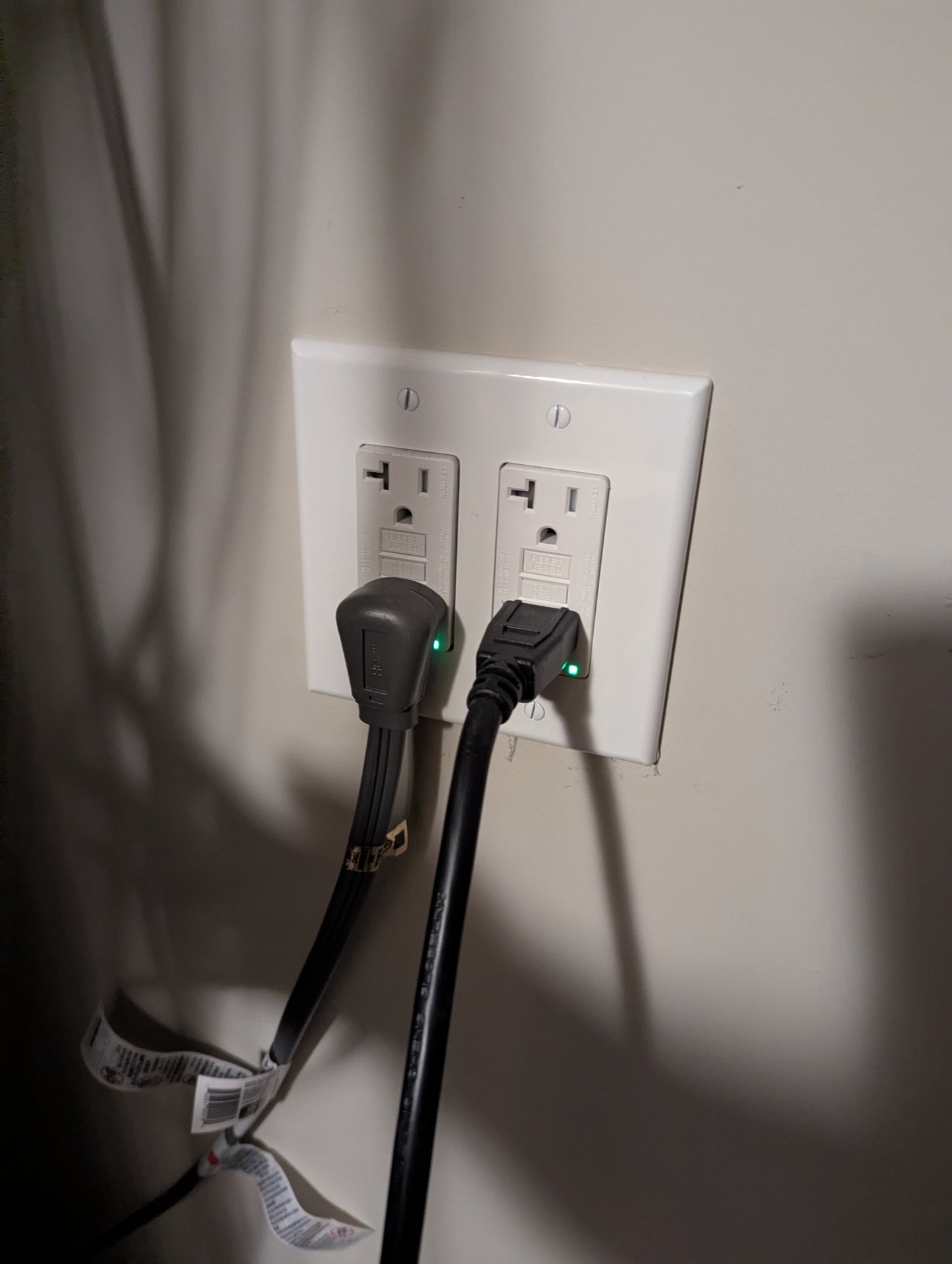
It’s pretty easy to do, but it does require replacing the breaker:
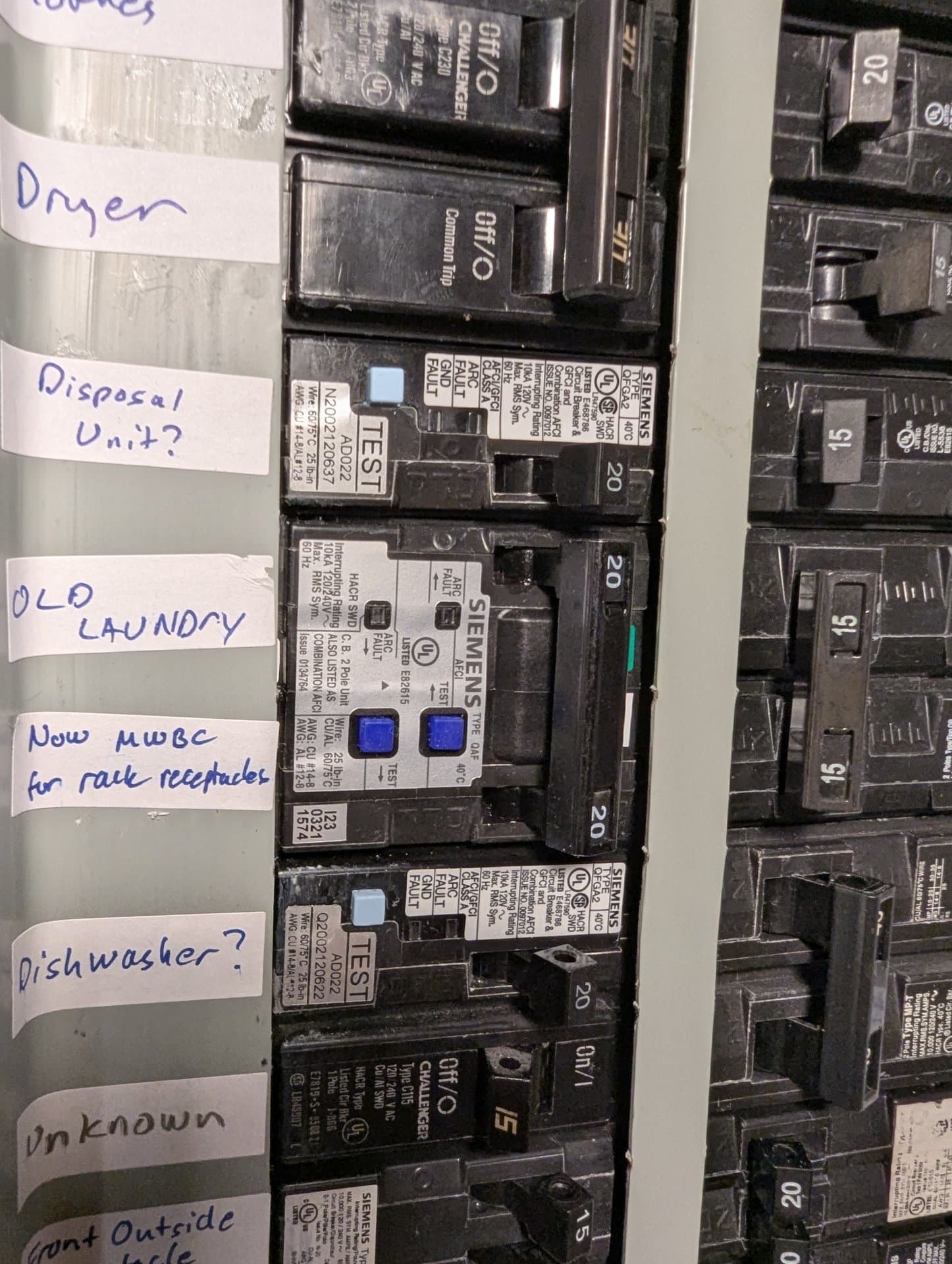
And this works OK right now. I have two aging 2U 1500VA APC UPS:es in the rack, one plugged in to each half of the MWBC, which gives them 20 dedicated amps each.

All systems in the rack that have redundant power supplies are plugged into both UPS:es, to distribute the load, and add redundancy.

But now I am adding some more high powered systems to my rack. Most of the time they will be nowhere near the max load on either of these two circuits, but it becomes complicated to decide which to put on which side, in order to best distribute that load.

It struck me. There are some enterprise UPS models that have split phase input for this very reason. Most of them are designed for 3 phase 120v/208v, but most of those also support split phase 120v/240v.

The holy grail would be something like an Eaton 9PX6KSP. It has 6 120v 20A outlets on the back, as well as a 240v only L6-30 and a L14-30 for 120v/240v use. Either of these could connect to a 240v PDU I could use for most stuff in the rack that supports 240v, and the 120v outlets could be used for the few things that are 120v only.

This would allow me to evenly distribute my use across the full capability of the old 240v/30A circuit.

The only problem? That Eaton PSU costs over $9000 new. :astonished:

That’s a little rich for my blood.

I guess my question is, are there any decent split phase 120v/240v I could get for much less decommed on eBay?

I’d appreciate any suggestions.

Well, these days, why not convert everything to a Lithium backup battery for the entire home? Could get one installed from, for instance, these fellas:

Roughly £5k for 10 kWh of storage, that can run all your base electricity from fridge, freezer and cloth drier during a blackout, and shift power to not be used during peak hours. Aka, you do not need that UPS anymore, essentially.

Maybe it’s a crazy idea, but it seems reasonable to me :slight_smile: You know that better than me though!

I’m hoping to get there some day, hopefully in conjunction with solar panels, but my budget for this is hopefully significantly lower than that, or it probably won’t happen :sweat_smile:

Well, one way you can justify it is as a home improvement for the entire house, subsidised by your PC hobby account. But I completely understand if this is outside your budget right now :slight_smile:

Otherwise, you can get a balcony solar kit for like £1k, that’s usually only like 2 kWh but for a UPS that beats what you have now, which is like… What? 500Wh? It’s awesome.

You do need to jank it a little though to have the same trip functions and stuff.

I don’t think those are legal in the U.S. yet. I remember reading an article about them this summer and how some states were trying to make them legal, but it requires some updates to the electric codes I think. Something like that.

I looked into solar panels last year. Unfortunately my location was deemed inappropriate for them due to there being too much shade. My neighbors have some massive trees just south of our house where most of the sun would come from.

They are probably going to have to come down at some point, as they don’t exactly look healthy, but as of right now it is out of my hands.

We also do not have any time of use billing here. The electric rate is the same 24 hours a day, so using a whole house battery would not have the potential financial benefits as it might elsewhere.

Yeah, no, for you the panels are just a bonus; Getting a kit for $1k is mostly to get only the battery as a base for a DIY UPS :slight_smile:

Of course if you can find just a 2kWh backup battery for cheaper that is great, too.

Your already having to make concessions on choices and power, so just drop a prefab building down, up the elceical service of the property to 400a if it isn’t already. Then you have a dedicated homelab building, with its own subpanel.
I know the cost might seem extreme, especially when you factor in HVAC and permits and such, butyou just file a DBA or business license with your local government, make the building your registered office, and now it’s free because it was all a write off. You just write it all off.

edit - removed incompatible UPS from post.

You dont need something specifically calling out split phase for your setup. Split-phase US is just one way of calling it, the system is still a single-phase electrical system though. That one I linked has typical US 208/240v voltage input support and it specifically says it accepts either 50 or 60hz input (us uses 60) and will even do conversion between 50->60hz or 60->50hz on the output if you want. AC voltage is nice in that the majority of devices do not care if you have 1 hot and 1 neutral or 2 hots to get your voltage, all they generally care about is that its incoming power lines have the total voltage,frequency, and amperage required that it was intended for.

You can even do crazy things like use exotic transformer designs for high end audio that takes incoming 120v or 240v and split it out into two 60v hots that are 180 degrees out of phase and run it as a quasi-differential 120v AC input to power amps and home theater equipment and it doesnt care at all since it is still 120v. None of that equipment was designed for a 2 hot 60v wiring system yet it works fine and tests supposedly show cleaner noise measurements because of the system design.

1 Like

I would consider going with a ecoflow or similar unit. And connect a smaller ups to handle the switch over. I use one of their Delta 2 max units with a cheap ups in-between to handle any switch over. However it does have a ups mode built in. I never tried it. I just wish they sold a rack mount for it. :slight_smile:

2 Likes

Agreed, but I don’t know what else to search for for a UPS that uses four conductors (line1, line2, neutral, ground) from the wall in order to support both 120v and 208v/240v devices.

Truth is, I’m really not all that interested in runtime. I mean, don’t get me wrong, I’ll take it if I can get it at a decent price, but for me I am more interested in having just enough time to do a clean shutdown of everything should the power go out and having a system that monitors power and switches to battery if something goes wrong with the input power to prevent damage.

That looks a lot more attractive pricing wise. :+1:

I wonder what the distinction between the Eaton and Tripp-Lite branding is.

If I am not mistaken, Eaton branding has a lot better reputation than Tripp-Lite. I didn’t even know they were the same company. I presume Eaton acquired the Tripp-Lite brand at some point? So maybe Tripp-Lite is better than it used to be?

You are right, your comment about the input wiring specifically got me looking again at the spec sheet. I mistook the output ports as they are in fact 200+ volt outlets only. Guess I need to pay closer attention to them.

Branding wise, Eaton bought Tripp-Lite a few years back so they are likely just putting their own name on products going forward.

Edit: this one looks compatible, says it has new batteries put in as well, and is $4500:

I have no idea where the heck the output plugs are on that thing, cant see them in the pictures. Says it has two NEMA L5-20R 120v outputs and two NEMA L14-30R 208/240v outputs. It supports 2hot+N+G wiring input like you mentioned, and supports either 208 or 240v according to APC’s spec sheet.

APC/Schneider Electric just EOL’ed that model this last August though. The only other model they sell that meets your specs is also around $9000, but is better spec’ed than the Eaton one from the 1st post is.

Looks like CyberPower does not make any UPS with both 240v and 120v outputs until you move into their 3 phase models.

The Ecoflow Delta Pro 3

  • is on sale in the US (~$2300)
  • has a 240V outlet
  • charges on 120 up to 240V
  • supports charging on solar (if it is an option)
  • comes with 4096Wh LFP Battery
  • expandable battery capacity (up to 48KWh from vendor; there are DIY expansion options for much cheaper)

I am looking at this thing because

  • it offers the last opportunity for a tax break in the US
  • I consider it more reputable than cheaper chinesium options that offer a similar package for ~1500
  • it actually offers a reasonable backup power time for max loads

Concerns:

  • it’s not marketed as battery backup for critical computer gear (UPS). Meaning it doesn’t guarantee switch times with the same speed and reliablitiy as a UPS

I made the same mistake. I skimmed it a little too fast and mistook the NEMA 6-15 outlets for NEMA 5-20 outlets.

As for not being legal in the US, I was referring to the balcony panel, not the battery backup unit.

So, I took inventory of my rack today, and it turns out that every last server, switch and device in it can run at 240v, so maybe I don’t need the dual voltage 120/240 capability after all.

A 240v model like you posted above might just do the trick, and those seem to be more plentiful, and a bit less expensive.

And computer PSUs tend to be slightly more efficient on 240v as well.

Indeed, but “slightly” is the effective word here. It’s usually less than 1% :stuck_out_tongue:

The primary benefit is that I will be able to balance all my systems across the total power of the 240v circuit instead of splitting it across two outlets.

Right now I have two APC SMT1500RM2U units. They are rated at 1440VA and 1000watt each, and while I can use 1000 watts each, the issue is that both UPS:es could be underutilized and I still can’t connect another system as it would cause either one of the two 1000w units to be overloaded, but if they were on the same 3000va unit at 240v that wouldn’t be a problem, as I won’t have to worry about how much power goes on each of the UPS:es / circuits.

This topic was automatically closed 273 days after the last reply. New replies are no longer allowed.