Airflow question with a Jonsbo D41 (vertical PSU)

An entirely new from-scratch build with a Ryzen 9900X. So I’m not anticipating a huge cooling demand. But I still want to get it right. Probably wont do water cooling though I could if worthwhile.

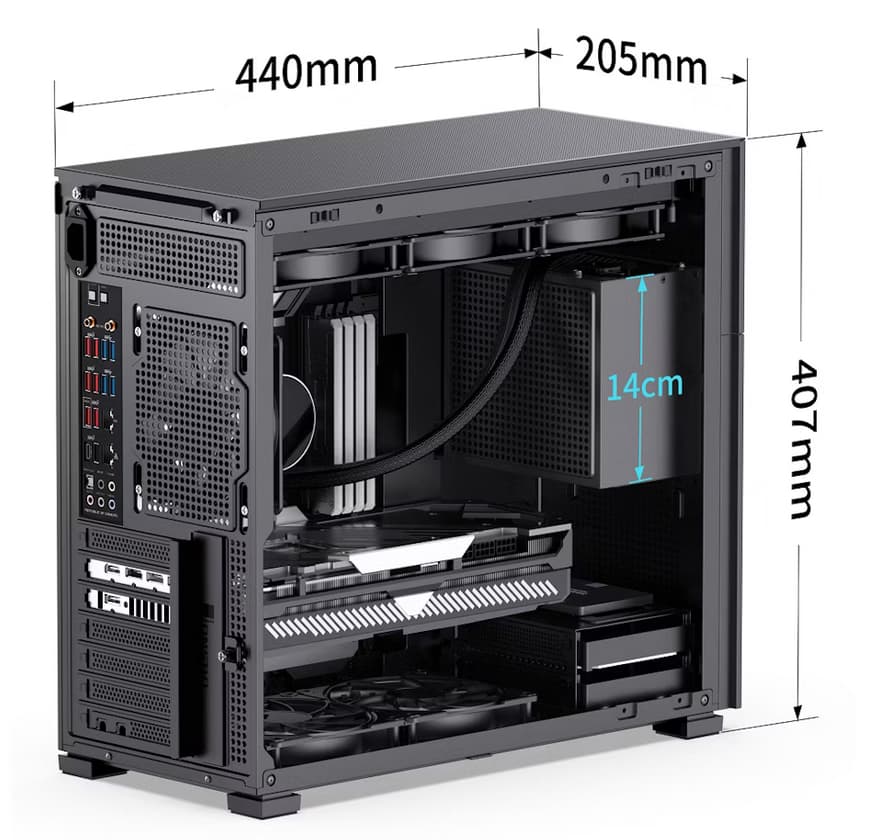
Planned case is a Jonsbo D41 Mesh - i.e. the version of the case without a screen.

The vertical PSU is throwing me a little bit. Normally I’d have a couple of intake fans at the front of a case, one exhaust at the back and the CPU cooler directing from front of case towards back as well. I’ve never got more sophisticated than that. With a PSU blocking most of the front that’s not going to work.

I don’t feel I need to max out the fans in this. Just a few. But where should I stick them? As it were…

(I will not have it on carpet so can have intake at the bottom). I’m also not technically wedded to the case, it’s just fairly cheap yet still looks nice. Main goal is quiet running and not costing the Earth)

It’s unclear what your question is but, yeah, choosing a case of this form factor brings airflow compromises. From the OP it’s also unclear to what extent a dGPU, other PCIe cards, and 3.5 or 2.5 drives might obstruct bottom to top airflow. Jonsbo’s implementation’s also restricted in that, if it’s iGPU or dual fan dGPU, the PSU cage can’t be moved down to bottom front to open up front intake for a front to back air cooler. The D41’s glass side’s also somewhat limiting as it’s a fair bit of work to mod it for side intake.

Given the ATX form factor is primarily oriented to front to back airflow I’m tempted to suggest doing this right would be to select a larger but less compromised airflow case. If you want front PSU placement that’s probably a Lian Li Lancool 207, though it’s not looking like it’ll release for at least a couple more months. In the meantime, where I am Lancool II pricing isn’t much more than the D41 and Lancool 216s are a bit lower. The II’s an excellent default for front to back airflow with current gen dGPU sizing (I’ve built a bunch and it looks like a 9900X+RDNA3 build in one is coming up soon). The 216’s good too.

If you want a short case without front PSU obstruction that means accepting the dual chamber width. The O11 Air Mini’s the best option I know at D41ish pricing.

If this is cardless and using the 9900X’s RDNA2 IO die cores then bottom to top flow means rotating a dual tower air cooler. Not much data on that and DIMM clearance is potentially an issue but the airflow path is clear and CPU temperature elevation from its cooler ingesting dGPU exhaust is avoided. If not, side intake and dropping a dual tower’s front fan is how Lian Li deals with similar obstruction in the A3-mATX. Fairly awkward, IMO, but perhaps the least awkward choice given a front PSU if an mATX mobo’s an option here.

Failing all that, if the build power’s low enough or noise budget permissive enough you could drop down to SFX or SFX-L to be able to push more front intake air around the PSU. Jonsbo doesn’t indicate D41 SFX compatibility but adapters aren’t too expensive.

1 Like

Thanks for that. Apologies if my question was unclear - I was asking how many fans and where to place them and in what orientations, and what orientation for the PSU, with this case.

For example, you talk about rotating the CPU fan - that was one of the things that threw me about airflow in this case - if the airflow is going bottom to top then how does a front to back cpu air cooler work with that and would that mean that this is really more suited to water cooling with a radiator at the top? Things like that.

FWIW, I am hoping to manage this with just the in-built graphics but may want to fit a discrete GPU down the line.

It sounds like this perhaps isn’t the best case for my needs. A small case would be a plus. I have a different case for my big threadripper build with 11 drives in it! :slight_smile: This is supposed to be my small desktop.

I looked up the Lian Li Lancool 216. It’s a bit larger which is a shame but do-able. Only about £30 more in price. It has USB-C front-connector which is essential for me so perhaps I’ll switch to that or keep looking. This was just cheap and small with the connector I needed.

1 Like

I’m not aware of any measurements on this layout. Or on rotated air coolers with recent gens, either with or without dGPU obstruction. So if you want a cookbook it looks likely you’d need to write it. The absence of data makes guesstimating dB(A) and °C disadvantages difficult, so it’s hard to quantify the size-cooling tradeoff.

A caution I’d make is case perforation and pattern have strong influences on flow resistance and load noise. From the various cases I’ve built and measured and Jonsbo’s product photography I think it’s possible the D41 may have greater build issues there than it does layout limitations.

I’ve been watching for a good mATX-ish airflow case implementation for a while and there kind of isn’t one. Prodigy M and Meshify 2 Mini aren’t bad. AP201 might be a little better than the D41, Pop Air Mini’s limited for dGPU or 3.5s. IIRC Lian Li showed a 205M refresh at Computex but that doesn’t matter until it’s shipping.

For shrink without getting into ITX the Jonsplus Z20 strikes me as something of a logical endpoint. Might be worth a look, though since you didn’t pick the D31 I’m guessing this an ATX mobo build rather than mATX. There might also be small tower options of interest but, among the ones I’m aware of, nothing stands out to me.

Either way a dGPU’s a substantial mid-case obstruction and the CPU cooling’s running in its exhaust. It’ll work but IMO part of getting a build right is being mindful of size-noise-heat tradeoffs. Hence the questions around how much of a dGPU. Like a 4060 dual that’s occasionally hitting 50 W’s probably not too much of an issue. For a 7900 XTX at 350 W sustained, Lancool (or similar). The design question’s where’s the breakpoint for going with a larger case but combination of data and build priorities is needed to answer that.

For a dGPU- and 3.5-less build with the D41 I’d probably use front to back dual tower air as a baseline. While PSU’s in the way and Jonsbo’s communication leaves something to be desired, top mid/front, front bottom, plus bottom front intake with reasonable curves and fans that are ok in pull will get air to the cooler (Jonsbo seems to have the PSU exhausting upwards). Rotating the cooler and measuring bottom to top airflow should then give decent initial data to work from. If you already have a dGPU around you could also assess its effects at idle and active.

Alternatively, going with AMD’s liquid cooling recommendation for the 9900X (I won’t be in my build) pretty well indicates for a 360 in top exhaust with 3x120 bottom intake. Since air coold GPU exhaust would mostly go through the radiator in this config, a proxy approach I’d use would be to add the dGPU’s heat load to the CPU’s. At common ambients with IMO a noise tolerance towards the higher side a good 360 AIO can handle around 250 W. Subtract out whatever you’re planning for the 9900X and that sets a dGPU power budget. With the 9900X at stock (162 W PPT) and a bit of margin it’s maybe 75 W GPU, though probably DDR should be included. Crossflow from front bottom intake and rear exhaust should get some heat out of the back of the case but I don’t think I’d want to try for more than a 4060 here.

For ambients over 25 °C or so, derate or accept additional noise accordingly. If it’s a warmer day, looks to me like the dGPU power budget could potentially close down to idle under a constant noise constraint with the 9900X at stock PPT. If that’s a likely operating point then a larger case looks to me like it’d probably be useful.

Pretty much anything vaguely current will, though it seems not uncommon manufacturers neglect to specify gen 1 versus gen 2. There’s starting to be some mobo 2x2 availability but offhand I can’t think of any cases indicating 2x2 support.
I also prefer a small quiet setup. I have a 7950X3D and a 4070 crammed into a Silverstone Temjin which is even smaller than the Jonsbo D41 while also including two 5.25" bays and four 3.5". I have the PPT set to 105W on the CPU and the GPU set to pull around 180W max. If the system didn’t run quiet under full load I’d nerf performance more but it does.

I’d position your PSU all the way towards the top with the intake facing front and exhaust facing up. Then put an intake fan just below the PSU drawing in thru the front panel. One more exhaust fan on the back set to run slower than the intake to keep positive pressure in the case and you should be good with any half decent air cooler.

Also, if you get a PSU with good efficiency and a fan that only spins when needed like a SeaSonic focus GX you’ll never hear a peep out of it.

If/when you add a dGPU you have options to add fans top and bottom or even an AIO as needed.

This topic was automatically closed 273 days after the last reply. New replies are no longer allowed.