To answer your question directly, it doesn't. Wattage is simply a measure of how much power is going through the speakers, and doesn't directly relate to sound quality. Let me go into a little more detail:
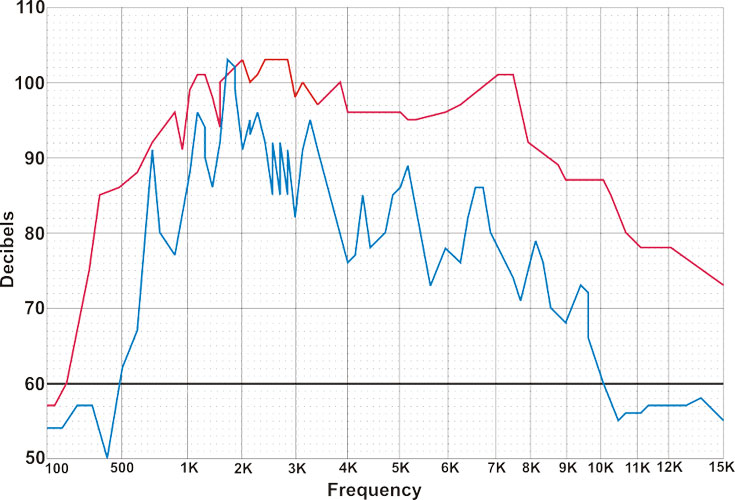
You see, a speaker may have a frequency rating of 20hz-20khz, but that only tell you a range, not what it is going to sound like at any given frequency. For example, a speaker may be rated at 50hz-20khz, however it may not actually start putting out any volume until 200hz, and may start cutting sound off at 15khz. Also, speaker curves are not linear, they have tons of weak spots. For example, when you measure a speaker output, it does NOT look like this like advertising may lead you to believe:
It looks more like this:
Now I know the first graph isn't of a speaker graph, but it is simply an illustration that the specs you see on the box mean next to nothing. In fact, many of those ratings are only at one given frequency, not the rest. Also, how much distortion should you expect throughout the range? Most manufactures will only give one rating at 1-2 volumes at 1-2 frequencies. A good example are the Infinity Primus P363's that I have. The specs Infinity puts out are:
Frequency Response 38Hz - 20kHz
Nominal Impedance 8 ohms
Sensitivity (2.83V @1m) 93 dB
However, after someone actually tested them, they rate more like a 4ohm speaker (with it ranging from 4-18), with a serious dropp-off on anything below 80hz, and more like 90dB on sensitivity (again at 2.83V, which is deceiving in of itself, as most tend to rate at 1V, giving them a real sensitivity of like 87dB at 4ohms).
So really my detailed answer is that there is a LOT of technology that goes into speakers, and simply going by specs listed is one of the biggest mistakes people make when purchasing audio equipment. Not just because the specs don't tell the whole story, but that a lot of times they are simply not 100% true.
This is why the age-old advice when buying audio gear has been, and always will be to try before you buy (and trying them out properly is another discussion in-of-itself), or if you are buying blind, to do your research and find a reviewer your trust, take their word for it, and buy them from someone with a good return/exchange policy.