Let me try and clear up any loose ends.
First off, no Inspiron 5675 is compatible with Ryzen 7 2700, or any other zen+ cpu natively. Not the 477DV, 7PR60, or XFRWW. The only board that is, is the VYXHD from the Inspiron 5676. I am not 100% clear what physical differences there are between the 477DV, 7PR60, and VYXHD; they appear largely identical to me. The XFRWW is the version that went in 5675s equipped with processors with integrated graphics (lower spec), and therefore have video output onboard, fewer USB ports, no secondary pci express x16 slot (x1 instead), and no nvme slot (likely due to # of pci express lanes being fewer on the A-series APUs compared to Ryzen CPUs).
Anyway, the reason 2nd gen Ryzen CPUs do not work on the 5675 is simply a BIOS limitation. All the boards use an x370 chipset and am4 socket which are both compatible, as we see on the 5676. The configuration of the BIOS is different between the 5675 and 5676, and for that reason, you cannot write the 5676 BIOS to a 5675 without bricking the board. Here are the different CPUIDs (microcode) in each BIOS, 5675 on top, 5676 on bottom:
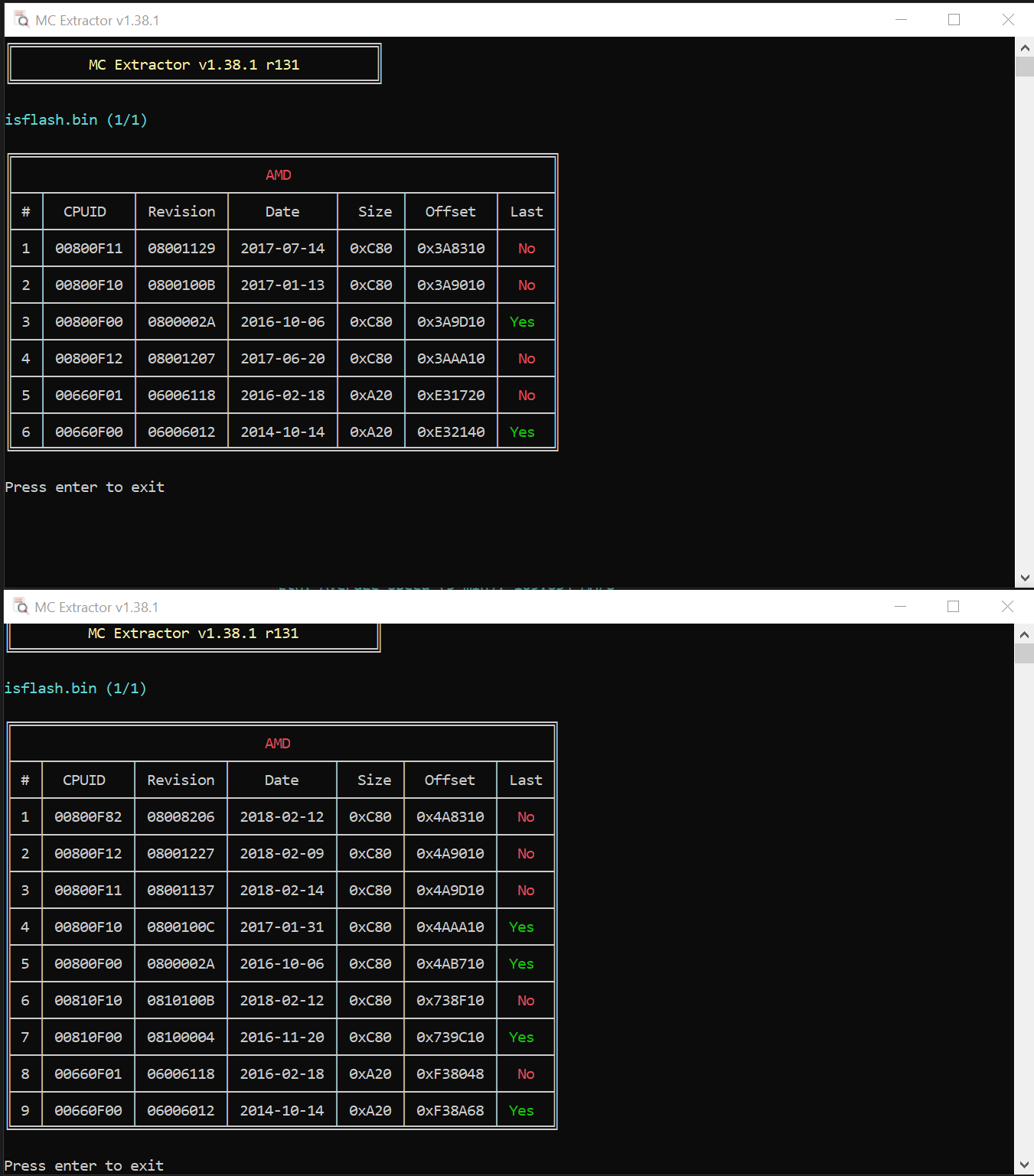
As you can see, despite the 5675 getting a recent BIOS update for a security patch, it still lacks the CPUIDs 800F82, 810F10, and 810F00, which are included on the 5676 BIOS from 2018. The 800F82 cpuid applies to zen+ cpus, while the 810F*0 ones apply to Ryzen 2000 series APUs (though I don’t believe these APUs are officially supported or equipped by Dell).
Now since the 5676 board is virtually identical to the two 5675 boards, I was confident a 5676 BIOS would work on a 5675, and because even the clearly different XFRWW board shared the same 5675 BIOS file as the other two, I was confident the same would apply for it. I downloaded a 5676 BIOS from dell, tweaked the installer config so it would force overwrite despite the different model number, and… BRICK. I guess I should have seen that coming.
At this point, I had a dead motherboard and was more curious if I could ever get zen+ support on the 5675 than anything. I looked into adding the microcode to the 5675 BIOS, which is virtually impossible since they use an entirely different AGESA and different parts of the BIOS are in different locations, so calls to one area of the BIOS would be calling on something that is not there or is somewhere else. So that was out of the question. Also, the BIOS you download from Dell is not a ‘full’ BIOS, but just the parts needed to upgrade from a previous version, so you cannot simply download the BIOS and write it to an EEPROM.
So what I did was I bought a Dell 5676 so I could get my hands on a ‘full’ 5676 BIOS using an EEPROM reader. I was able to do this, but it does require desoldering the EEPROM from the motherboard, as the BIOS cannot be accurately read or written while the chip is in circuit (believe me I tried). I did the same with the EEPROM from the now dead 5675 I had, and compared the BIOS between the two, as well as compared the downloadable BIOS for each model. There were extensive differences in the BIOS, but I was able to locate the key information I was looking for.
What I did was essentially take the 5676 BIOS, replace the service tag (1 instance), MAC address (14 instances), and windows key (1 instance) with those from the 5675 BIOS, and then wrote that modified 5676 BIOS to the original 5675 EEPROM, and soldered it back onto the 5675 board. And it booted back up, unbricked, thinking it is now a 5676.
By the way, the 5675 board I had was the XFRWW, so the least likely to work. I fixed @imrazor board, which I believe was the 7PR60, but it might have been the 477DV. Either way, my board was the single x16 slot, his was the dual.
I think I pretty much can call this wrapped up, there is no way to flash a 5676 BIOS onto a 5675 without having a 5676 ‘donor’ BIOS first, and modifying it to contain those three pieces of system info from the 5675. Dell is 100% wrong in saying the 2700 will work in a 5675, despite what their parts lookup shows; the CPUID is simply not in the BIOS.
For my board, I ran a ryzen 1600AF (which is zen+, same as a 2700) with no issues, and I think imrazor ended up using a 2700(x). I later ran a 2400g in mine (since I had the onboard video output), and it worked, but for some reason had some usb issues with that APU. I think it just isn’t supported beyond having the microcode in the 5676 BIOS, but the 5676 never came with video output onboard, so no point in really running one.
I hope that answers everything. @90Ninety , if you want to send me your BIOS file that you read off of the 5675, I can send you back a modified one, BUT I assure you that it will require desoldering (heat gun and be patient, that lead free solder takes some time to let go. I ripped a trace on my board when I was impatient and had to run a jumper ultimately).