Looking good 
1 Like
That video is from a Facebook post. Could it be of either the front “undercover” or the rear undercover? (I don’t have a Facebook account, so I can’t read the thread or listen to the audio.)
Yes, front and back “undercovers” are made of flimsy (black) plastic, and can sag. They don’t, however, cover the battery. They cover the areas in front and behind the battery.
Hang on, GIMP to the rescue:
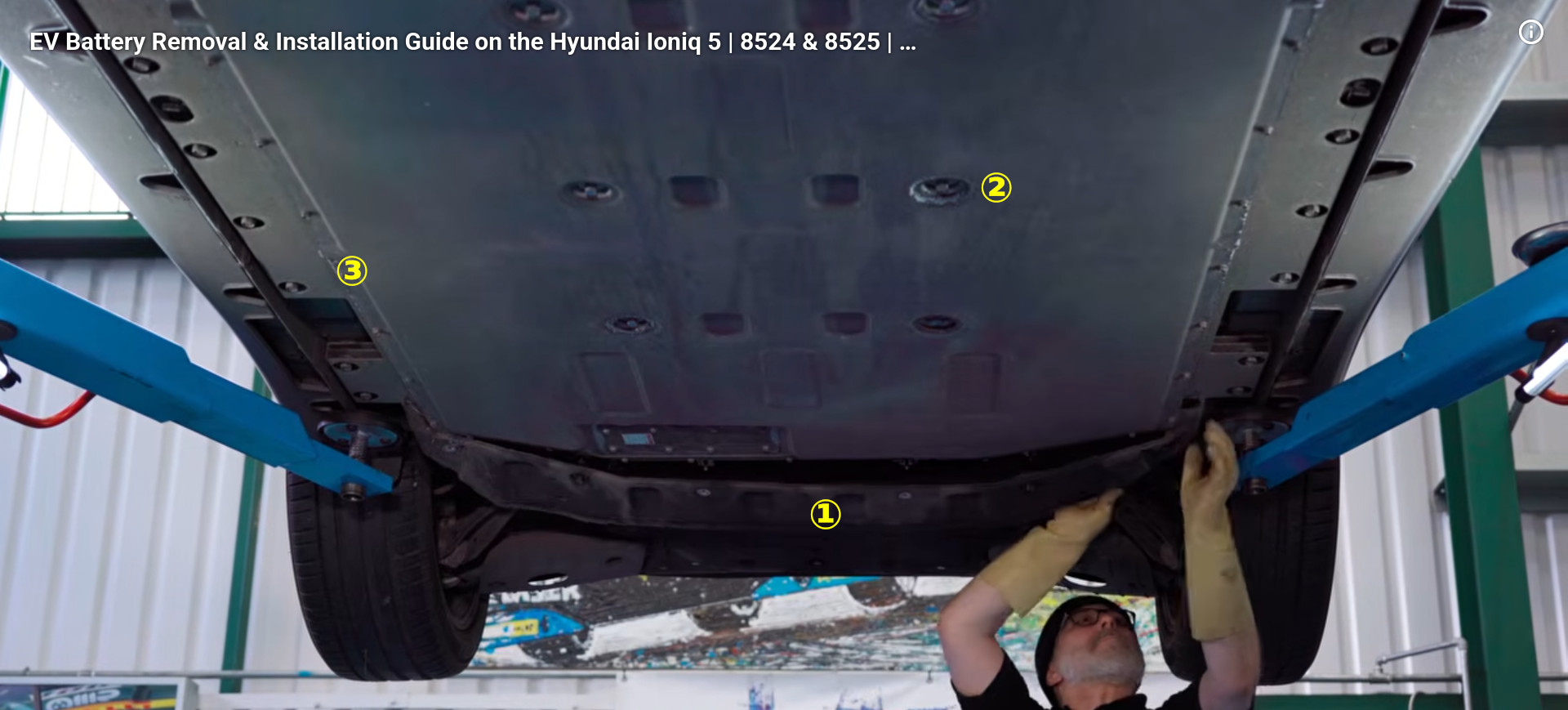
① is one of the plastic undercovers
② is one of the cutouts on the protective composite battery shield
③ is the area that Kyle’s car got damaged in the first photo you linked
Since the bottom of the car is relatively symmetric, ③ could be on the right side instead. Anyhoo…
The image was taken from a workshop in the UK in 2023, so I’m pretty confident that it’s the same car. I doubt if left-hand-drive vs right-hand-drive makes any difference to the battery layout.
So, yeah. The damage was done to the composite shell protecting the battery case. This thing is supposed to be rigid and not sag. It’s supposed to be bonded to the bottom of the battery case along its entire length. If it’s not, something has gone wrong.
Finally, did you notice the angle of the scratches? They suggest that whatever the car hit passed under the car from the side, not the front. One scenario I can think of that explains both the severity and angle of the damage was that Kyle was doing burnouts in a supermarket carpark, lost control and slid the car sideways towards a tree — impacting the 15cm-high concrete ring that was protecting the base of the tree.  No doubt other plausible explanations exist.
Whilst long-distance forensics is fun, we’re really just guessing. The actual mechanics/techs who closely examined the car made the decision that sufficient damage had occurred to cast doubts on the long-term reliability and/or safety of the battery, and the warranty was voided. Those — qualified — individuals were in a position to make that call. They did, and the rest is unchangeable history.
2 Likes
Everyone is making good points.
It’s not the tech that is the problem. If the complexity was bought down to an fancy golf cart, then we would all be good. I had an EV conversion back in the 1990s. Basically a K-car van from the 1980s with a motor swap and 102v of golf cart batteries. All off the shelf parts.
Several things happened at the same time.
- Battery tech got good enough and cheap to make EV affordable to the general population.
- The manufactures integrated stuff into large modules (motor/transmission, battery) so the entire module has to be replaced at great cost.
- Insurance looked at the auto repair industry, EVs and noticed the 500 volts, the lack of any training of the techs, and raised the rates to an insane amount. So many shops just declined working on EVs period.
- The shops that do repair EVs, charge a higher amount to do so to cover the insurance and teach training cost. So the car gets totaled quicker because the repair cost is to high.
- Manufactures also locked a bunch of the diagnostics behind dealer only tools.
- Manufactures also realized there is more money to be made in leasing and financing then the car sales, so the cars only have to last the term of the lease. This is also the point that people don’t care about the replacement cost of the battery as it’s cover under warranty, and they will not be owning the car outside of the lease/warranty.
- We are also loosing auto techs at a fast rate. The older guys don’t want to deal with everything being a computer. Post 2001, the mindset is that you can’t work on your own car because of the electronics, so people don’t. So the new generation of kids that grew up working on their own beater car and now want to be an auto tech for a job, just does not exist in 2026. (excluding the custom car builders, and some edge cases).
3 Likes
I’ve noticed this becoming the norm for all cars, even ICE. My paren’ts were looking at one of their new cars and their mechanic couldn’t get diagnostics without paying like $100 for 2 days to access it.
That is the manufacture DIY price. It’s hard to find the websites, but most manufactures offer their service information online (I believe this was a government requirement) and they can charge for it. They tend to have deals where you can pay for a few days of access, and sometimes for 1 model of car. It’s targeted at people wanting to fix their own cars, and not auto repair shops.
The 3rd party repair sites, (AllData, https://www.alldata.com/diy-us/) have better pricing, but the information might not be as good as the factory stuff.
3rd party auto repair shops will generally have company accounts with several of the 3rd party sites so they can look up any car.
–Edit
Found a website that list most of the manufactures official tech repair websites. Looks like it’s around $40 for 24 hours of access for the ones I clicked on. https://www.oem1stop.com/
From the right to repair standpoint, the manufacture hosting a website with repair information like the above, should be the the bare minimum for every product.
1 Like
I traded in my E92 M3 at the dealer because the transmission was making a weird noise and I knew just how hard that was to get serviced. The procedure for working on some modern (not tha modern now) car is changing.
It’s going to change again as many are moving to their “zonal architectures” where they are replacing all the previous control units with more centralized systems. Having one (or few) complex control units in place of a lot of simpler, probably oursourced, units makes sense from a production and performance perspective. However, for DIY, it’s mostly tough luck.
VW has an infamous slide for this. They were going to make their cars better, simplier, and easier to maintain by adding millions of lines of code. That worked out as well as anyone who worked on large software projects expected it to.
It’s a common practice for “malicious compliance” with right to repair laws for electronic consumer devices, inflate spare parts prices to make it uneconomical to perform any repair and count on the fact that there is near zero third party spare part manufacturers for many devices.
Apple does it, Samsung does it, it’s not surprising.
For example, a situation like that would simply not work if the guy could just buy a compatible third party battery from someone else, like it’s common with ICE cars at least historically (now they are learning the same tricks).
2 Likes
Litterally just bought a complete wrecked EV for 6k. 200hp motor transaxle, 66kwh battery, all the ECUs & wiring. A nearly perfect EV kit:P.
Also, this car didn’t have frame damage so in theory they can be had even cheaper.
Relevant project playlist:
1 Like
Unless it’s powered by a Mr Fusion it’s not worth it.
If it is powered by a Mr Fusion, they will all be bought by Nvidia to power data centers & you won’t be able to afford one anyway.
2 Likes
I would love an electric DeLorean. Next to the iconic look, it’s replacing the horrible drivetrain.
2 Likes
That “flimsy” black cover from the .gif is the actual battery cover. I found a munro video describing it as a sheet molding compound cover, basically fiberglass:
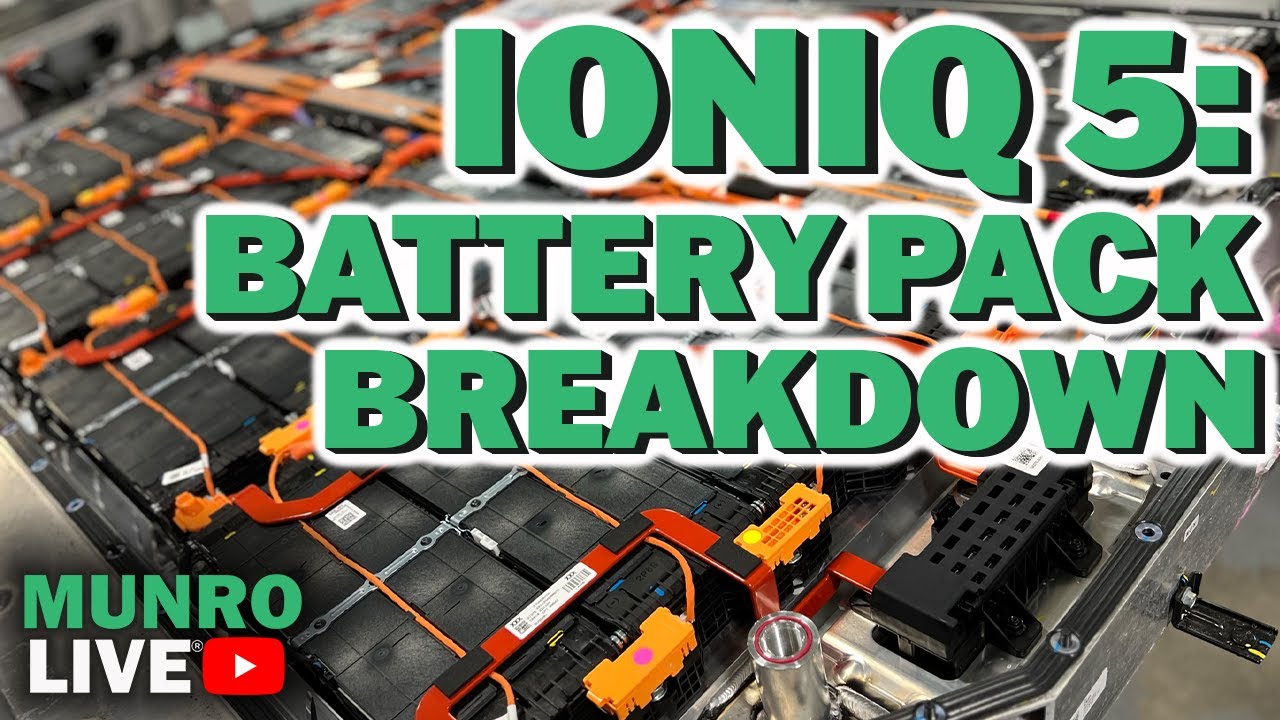
Apparently that cover is glued to the battery/cold plate and the glue failing is why it look so flimsy in the .gif; not being glued to something ridged gives us a good idea of how strong it is and how much protection it can offer. Right above the cover is a thin/delicate aluminum cold plate, which explains why Hyundai was so concerned about any underside scraping requiring a battery replacement. I think the cold plate location is the bad design here.
2 Likes
I don’t really see an issue with the location, the other option is where? Main issue is the lack of a “hard cover” on the bottom. I mean it looks like they were backed into a corner with the ground clearance being so low probably, which is probably why the cover is basically paper thin.
It would be interesting to know what the ground clearance of the car is both an nominal weight and max load/high turn. All the EV’s I’ve seen are on the low side. As someone who has an ICE with a low ground clearance, I know what bad/damaged/poorly designed roads can do to the thiqqq steel plate at the bottom protecting the engine. Although I haven’t seen what other EV’s do to protect the bottom of the battery, I have never heard of issues outside of after car accidents.
Technically you can fast charge you are just stuck at Tesla 400v speeds
I was surprised that my Ioniq 6 sits fairly high off the ground for a sedan, had no issue taking it onto rock/dirty roads and even off the road in a few places, ya you aren’t going to climb mountains in it. EVs from what i have seen at least tend to have higher ground clearance as in they are higher then the lowest object on a lot of ICE vehicles, but like my old car had areas that sat really high and as long as i avoided the oil pan it would do ok. But the oil pan sits lower then the EV does.