I’m looking for a new drive, and I was originally going to get the P44 Pro, but I noticed the FireCuda 530R is slightly cheaper. I looked up comparisons, and from what I can see, the 530 non-R seems to be slightly slower than the P44 Pro. I can’t find any reviews of the 530R for some reason, it’s almost like it doesn’t exist. It seems to have better specs than the P44 Pro and 530, so I assume it’s an upgrade from the 530, and should be better than the P44 Pro. However the lack of any reviews gives me pause. I’m not sure what I should get here.
You will to practical purposes never notice a negligible difference in a paper specification. You will notice a randomly breaking jank firmware, not that ever happend to a firecuda 520 I have. If there’s no general bad feedback on the P44 that dissatifies, and it’s about the same price (as a theoretical you of 2 years hence might consider), then you have all the information you need to make a choice.
Choose a vendor or manufacturer that will be around long enough to honor or care about a warranty (i.e. probably not amazon) and either are probably fine - any storage can fail, and you will, of course have backups.
4 Likes
Seagate is mostly for OEMs looking to shave a buck.
They have close to 10x the annual failure rates of their competitors and as such, fewer reviews yet TONS of people are using them.
Solidigm is used by OEMs selling more premium products
1 Like
Solidigm = old Intel SSD division.
They are very good. And Solidigm has a special driver for Windows that makes it a top tier gaming SSD as it can do some special sauce to improve performance in ways that benchmarks will not be able to show due to benchmark workload behavior vs how many games do a workload.
4 Likes
What does this mean exactly? Maybe the 530R fixes this?
I’m pretty sure both companies would be around for 5 years, but why not Amazon? They’ve been around for a while and have a lot of money. Also why would Amazon matter here? Isn’t the warranty with the manufacturer anyways?
I wish I had the money for that. All I have is a 90% full 12TB NAS that I don’t think could fit a backup from the drive.
I know Seagate hard drives don’t have the best track record, but I haven’t heard much about their SSDs. I think a high end drive like this, especially having double the TBW of the P44 Pro would last.
I guess, but the first I heard of Solidigm was the P41 Pro being shilled while having a name so close to the P41 Platinum that it could mislead people into getting a worse drive. So I didn’t like that very much.
I did notice that, but I don’t think my system could use it anyways. I also already have been using the modified universal Samsung driver from Win-Raid and that has worked well for me.
What I ended up doing was I was talking with a friend that owns the P44 Pro, and before anyone replied here, they convinced me to just buy the 530R going off of it having double the TBW and higher rated speeds. Maybe this was a mistake, maybe it wasn’t, idk. I would still like to hear feedback from others about the choice, as I can’t be the only one and it would help others decide.
hardware is temporary
move up and move on
you’ll be fine
no time in life to live with regret
2 Likes
Any data to back up that claim?
1 Like
I haven’t been able to find anything either. My best guess is the 530R is a refresh of the 530 with a different controller and maybe different flash, or perhaps both, to increase IOPS competitiveness. Realistically, there’s not many workloads which utilize 4.0 x4s well enough to be particularly responsive to performance differences among upper end drives. If you don’t have specific loads in mind in that category I wouldn’t worry about it too much. Similarly, if there’s a high write use case that multiplies out into the FireCudas’ endurance then that would settle the choice. Otherwise it probably doesn’t matter much.
The pricing stack rank I can get varies with drive size but is mostly close enough it doesn’t matter much either. The exception’s +60% on the 4 TB 530R.
Usually the approach I use is, if important variables can’t be identified, then the specific choice isn’t important either.
Cherry pick Backblaze and you can claim anybody’s drives are 10x worse than anybody else’s.  Seagate did have an epic support meltdown in some areas for about six months of 2023.
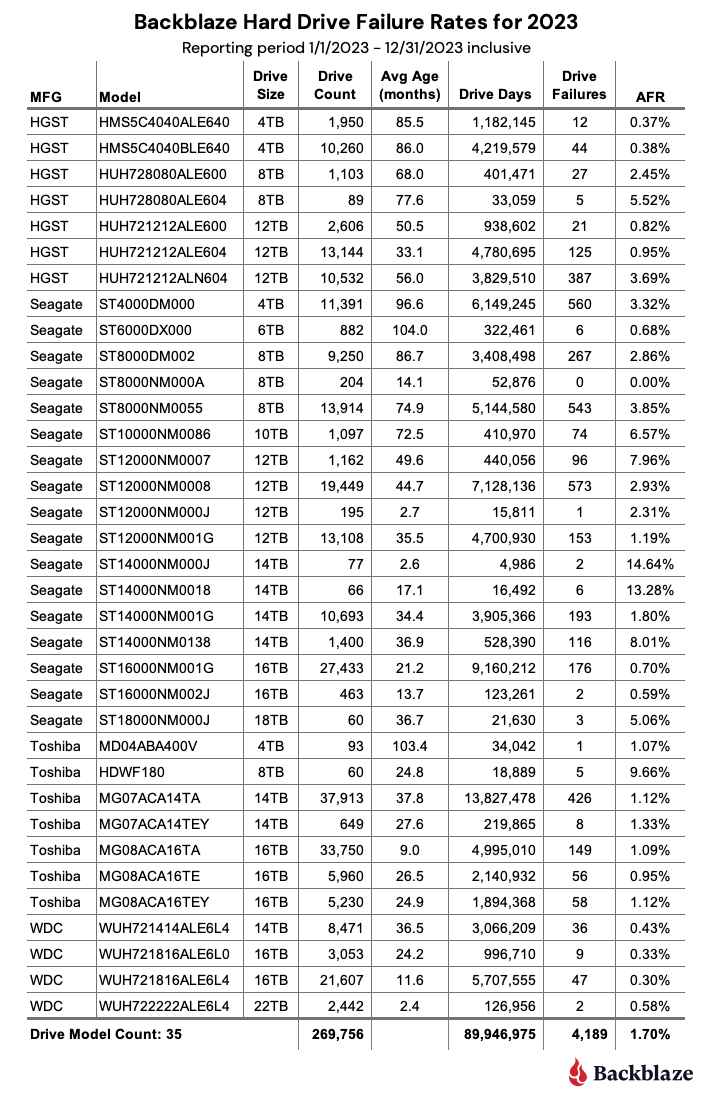
Seagate has 1 outlier:
ST6000DX000
damn thing is unkillable
You gotta take the backblaze data for what its worth though. A 1% failure rate across 38k drives might be something. A 15% failure rate across 70 drives could easily just be a fluke.
3 Likes
I think that soildigm and SK hynix should have come up with better naming for their 2 product lines. But i will say that the P41 plus is one of the best QLC based ssds available. So it’s not a bad product. It’s just bad naming.
I do wonder what Sk hynix is going to do with their 2 ssd divisions. It seems odd that they would have 2 enterprise ssd brands and 2 consumer ssd brands.
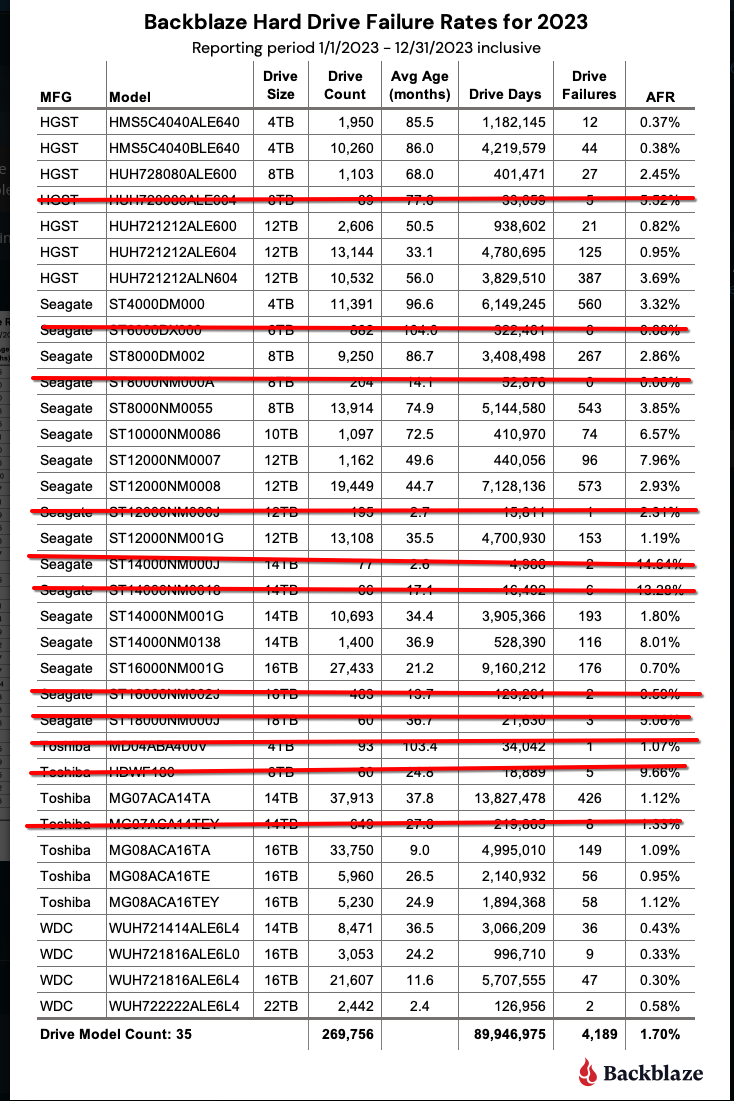
I got a bunch of the refurbished Seagate ST16000NM001G from goharddrive on ebay. For $130 a while ago.
1 Like
But to answer your question @K4sum1, No experience with the 530R here, but I’ve got a few P44 Pros. No complaints there.
I mean, do you really want to try explaining to your non technical friends what a firecuda is and why you bought one?

what’s the ONLY manufacturer with an 8%, 7%, or even 6% AFR?
The next worst is 3% AFR on almost 5 year old drives
The one with 1.5-3x more models listed than the other manufacturers with also a tendency towards longer runtimes? It’s additionally uncertain how similar the drives’ workloads are. Doesn’t appear these factors were controlled for and an explanation of how BarraCudas and Exos hard drives are predictive of FireCuda versus Solidigm NGFF survival is absent.
I mean, I have some questions about 8 and 10 TB Exos based on the latest snake chart and have had to RMA the same IronWolf Pro three f*ing times but it’s unclear to me this is any more thread relevant than the latest WD complaints. The most recent Backblaze SSD data I’m aware of has I think no NVMes, only one drive over 500 GB, and doesn’t include Solidigm.
This is pretty much what I go with. Backblaze’s overall AFR varies from 0.7-2.3% by quarter as drives’ different ages and odds come and go. Some models are clearly less reliable than others but, by the time enough drives have run for enough years for that to be apparent, it doesn’t really matter for choosing new drives because those models are no longer on the market.
I understand why people get upset after drive failures and say they’ll never buy the manufacturer again. But if I did that I wouldn’t be able to buy drives except in brief windows after a new manufacturer enters the market. ¯\_(ツ)_/¯
1 Like
I am running a random selection of whatever in hope that no drives holding the same data die together.
I’ve got a mix of seagate and old HGST here. We don’t really have much of a choice but to mix brands with only two or three major players left in the business.
All drives must die.
1 Like
We’re discussing hard drive failure rates on a post about SSDs? These are two completely different things, made by probably two completely different departments. I don’t think much can be extrapolated from hard drive failures aside from how support and warranty is.
If I’m looking for hard drives, I just get refurbished HGST drives. I know you can’t get much better than that for cheap.
3 Likes