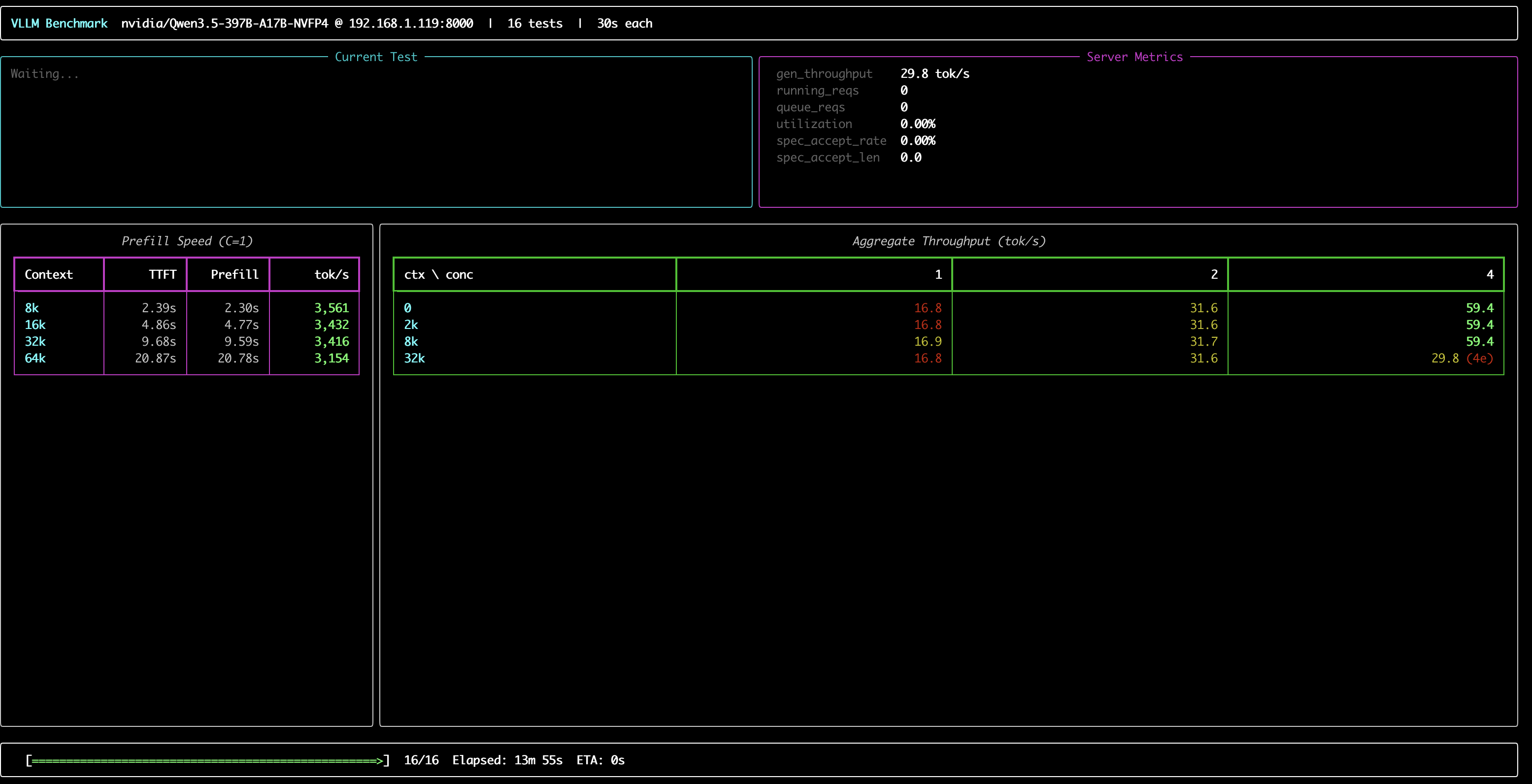
I’ve got a 4-node cluster (3x ASUS GX10 + 1x Dell GB10, all Grace Blackwell with 128GB unified memory each) running Qwen3.5-397B-A17B-NVFP4 — a 397 billion parameter mixture-of-experts model with 17B active parameters per token, quantized to NVFP4.
Nodes are connected via 400GbE RDMA using a MikroTik CRS804-4DDQ-hRM switch. Serving with vLLM using tensor parallelism across all 4 nodes. Here are the llama-benchy results:
Results
Prompt Size
Output Size
Prompt Speed
Generation Speed
Time to First Token
128 tokens
128 tokens
541 t/s
16.7 t/s
240 ms
128 tokens
512 tokens
579 t/s
16.8 t/s
224 ms
128 tokens
1024 tokens
598 t/s
16.8 t/s
217 ms
512 tokens
128 tokens
1,214 t/s
16.9 t/s
424 ms
512 tokens
512 tokens
887 t/s
17.2 t/s
578 ms
512 tokens
1024 tokens
1,273 t/s
16.8 t/s
404 ms
2048 tokens
128 tokens
2,194 t/s
16.8 t/s
935 ms
2048 tokens
1024 tokens
2,281 t/s
16.6 t/s
899 ms
8192 tokens
128 tokens
2,052 t/s
16.7 t/s
3,994 ms
Notes
Generation speed is consistent ~17 tokens/sec.
Prompt processing seems to scale ok (541 t/s at 128 tokens, 2,200+ t/s at 8K tokens)
Time to first token is sub-second up to 2K token prompts, ~4 seconds at 8K tokens (I need to look at what was happening here more closely, I believe there were instabilities)
CUDA graphs are disabled (`–enforce-eager`) because capturing them requires pre-allocating memory buffers that don’t fit alongside the model in 128GB unified memory — Claude tells me to expect ~20-30% throughput improvement once this is resolved
Using `VLLM_TEST_FORCE_FP8_MARLIN=1` to force Marlin kernels for NVFP4 quantized weights as the default kernels don’t support SM120 (Blackwell) yet
Engine crashes at larger prompt + output combinations (8K prompt with 512+ output tokens)
Caveat I have only run the benchmarks at this point, it was a bit of a journey to get it running. This is not going to compete with an 8xH100 setup on throughput, but the total hardware cost is roughly £15K — which seems like a fraction of what you’d normally need to run a 397B parameter model.
I not entirely sure this is useful, but I thought I’d go large before I went sensible
Switch: MikroTik CRS804-4DDQ-hRM (~£1,000) — 4x QSFP56-DD 400G ports
Cables: 1m DAC/AOC cables, one per node
Link speed: 200Gb/s per node (ConnectX-7 in the GB10 negotiates at 200G, not 400G). Single port is limited to pcie g5 x4 so doesn’t reach 200Gb/s
MTU: 9000 (jumbo frames)
RDMA network: Dedicated 10.200.0.0/24 subnet, separate from management LAN
10.200.0.1 (head) → 10.200.0.4 (worker 3)
Each node uses one port of a dual-port ConnectX-7
RoCE config:
RoCE v1 (IB/RoCE v1 mode)
PFC (Priority Flow Control): not enabled — works fine on a dedicated switch with no congestion
No special MikroTik config needed beyond default switching — the CRS804 just bridges the QSFP-DD ports at L2
notes:
The switch is basically a dumb L2 bridge for this use case — all RDMA traffic stays on the 10.200.0.0/24 subnet
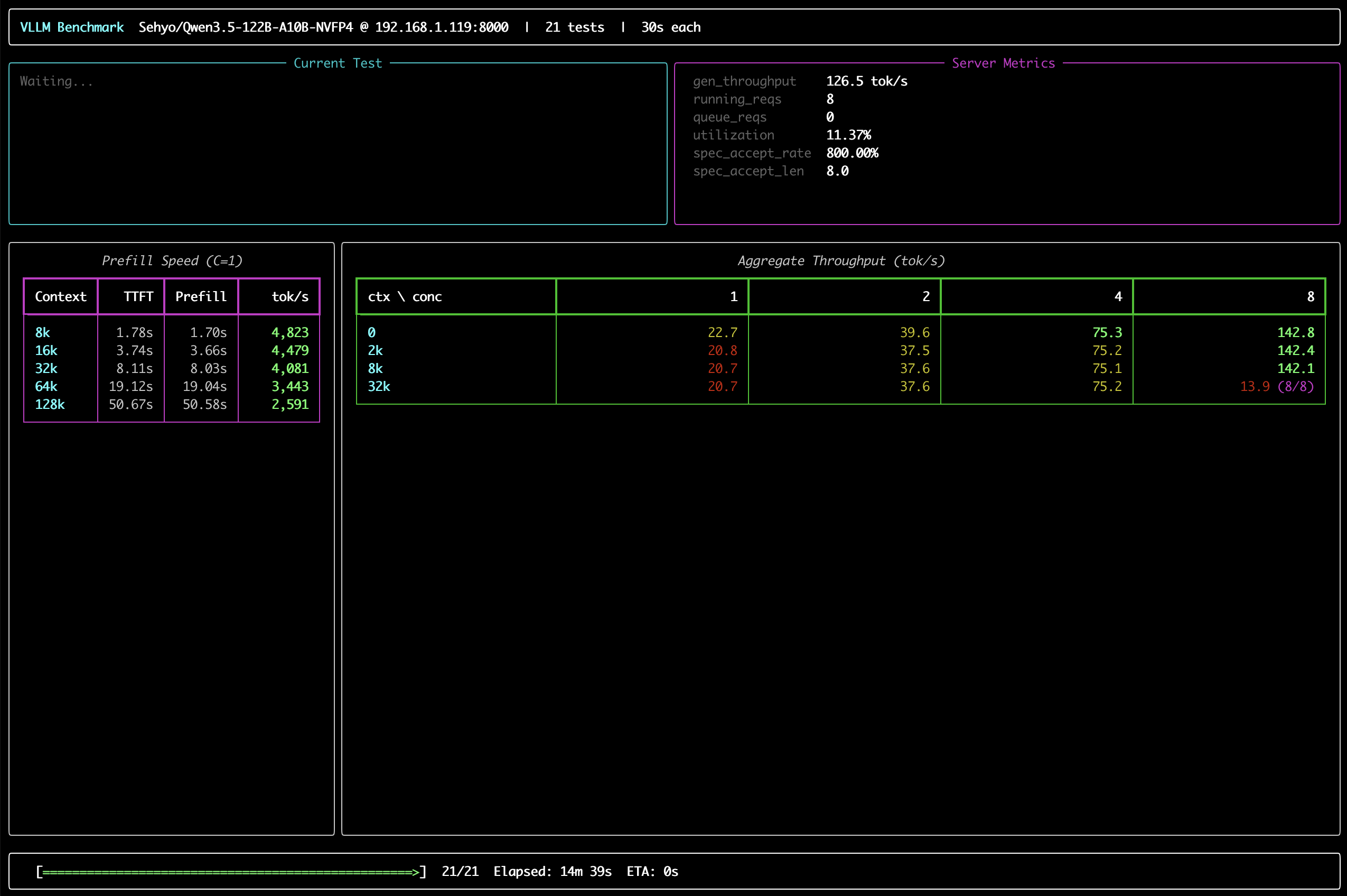
Single node, more modest model. Interesting that the single request TG speed is not much higher than the 397, perhaps I will play about with the 397 after all.
Not really for GB10 systems. For the most part there is little to no speed up for large models that require >1 GB10. It’s simply splitting the layers and load across the systems. Adding extra nodes gives you more ‘lanes’ to your highway, but there is an inherent speed limit due to memory speed. Some of the smaller MoE’s are a bit more efficient by breaking larger models up and sometimes see some speed up’s but not for huge models.
The thing I am most interested in is to optimise the use of the 4 boxes. I mean, I have plenty of “jobs to be done”, but will they get done better by a single super smart agent using a big model running on the cluster? Or should I have 4 agents running independently… if the practical intelligence of the 122 is “good enough” then I get 4 times the capacity if I keep them busy (which I will). So, I probably need to stop running benchmarks and get my AI team doing some real work :D.
You could likely increase PP or TG if you went with a disagg structure, depending on what you find more relevant, given that this model should fit in 2 of your Sparks.