NOt quite. not every AI is constantly interested in fresh load of dickpicks, meals and cats.
Besides, phones also need NAND FLASH, RAM and advanced silicon in general.
And they do age fast.
NOt quite. not every AI is constantly interested in fresh load of dickpicks, meals and cats.
Besides, phones also need NAND FLASH, RAM and advanced silicon in general.
And they do age fast.
I don’t have a ton of fast/ modern hardware, but more than most people probably. The vast majority of consumer use cases don’t see any perceptable difference between platforms or memory type if you aren’t timing tasks or running a benchmark to quantify it. Software itself is not well optimized to utilize 8+ cores well, let alone 16, 24 or 32++ cores, even when it can “use all cores” it is rare that it scales well with more cores. Then the fact is that hardware has more or less hit several plateaus and hurdles in recent years that sees diminishing returns with new revisions due to built fundamental manufacturing limitations.
Probably the most important factor is if your platform has decent software and security support and is somewhat modern, it is likely “good enough” that a massive $$$ platform upgrade doesn’t get you as much benefit. When the industry moved from HDDs to SSDs it was a world of difference even at the level of kinda bad consumer SATA SSDs that were available. When the industry moved past 4 & 6 core CPUs that sometimes did but often didn’t have hyper threading. But a lot of things don’t matter that much for 99% of consumer uses, like PCIe version, lots of tests show that a single consumer GPU in game performance doesn’t care that much if it’s running at the newest or last gen PCIe speeds (half the bandwidth)
I have a 9970X 32 core Threadripper build, a couple generations old 3970X 32 Core Threadripper I just put together from used parts. The 3970X performs just a bit lower than a 9950X in multi core but quite a bit worse single core performance, where the 9970x way exceeds the multi core and almost matches the single core performance of the 9950x.
Compare a 3970X (2019), 9970X (2025) 9950X (2024) to a 12700K (2021) or 14900K (2023) Intel LGA 1700 platform, or a 5800X (2020), 5800X3D (2022), 5900X (2020), 5950X (2020) AMD AM4 platform (that I have except for the 9950X) and there isn’t a massive difference in actual general consumer usage, in resource heavy applications there is sure, but there isn’t a world of difference like from an AMD Phenom II X6 1090T (2010) or an Intel 3570K (2012) where multiple things changed at once.
Once OS cold boot times hit a certian speed (going from a few minutes to tens of seconds or less) people stopped caring that much and the difference between a 18 second boot and a 9 second boot doesn’t matter to pretty much anyone. Once launching a program went from 5-15 seconds to maybe a couple of seconds people stopped caring or needing the fastest (a 2.5 second vs 1 second time to open a program doesn’t matter, especially when it’s not always consistent due to updates or other minor things). When unzipping files or transferring a pile of data went from several minutes to a 1-10 seconds people stopped caring as much.
That’s what diminishing returns look like to average consumers, the days of WEI score benchmarking threads, or cold boot time threads and similar are way behind us now. There is extremely minimal pressure on the consumer side for manufacturers to make platform upgrades or large changes. The focus is on improvements to local or enterprise scale AI performance that takes advantage of every bandwidth increase or latency improvement, and especially performance per watt capabilities. That will eventually trickle down to consumers… Or maybe not, like the RTX 5090 being unofficially discontinued to feed AI/ workstation GPU production, so the consumer high end market is cut off completely.
Server, workstation and AI/ enterprise gear is stability and feature centric, even still it has closed the gap to consumer hardware, though it may be more accurate to say consumer hardware has stagnated more than enterprise hardware recently.
Another example is Apple and their M-series hardware vs their older Intel stuff. The difference from the latest Intel Macs (2019) to M1 (2020) is massive, enough so that a lot of general users made the swap because it was a ton of improvements at once. But there is less reason to upgrade to an M4/M5 device for someone who has an M1 as long as they have enough storage, enough unified memory for their uses and continued security updates (and aren’t experiencing slowdowns from new OS versions). The people upgrading to high spec M5 devices are doing local AI, or very resource intensive tasks (or are doing it “just because” they have the money), at least that is what they say online, and that is what Apple has been focusing on improving!
The enthusiast PC market had a good chunk of the top cut off and shifted to the lower end enterprise segment, maybe 2030 or well beyond for that to change if ever due to how much money is chasing the hardware and how little consumer demand actually is (both $$ and performance needs)
Ram has been booked for data centers that have not been built yet (if ever) for 2 major players that lose 3-4$ for every dollar they get and only exist because they manage to raise more debt than brains (perhaps for not so long). No one is cranking out megatons of ram chips, it all exists only on paper.
But when the bubble bursts most people won’t have a pension anymore but hey maybe cheap ram (unless you get drafted for WW3 to play real life COD).
One AI workload that would attract the mass market would be asking it stupid questions ( it seems that is what ChatGPT is used for mostly right now) and paying a subscription for it. Which you can do on any phone released in the past 10 years or so. You don’t need a brand new phone for it, all the computation is done elsewhere. Just like Google Search.
Humans produce more data daily. Just check a news site, do they have articles from today? Do forums, Reddit etc have posts daily? Does new code get written and pushed to Github? I don’t see any of it stopping.
There’s a way out 
The vast majority of human-generated data comes from non-PC devices as well as apps and services, not hardware per se.
Yes, this is why phone MSRPs have been climbing and OEMs are outfitting them with less expensive components.
Not as much as they used to. Between Google, Samsung, and Apple, the average flagship phone has 5-7 years of update coverage.
This. Most of the additional consumer PC compute we’ve seen over the past few years is synthetic benchmarks and diminishing returns framerate chasing, not actual UX improvement.
My Debian server is a 2011(!!!) Dell OptiPlex 390 with Core 2nd Gen i3 and 16 GB RAM. It still runs Pi-hole and unbound just fine and is also a restic NFS target. It’s more than fast enough for all of the above.
While 95% of AI users are on free tier, that represents only 18% of AI compute (note the difference). The remaining 82% of compute is via paid plans. With frontier models starting at ~$240/y I doubt the people paying them are using them purely for mindless entertainment.
More proof nothing is happening for the next 2+ years: reliable leaker says good chance the RTX 6060 arrives in 2029. -60 tier cards make up the bulk of PC gaming.
Yes, and no. A more accurate description is that sub- $300 GPUs that make up the bulk of PC gaming. Not the 60 cards specifically.
So if the 60 card is $500 then no, it will not be bulk gamer material and many will opt for a $300 6050.
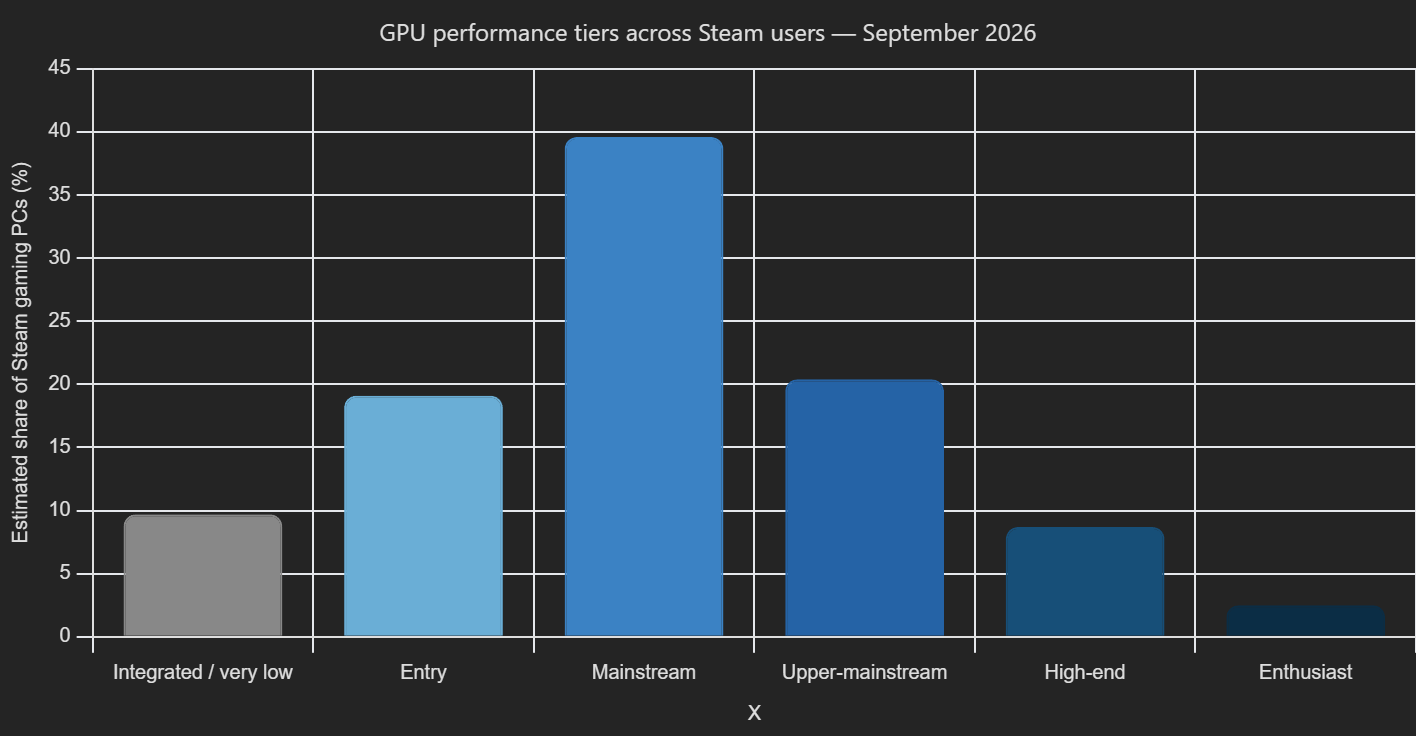
Fair. GPU tier histogram based on the latest Steam Hardware Survey data:
| GPU tier | Estimated Steam share | Representative GPUs |
|---|---|---|
| Integrated / very low | 9.7% | Intel UHD/Iris Xe, Radeon integrated graphics |
| Entry | 19.1% | GTX 1050/1650, RTX 2050, lower-end laptop GPUs |
| Mainstream | 39.6% | RTX 3050/3060, RTX 4060/5060 class, RX 6600-class |
| Upper-mainstream | 20.4% | RTX 3060 Ti/3070, RTX 4060 Ti/5060 Ti/5070, RX 7800 XT/9070-class |
| High-end | 8.7% | RTX 3080, 4070 Ti-class, 5070 Ti/5080, RX 7900 XT/XTX-class |
| Enthusiast | 2.5% | RTX 3090/4090/5090 and comparable halo products |
Yeah I can see that. I had my friend using my old 3090 in his gaming PC for a while until I realized I could be putting it to work running LLMs and swapped it out for a 3050 I had laying around. He had to ask me to explain to him in exact detail exactly what changed and what he was supposed to be looking for, because with DLSS upscaling and his monitor not having an insane high refresh rate anyway, plus him not being in the enthusiast tier of people like us who are going to scrutinize every detail and nitpick everything and push things to their absolute limit, he honestly couldn’t tell what had changed. As far as he could tell I came over one day and paid him cash and swapped a part in his computer and in a few minutes he was back up and running the exact same games he was playing and they still looked the same and worked the same. Obviously there was a difference in quality due to scaling and it was running at a lower framerate, but it was still hitting above 60 and looked arguably the same because of DLSS magic, so for him, for all intents and purposes, it was the same.
So with that being said, I concur with the above points that I don’t think the enthusiast tier is going to get any more entries any time soon. We’re already seeing a plateau in what the normal consumer actually cares about and can afford, and there’s no reason for them to do anything more than that for a high end consumer platform. We’ll never see more than dual channel ram on consumer desktop, even though we sorely need more than dual channel right now with existing chips even, it’s just not going to happen because motherboard manufacturers and cpu makers already make those parts, they just sell them for thousands of dollars more to enterprise clients. Why would a mobo maker spend all the extra money and time developing a prosumer board with the capability of doing quad channel ram and then sell it for thousands less than what they could sell the same for to an enterprise client? And why would AMD spend all the extra time and development costs on giving some niche high-end sku that nobody is going to buy some crazy special i/o controller that can handle more than dual channel ram and it only works with very special high end motherboards that nobody is going to manufacture and sell, and then sell it for thousands of dollars less than they could to threadripper customers? And why would nvidia make another 90 class GPU for gaming GPU prices when the games don’t need it and enterprise clients will pay 10x for the same, and your average gamer actually has to have the difference explained to them so it’s clearly not even worth thousands of dollars to them? None of it makes sense at this point.
This is interesting. I noticed my PC builder friends were “settling” for -70 non-Ti/SUPER cards and was wondering why. Now I know.

Coming in late here…I’ve currently got 128GB + 64GB + 32GB DDR4 doing the rounds in all my machines. In fact, it’s been that way since 2024 - it’s heavily influenced my buying choices when it came to upgrading my AI server and NAS, because I’m essentially locked to DDR4-compatible platforms.
That’s not really a bad thing, I guess. I’m just putting together a gaming rig for my nephew, which is basically all the parts I’ve got lying around - i5 13400F, 16GB DDR4 and 2080 Ti. It’s actually pretty surprising how good a machine full of hardware that’s between three and five generations old really is.