2FA, banking, public transport tickets, and some more.
My primary (and only) phone is a dumb phone. No Apps, no mobile internet access. Just phone and SMS, that is it.
2FA, banking, public transport tickets, and some more.
My primary (and only) phone is a dumb phone. No Apps, no mobile internet access. Just phone and SMS, that is it.
This may not be as complicated as one thinks.
I made cellular communication using an arduino.
Nothing fancy but a text connection.
But it did work.
Carrying around multiple devices doesn’t feel like a practical solution either. It’s already annoying enough to have to charge one device every night, let alone multiple. Wallet/keys in one pocket, phone in the other. I need a third pocket now for the secondary phone? you shouldn’t put things in your back pocket. Its not healthy for posture / hip alignment.
And stating that you need secondary device for said authenticator apps is exactly proving my point that its not exactly practical to simply not own a phone as more and more services become reliant.
Agreed and I will never do this.
I left the dedicated authenticator phone at work. However, some employers may not like that?
Either way it still proves the point that more things are becoming reliant on smartphones and we have do all these workarounds to take back control.
Unnecessary. I still just use the browser. If my bank ever stops supporting the browser then I will simply not do mobile banking. I very seldom do in the first place.
A text is simple enough sure. But the modem itself was probably still proprietary no?
Also Arduino is a microcontroller, which is a different beast. You’re not installing Linux or preferred flavor of Android on that.
At that point a dumb phone is probably the way to go. Yet still proprietary…
You don’t have to carry them around. Just remote into them from your main device. I’m not planning to buy 3 phones, but a single PinePhone and a bunch of SBCs. I mentioned this before, please read carefully.
1 device to control them all. And you’re using just a browser to do so.
If you require a phone with a wallet, don’t go with a linux phone, use an android as your main one. If you care about privacy, probably graphene.
Get a backpack, leg bag or a fanny pack. Women wear purses all the time, men should consider something similar. I have a small backpack that I take with me whenever I need to take more than just my phone, like my hotspot. When I only need my phone, I’m not even using my pockets, I have a belt phone carrier. Way more comfortable than trying to slide my phone in my pocket (I wear tight jeans) and the phone doesn’t get sweaty if I unintentionally do a quick workout.
Mine doesn’t even know I run mine in a VM. They never even asked.
I agree on that. Maybe at least part of the world will wake up and push back enough to make it count (there’s already the homeassistant people who are giving back control over IoT to the people, pushing against the cloud and subscription models, others are pushing against spyware, like the programs on F-Droid, hope more will help better humanity).
A new improved version.
Open Source.
How do we make this accessible for grandma who wants privacy? No way she’ll handle the mental overhead of trying to remote into and manage multiple devices. The current single device is already a struggle.
Again I don’t see multiple devices and SBC’s as a practical solution for normies. The idea is everyone deserves privacy. Not just those who are tech literate enough to work around the enshittification. It’s a human right that we need to take back.
Interesting. But this uses a SIM800H as the modem.
It supports only:
Quad-band 850/900/1800/1900MHz
Generation: 2G , 2.5G
Standard: GSM , GPRS
GSM is an insecure protocol. We need end-to-end encryption. eg: Signal
Perhaps one day Ill be as brave as you lol. I still need maps occasionally.
If it’s just another icon in your launcher, it shouldn’t be any different than something like x2go. You click / tap a program you want to open and it’s opened in the proper backend instantly.
I agree, but as you can see, just wanting to offer better alternatives and even providing these better alternatives (like the fediverse), is not enough to convince normies to stop using stuff that repeatedly violates their privacy, to a degree that they might even be aware (I’ve seen lots of people who say “if the Zuck and all the employees from poor countries who have no incentive to not use your data for their own gains, can see my messages, so what?” and kept using them in ignorance and even provided sensitive information through such platforms - some people are beyond saving).
I wish there’d be a way to help everyone, but you can’t do it without making them ultimatums and if they care enough about you, then they will move off those abusing platforms. That’s how I moved most of my family from meta programs over to other stuff like telegram (and now I’ll need to move them to something truly out of other people’s controls, dependency on other platforms is bad, either I control and manage it and everyone just uses it without an issue, like if I were to host a matrix server, or we use something completely decentralized, like briar).
But even then, there will not be enough to stop them from using other abusing platforms, like uber or doordash. These are things that I can’t help with, so at most, we should make it so that it’s harder for these platforms to abuse their users (like confining them in sandboxes in graphene).
Still too complex for grandma “why do I need to do this? why are there two phones? where is my email?” when she can barely remember her password. I think you’re missing that point that this is not a feasible solution for non-tech literates.
The point is not to help everyone. It’s not my job to convert people, tho I’ve tried…
The point is we need open source hardware under the open source software. To provide a better service. Then perhaps people will naturally switch.
Lets use Gabe on piracy as an example: ''One thing that we have learned is that piracy is not a pricing issue. It’s a service issue,"
By providing a better service, people will naturally use it. So lets adapt that quote: “Privacy is a service issue”. Meaning we need to make private alternatives accessible and streamlined like the proprietary spyware services. For example proper sandboxing, and end-to-end encryption needs to be the built-in seamless default, and grandma never has to care or understand the difference between a public and private key.
What I am proposing is literally the same experience as today. You click on an icon on your phone and it’s completely transparent that it’s actually running somewhere else. Your grandma shouldn’t even know it’s running somewhere else. Imagine your grandma opens, idk, signal or something, to text you. To her, it’s just another icon, but in the backend, signal is running on a separate device, somewhere else.
Think of something like Google Stadia, or if you remember the old days, OnLive (took a while to figure out the name of it). But there’s no launcher or anything of the sorts, just another icon on your phone’s launcher.
No, actually it is literally not the same experience. One is native and local. The other is another app to another device (that would require an internet connection to talk to said device). And is grandma going to flash and maintain that graphene device with signal from her iphone? Absolutely not.
This is not open source phone hardware.
But I think we are getting lost in the weeds here.
Let us leave it at that and focus on the technical feasibility of an open source hardware phone device.
If all LTE phone modems require a licensed firmware, I think the backend cellular component is the problem.
We should probably do something in a wireless band and be our own “cellular” provider?
Yeah, I think perhaps the modem itself may be the largest roadblock.
Lets assume there will be a Risk-V SoC that will be a viable phone chip in the coming years.
What do we do about the modem? There’s SDR and FPGA’s perhaps… The RF engineering side may be the more complex side of this equation…
PinePhone pro uses the Quectel EG25-G, which is proprietary.
Searching for open source modems:
Been reading up on some communication protocols. Quadrature amplitude modulation (QAM) is really cool. I have a deep appreciation for all the tech that goes into making all this stuff work.

Found a rotary phone style, that’s kinda fun. Uses a uBlox modem.
Looking again at OpenModem, its uses ATmega1284p which is a RISC-based microcontroller, but NOT RISC-V :
Power consumption: ~31mA at 5V
Lets say you have battery capacity between 2000-4000mAh
2000mAh / 31mA = 64.516  Hours
3000mAh / 31mA = 96.774  Hours
4000mAh / 31mA = 129.032 Hours
Not including the rest of the phone components of course.
Reading more about the PinePhone looks like modem runs a custom firmware with its own Linux Kernel. But the DSP still closed
"
0 binary blobs in the userspace. Only closed source running on the modem are TZ Kernel and ADSP firmware
"
RISC != RISC-V.
ATMegas are AVR microcontrollers.
ARM used to stand for Advanced RISC Machines and Acorn RISC Machine before that.
Ah… Noted!
This recent episode of Darknet discussed how there is a lack of privacy focused devices:

And discussing some of the mechanisms used to get into your devices.

Interesting talk on TETRA protocol for infrastructure and use of secret cryptographic algorithms.
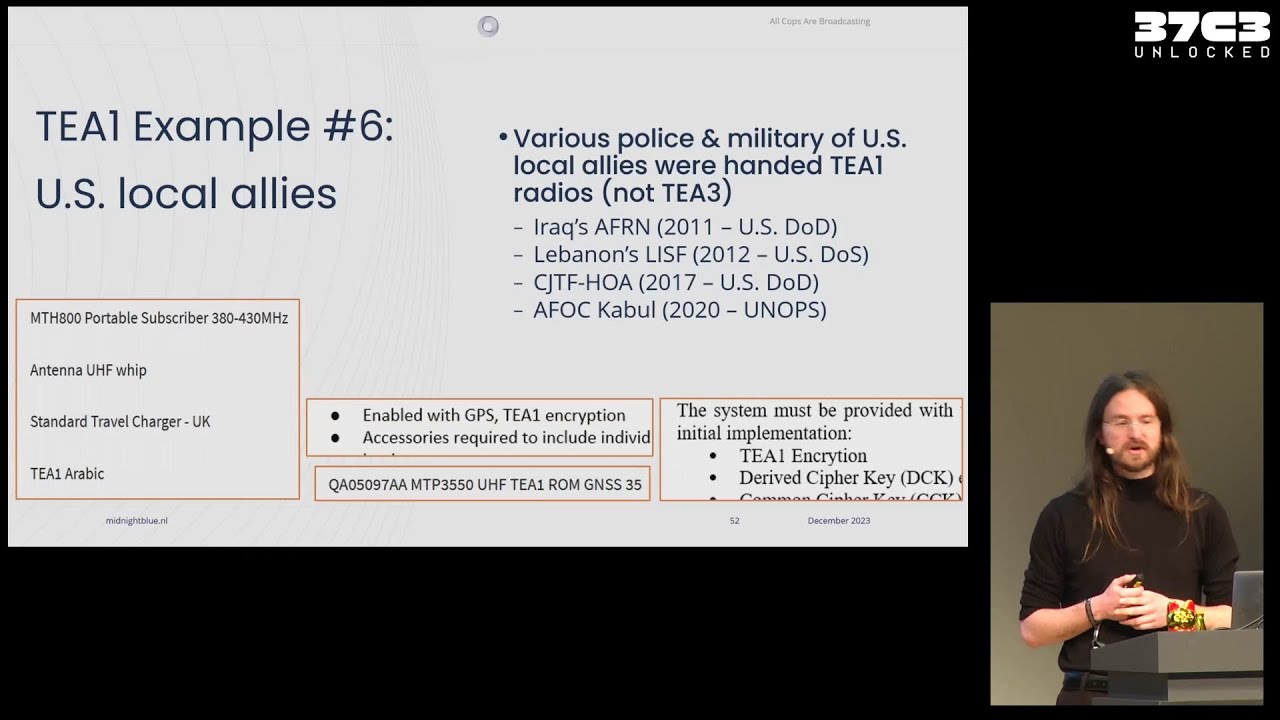
This once again goes to show how security through obscurity doesn’t work, protocols and encryption algorithms must be open source to prevent backdoors.
There is clearly a desire for secure phones, and phones that actually respect the user’s data. I try not to be too tinfoil, but it really is frustrating to not be able to trust your own devices.
This topic was automatically closed 273 days after the last reply. New replies are no longer allowed.