It’s good, it was Umccoy adapter the problem (not good on pcie 3.0)
if u use a different file manager the speeds would change , i use directory opus and so far i have seen its more consistent and faster than windows file manager
I recently ordered a few 400 gb E1.S P5801X drives. I have a warning and a question.
Don’t buy the Microsatacable E1.S to M.2 2280 adapter (the one without the PCB cutout) and expect to use it with the E1.S P5801X. The drive does not fit. The heatsink on the P5801X is too beefy. It’s also very firmly attached, and removing it seems to require more force than the drive can safely withstand (or tools/technical knowledge that I don’t have).
To replace the Microsatacable adapter I ordered the ADT-Link PCIE 5.0 M.2 NVME to U.2/U.3 E1.S E3.S SSD Riser Cable M.2 NVMe Slot Extension NVME 2230-2280 Solid State Drive Gen5 (Model number F47SD). Can anybody here tell me whether the adapter has drawbacks? Will using it incur any penalties in drive speed or latency?
Note: the adapter does not contain a redriver, which, if I’m not mistaken, can improve performance in some cases. So the answer to my questions is that “it depends” and “getting a pcie adapter with a redriver would have been better.”
1 Like
Just in case anybody else is wondering about the benefits of a PCIe redriver, I want to share some synthetic benchmarks. All were collected in the same system – 12700K, 64 GB DDR4 3200, MPG Z690 EDGE WIFI DDR4 Mobo.
Here’s the CDM benchmark of a P5801X when connected to the PCIe 5.0 slot (direct to CPU) via a Umccoy PCIe 5.0 x4 AIC without redriver:
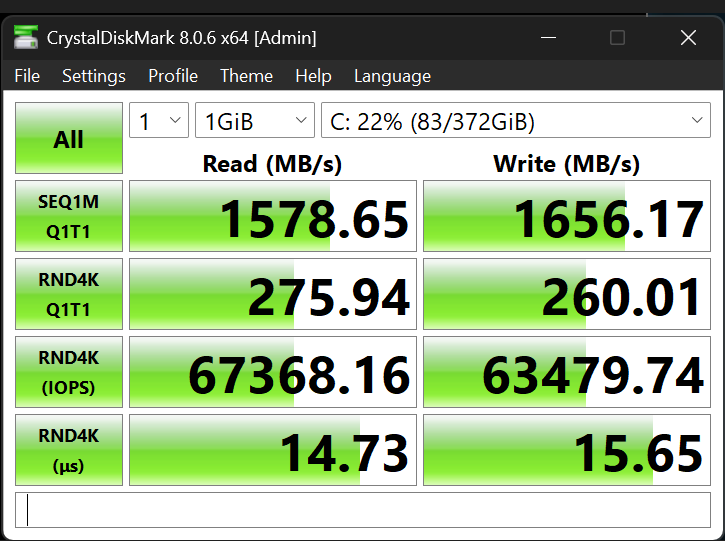
(For posterity, in case images are lost, I’ll also summarize the data):
| - | Read (MB/s) | Write (MB/s) |
|---|---|---|
| SEQ1M Q1T1 | 1,578.65 | 1,656.17 |
| RND4K Q1T1 | 275.94 | 260.01 |
| RND4K (IOPS) | 67,368.16 | 63,479.74 |
| RND4K (µs) | 14.73 | 15.65 |
Here’s the same P5801X in the same slot, but connected via a Microsatacables PCIe 4.0 x4 AIC with redriver:
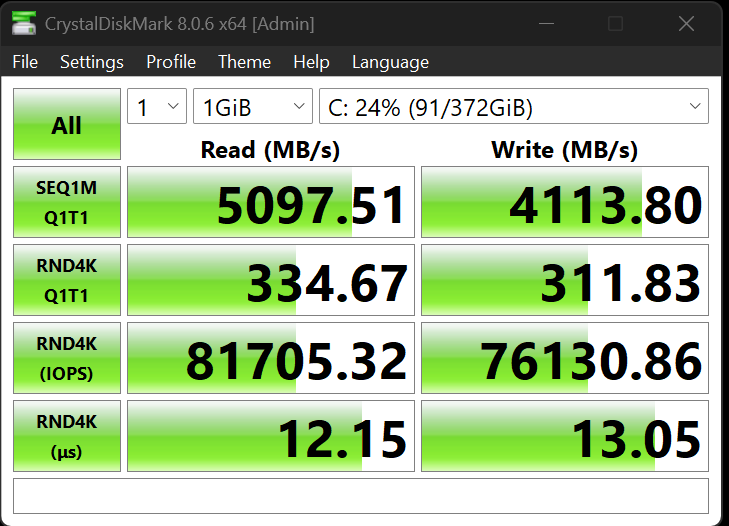
| - | Read (MB/s) | Write (MB/s) |
|---|---|---|
| SEQ1M Q1T1 | 5,097.51 | 4,113.80 |
| RND4K Q1T1 | 334.67 | 311.83 |
| RND4K (IOPS) | 81,705.32 | 76,130.86 |
| RND4K (µs) | 12.15 | 13.05 |
And here’s a set of three 3dmark storage-benchmark runs, comparing, respectively, the P5801X (Microsatacables PCIe 4.0 x4 adapter with redriver), P5801X (Umccoy PCIe 5 adapter), and Samsung 990 Pro (M.2 direct to CPU).
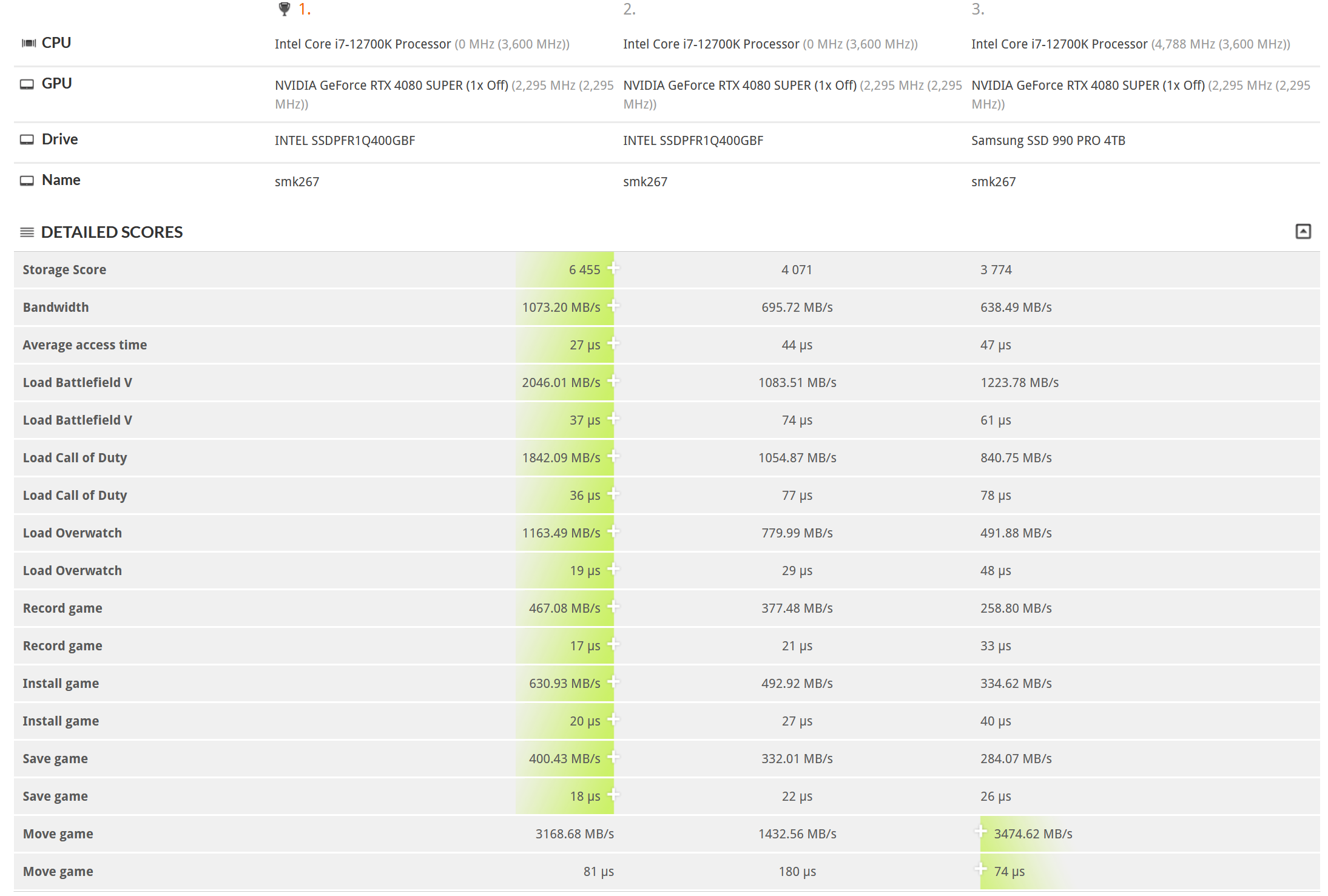
| Category | P5801X | P5801X | Samsung 990 Pro |
|---|---|---|---|
| Storage Score | 6,455 | 4,071 | 3,774 |
| Bandwidth | 1,073.20 MB/s | 695.72 MB/s | 638.49 MB/s |
| Average access time | 27 µs | 44 µs | 47 µs |
| Load Battlefield V | 2,046.01 MB/s | 1,083.51 MB/s | 1,223.78 MB/s |
| Load Battlefield V | 37 µs | 74 µs | 61 µs |
| Load Call of Duty | 1,842.09 MB/s | 1,054.87 MB/s | 840.75 MB/s |
| Load Call of Duty | 36 µs | 77 µs | 78 µs |
| Load Overwatch | 1,163.49 MB/s | 779.99 MB/s | 491.88 MB/s |
| Load Overwatch | 19 µs | 29 µs | 48 µs |
| Record game | 467.08 MB/s | 377.48 MB/s | 258.80 MB/s |
| Record game | 17 µs | 21 µs | 33 µs |
| Install game | 630.93 MB/s | 492.92 MB/s | 334.62 MB/s |
| Install game | 20 µs | 27 µs | 40 µs |
| Save game | 400.43 MB/s | 332.01 MB/s | 284.07 MB/s |
| Save game | 18 µs | 22 µs | 26 µs |
| Move game | 3,168.68 MB/s | 1,432.56 MB/s | 3,474.62 MB/s |
| Move game | 81 µs | 180 µs | 74 µs |
TL;DR: In sequential operations, the redriver increased read speeds by 3x in CDM. Random read didn’t benefit as much but still increased substantially. RND4k IOPS increased by approx 25% and aren’t nearly as high as I’ve seen in other people’s benchmarks. System responsiveness hasn’t perceptibly (as far as I can tell) improved with the redriver. It’s significantly improved compared to the Samsung 990 Pro – but that’s somewhat apples to oranges, since I’m also comparing a fresh Windows installation on the P5801X to one I’ve been using for about a year on the Samsung 990 Pro.
2 Likes
Thanks for the advice. I tried multiple file managers in Linux (Thunar, Dolphine, Nautilus) and even cp in terminal with more or less the same sequential file local copy speed. But I have some news in a post below…
And another update! After having played around with a AMD Ryzen 5 5600X for a while, which was a solid upgrade from the AMD Ryzen 9 3950X regarding single threaded applications and games, I decided to upgrade the whole platform to get even more performance with the following:
CPU: AMD Ryzen 5 9600X CPU
Motherboard: ASUS ROG B650E-E
Memory: G.Skill Flare X5 6000CL30 2x 16 GB
SSDs, GPU, Cooling, PSU are all the same
And the improvement for this sequential file local copy test vs the 5600X and 3950X is… incredible! I can now reach around 2.1 GB/s copy speed, closing in on the 2.7 GB/s speed on Windows (when its antivirus and antimalware plays nice!).

So to summarize the sequential file local copy test results on Pop_OS 22.04:
- AMD Ryzen 9 3950X with DDR4-3200: ~825 MB/s
- AMD Ryzen 5 5600X with DDR4-3200: ~1.05 GB/s
- AMD Ryzen 5 9600X with DDR5-6000: ~2.1 GB/s
Furthermore, copying folders with many small-ish files (larger than 4K, though) with a file manager is also sped up significantly, although I don’t have a benchmark for it.
I am definitely pleased with this last upgrade. This CPU makes using the PC feel generally very snappy with the Optane P5801X.
1 Like
Has anyone tried replacing the very tall heat-sink with a lower-profile one?
I have a few extra of these drives and was considering it. For space saving reasons
I’m not experienced with Optane thermal performance, just looking for candid ballpark estimates on how big of an issue this may be
I’ll try to report back with results if I have time to try it and no one else has already experimented with this
I’ve looked through this and two or three other threads and had a few questions.
How far does the heatsink on the p5801x protrude into the adjacent expansion slots compared to a Optane 900P?
Is this one still working for people OK after a few months? Aside from it looks like no redriver means ~10-20% lower performance. And needing to get the “with heatsink” one that has longer standoffs?
I’m looking to finally upgrade from my Star Citizen Edition 900P after…however many years it’s been.
15 mm for the U.2 and 25 mm for the E1.S
Is your Optane Drive 3km away from your motherboard? I’m kinda impressed how bandwith spikes up and even latency improve with redriver. Never heard of redriver before.
Planning for my p5801x to use an ICY DOCK EXLink MB309A to check if the performances get this high too.
May someone explain why redriver altered the performances so much?