not sure if i should put it in CPU,mainboard,overclocking or cooling....
now to my post,
i recently switched from a Crosshair V formula to a Sabertooth 990fx gen3/rev 2.0 to house my FX-8320
and i used all the values from my previous overclock, except i upped the voltage a bit to make sure its stable at the boot its installing all the drivers.
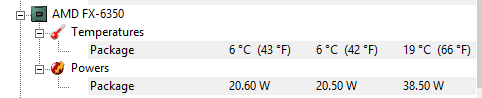
after lowering the voltages to the Crosshair V formula sttings again i started stress testing it with prime95 and noticed that both Coretemp and the AiSuit show a lot lower temperatures, both around 10°C cooler. 53°C under load with coretemp instead of 60°C and 61°C in Aisuit instead of 73-76°C
i already thought that i was getting wrong temperature readings on the crosshair board, because 60°C on 4.5ghz with 1.38V seemed way to high even for the worst of the worst 8320 out there.
now how can i be sure if the new readings are correct?
could only re-applying the thermal paste create such extreme temperature differences? ( i did it nearly the same as the last time with the same Gelid paste that came with my Ek supremicy waterblock.
i just want to know the temperature of that damn cpu!
I understand your frustration. Simply put Asus software temp monitoring is still crap. Use a few different monitoring tools to monitor your temps and dont take one as the truth. Speccy HWINinfo64 There are several.
Watch the attitude if you dont know what you're talking about. Which, you don't.
Temperature monitoring on current AMD processors differs from that on Intel CPUs in two ways:
there is only one temperature sensor per CPU (not one per core), meaning there are no seperate temperature measurement values available for each CPU core.
the tempeature sensor does not read real physical CPU temperature, so that there can be a rather large temperature difference between the measured and real CPU temperature -- especially if the CPU is idle.
(1) One temperature sensor per CPU Because of this limitation of AMD CPUs Argus Monitor only displays one temperature graph for all CPU cores; the overview tab shows all CPU cores having the same temperature.
Some other programs show seperate graphs, one for each core. They might even differ by one or two degrees, but this is caused by different times these measurements were taken (sampled).
(2) No direct reading of physical CPU temperature The value for the CPU temperature of the (digital) on-chip sensor does not equal any real physical temperature but is measured on an AMD spezific scale. This was done to be able to provide more accurate values when the temperature is close to the thermal design limit of the processor and is used to throttle the CPU to prevent damage by overheating. Therefore reliable measurements for CPU idle states is not possible.
If the CPU is idle a more reliable reading can be obtained using the analog temperature sensor located in the CPU socket, but its reading is only available if the the mainboard contains an supported Super IO chip. For users with AMD processors Argus Monitor provides the temperature of this sensor in the CPU temperature graph in the default configuration as well. For users with other processors -- or in case the correct temperature channel could not be detected automatically -- the option to display this temperature can be found in Settings/Mainboard.
Don't be a dick just because someone doesn't agree with you.
I agree with Phantom, also Asus puts a lot of work into there boards, especially the TUF series and the temp sensing in the board is better than the temp sensor in the AMD CPU
Software is reliant on hardware, so if there is software that does a better job a measuring temperature wouldn't that mean the sensors would have to be good at measuring temps as well besides there isn't anything like a calibrated themocouple
Intel boards give very accurate temperature readings, and Realtemp provides them. So does coretemp, but a little lss accurate in haswell, because of sensor differences. Your direct hate toward Asus is ignorant, because their Intel boards read perfectly.
It isn't even fanboyism. Its actually Physically how it's designed. Intel chips have sensors, AMD chips do not.
So you think, there is a bias involved. I am pretty sure there is. I am willing to conside you have a point intel wise. But i dont know that for a fact. Since i dont build intel.