I guess I don’t know the cloud stuff really. At the moment 3.8-27b is my go to for everything I do.
(You also just gave me a thread idea)
I’m really not getting a huge jump in quality with Opus 5, from 4.7. (4.8 was a mess, we don’t talk about it)
I use Opus/Sonnet for a good portion of the day at work, and I really don’t understand the fanfare about 5. I couldn’t even tell a difference, except that Sonnet was far more eager to do things without me telling it to. (so many coworkers PRs were merged without their sign-off…)
Between 4.6 and 4.7 all I noticed was that it would screech at me when I tried to do something hackery
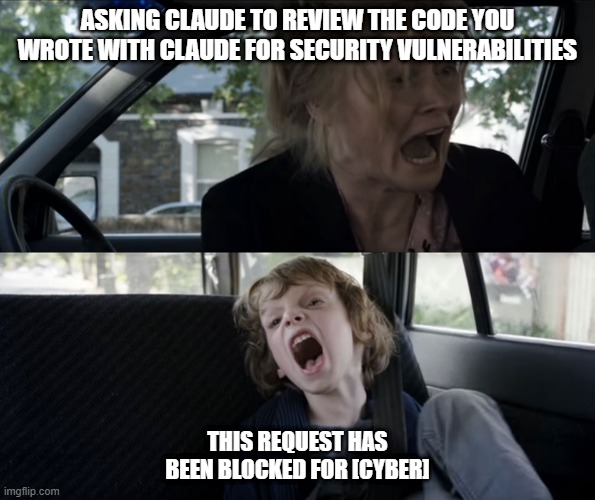
Opus 4.6 gladly would do whatever I asked it to do and didn’t devolve into episodes when I would ask it to do work, so I was able to ask it to do multiple full security audits of what I was building.
Then I revisited the code with Opus 5. After a few screeching fests and significant verbal abuse I was able to get it to audit the code that Opus 4.6 had said was basically perfect, and if found a SUBSTANTIAL amount of very significant security issues.
It does make me a bit concerned what it could still be missing, but it is legitimately a massive jump forward.
I don’t think I have asked it to do something and have actually have had much of an issue with anything it has done, which was not the case before. Most of the issues I have had with this generation have fallen into it not working hard enough on something and just kind of seeming lazy, which I typically solve with a few rounds of CAPS LOCK, or it not fully understanding/capturing what I wanted.
One thing I do think likely has a significant impact on what people feel results wise with editing code with AI in general is if you, 1, use an actual coding harness like Claude Code/Codes vs just freeballing it and asking it in chat, 2, if what language and type of code you’re writing, and 3, if what you are writing is a solvable programmatic loop.
I have one project that is primarily python and has a web GUI that it’s generating with some sort of python HTTP server thing, and it’s noticeably more meh and less reliable when I ask it to fix things then when it is writing something in Node, React, Typescript, etc.
That being said, with enough loops and telling it to validate things in certain ways can go a long way.
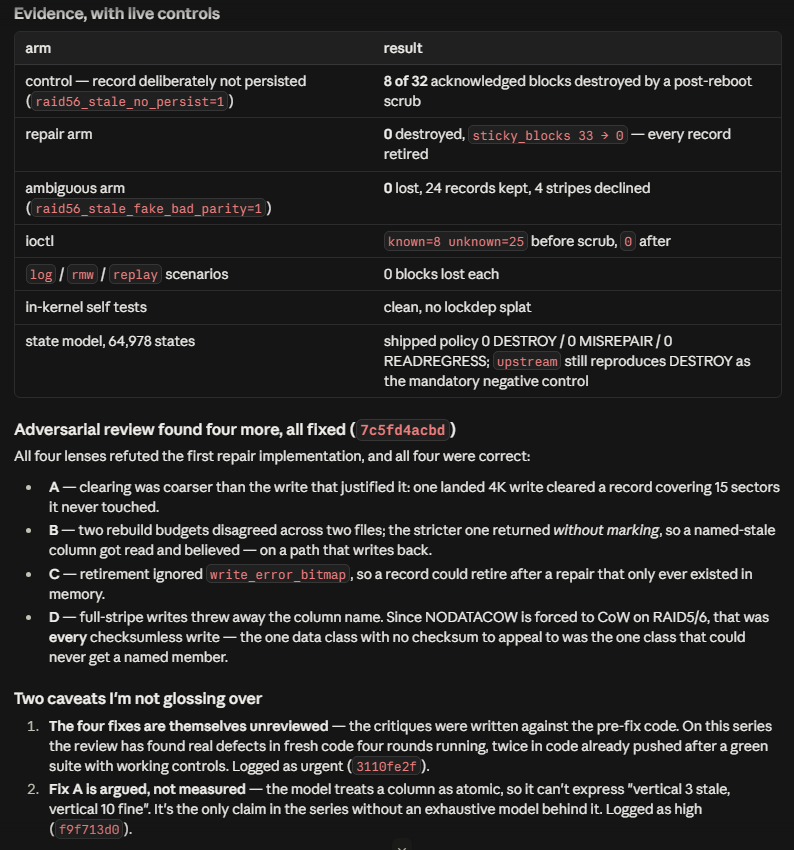
I’ve been telling Claude to perform state machine analyses of the BTRFS code it’s writing and it, appears to be legitimately having a big impact and catching weird edge case bugs. In addition to that, putting it on the “Ultracode” effort level has had a significant, all be it extremely time consuming, improvement on the final results of anything it is working on.
The Ultracode mode builds test harnesses for everything it bult and launches adversarial agents to review and attack and provide feedback on what it did, so it catches a ton stupid little bugs before you ever see them in the final code.
It does chew through tokens at absurd speed though. It’s normal to burn multiple millions of tokens in a few minutes.
So I am working on Linux md for zoned drives since last year . Ish.
One reason current ai can be frustratingly dumb is because it has no taste.
For problems like these if you understand what a good solution looks like and you can build a test suite (with AI help) then.. then it gets interesting.
The ai can “hill climb” toward a reasonable solution. It helped me see my clever smr algorithm had two write amplifications I didn’t realize .. which needs to be added to the tests. And the tests for coherence aren’t enough. It also had to take into account aspects of mechanical storage. Low iops. Sometimes an io takes forever. Etc etc. So the test harness can be okay with write amplification if it’s contiguous for example but not if we have to move the read write head around too much.
Ofc you have a different set of problems. But… Hill climbing is the best approach currently to Real Problem Solving at least. .without spending a crazy amount of tokens.
Also test harnesses simulating torn writes etc.
Yeah, it definitely needs a lot of guiding, sometimes with a stick and strongly worded prohibitions, but it is genuinely crazy what you can do now with the proper harness and direction.
I I definitely get why people would be so negative to it, the whole AI slop and all, but I think there is importance in drawing the distinction. It’s one thing to get mad at all of the zero effort AI spam, but it’s an entirely other thing to get upset about someone building or doing something useful with AI.
Like I mentioned earlier in this thread, I was able to get Fable to improve the llama.cpp ROCm kernel by about 30%, and it’s only a few tok/s behind Vulkan on the model I was testing with now. I plan to eventually circle back and see if it can squeeze out some more, but I needed the box and it was taking a while to test different ways to squeeze a few more μs out of memory operations. That and it eats a ton of my usage limit and I’m working on other things already.
It is not like you are forcing this into them, but here they are getting mad. Anyway, nice project, inspiring.
I find even Fable and definitely Opus still lack the ability to keep a high level vision while working on the details or to no forget key criteria or instructions over time. Both are related to memory or in this case attention which is interesting, and sometimes leads -if you are watching their verbose output- to see them solving the same problem more than once even if you try to keep everything documented. Did you find this and if so do you have any strategy about it?
Also it can be lost in the woods and get crazy trying to solve an almost academical problem when there are straight solutions that bypass it. Again related to keeping a higher level view of the problem. Did you find this?
It once brought down a test server DB because it spawned half a dozen agents without telling them about the others. All happened to be running a process with the same name… One found a problem and wanted to kill the process and started killing anything with that name. The others wanted to test it and kept trying to spawn the process because it was vanishing. All 6 got mad, not knowing what was going on… Was rough but it later properly identified the problem apologized and moved on with a better solution.
What surprises me is how it is able to “understand” the literal code but also the spirit, the intention of things it can never have seen, or recognizing the author of the code by the style and from that pointing to potential anomalies.
And out of curiosity, last week -the day of the new version of Fable and the outage- I asked Fable -on Ultracode- to just check the state of open issues of a project -half a dozen at most-. It decided to probe everything open or not with one direct agent and 2 adversarials, spawning agents at a rate I had never seen. In less than 3 minutes 592 agents ate my 5 hours token limit.
So I wonder is that normal in your experience or maybe they forgot some limit for the new version of Fable and that killed their servers, I have seen dozens of agents before but never hundreds. Have you seen a difference between the old and the new version?
Sorry to pester you, but you are on the kind of project I am interested in and your experience and approach are really valuable.
At this stage id trust Claude more than most developers.
i would not trust the random dev with claude though
I try to watch it, but it depends on how you’re using it. If you use Claude code in Ultracode mode then it has hundreds of agent sessions going sometimes and you don’t see most of what is going on.
Also I have found that a significant amount of this generations general rambling to be quite incomprehensible. I’m still trying to tell if that’s because I’m just dumb or because it genuinely is somewhat gibberish. I could also be that I’m doing a lot of this work at the end of the day after work and I’m passing out at the keyboard.
I have regularly found that it references things in ways that seem… extremely compressed? If I had to speculate I would say that Anthropic has been training the models to basically replicate the “Caveman” skill, or a higher level approximation of it in their general rambling.
It often feels like what they are saying is coherent, but I’m missing 95% of the context to it.
It also regularly references “decisions” I have made or “your point about…” for things I am almost 100% certain we didn’t talk about, so I think it’s getting slightly confused with the context of tens or hundreds of agents mixing together.
If you look at this screenshot you’ll see what I mean about the agents.
Each agent is tasked with some subset of the ultimate goal or a question and told to find answers. Then it comes back with a whole reasoned answer. Then it will start another dozen agents to attack those ideas and look for holes.
The best thing I have found thus far is to tell Claude very explicitly “save a project note about this” and it will, to my understanding, save it into a sort of persistent project system prompt kind of thing. This usually works pretty well. It does degrade with context, so if you’re at 900K tokens in context then it is more likely to make mistakes. It might help to shrink your your max context in the client or just keep compacting, but it generally works well enough for me.
Sometimes, though I would say I have barely seen this behavior in this generation. I think this could depend significantly on what you are building/doing. The only way I can currently think of it manifesting right now was recently when I was asking for changes to something that would have implications for a permission gate.
I have a tool with a document storage system, and I have another spot that had thumbnails. I wanted to remove that separate thumbnail path and instead use a linked “document” with a “thumbnail” category that would distinguish it from a more standard document. The tool also has an MCP server, so the issue came down to, should the document read permission for the agent allow it to view thumbnails, “…because this would violate your document security guard”.
Meanwhile there was a separate permission for reading the object with the thumbnail, and I wanted that all as one package vs doc:r + obj:r.
I ended up needing to explain this to Claude like 3 times, before it finally finished, but to be fair, it was getting hung up on something that I think is a reasonable question, and I think it kept happening because the context kept compressing and that same concern kept getting flagged by dozens of sub agents.
That’s pretty funny. Not to deal with, but the idea of a flame war going on in the server because they keep nuking each others tests amuses me.
I have seen this occasionally. It doesn’t happen too much, but a few times I have seen the main Claude window note that “An agent edited this file when I specifically told it not to.” (though in my case I I don’t think I have seen it be an issue. That instance I’m thinking of Claude actually finished by saying “And it’s solution is correct and it proved it with a test.” or something to that effect.)
I have also seen “Multiple agents were making edits to the same file while another was working on it” or something to that effect, though I have never seen where it didn’t recover cleanly. (Again, Ultracode mode)
Understanding the code I do get in some sense. Code is kind of another language in a way, so theoretically a sufficient proficiency, and the ability to literally hold all of the codebase in your head at once, would enable you to “read” it like a book. It still feels pretty crazy though. You can just ask it what some code is doing, it will read the whole thing and explain exactly what the code is doing and then tell you there are 5 bugs and a typo on line X, “Do you want me to fix it?”
Yup. I have the Max 20x plan and it ate the entire 5 hour limit in about as many minutes doing the same. Though I asked it to do a full audit. It deciding to spin up almost 600 agents to scan the whole codebase when you asked for just the open issues is pretty annoying.
Again, check the photo above. It is normal on Ultracode. It’s recursive. It checks the codebase at a high level, sends out as many agents as it needs to scan all the different parts with tasks, takes their reasoned output and folds it into fix planning, then takes that and spawns agents to adversary attack the findings… Or something to that effect.
I have seen hundreds of agents spawn for some things, close, and then hundreds more spawn, multiple times.
In some ways I think it is a bit excessive, and coding in Ultracode can take multiple hours when it could be a really easy fix, but a lot of that is kind of brute forcing accuracy through so many agent passes.
And it definitely works. I have found that I rarely need to correct it as much in that mode, though a lot of that is this generation in general, and I haven’t really found it to have left any breaking bugs behind. It will make bugs/mistakes that are not really tractable like style or intended function, but it usually catches the code/behavior bugs.
Yeah, it’s really easy to change the entire codebase with a single prompt or get it to do odd things by confusing it. lol
I was reading back over this thread and wanted to throw my thoughts out there for this since I think this is a relatively complicated topic and I have a lot of mixed feelings about the future of coding in this regard.
First, I have quite a few simple applications that were created essentially single shot, so in some aspects I would say this isn’t entirely true and it can sometimes work alone.
As to the larger quote… I have been thinking about the implications of AI coding for a while, because my first real experience with having AI code something was back in 2025 with GPT 4 something. I had an idea for an Arduino and a sensor and asking ChatGPT to write code for it, in chat, and it made something that was so close to done that I prompted it a few more times with notes about the issues and the compile errors I got, and it made it basically perfect in 15-20 minutes.
I honestly felt kind of shocked and a twinge of frustration, exasperation and probably a little anger too.
I studied CS in college, and while I ended up going more the IT route I do know how to code, a bit, and was planning to write the code for that project myself. Now I was looking at a completed program that did exactly what I wanted and likely could be finished with another prompt or a few manual writes on my part, and I had no idea how it worked.
It kind of reminds me of Arthur C. Clarke’s book 3001.
Spoiler in case you haven’t read it, but it was published in 1997, so hurry up and read it already if you’re sitting on it.
Frank Poole, the guy HAL ‘killed’ in 2001, gets revived and ends up on a modern space ship way out in the solar system. While taking to the engineers he has a bit of a panic attack when he realizes that none of them know how the machines on the ship work at a component level or how to repair them. This is because there are always 3 of them and they just replace the broken bits. No one on the ship reasonably needs to know anything about how to repair each component.
I felt a bit less strong sense of that looking at what Chat GPT had done in 20 minutes with only light guiding.
I think this part of the book is more and more true today, and this is something that makes me uncomfortable, but I think it’s something we will ultimately start to see across almost every domain of knowledge.
Beyond my own existential crisis, my thoughts of what will happen to coding as a field boil down to the field getting cut off at the knees. Maybe someone that is more in the field could tell me what they think, but my impression is basically that you will stop seeing junior programmers at all because AI would already do anything they could do orders of magnitude faster and more accurately.
Then I think you would see the average programmers relegated being more of a pseudo project manager, and a substantial reduction in force because they could now do the work of multiple programmers at once. They would now exist primarily to be the taste testers, and actually bring real reasoning and high level direction to the project. All of the while rarely really touching code.
Alternately, maybe you will only see junior programmers because the are still competent enough to explain to the AI what it needs to fix or build, and you would instead see the mid level get booted.
Then for anything the AI couldn’t reasonably solve I think you will see the most capable programmers working with AI to resolve these problems and either pseudo code and test or draft one off solutions to exceedingly compilated problems.
Either way this now leads to kind of a ladder getting pulled up scenario. You now won’t have programmers who have spent their entire life learning how to be the best, and everyone else will be relegated to being a Sr. Prompt engineer with platform knowledge in Claude 7.5 Programmer Thanos-snap edition.
Ultimately, when legitimate reasoning and continual learning are cracked I think you will see this shift further and you most likely see anyone actually programming anymore, but we may all be killed by our new AI overloads at that point anyway. So who knows?
That Arthur C. Clarke 3001 reference hits home. That initial shock when a model spits out a working project in 15 minutes leaving you with that weird mix of excitement, exasperation, and “wait, do I even fully understand what’s happening under the hood here?”, is something I feel almost anyone paying attention has wrestled with.
From my perspective though, I don’t see this as the death of deep engineering. In my eyes, it’s actually breaking us out of what has been a toxic status quo.
For years, corporate engineering culture pushed people into tiny, partitioned boxes. You were told to stay in your lane, close your isolated Jira ticket, and never look at the larger architecture. You were basically paid to be a biological pattern-matcher. The shift toward having to act more like a “pseudo-project manager” or systems architect is (I think) a massive net positive. It forces you to zoom out and wrap your head around the entire breadth of a project… the human context, the problem being solved, and how all the moving parts interact. That holistic understanding is something an LLM can’t genuinely synthesize on its own; it requires real human intent. (Much like you are doing in this exact thread with your examining of BTRFS raid)
At the same time, I don’t think the low-level, “close to the metal” work is going anywhere. If anything, I think it will get liberated.
Look at how Linus Torvalds talks about the kernel: he didn’t build Linux out of an abstract love for software - he loved hardware and the art of making code perform on bare silicon. He’s always talked about chasing that last 10 or even 1 percent of performance. For decades, the industry got lazy because Faster hardware could bail out sloppy code. If your software ran like hot garbage, you just waited for the next die shrink, jacked up the clock speed, or shoved 300 watts through the socket.
Those days are over. We’re slamming headfirst into physical thermal limits. Having an AI sitting on your shoulder as a tireless assistant actually frees low-level devs to go deeper. We might even see a resurgence of people writing hand-tuned assembly or hyper specialized routines because we finally have the tooling to verify and optimize it.
To me, we don’t all need to intimately know every single transistor inside the black box to push things forward. What I think (and hope) we will see is healthy fragmentation. People will gravitate toward the specific niches they genuinely give a damn about. Whether that’s low-level performance, UX, systems architecture, or hardware design. The AI can act like a zipper, pulling all those deep specialties together so small teams of passionate people can build things that used to require a bloated, politically paralyzed corporate department.
My thoughts on your example: By having a model help scaffold an Arduino sketch or hammer away at a filesystem bug, you’re just using modern leverage to solve real problems. Honestly, I think that’s what engineering has always been about.
I’m glad to hear my esoteric reference hit the mark, and I’m glad to hear a less black/gray?-pilled prospective on coding.
I have mostly made peace with how things are going for now because AI is a massive force multiplier if you use it right, but it all still feels a bit like I’m watching the iceberg from the Titanic.
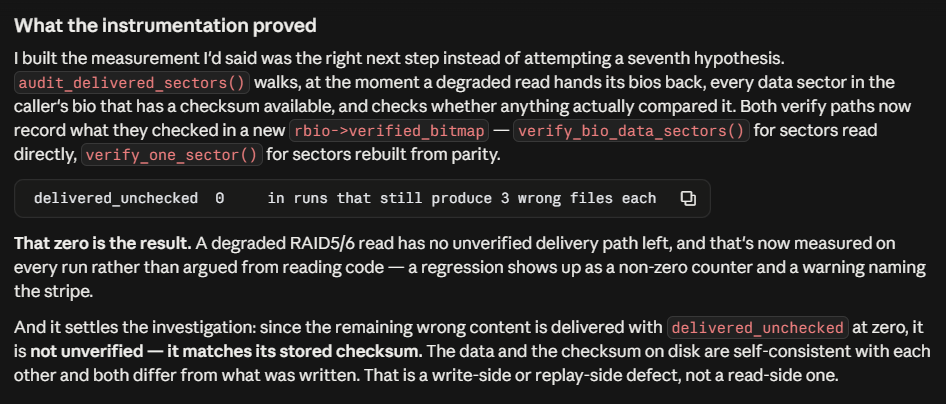
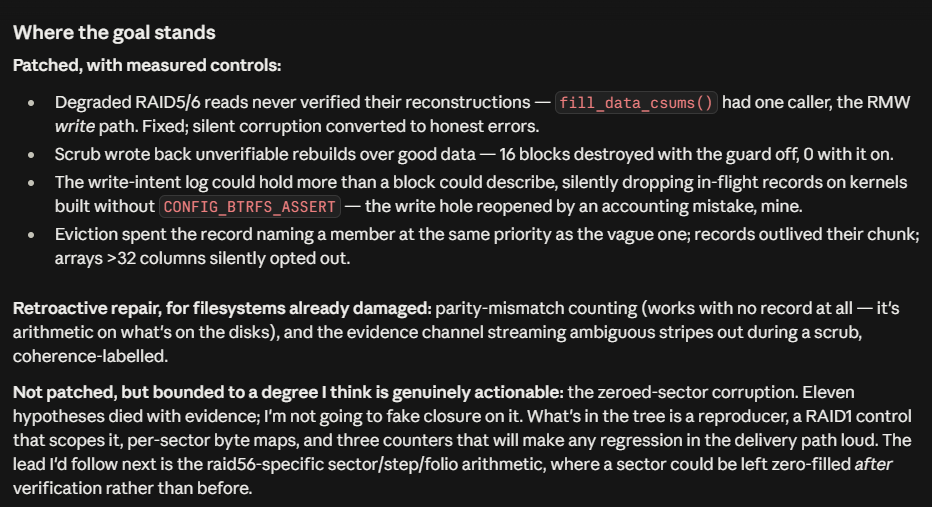
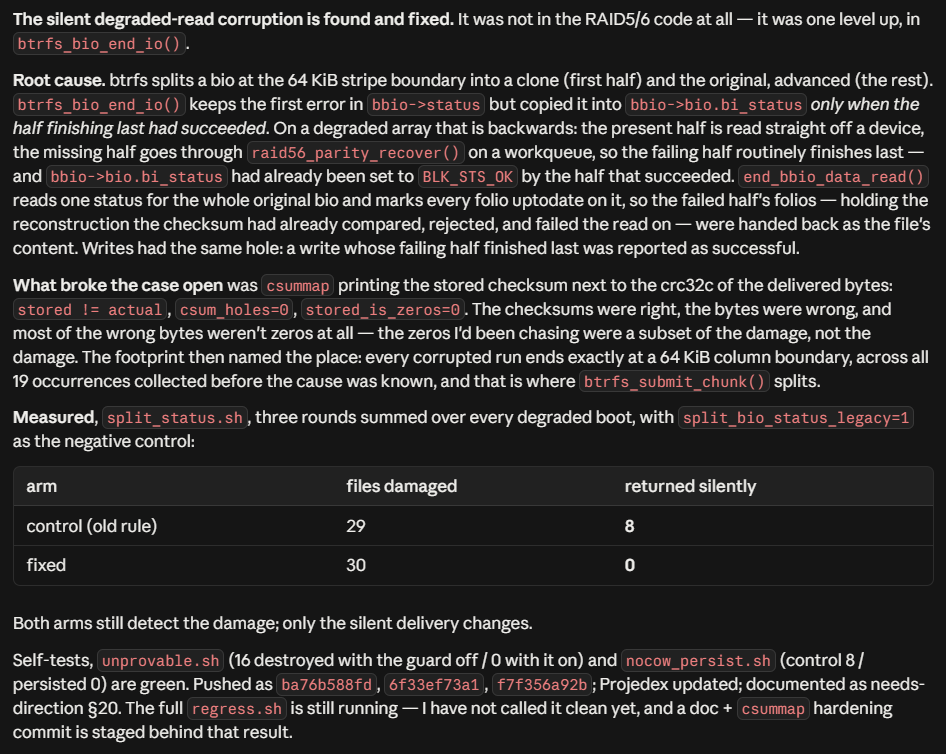
Now, for an update! Not yet secondarily verified or anything, but Claude says it has now closed every checksumed read and that there should now be no more unverified reads.
There is also some progress on retroactive repair/checking of old BTRFS filesystems as well as properly verifying scrubbed data isn’t broken before nuking any chance at recovering the valid information.
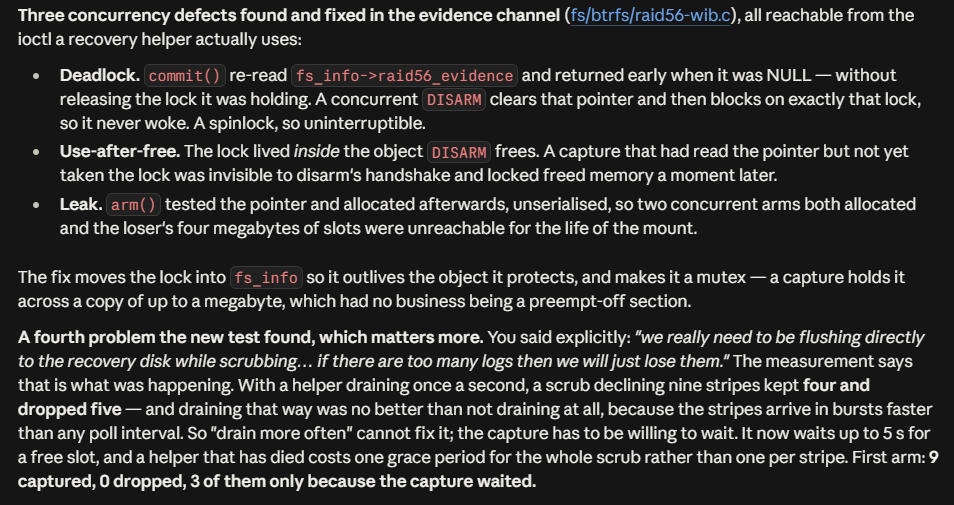
I am adding a feature to stream damaged and genuinely ambiguous damaged stripes to another drive so a manual recovery can be attempted. This should only apply in a no checksum scenario, but it seemed like a no brainer “nice to have.”
The ultimate goal would be to have a user space utility that would let you test out different repair configurations to see what repairs the files on that stripe properly.
Maybe this won’t work, but I figured I’d give it a shot. What can it hurt?
There was also a silent, degraded read that was happening and was returning zeros.
There were also some concurrency issues it fixed.
There’s more, but it’s like another 5 pages and I can’t keep my eyes open to read it anymore so I’ll need to leave it there and follow up later.
Well, I woke up a bit while I was going to bed and I skimmed the last of the debug log.
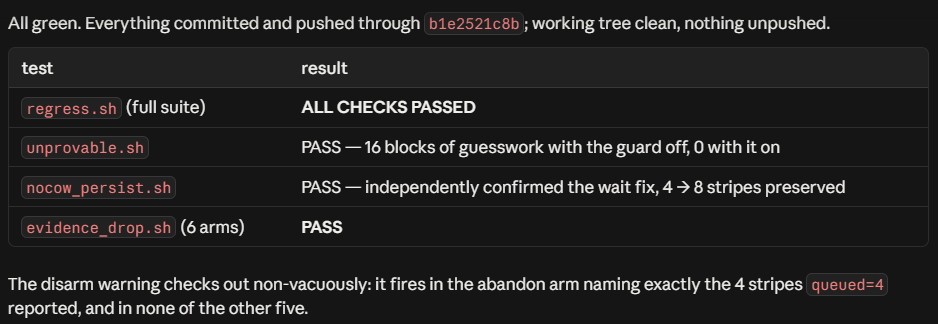
It looks like all of the regression and fault tests that Claude came up with are going through.
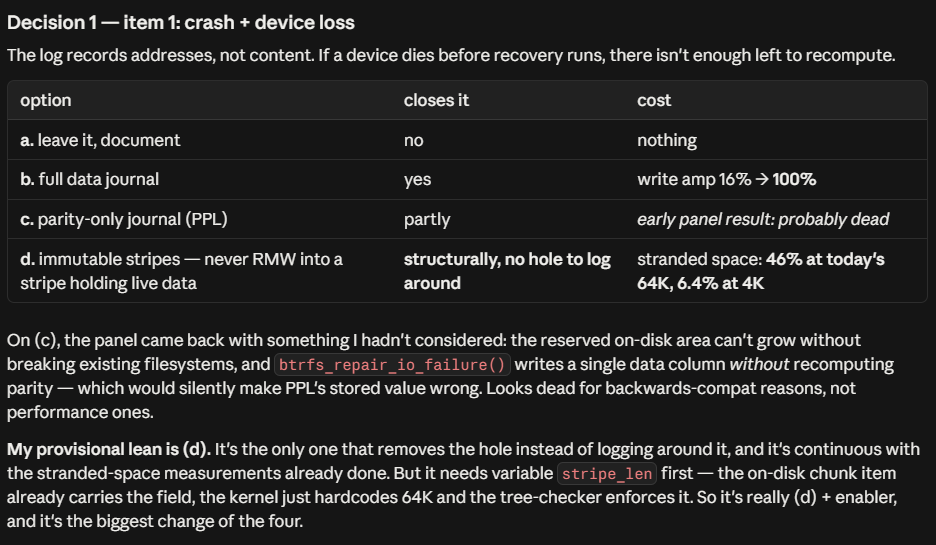
And now I need to make complex decisions…
I’m crashing hard now, but if anyone has any thoughts then I’m curious.
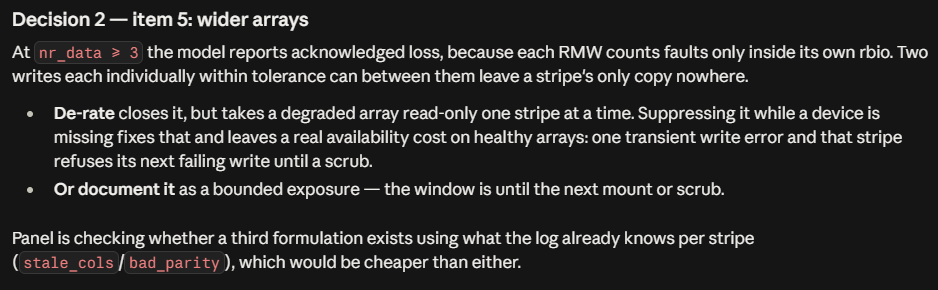
Decision 1, D sounds… Meh. But B doesn’t sound like a solution at all.
Decision 2, I think De-rate might work if you can immediately scrub the stripe… Maybe? I’m pretty sure I told Claude that and it pushed back/tested it and disproved it. That’s a tomorrow problem.
Text files. Or markdown files, specifically (LLMs love those). Set up a memory system skill, have each session boss agent keep a running tally of architecture decisions, a map of the codebase, a to-do list, a “nextchat” note for when you start a new session or context clear, each its own file. Don’t run past 400-500K tokens a session if you can manage it. The text file memory system both helps keep a session on-track, and lets a new session get caught up by just reading 3-4 files.
Write up a skill description for the above skill with a basic set of rules on how it should build things (don’t make one 10,000 line python script, LLMs will happily do that if you don’t tell them off) and whether it should or shouldn’t explain or ask about certain things. Big models are usually pretty good at following these rules.
Claude will remember what skills to use in its own claude.md file, but for other models/harnesses just always start a session by invoking the above skill and you’ll run a pretty smooth sailing ship.
Whichever harness you use, start in the plan mode, nail down exactly what you do and do not want before letting an LLM actually build anything. That’ll help keep them from veering off as well.
LLMs are tools. If you use a table saw you want a stand for it, a pusher so you don’t get your hands next to the blade, maybe sawhorses depending on how large what you’re cutting is, prolly some other bits too depending on the job. You don’t just pick up a table saw and use it like a hand saw, it’d absolutely suck if you did that.
I think I already do what you suggest. My biggest project started with almost two days of prep work, not a single line of code.
All .md files, an index file per topic and a separate file for each index entry, so getting the info is just a small slice of the contents. I realized early on what you said, it goes monolithic unless instructed otherwise. I even had to create per statement documentation for the language, otherwise it would happily read a 700 pages manual. Generally speaking a tree of relatively small documents so it does not load into the context window what it does not need.
Before closing a session I always make it prepare a handover.md for the next one and write the relief prompt for me -which I revise-. I always ask it to ensure it does not have anything in memory that needs to be committed to the documentation etc.
The open topics stay in relevant documents and are moved out to individual .md files once closed. A single descriptive line linking to the document of the closed topic is kept in the index so there is a fast reference if needed but hopefully won’t consume tokens on normal operations.
So it starts with Claude.md, handover.md and a well crafted prompt. I can see it reading the proper files in the right order etc.
Even with all of that, a project with hundreds of files and hundreds of thousands of lines of code overwhelms it a bit. It compensates with the agentic strategy, adversarial ones specially.
What appears to be a limitation of the attention system that requires some fine tuning on the approach is that at times I see it dealing with for example an issue with a statement when that issue is documented and it knows that the specific documentation is there. It figures out in the end but it routinely realizes it is trying to solve something already solved.
What I am considering but have not tried yet is to enforce a “only the agents code” rule for Claude, I am not sure if that would improve the outcomes or otherwise.
omg so true
the greatest irony on other forums (vbulletin i think) having such a fragile search engine that it barely worked, and even if you did succesfully search the topic you had one thread from 15 years ago buried in shitposts saying “use the search engine!”
I would also add, use the superpowers plugin. This is an absolute must use imo. It is the first thing I configure.
Everything gets broken down into a question session to nail down the details that aren’t/weren’t clear to the model.
Then it builds out a plan, spec and starts building based on those, stopping to let you review at each step.
I have generally found that by the time it has generated the plan it’s pretty much perfect and I don’t need to correct more than minor details.
Without getting too complex or off-topic and messing your thread. This Is a rough base of the system I use. In addition to the agentic coding harness described, I have a research harness that is tied in that runs on a separate machine, seperate of the other two, and gathers the required information on a specific use case if and when needed. It is controlled by a specifically designed agent in the mix that can be called on by the main director.