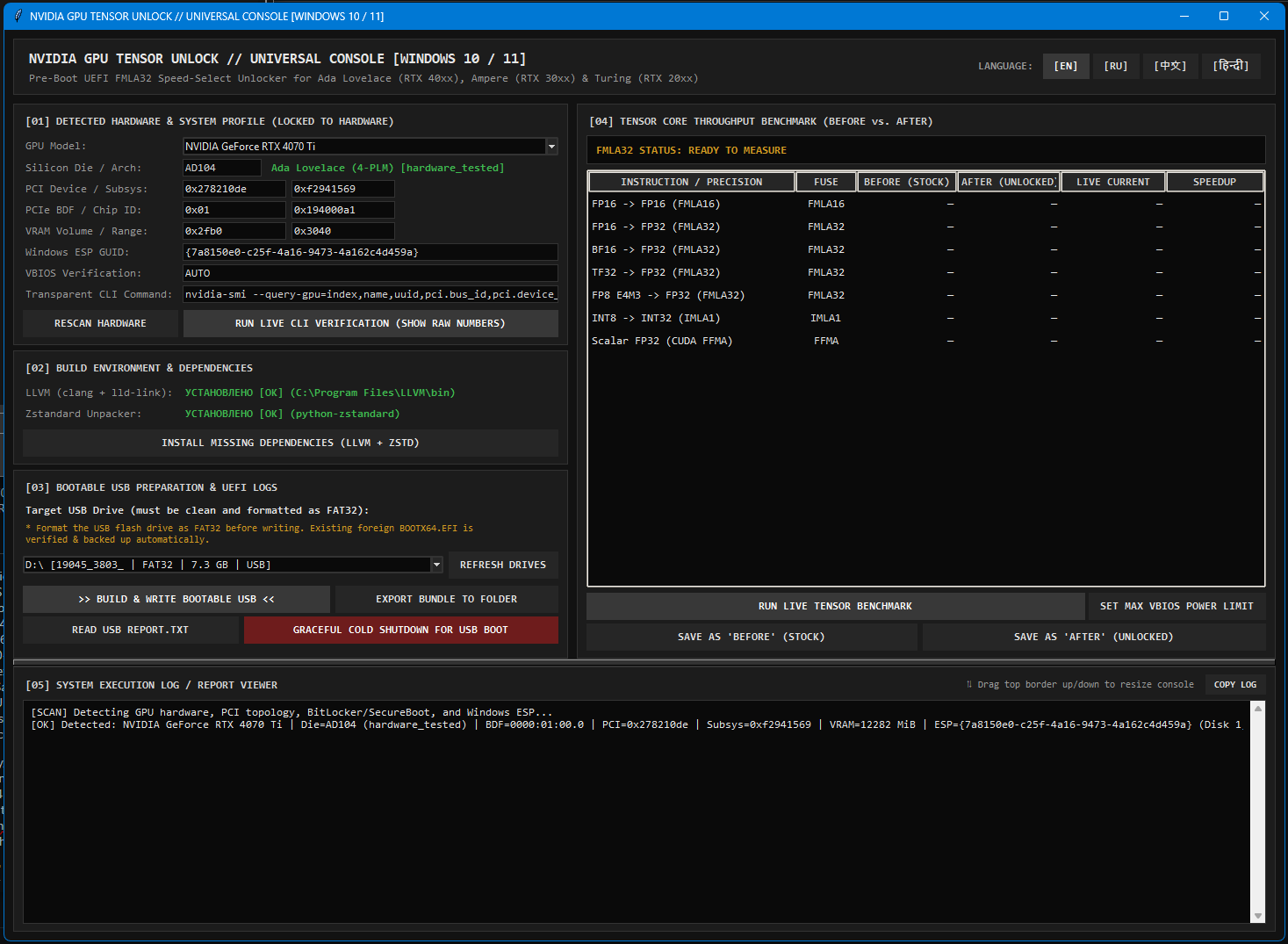
For the past few days I have been testing the pre-driver FMLA32 (full-rate FP16/BF16/TF32 → FP32 accumulation) unlock on my Windows 11 workstation with a Palit RTX 4070 Ti (10de:2782, 12 GB, 300W power limit). The underlying SEC2 Booter 610.43.03 method works as advertised, but the setup process was pretty inconvenient if there wasn’t already a ready-made profile for your exact hardware. Linux users had to jump between separate repositories for Turing, Ampere, and Ada. On Windows, existing UEFI builds were mostly tied to the profile of a single specific board. To run them on your own card, you had to manually pull your PCI Device/Subsystem IDs, VRAM offsets, and the Windows EFI boot partition GUID, edit local_profile.h by hand, and compile BOOTX64.EFI yourself.
While adapting this for my own GPU, I decided to refine the existing work and bring everything into a single tool for both operating systems. The result is a unified cross-platform package (GPL-2.0-only) that combines support for desktop RTX 40 (Ada), RTX 30 (Ampere), and RTX 20 (Turing) series cards on Windows 10/11 and Linux: GitHub - MindAllik/GPU-Tensor-Unlock-Universal: Pre-driver FMLA32 Tensor Core unlocker and PTX benchmark console for GeForce RTX 40-series, RTX 30-series and RTX 20-series on Windows 10/11 (UEFI USB) and Linux (gpu_unlock.ko), with friendly UI for Win/Linux. Restores full 2x FP16/BF16/TF32->FP32 accumulate rate with automatic hardware profiling, pre-flight ROM checks, and zero VBIOS flashing. · GitHub
Full credit goes to the authors of the foundational research, payloads, and loader code that this project builds upon: TOTORONG/AD103_win_unlocker, Zagitta/gpu-unlock, elias-gaeros/gpu-unlock, JustAResearcher/gpu-unlock-ada, KohakuBlueleaf/KohakUnlock, impacifist/Windows-GPU-UNLOCK, Goldlionren/gpu-unlock-4080s, haohervchb/Turing-unlock, and of course Jon Pry.
On Windows (Windows_Launch_UI.bat), the core_detector.py script cross-queries NVML, CUDA Driver API (sm_89 / sm_86 / sm_75), and pci.sys to automatically detect the PCI Device ID, Subsystem ID, bus number, VRAM size, and the EFI partition GUID on the boot drive. It checks the PCI ID → Silicon Die → PMC_BOOT_0 mapping, generates the headers in a temp folder, and compiles BOOTX64.EFI onto a FAT32 USB drive (with a 30-second confirmation timer on pressing U at boot). Special attention was paid to display handoff and memory safety in UEFI:
-
Two-phase ROM check before display disconnect (PromCheck): instead of relying on a single hardcoded ROM hash or calling DisconnectController blindly, the loader first reads the card’s VBIOS via BAR0 + 0x300000, verifies the BIT table, the Falcon descriptor (V3 RSA-3K on Ada/Ampere, V2 AES-128 on Turing), and the DMAP structure, and runs a dry-run FRTS patch in RAM. If a vendor VBIOS layout is non-standard, it safely aborts while the display is still active and boots into Windows normally.
-
Hybrid graphics and multi-GPU handling (DisplayCheck): the loader distinguishes child handles belonging to the target card from independent display adapters (Intel/AMD iGPUs, server BMCs like ASPEED/Matrox, or a secondary GPU) and verifies GOP recovery before handing control to bootmgfw.efi.
-
Fail-closed DMA containment: if any fault occurs after microcode starts on GSP/SEC2 before PCIe FLR quiescence is confirmed, Bus Master Enable (BME) is cleared to 0 and allocated DMA buffers remain pinned in memory until cold power-off.
On Linux (Linux_Launch_UI.sh or via CLI make install), the tool installs the gpu_unlock.ko DKMS module and rebuilds initramfs for mkinitcpio, dracut, or initramfs-tools. For experimental Ada and Turing cards, an explicit single-card PCI BDF (0000:xx:00.0) is required instead of targets=all so multi-GPU workstations don’t touch a neighboring card. It also includes tools/read_sm_rates.py, which queries /dev/nvidiactl via ioctl 0x20801230 to check all 9 hardware SM issue-rate selectors (including fmla32 = 0 full) directly from the driver without creating a CUDA context.
A 7-kernel PTX JIT benchmark is also built into the console (tensor_benchmark.py: FP16 → FP16, FP16 → FP32, BF16 → FP32, TF32 → FP32, FP8 E4M3 → FP32, INT8 → INT32, and Scalar FP32). As KohakuBlueleaf noted earlier, standard mmapeak filled matrix fragments with compile-time zeros, which allowed ptxas to optimize away calculations inside the loop. This benchmark generates random non-zero data at runtime and verifies both the loop iteration signature (iter ^ 0x67b05a5a) and finite IEEE-754 accumulator values (plus a button to raise the Power Limit to the VBIOS maximum via NVML was added to the interface).
On my test bench (Palit RTX 4070 Ti 10de:2782, Windows 11 UEFI, 300W limit), the unthrottled FP16 → FP16 rate (FMLA16 control kernel) is 172.8 TF/s. At stock, FP16 → FP32 was around 86.4 TF/s, and after the UEFI unlock both FP16 → FP32 (172.8 TF/s) and BF16 → FP32 (172.7 TF/s) reached the full 2.00x rate. For comparison:
| GPU | PCI ID / Die | FP16->FP16 (Control) | FP16->FP32 Stock | FP16->FP32 Unlocked | BF16->FP32 Unlocked | Source |
|---|---|---|---|---|---|---|
| RTX 4070 Ti | 10de:2782 (AD104) | 172.8 TF/s | 86.4 TF/s | 172.8 TF/s (2.00x) | 172.7 TF/s (2.00x) | Tested by me (Win 11 UEFI, Palit 300W) |
| RTX 4090 | 10de:2684 (AD102) | ~331.6 TF/s | 165.6 TF/s | 331.6 TF/s (2.00x) | 330.6 TF/s (2.00x) | Upstream report (elias-gaeros, Linux 450W) |
| RTX 4070 Ti SUPER | 10de:2705 (AD103) | ~190.0 TF/s | 95.0 TF/s | 189.9 TF/s (2.00x) | 189.7 TF/s (2.00x) | Upstream report (JustAResearcher, Linux 240W) |
All operations happen in volatile MMIO registers prior to OS driver load and reset on a cold power-off (VBIOS flash memory is not touched, and the script downloads the NVIDIA firmware binaries directly from the official 610.43.03 package and verifies its SHA-256 locally). Right now, RTX 4070 Ti (10de:2782), RTX 4090 (2684), RTX 4070 Ti SUPER (2705), RTX 3090 (2204), RTX 3080 (2206), and RTX 3060 12GB (2504) are verified on real hardware. The remaining desktop AD10x (40-series), GA10x (30-series), and TU10x (20-series / CMP) profiles in the matrix currently have the experimental_simulated status (verified on a 106-scenario simulator under GCC ASan/UBSan). If you decide to test one of the experimental cards on Windows or Linux, please share your EFI\UNLOCK\REPORT.TXT (or dmesg) and benchmark numbers in GitHub Issues or here in the thread, as the report is very important both when a run succeeds and when it stops at the pre-flight check so each board profile can be confirmed (: