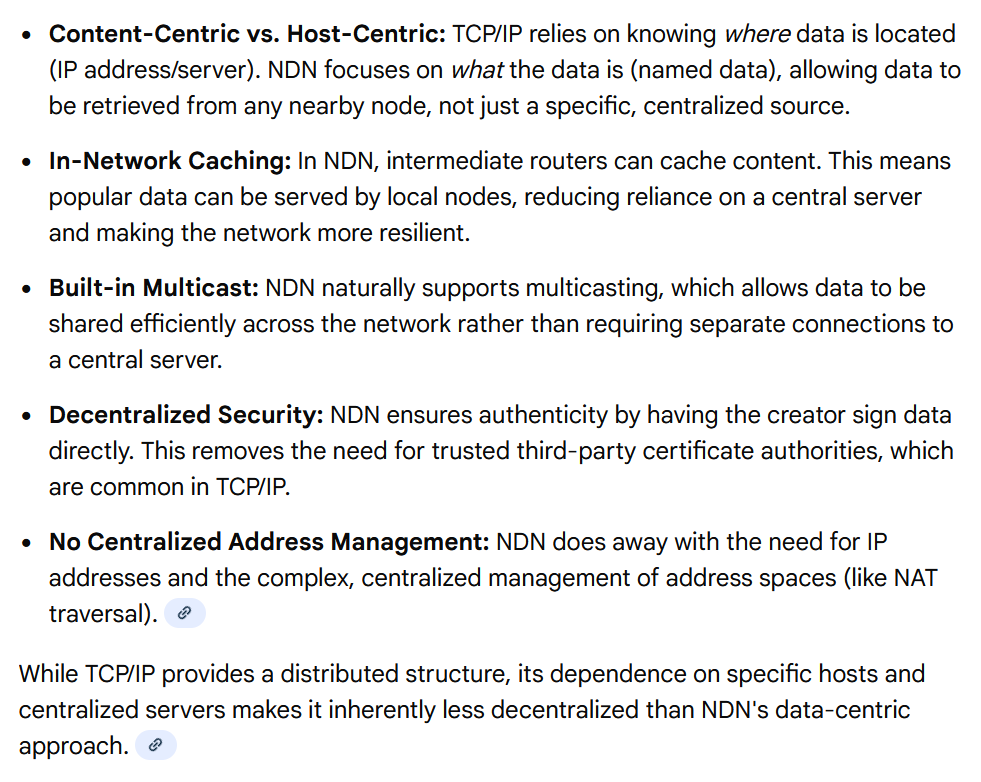
Tying routing directly to content would be a massive step backwards from TCP/IP in terms of decentralization. At least with TLS the network is oblivious to what content is being requested from a server, as it should be. NDN sounds like a wet dream for centralized authorities.
Can anyone raise an issue with TCP/IP in regards to centralization? If there’s some aspect of the TCP/IP suite that’s prone to centralization and warrants a change to something more decentralized please name it.
I’m having trouble understanding this, NDN could/would take away a central server’s ability to be the sole source of data so that it being taken out would not interrupt the availability of data.
I’ve seen papers that propose a centralized controller to NDN, but this isn’t baked into it and isn’t how it’s currently being used.
EDIT:
Remember the particular content packet you request on NDN is cryptographically marked so you aren’t going to be trojan-horsed by packets trying to pretend they are something that they aren’t like in TCP/IP stack which is more susceptible to this exploit since it isn’t wielding it’s encryption as effectively (per packet keys).
I’m saying TCP/IP but what I mean is the encryption handled at a higher level like IPsec.
IIRC the “new internet” very much was decentralized in that show, but the writers scripted other problems into it; If you were worried about data privacy on NDN it could be handled at a different layer that the routing layer.
Maybe I’m misunderstanding but on first glance a fundamental aspect of NDN is basing routing directly on content.
The way I’m envisioning it this would make it easier for nodes to not only block content selectively but to see exactly what content users are requesting. eg. someone views something our overlords don’t want them to on some torrenting site for example. With NDN every request for a specific piece of content has to be transparent rather than being exclusively between the client and the server.
As is adversaries need to index sites and then guess what users are requesting based primarily on the size of responses.
You bring up legitimate security/privacy concerns, and honestly I don’t think they’ve been completely gamed out with how new the use is; but the system enforces decentralization pretty heavily.
I don’t normally do this, but I thought I’d post some AI slop on NDN since it probably isn’t very well known to many:
Sounds great for content delivery where many users are all requesting the same content eg. netflix. I’m not sure what it offers over existing caching setups though.
I was, quite obviously, replying to your question about the difference between decentralisation and wireguard. Equally obviously, I wasn’t specifically talking about fido or the phone network.
However, it’s painfully obvious that too much centralisation has occurred on the Internet. We now have a number of single points of failure for the majority of the sites that people use - ignoring regional issues (eg national telecoms networks), we now know that a blip at Amazon, Cloudflare or Akamai is functionally enough to break most online tools that people use. The business world has treated that as a feature for years, whereas it’s the very definition of a design bug.
There’s also the fact that governments are increasingly exerting excessive pressure in terms of what can and cannot be done on the Internet; that also runs contrary to the design goals of the Internet. The mere fact that they can get 95% of that job done by just hitting four service providers with threats of a monstrous fine is evidence that we’ve gone too far in that direction.
there’s another YTber that made a similar device with the same tech and apparently with just that alone, no internet, 2 iPhones can facetime
I thought facetime would require apple cloud servers but they can work with Wi-fi direct using this since it’s full IP networking over a mile long range.
And being Mesh like LoRa or Meshtastic, the more people running nodes, the better the entire network is.
This is the future of decentralized networking. bringing information back to the people instead of comcast or att
Not really considering you didn’t answer the question of why reviving fido net to connect “mesh nets” vs using existing TCP/IP based tunneling protocols like wireguard would be any more decentralized.
I’m not sure calling out the use of cloud providers (Amazon, Cloudflare, Akaimi) as a point of failure even makes sense when a huge part of what they’re selling is availability. Whether you’re using them to host directly or just putting them in front of an origin server their services are used precisely because they’re reliable and because they make things very difficult for bad actors. When you want to put something between you and your adversaries you want the death star not the rebels so that’s just the way it goes. Users experience more blips on self contained sites than those that run on or behind any of the mentioned behemoths.
I think “We” is doing a lot of heavy lifting here. I don’t think you can include anyone who works for, uses, or owns stock in any of the companies listed above which is lot of people.
My point has just been that the centralization of the internet isn’t really an issue that can be traced back to the technical underpinnings of the internet. The device @KenPC posted is a great example because while it operates completely independently it still uses TCP/IP allowing an enormous number of services to very easily be setup on the device. It’s both the router with the WAN unplugged that I earlier suggested and uses LoRa mentioned by @johney_iron. With battery/USB power it also avoids the most significant centralized point of failure which is the power grid, all in a neat little package.
I just don’t think there’s a good reason to throw out any of the tech that defines the internet in search of decentralizing.
Because tunneling is not decentralisation in any way, shape or form; yes, it enhances privacy, but it’s absolutely nothing to do with decentralisation, which is the actual topic of conversation. And, for the record, I never said that fido was a good option for decentralisation at all. Perhaps you ought to ask the person who suggested it?
It absolutely makes sense - they are single points of failure for the hundreds of millions of people who use services hosted with them every single day, and they’ve proven that they can have one tiny misconfig and everybody’s services die. That’s the point; in hosting 58% of the top 100k sites with AWS, we’ve taken a largely-decentralised architecture and centralised it through commercial means.
You obviously don’t see that as a problem, and that’s fine. However, with governments seeking to increasingly exert control over what people can and cannot do on the Internet, and further restrict entirely legal content, that centralisation is going to be a problem because - sooner than you think - they’ll realise that hitting the service providers running the sites and VPN services isn’t the silver bullet they think it is, and they’ll go after the hosting companies next. And, when they only have to threaten one or two companies with massive fines or losing an entire country’s business to do most of the job, that becomes much easier.
The threat to a commercially-centralised Internet is not script kiddies renting botnets; it’s legal frameworks built by people who don’t understand what they’re doing and don’t have to think long-term because it’ll be somebody else’s problem in a few years’ time.
It effectively connects isolated/decentralized networks similarly to how fido net connected isolated/decentralized BBS.
Run ins with script kiddies and botnets or just fear of it is often what drives users towards the commercially centralized internet because the cost of entry for independent protection from even low level attackers tends to far exceed the cost of services offered by cloud providers.
I see it as a primarily social problem… Of course there are drawbacks to using centralized services also so people may shift away from centralized providers including jurisdictions/governments, especially those who opt to or are coerced to leverage their positions against their users. It’s not poor service availability that drives people away though, that’s what drives them towards.
This is basically exactly what I was talking about before. Long range “normal” networks could be great for this sort of nomad decentralized internet. Haha in a future where all people are van lifers as there are no homes this would slap. Ok maybe we wont all become roamers in vans, but neat to think about how the internet would look if that were the case.
I think that the centralization of web services onto the big 3/4 major providers is a problem, but only because if you rely entirely on another provider, and have no method for providing even degraded service if their stack goes down, your company/service effectively folds up and disappears for however long the outage is, and as a small business owner myself. a prolonged outage would mean that I am suddenly going back to personally paying for the companies expenses simply due to the fact that the company does not have enough cashflow yet to absorb prolonged outages.
I think that LoRa is part of the solution for individuals, but not replacing TCP/IP by any means, im pretty sure that I have read up on TCP/IP over LoRa, someone has put in the hard work, you can make your own failover infra without replacing all of the internet. but keep in mind that you are looking at somewhere between dial up and DSL speeds on LoRa, unless you manage to figure out how to parallelize your traffic a lot, then theoretically you could use an array of antennas and stream your packets out on more than one frequency pre-set at once. but you cant be doing that all the time, or you are just going to swamp the network.
LoRa, at least with the meshtastic implementation, you are limited to 7 hops, so that means you either need to have directional antennas focusing on your own series of nodes (or you and a jolly group of other super nerds), or you need to use a internet relay to capture the LoRa Packets on one end, and rebroadcast them somewhere else, but then you are relying probably on a cloud provider again at some point.
now, building out LoRa infra (or similiar), for both local area disaster recovery, or for your friends and family during disaster, I think has a ton of merit.
As a network geek, I’d say the internet is doing great, the world wide web is well and truly knackered.
While I find LoRa interesting as a concept, we don’t really need a new way to transport data, the internet is already doing that brilliantly, it’s the content and control of the content that needs a rethink.
Someone mentioned fido net earlier in this thread. I was part of that in the late 80’s, early 90’s and we paid a lot to transport data short distances. There was a huge debate at some point because the guy providint international fido feed to my country had the audacity to transport the data over usenet rather than making long distance calls over seas.
The internet gives me the ability to connect to systems all over the globe for almost free and the decentralised nature of it all makes it awesome. Even connecting from my phone to almost every server in the world costs less than a 6 pack of beer, what’s not to love?
It’s the content of those servers around the world that needs a rethink, LoRa isn’t solving that..