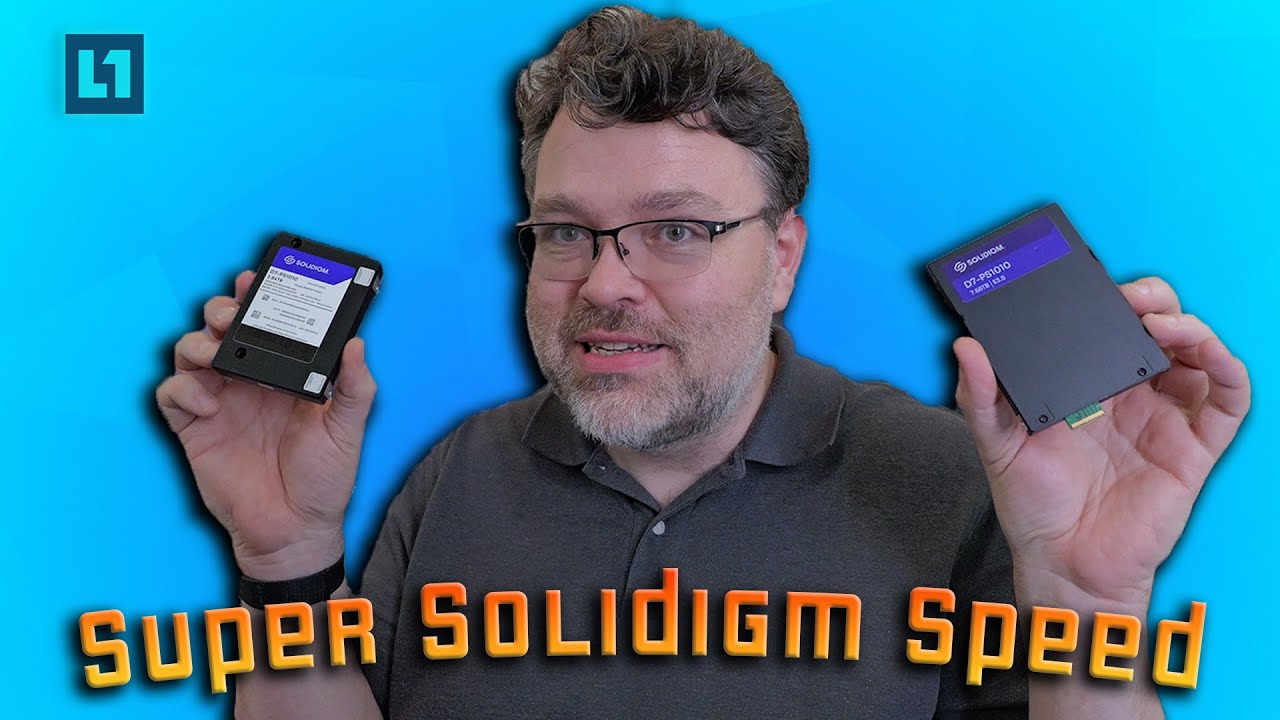
I created this thread to discuss Solidigm’s new D7-PS1010 and D7-PS1030 SSD drives. I watched @wendell’s video about them. They sound like something I might want to use in the new virtualization server I am planning. I assume you can only purchase these drives through your system supplier. You can’t go to Microcenter or Amazon to buy these drives. What do you guys think about these drives?
I guess we both tried to create the same thread simultaneously. @Platypussy was just a little faster than I was.
Yes, I would like to discuss these drives. I would like to know what machines they would work in. Would they make a good drive for a high-end virtualization server? If anyone knows where to purchase them other than the way @wendell mentions in the video, please let me know. If you know anything about these types of SSDs, please share.
4x PCIe 5 lanes per drive to fully utilize…better go EPYC (so you can have…carry the 4…128TB of fuck you fast, nvme storage)
6.8 TB for $1200 x2 for < 7 TB of usable storage
there goes your budget… worth it
Realistically, you’d throw one in for a scratch disk and run prod vm’s from a more pedestrian NVME array. This would be reserved for testing updates, upgrades, and general tweaking that might break installs/require rollbacks.
For devops, that’s the typical config on a budget. We’ve gotten away from that to the extent that both arrays are now underpinned by identical drives to keep engineers following SOP instead of saying, “well it runs well here so can’t we leave it be?”
These will be ideal for a virtualization server or database host.
With IOMMU, SR-IOV, etc… you can expect a VM to outperform a high end baremetal installation.
I have solidigms in prod and highly recommend for random q depth, but the same goes for Intel at this level.
+1 Definitely a your mileage will vary with workload thing but, to put on some data points towards discussion, I regularly see 4.0 x4 at 7 GB/s saturate 12-16 cores and two DDR channels. That suggests 9274F or 9374F for one 5.0 x4 at 14 GB/s. (Or, minimally, 7960X in Threadripper but I’d favor 7965WX for channel margin.)
With two 5.0 x4s and slightly more compute intensity per unit of IO, maxing a 9754 doesn’t look difficult. The design issues are likely to lie more in configuring data sources, sinks, and network bandwidth to keep the server busy. If it’s much of a sustained workload I’d also expect drive cooling to be an issue.
Thanks, @TryTwiceMedia and @lemma, for the information; I guess I will reprioritize my wish list to include one or two of these drives. I will research these drives more, and if I have any more questions, I will ask them. Let’s keep the discussion going.
Who would benefit from these 128GB solidigm drives?
First - nobody that cannot afford them. Assuming their price will be higher than the $200/TB level that can be observed in latest gen server level NVMe drives you will need to shell out ~$25,000 for a single drive.
Not having seen an actual price for these drives I assume the actual price for this special drives may actually be higher - priced at a premium.
Assuming this to be case, these drives are worth the cost only in specialized use cases:
E.g., requirements for very high storage density. The largest HDDs have reached 30TB? So, a single drive replaces four or more HDDs at significant space and energy savings (well, up to 4x). I think this makes sense at a data center scale where the energy and space savings allow adding a rack or two of extra compute because of power supply or cooling limits. In my home lab I need to run such an SSD for quite a while until my power bill catches up with the upfront cost of the SSD
Wendell mentions optimization for “mixed workloads with lot of read/write pressure”. Mentioned are the letters that a donkey makes backwards. Apparently these open wallets. I don’t understand the usage pattern myself.
I don’t think these drives would be a great fit for traditional database workloads with lots of small record size read/writes (the <500k IOPs are too low compared to better suited drives).
I tried to order a pair of the D7’s today from the local janitor supply shop. They had D5’s but apparently the D7’s are still hard to find, but they reached out to solidigm to see what the lead time is on em.