1.3 is the max here and it’s like €100/month. I get a price break on 400 Mb but for most folks even 100 Mb’s fairly spendy.
Was on 3G symmetrical fiber for two years as part of an off-site backup evaluation. Turned out the backup provider could only sustain slightly less than 1G, so that turned out to be the sweet spot based on cost / benefit.
USD$50 for 1G symmetrical and USD$65 for 3G symmetrical. Provider doubled rates after 2y promo ended so I downgraded to 1G.
Also, ISP may have been tempted to downgrade the PON to an inferior fiber technology for lower than 1G service which I did not want to risk for scant savings.
QoS? If I started a downloaded, I expected everything else to slow down; I want the download going as fast as possible on 56k 
Properly configured QoS doesn’t slow your download noticeably. Just a tiny bit, to ensure other connections can get through before they time-out. With a large download on a slow connection is going to take hours, it was very important that you can still do other things with your connection during that time.
Are most people vastly over networked?
No. 
When we bought our house a few years ago, I didn’t care about many things but availability of Verizon FiOS (and their full, symmetric duplex approach to bandwidth) was a non-negotiable.
I have found that I can no longer just move somewhere and then figure out what the internet situation is like. It has to be part of the plan.
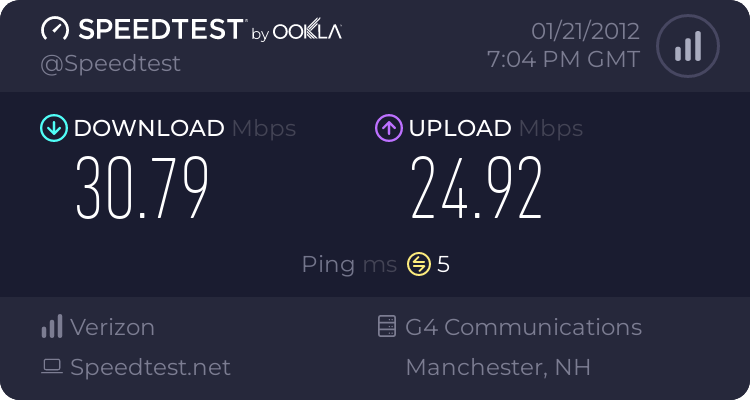
I’ve had Verizon FiOS since ~2010 (I think it was) when they first came to this general area and I got 25Mbit up/down. It speed tested at about 30down, 25 up though. (FiOS always benches slightly above advertised to a good nearby server)
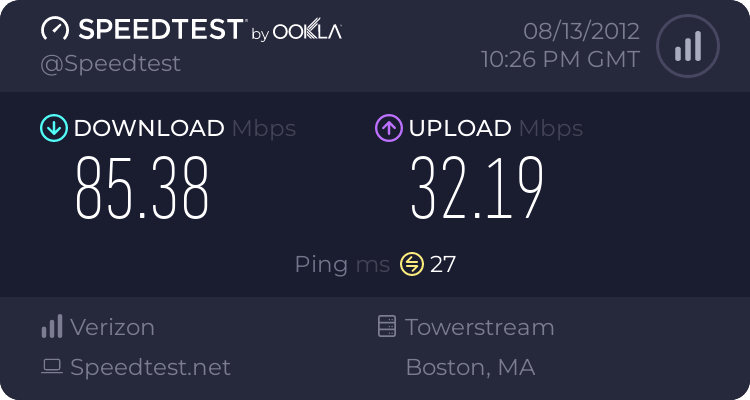
They increased the available tiers at some point (2012?), and I got 70 down, but only 35 up. (they hadn’t made symmetrical bandwidth their policy yet)
Like before it benched better than advertised though:
Then in 2014 150/65 Mbps became available. It too benched higher than advertised on the downstream by about 5mbps, but that Speedtest.net result is lost to time. From conversations I had with people at the time I know I got about 158 down.
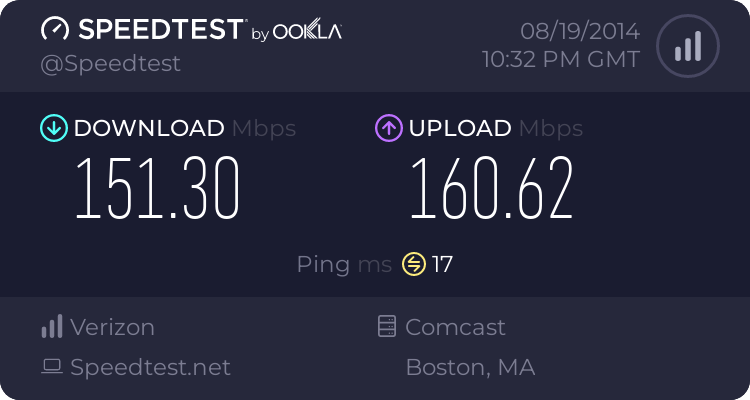
Then two months later in August of that year Verizon sent out an email to their FiOS customers that they were making their bandwidth symmetrical, and that I was being bumped to 150/150 at no extra charge. I was excited to get home and test it, and it checked out:
Then in 2017 their gigabit service (well, 940 down 880 up) became available. It was only $20 a month more than their 150 service, so I figured why not?
I’m not sure why it isn’t true gigabit. I’m guessing there is some limitation in GPON or other overhead (maybe reserving some bandwidth for video on demand services? Do they still offer that?)
I’ve been on that ever since.
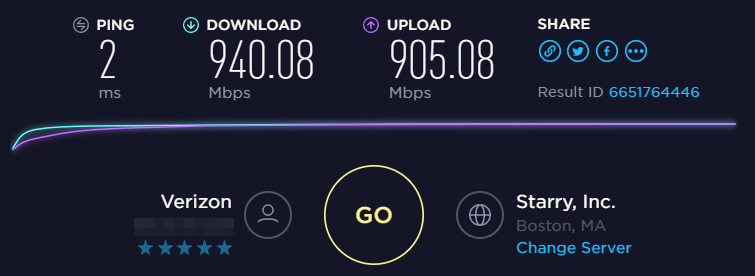
It benches stronger on the upstream than advertised, which brings it even closer to being symmetrical.
I have my OPNSense firewall/router configured to rout all non-gaming traffic from my network through my Mullvad VPN account, which loses me a slight amount of performance, but I lose much less than one would expect:
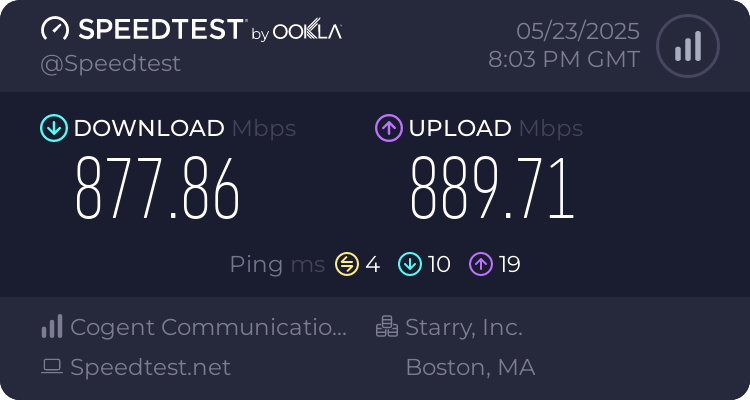
I find it pretty astonishing that my ping can be only 4ms through a VPN.
I suspect I could achieve even higher performance, but that I might be limited by the CPU in my OPNSense box. The old OpenVPN protocol and ciphers were less efficient than then new WireGuard implementations, but the difference is that OPNSense using AES could be accelerated by the CPU’s AES-NI extensions, whereas WireGuard is all CPU all the time. I pin the poor CPU (Rocket Lake Xeon E-2314 (4C/4T, 2.8Ghz base, 4.5Ghz turbo) when I do a full out bandwidth test.
It probably doesn’t help that it is running as a VM in KVM. I have considered moving it to bare metal to see if that helps, but haven’t gotten around to it. It’s not like it is holding me back much anyway.
Now, my only gripe is that Verizon has seen it fit to roll out 2Gbps service in some markets, but they seem to be dragging their feet when it comes to coming to mine. I bet it requires some infrastructure upgrades which are expensive. I hope they at least have it in the plan…
1 Like
For me it was a natural progression.
Step 1.) (2010) I want more storage, but it wont fit in my workstation. I’ll use external storage. How about a Drobo?
Step 2.) (2011) The noise of the storage right near my workstation is a bit annoying. and it is using a bunch of space. What if I build a server from spare consumer hardware and move it to the basement?
Step 3.) (2011) It’s actually kind of nice to have a server for other things than just storage. I can run long batch jobs and downloads on it, host some things I can access when away from home, and I am free to reboot my workstation as I see fit!
Step 4.) (2011) Oooh. VM’s open limitless possibilities and help keep different server appliactions from trampling on eachother.
Step 5.) (2012) Proprietary RAID-like storage hardware in a box is growing old. Time to move to ZFS.
Step 6.) (2014) I really should be using enterprise hardware. Not only can I not get enough RAM on this consumer hardware, but not having ECC with ZFS makes me a little nervous. Time for an Enterprise CPU, Motherboard and ECC RAM (acquires dual socket Supermicro motherboard, Xeons and lots of ECC RAM and sticks them in a 4U rackmount case with a 24 3.5" drive backplane.
Step 7.) (2014) I demand more performance to the NAS, but 10gig switches are still WAY too expensive. Time for 10Gig dedicated fiber direct link between the workstation and the server. Used Brocade BR1020’s are cheap!
Step 8.) (2019) Decommed enterprise switches with a few 10gig SFP+ upload ports are starting to become affordable. Got an Aruba switch, and upgraded my NIC’s to Intel x520 fiber SFP+ NIC’s.
Step 9.) (2020) Gee, Enterprise switches are kind of loud, and licence requirements mean I can’t get the proper management tools and have to manage them using SSH and the commands are often non standard, and undocumented making it a pain in the ass. Hey, Mikrotik switches are pretty affordable, and they have 10gig SFP+ ports now too…
Step 10.) (2020) I really want to add more switches, a second server, a bunch of beefy UPS:es, and other things, but space is starting to become an issue, and it is a disorganized mess. I should try to get a rack. (Finds a really old one nearly for free on Craigslist)
Step 11.) (2020) Shove all the server stuff in the rack.
Step 12.) (2023) Hmm. Occasionally the workstation is really loud. What if I shove that in the rack as well, and use 65ft long USB and video cables and run them to my office.
Step 13.) (2022) I could really use more bandwidth to my NAS than only 10gig. INteresting, these decommed 40gig Intel NIC’s on eBay are quite affordable. I know QSFP+ is a dying standard and SFP28 and QSFP28 are taking over, but at this price I can’t ignore it.
Step 13.) (2023) You know, 40gig in a direct link between the workstation and NAS is pretty nice, but it really would be cool to be able to have it going to a switch. This used Mikrotik switch is pretty cheap and actually has two 40gig QSFP+ ports and 24 10gig SFP+ ports. That will be a nice addition to the rack…
Step 14.) (2024) I have all of these things running off of a single 15amp circuit that is shared with other things throughout the house. This is really precarious. Hmm, there happens to be an old disused 30amp 240v NEMA 14-30 dryer outlet right here next to the rack… I’d love to get a 240v UPS, and switch the rack over to 240v, but that’s not in the cards right now budget-wise. What if I replace the 30amp breaker with a 20amp one, and convert the dryer outlet to two 20amp circuits in an MWBC configuration? Done. Went from 15 amps available right near the rack to a total of 55amps at 120v.
(I still would love to move to 240v some day though…)
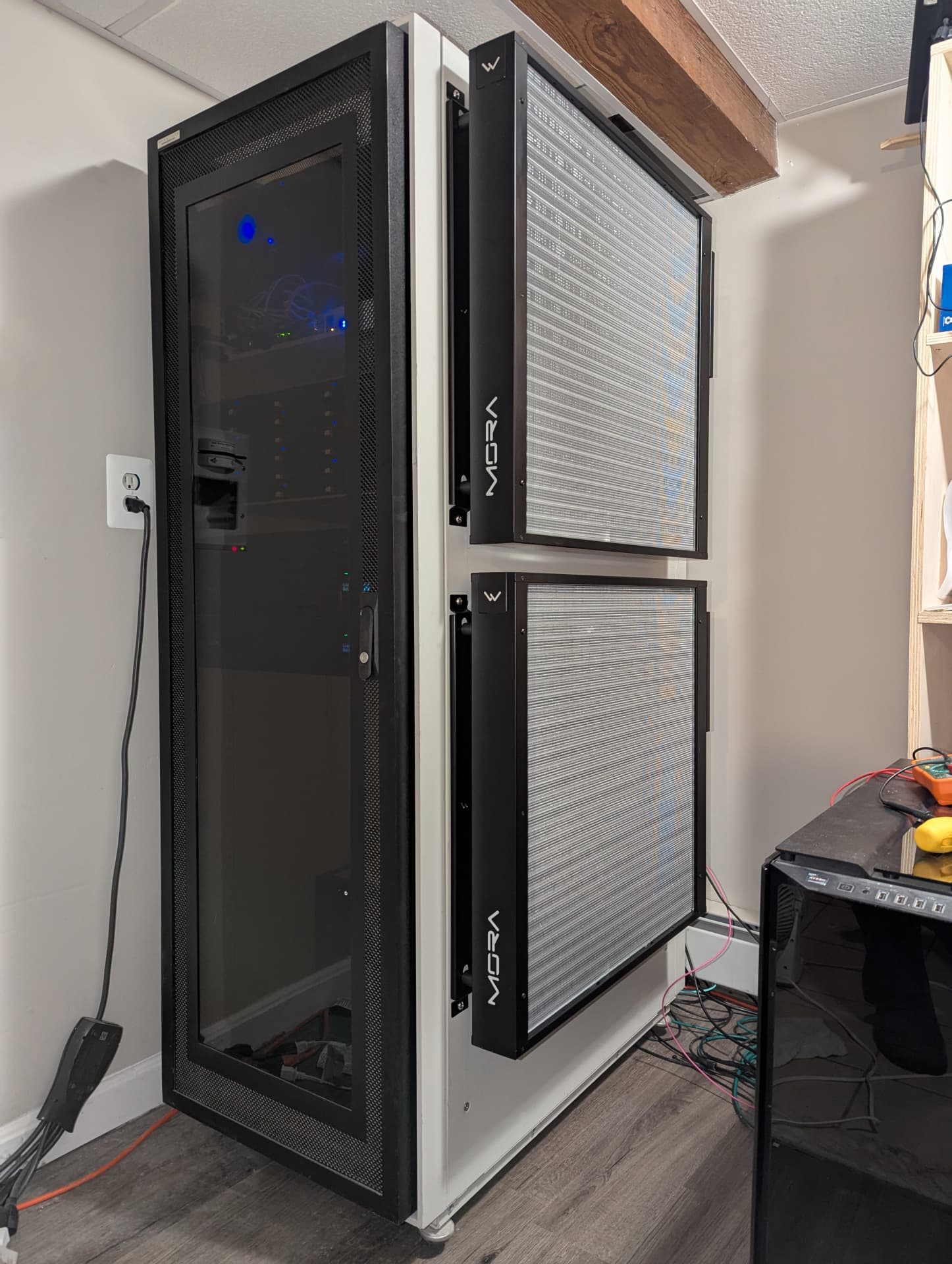
Step 15.) (2025) I really want to play Stalker2, but it runs like crap on my workstation, and upgrading workstations is getting really expensive, and for all that money, consumer/gaming performance is still crappy. Maybe I should just build a dedicated game machine? It looks like that would be cheaper than trying to chase workstation performance. Oh, and they should both have excellent cooling. Those new MORA IV Radiators Watercool released look really nice and are huge.,… What if I hung them on the side of the rack, and used them to cool the workstation and game machine? (This project is still in process)
And I’m not even in IT professionally. This is all just a hobby / personal use for me. 
5 Likes
running this off a 100Mbit NIC would risk throttling if too many cameras are on at a time, which is probably not a good idea.
Anyway, this is why ethernet speed capped at gigabit like 20 years ago and anything else is expensive niche prosumer stuff or full blown businness/server hardware. Some people need it, most consumers are on wifi and have no ethernet cables at all.
In a consumer environment gigabit is often overkill but it’s cheaper to have everyone on gigabit so you can mass produce the same thing for everybody instead than splitting into tiers.
You know what was the biggest innovation for consumer networking? Mesh wifi. That allows to actually drop nodes around the house and they will mostly automatically create a wireless connection that is good and fast (for wifi standards anyway) with no dead spots.
It’s also the reason wifi keeps being developed, because that’s what consumers actually use for the most part. If you use ethernet you are a nerd.
see the trick here is that numbers given by ISP are a maximum not a guarantee. They have built the infrastructure so that they think they can give relatively close to 1Gbps to most people most of the time, RIGHT NOW.
But it works like water pipes. All the new people from now until the next time they feel like upgrading is added to the same pipe, you don’t have your dedicated 1Gbps wire that goes straight to the internet backbone infrastructure.
In a lot of places, they have been oversubscribing like mad and even if they sell theoretical 300-500-whatever Mbit contracts the actual real world speed is much lower. Or like in my area, I’m using 4G/LTE because it’s actually faster internet than what I get from wired internet.
So it’s reasonable to assume that over time the speeds will go down from that.