Shameless self bump for all the edumacation
I’m so happy, I intend to install Arch on a xps 15 tomorrow. I can see this guide being very helpful. Thank you.
To all the “Arch Virgins” try it, the first 7 times might be hard but then it gets easier. I now can do a proper install in 10 minutes top, once you get the hang of it , you can design your own installation scripts and use them. While challenging, if you have the stomach for it, you can jump on it even with no prior Linux exposure, just be sure to follow the guide+archwiki. Oh, boys the things you learn.
Just be warned, once you try AUR you never come back.
1 Like
Shameless self bump for all who wish to learn some Linux as I may or may not be making a quick tutorial on how to use Pacman (the package manager of Arch Linux, Manjaro, and Antergos.)
1 Like
I’m very much a Linux noob, but pacman is what I really like about Arch based distros. It is simple and powerful at the same time. Reminds me of MSDOS in the way it uses a lot of switches.
This actually semi helped me when I installed arch a few days ago. Although, a good chunk of your guide is inaccurate. Especially the part about the UEFI stuff.
what is? everything that I wrote here is exactly what I did to install Arch Linux at that time.
The current guide on the arch wiki doesnt even have you install grub if you use UEFI boot.
I find that hard to believe considering GRUB2 is the most popular and widely used Bootloader. if you wish to use the bootloader of Systemd then by all means try it. this just was just a run down on getting everything set up like anyone else would do.
You create an EFI system partition
if you read the guide. I mentioned you need a EFI System Partition for UEFI.. and I gave specific instructions on what must be done.
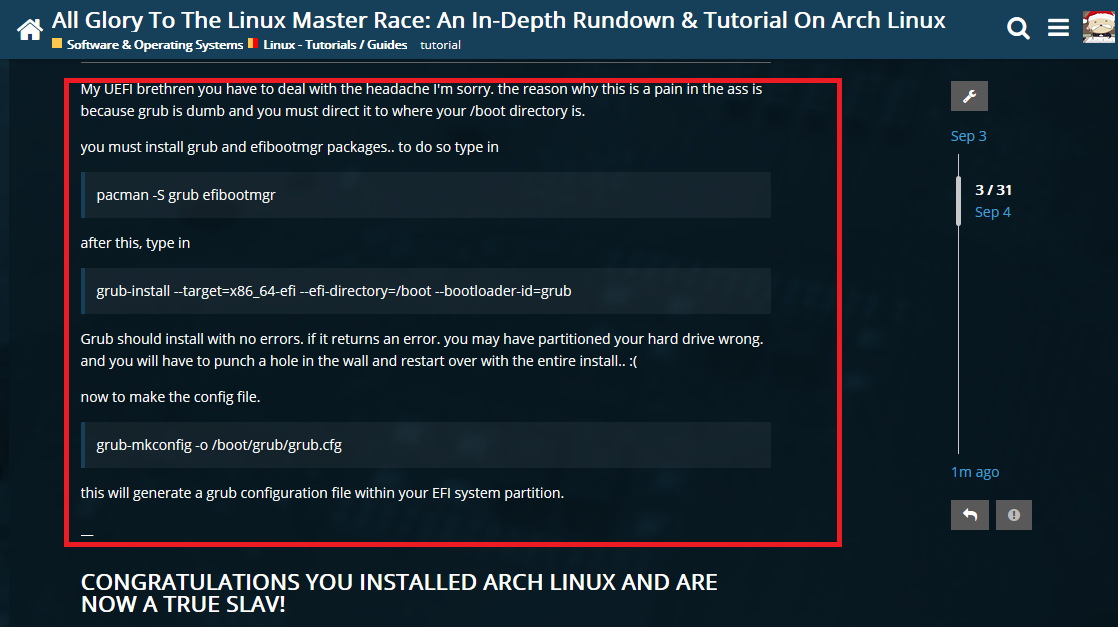
You can move EFI straight into /boot, and no need to use grub. Let me organize a good response, I have to remember what I did lol.
like I said, whatever you did is fine. for this tutorial I used GRUB.. if you did anything differently then good for you.
I used GRUB2 cause of it’s functionality and it’s easy to switch Kernels if you ever need to.
Haha yes GRUB would’ve been much easier IMO, as the way I did it is a bit more involved.
Heres what my /boot looks like.
/boot/initramfs-fallback-linux.img
/boot/initramfs-linux.img
/boot/EFI
/boot/intel-ucode.img
/boot/vmlinuz-linux
/boot/loader/loader.config
/boot/loader/entries/arch.config  <--contains UUID of where root is
Once my system posts, the UEFI looks for the EFI partition, goes to loaders then loads the config with the UUID. I had to manually do this, but it wasn’t too difficult. Just had to follow the manual. GRUB2 would’ve been far easier lol. Although, I set out to find this method, because some laptops have terrible implemented UEFI that will only look for windows, even with secure boot turned off. My gf’s laptop is one of these laptops. So I think it should be mentioned that people have options besides grub. Thats my 2 cents about that though.
Lastly, we need to talk about this[quote=“Kat, post:3, topic:106683”]
useradd -m -g users -G /bin/bash x
[/quote]
I found a really good guide about this stuff here.
The correct command should be this syntax.
# useradd -G wheel,users -m -d /home/user -s /bin/bash -c "custom comment" -U user
Like i said, whatever works for you. there’s multiple ways to do this.
1 Like
Good guide, I’ll read the whole thing when I get home. Just a note; it’s probably better to ping an IP such as 8.8.8.8 rather than an address as DNS isn’t the most reliable thing going.
It was just a quick thing. In the very beginning I struggled to install Arch Linux. now it only takes me like 6 minutes to do.
1 Like