I’ve been working on this for a while, and so far it’s giving good results. I’ll open with a screenshot:
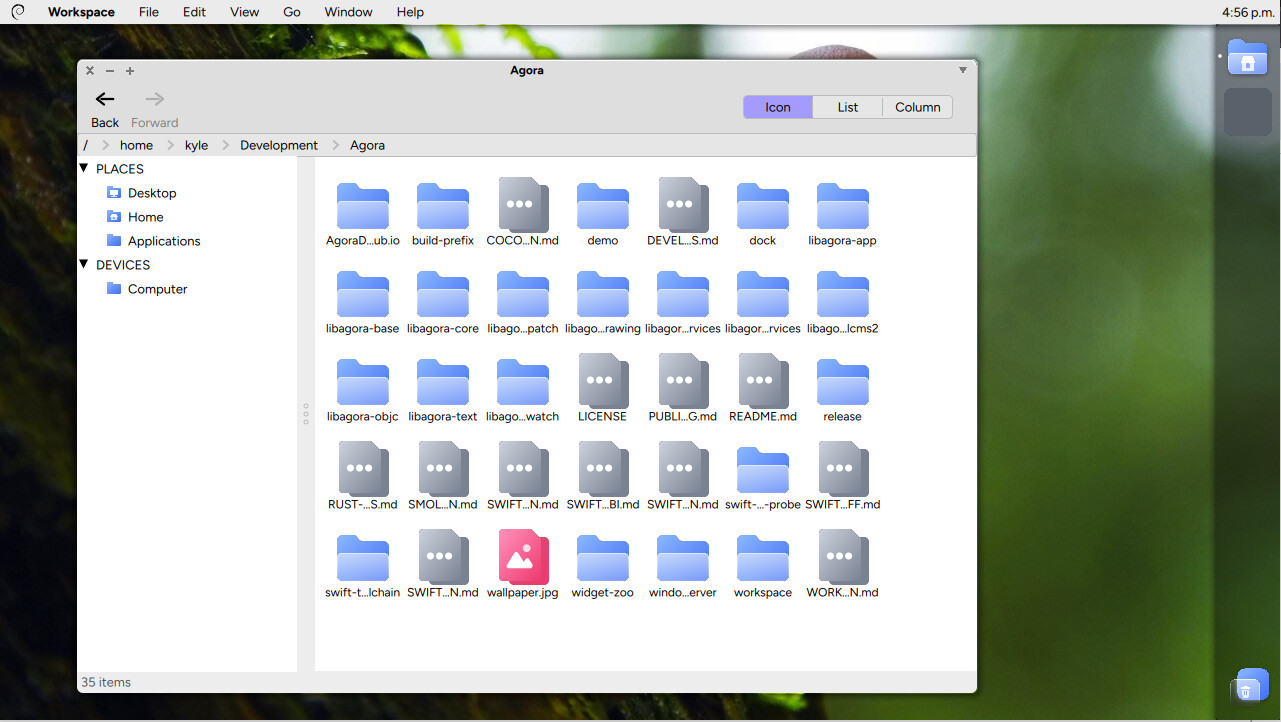
What you’re looking at is an in-progress re-implementation of the Cocoa library stack and UI for Linux and the BSD family, done in Objective-C, with agentic coding. So far, it consists of a bunch of libraries and four actual programs:
- A custom Wayland-based, extended, GPU-accelerated, compositing window server
- A file manager (Workspace)
- A dock
- A custom port of the Swift compiler which has the Objective-C bridge reconstructed.
Obviously, it has a long way to go before it’s a really usable desktop environment, and it doesn’t even have the advantage of using applications from outside itself, but for me it represents the achievement of everything I want in a Linux DE - basically what I had with Mac OS X 10.6, but done on a better OS core (Linux or FreeBSD). I”m at about 81% coverage of all Application Kit APIs from that era, and rapidly expanding coverage there.
The APIs covered include Core Foundation, Core Graphics, Core Text, Foundation, Application Kit, and others will be added as time goes by and libraries reach 100% coverage. I’m only one man, I can only do so much at a time, even with an agent helping me out.
Some people will take issue with the methods (agentic coding) used to produce all this. I have to accept that going in. My hope is that at least some people will see the potential in what I’m trying to make, and will want to actually use it when it becomes usable.
My motivation is that none of the existing DE options ever felt right to me; GNOME and KDE and XFCE are fine, for those who like them, but I just plain like the way Cocoa works better than GTK+ or QT. I would like to make it something not only for myself, but for others who feel the same as I do, which I admit is probably a tiny minority of the Linux desktop crowd. But one way or another, it’s real and growing in functionality and completeness.
My qualifications: I am a 30+ year programming veteran (C/ObJC), with a long history with both Linux and Mac OS X, and a former Mac application dev. I’m fairly new to agentic coding, but I pick things up quickly.
If you have any questions I’d be happy to answer them. Or you can follow me on Mastodon at @agora_desktop@mastodon.social for near-constant updates as I like to natter on social media while the agent and compiler grind away.
 Personally I don’t have a single issue with AI generated code, as long as it works, but as soon as I see a wall of text that took me longer to read than the “author” spent writing it i get real sad.